-
-
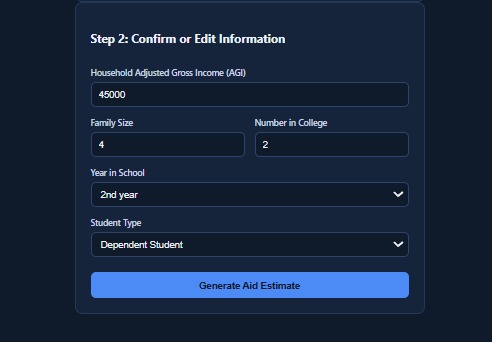
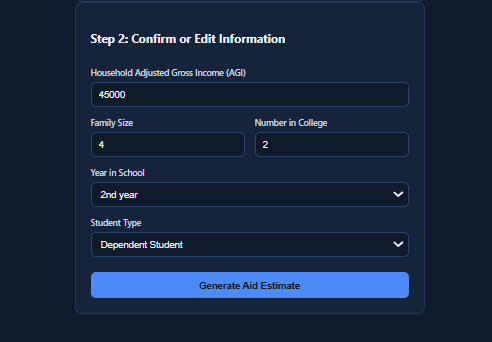
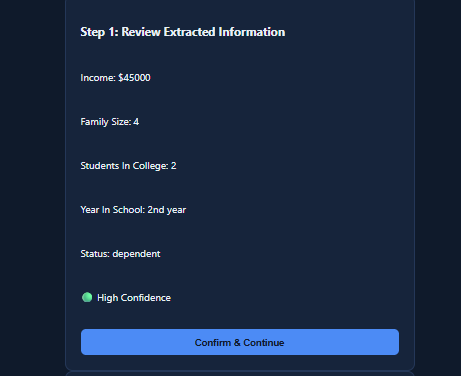
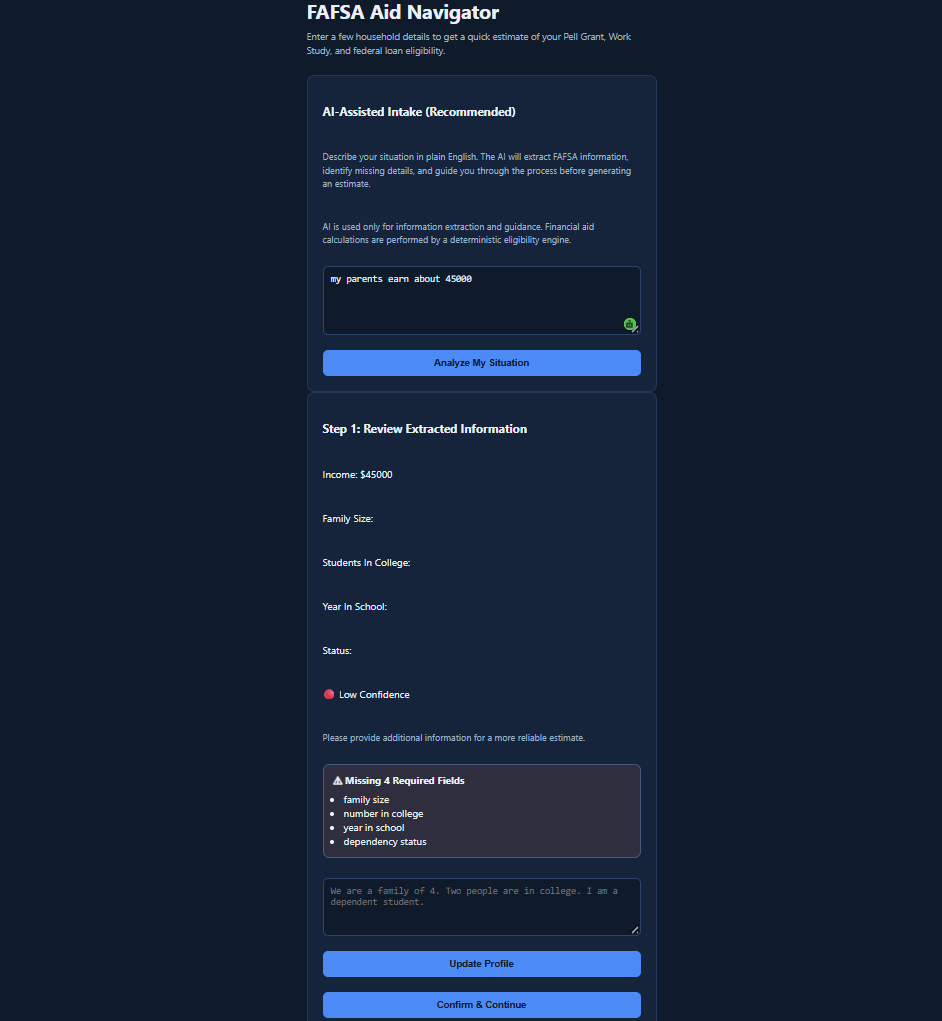
Users review and verify the extracted FAFSA profile before any aid calculations are performed, ensuring accuracy and transparency.
-
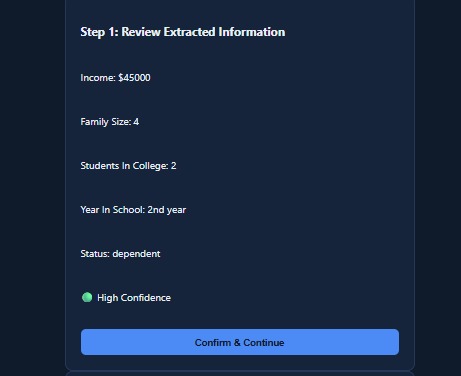
The AI extracts FAFSA-related information from natural language input, identifies missing fields, and requests clarification when needed.
-
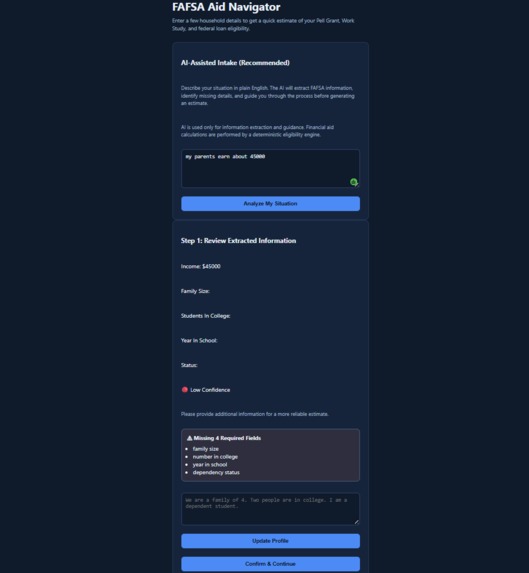
The AI extracts available information, identifies missing FAFSA fields, and requests clarification instead of making assumptions.
-
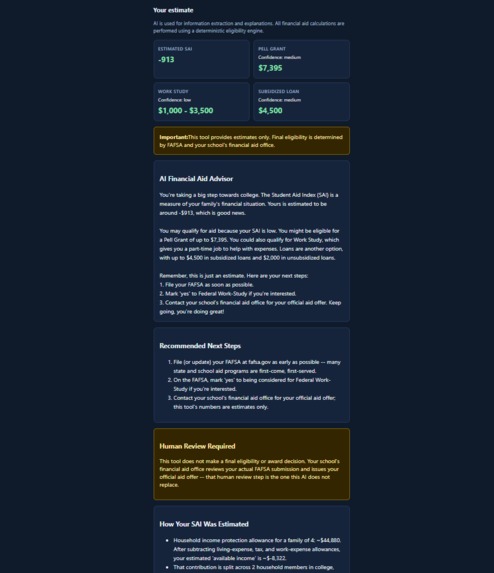
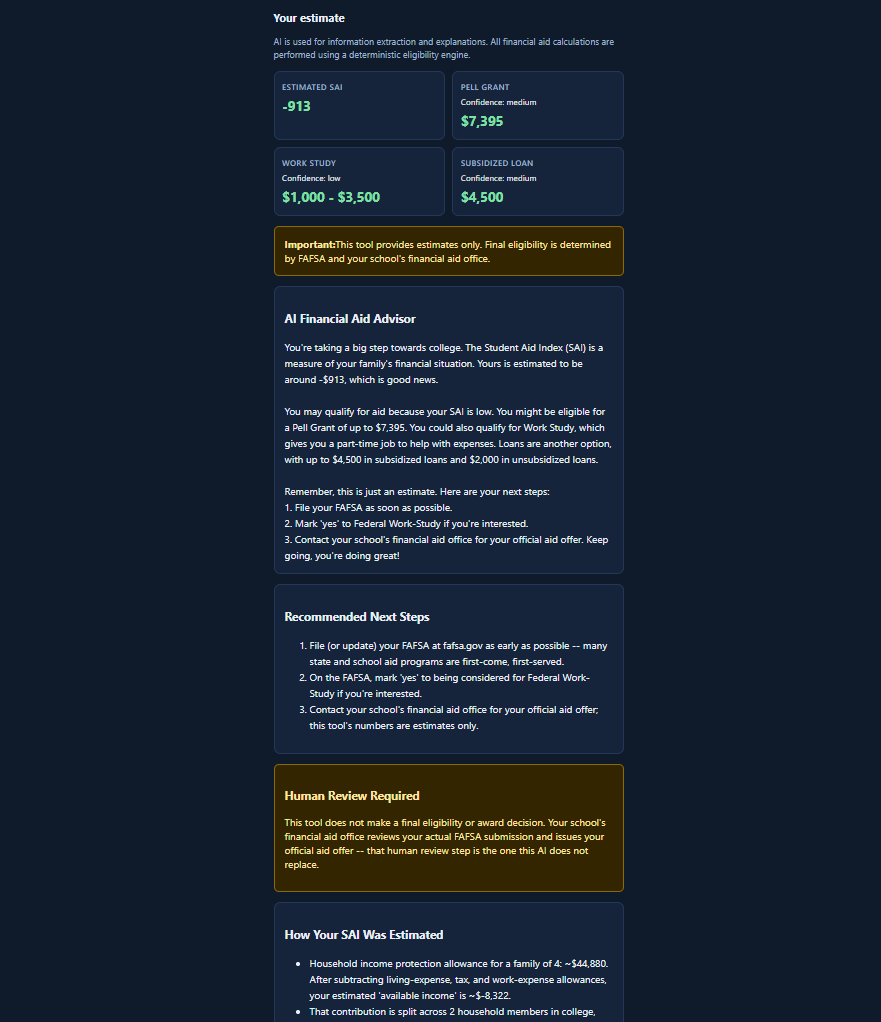
The deterministic eligibility engine estimates SAI, Pell Grants, Work-Study, and federal loan eligibility.
-
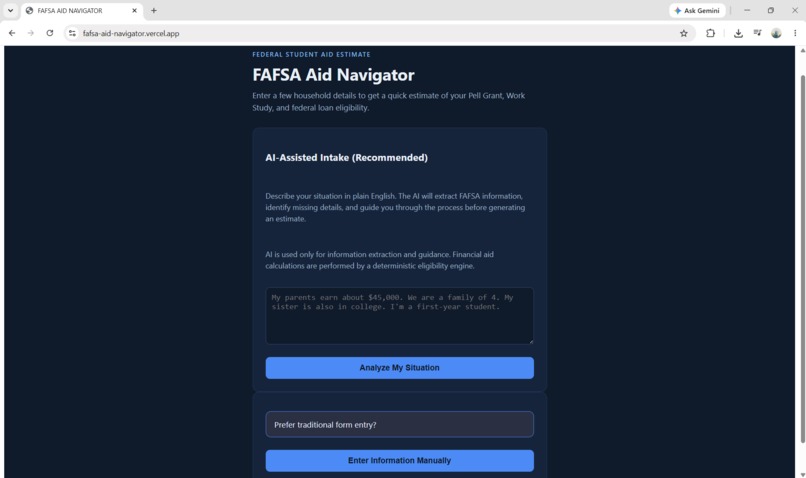
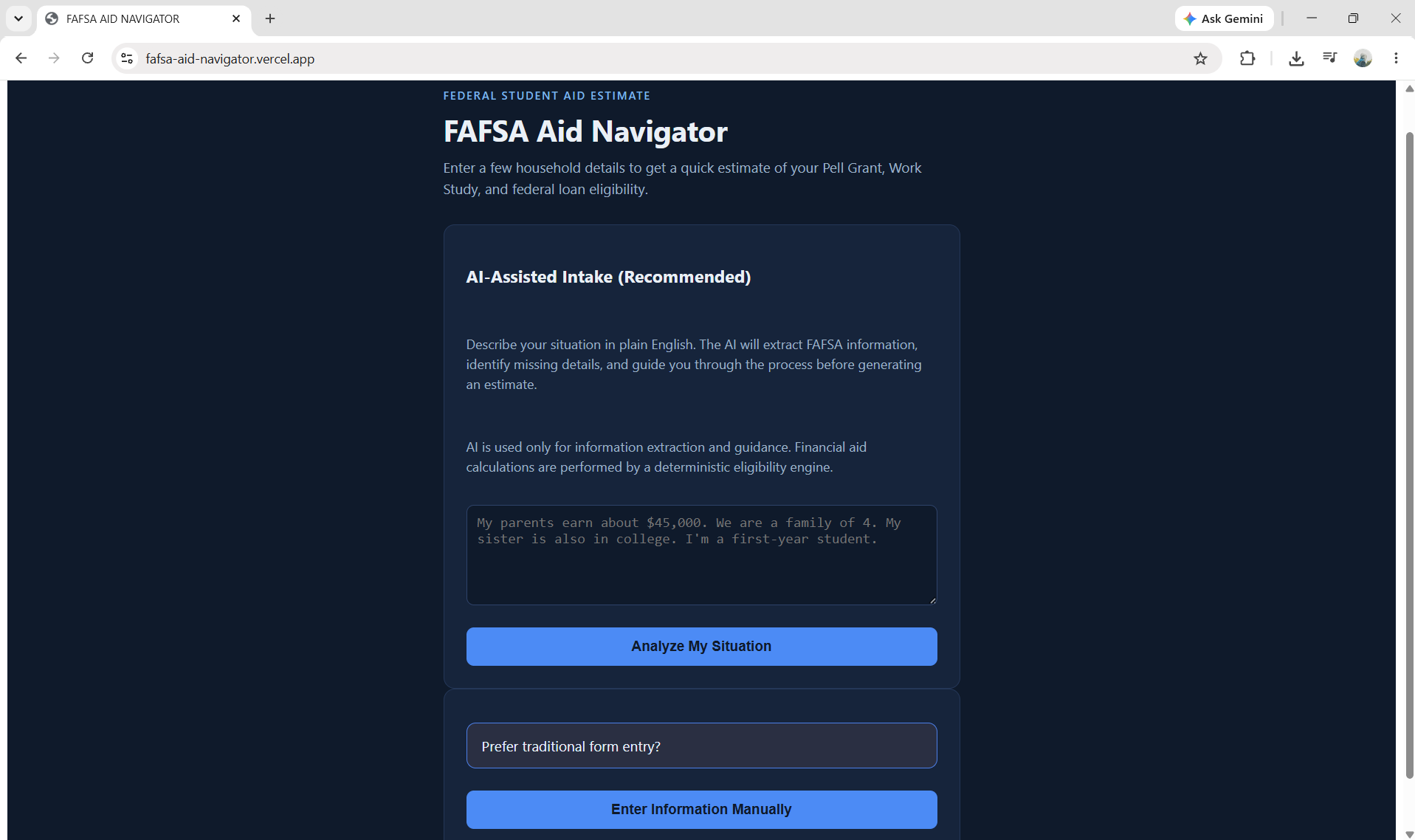
Students can describe their financial situation in natural language instead of filling out complex FAFSA forms.
-
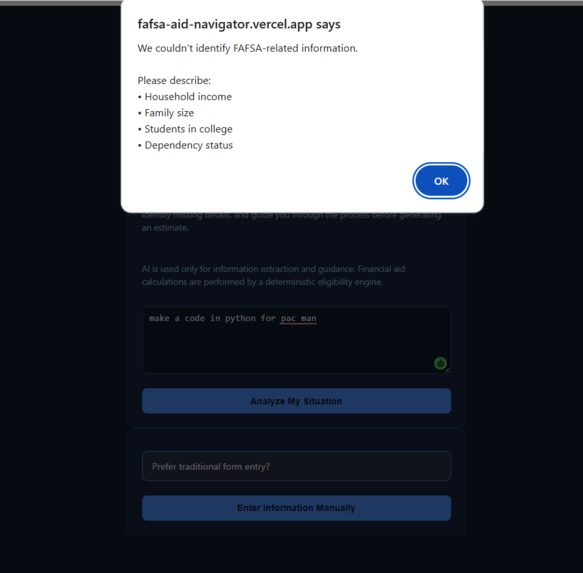
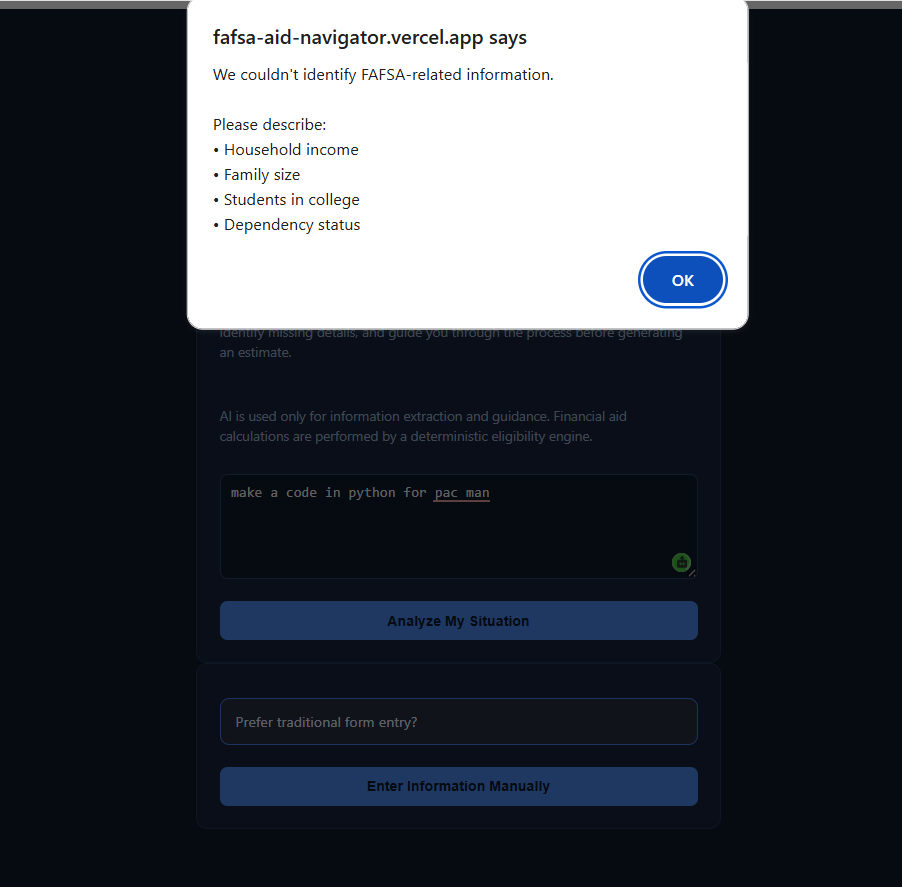
Built-in AI guardrails prevent misuse by rejecting unrelated requests and keeping interactions focused on financial aid guidance.
Inspiration
Applying for financial aid is often a confusing and intimidating process for students and families. While FAFSA is one of the primary gateways to federal financial aid in the United States, many students struggle to understand what information is required, whether they may qualify for aid, and what the results of a financial aid calculation actually mean.
Most existing calculators rely on traditional form-based interfaces that require users to manually enter information into structured fields. This can be overwhelming for first-time applicants who may not know FAFSA terminology or even which details are needed to begin.
We wanted to create a more accessible and intuitive experience by combining conversational AI with transparent financial aid estimation. Our goal was to allow students to simply describe their situation in plain English while still maintaining accuracy, transparency, and responsible AI principles.
This led to the development of FAFSA Aid Navigator.
What it does
FAFSA Aid Navigator is an AI-powered financial aid guidance platform that helps students understand their potential federal financial aid eligibility through a conversational workflow.
Instead of completing a traditional form, users can describe their financial situation naturally. For example:
"My parents earn about $45,000 per year. We are a family of 4. My sister is also in college. I am a dependent first-year student."
The platform then:
- Extracts FAFSA-related information from natural language.
- Identifies missing information required for a reliable estimate.
- Calculates a confidence score based on profile completeness.
- Requests clarification only for missing fields.
- Updates the student profile through conversational follow-up.
- Allows users to review and verify extracted information.
- Generates a financial aid estimate using a deterministic eligibility engine.
- Provides explainable results and next-step guidance.
The platform currently estimates:
- Student Aid Index (SAI)
- Federal Pell Grant eligibility
- Federal Work-Study eligibility
- Direct Subsidized Loan eligibility
- Direct Unsubsidized Loan eligibility
In addition to presenting estimated awards, FAFSA Aid Navigator explains why a student may qualify, how the estimate was calculated, and what actions they should take next.
Key Features
AI-Assisted Intake
Users can provide information in natural language rather than completing complex forms.
The AI extracts:
- Household income
- Family size
- Number of students in college
- Dependency status
- Year in school
This creates a significantly more user-friendly experience for students who may be unfamiliar with FAFSA terminology.
Missing Information Detection
Rather than making assumptions, the platform detects which FAFSA-related fields are missing and explicitly requests clarification.
This improves reliability while reducing the amount of information users must provide upfront.
Conversational Follow-Up
When information is incomplete, users can continue the conversation naturally.
The AI updates only the missing fields while preserving previously extracted information.
Confidence-Based Guidance
The platform evaluates profile completeness and provides confidence indicators.
Users immediately know whether additional information is required before generating an estimate.
Human-in-the-Loop Verification
Before any financial aid calculations are performed, users review and verify all extracted information.
This ensures that users remain in control of the process and provides an additional safeguard against extraction errors.
Deterministic Aid Estimation
Financial aid estimates are generated using a deterministic eligibility engine rather than by the language model itself.
This includes:
- Estimated Student Aid Index (SAI)
- Pell Grant eligibility
- Work-Study eligibility
- Subsidized Loan eligibility
- Unsubsidized Loan eligibility
Explainable Results
Rather than simply displaying numbers, FAFSA Aid Navigator explains:
- How the estimated SAI was calculated
- Why aid may be available
- Which factors influenced eligibility
- Recommended next steps
This improves transparency and helps students better understand their financial aid situation.
AI Guardrails
The platform includes safeguards that prevent misuse and off-topic interactions.
If a user submits unrelated requests, such as programming questions or general-purpose AI prompts, the system redirects them toward FAFSA-related guidance rather than attempting to answer unrelated queries.
Responsible AI Messaging
Throughout the experience, users are reminded that:
- AI is used only for extraction, clarification, and explanations.
- Financial aid calculations are performed by a deterministic eligibility engine.
- Official eligibility decisions remain the responsibility of FAFSA and institutional financial aid offices.
How we built it
The frontend was developed using React and Vite, creating a responsive and interactive user experience.
The backend was built using FastAPI and Python, providing API endpoints for:
- AI-assisted profile extraction
- Follow-up profile updates
- Financial aid estimation
For natural language understanding and information extraction, we integrated the Groq API with Llama 3.3 70B.
The AI is responsible for:
- Understanding user input
- Extracting FAFSA-related information
- Identifying missing fields
- Updating profiles through follow-up conversations
- Generating personalized explanations
The financial aid estimation logic is intentionally separated from the language model.
A deterministic eligibility engine performs all financial aid calculations, ensuring consistent and transparent outputs while preventing the AI from directly making financial aid decisions.
The application is deployed as a full-stack web platform with separate frontend and backend services.
Challenges we ran into
One of the most significant challenges was ensuring that the AI did not make assumptions when information was incomplete.
Large language models naturally attempt to fill gaps, but financial aid estimation requires accurate and verified information. We addressed this by implementing missing-field detection, confidence scoring, and conversational follow-up mechanisms.
Another challenge involved separating AI functionality from decision-making. We wanted to benefit from the flexibility of conversational AI without allowing the model to determine aid eligibility. This led us to build a deterministic eligibility engine while restricting AI usage to extraction, clarification, and explanation tasks.
We also needed to ensure that extracted information remained trustworthy. To address this, we implemented a human verification step before any calculations occur.
Deployment and integration presented additional challenges. Coordinating the frontend, backend, AI services, environment variables, and production deployments required extensive testing and debugging before achieving a stable end-to-end workflow.
Accomplishments that we're proud of
- Built a complete AI-powered FAFSA guidance platform from concept to deployment.
- Successfully deployed and tested a working full-stack application.
- Implemented conversational intake and natural-language profile extraction.
- Developed missing-field detection and follow-up clarification workflows.
- Added confidence-based guidance and profile validation.
- Integrated explainable results and next-step recommendations.
- Built AI guardrails to keep interactions focused on financial aid guidance.
- Implemented responsible AI safeguards and human-in-the-loop verification.
- Combined conversational AI with deterministic financial aid calculations.
What we learned
Through this project, we gained valuable experience in building practical AI-powered applications that balance usability with transparency.
We learned how to:
- Integrate large language models into production workflows.
- Design structured extraction systems.
- Build reliable FastAPI backend services.
- Deploy full-stack applications.
- Engineer prompts for consistent outputs.
- Create explainable AI experiences.
- Apply responsible AI principles to high-impact domains.
Most importantly, we learned that AI often delivers the greatest value when assisting users rather than replacing important human decisions.
What's next for FAFSA Aid Navigator
Future development may include:
- More advanced FAFSA estimation models.
- School-specific aid estimation.
- State financial aid eligibility support.
- Scholarship recommendation systems.
- Multi-language support.
- Enhanced accessibility features.
- Mobile-friendly experiences.
- Additional financial planning and college affordability tools.
We believe FAFSA Aid Navigator demonstrates how conversational AI can make financial aid guidance more accessible, understandable, and student-friendly while maintaining transparency, accountability, and responsible AI principles.

Log in or sign up for Devpost to join the conversation.