-
-
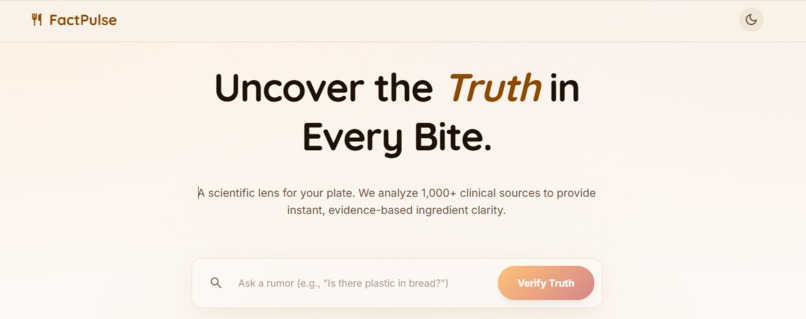
Light Mode: Landing page
-
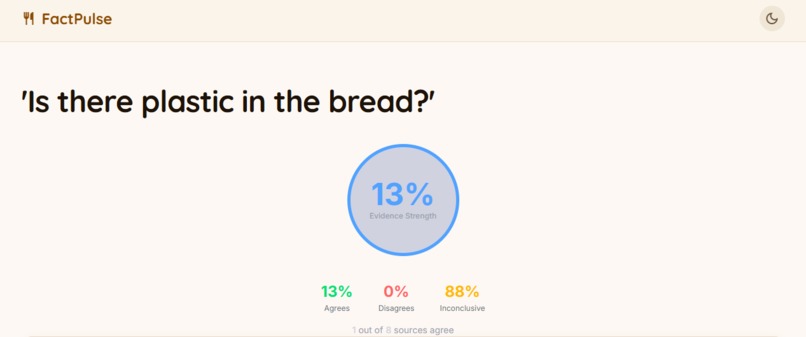
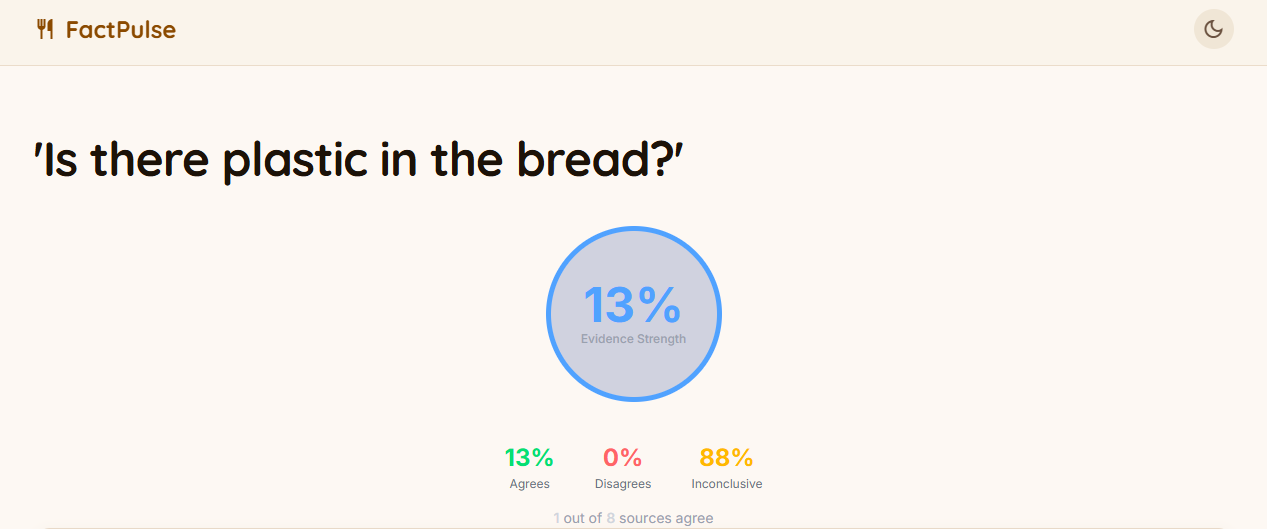
Light Mode: Result page of user query
-
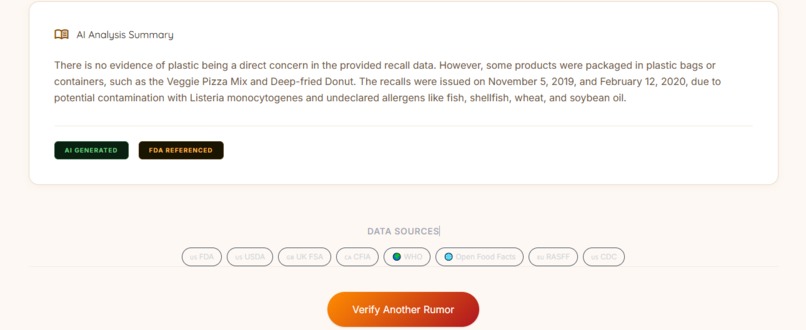
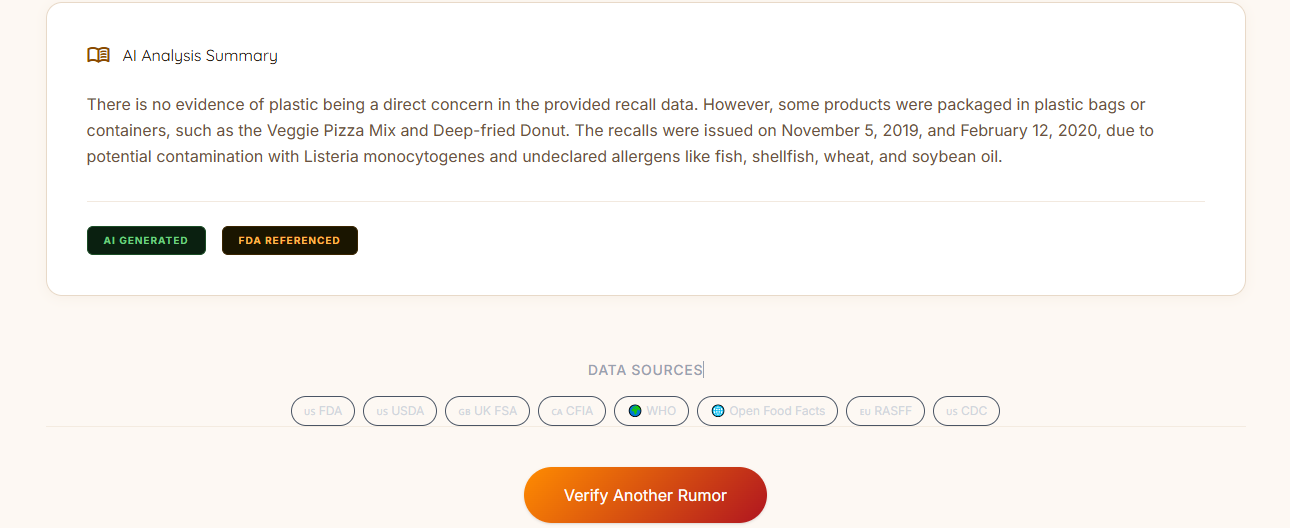
Light Mode: Result Page - Small AI Analysis
-

Dark mode: Landing Page
-

Dark Mode: Result page of user query
-
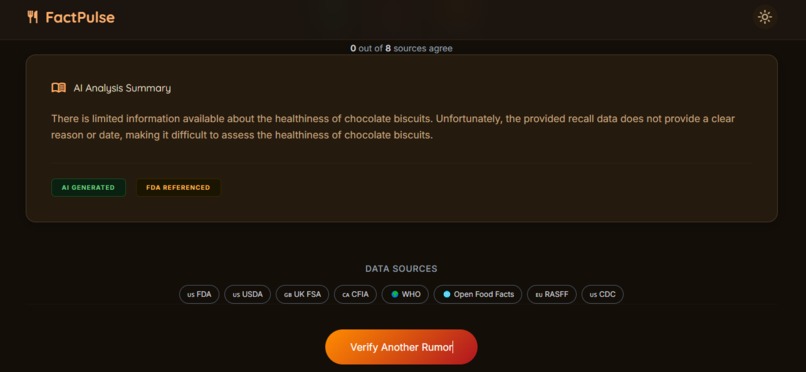
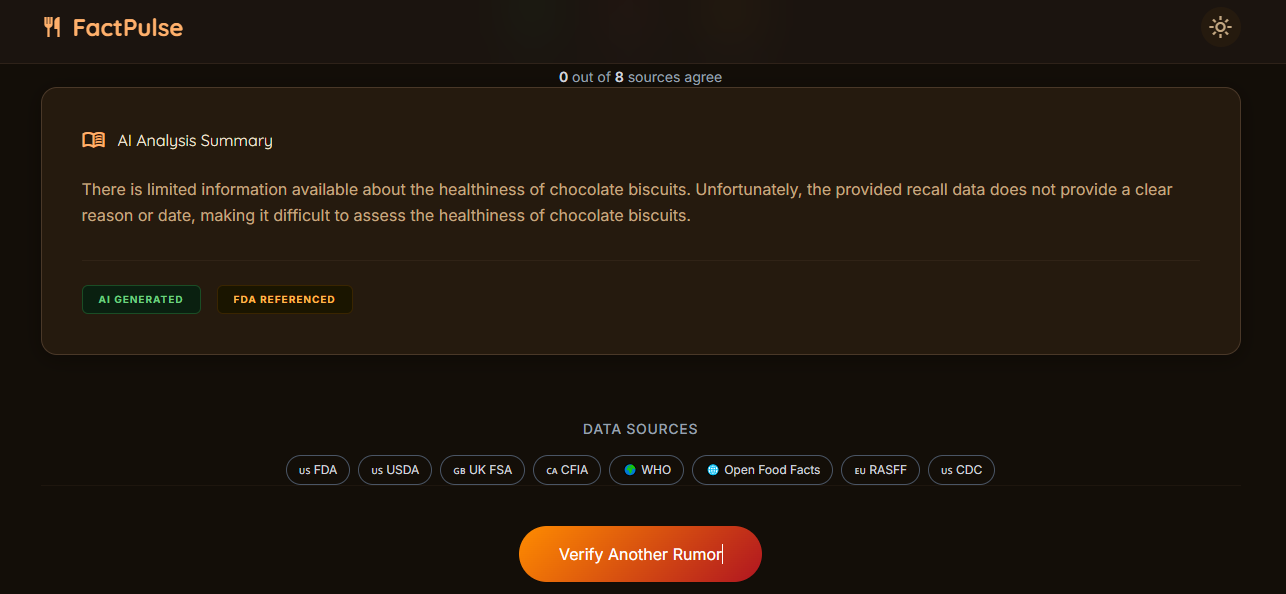
Dark Mode: Result Page - Small AI Analysis
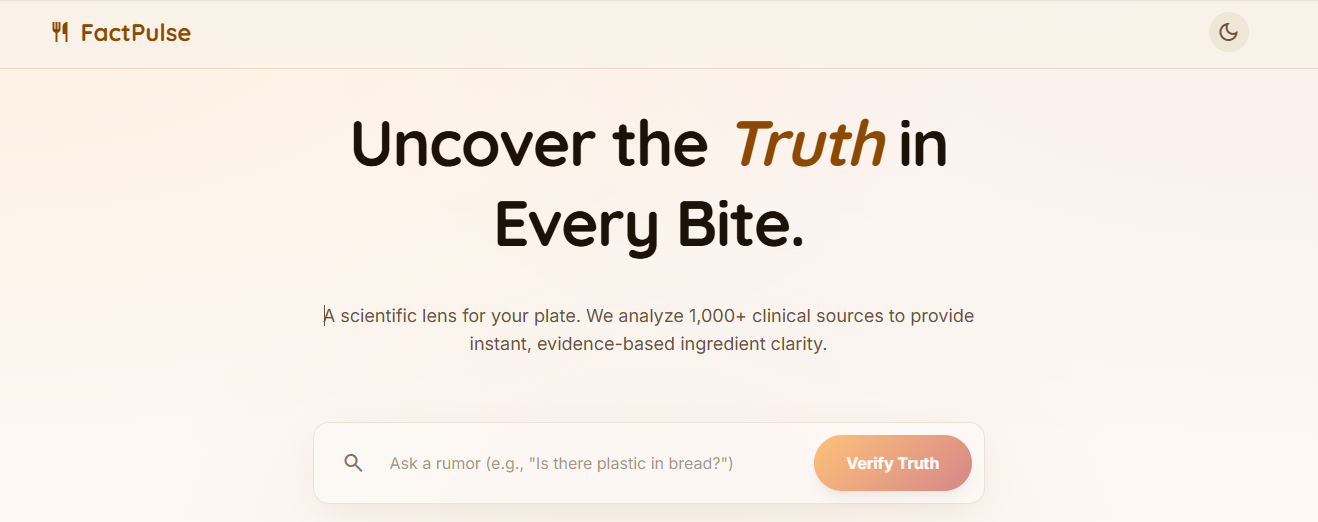


FactPulse
Stressed parents who are unsure about claims they have heard about the food they feed their children can use our AI web application, "FactPulse". Here, they can submit queries, and the AI will compare them with relevant and credible data sources to inform them whether the claims are true or just rumours.
Inspiration
Food companies tend to introduce changes to their food products that aren't well communicated to the public. On top of that, numerous unverified pieces of news about children's food products circulate among parents with no guarantee of whether they are true or not. The majority of them tend to be just rumours, so for a parent who is already stressed by the pressure of raising their children, they can become even more stressed when they hear about unexpected changes to their children's food products. To add salt to their wounds, most authentic food updates aren't publicly announced to parents, and the government portals, which are often complex to navigate, are largely unknown to them. Therefore, we felt it was necessary to bring an end to this problem. Being teenagers ourselves and recalling how our parents struggled to keep up with food updates, we felt it was our responsibility.
What it does
Here is an in-depth understanding of how our web application verifies rumors about food products:
- Query Processing: Parents input a question about a recent food market change or rumour.
- Source Scanning: The app searches through pre-vetted reputable sources and cross-references evidence that either supports or refutes the claim.
- Statistical Breakdown: It presents a straightforward metric—the percentage likelihood that the rumour is true, false, or inconclusive. Alongside a confidence score, which is termed as "evidence strength" is displayed. The confidence score highlights how reliable the application's conclusion is for that particular query in the context of the available sources. The confidence score is calculated as, $$\text{Confidence Score} = \left( \frac{\text{Total sources with query data}}{\text{Total sources}} \right) \times 100$$
- Human-Centric: At the end, it leaves the final interpretation to the parent, combining automated research with human judgment and thus enforcing critical human involvement. It is important that this particular duty is undertaken by a human, because it is a sensitive decision as it will affect a child's life and due to the limited data sources, the risk of invalid advice remains.
- Disclaimer: It should be noted that our application is to be used only for food products and nothing else.
How we built it
- Frontend: We developed a web-based interface to easily collect user queries. We ensure that the interface appeared easy to navigate and friendly to the average user.
- Backend (NLP): We utilized Natural Language Processing to understand the user's question and extract the core claim.
- Integrations: We integrated search APIs to scan trusted databases and regulatory websites that provide authentic and accurate data.
- Algorithmic Scoring: Lastly, we built a custom scoring system that weighs the gathered evidence to calculate and display the three final percentages.
Challenges we ran into
There were scores of challenges we faced. Some of the major ones include:
- Appropriate friendly front-end UI: As our user base is mainly parents, we had to ensure our web application appeared simple and comforting to the parents so they develop a sense of trust. Therefore we used a minimalistic design approach with a calming color theme to ensure comfort.
- Identifying credible data sources: Our biggest hurdle was ensuring the system accurately distinguished between highly reputable sources and heavily biased blogs, articles and content pieces across the internet. Moreover, it was difficult to identify proper databases as very few repurtable food-safety entities maintained an appropriate data source.
- Integrating API into the web application: Initially we had successfully integrated our databases to our web application via API however the application wasn't functioning properly, it took a long time, perhaps two days to realize the error, which was that a .env file wasn't saved in the right directory.
Accomplishments that we're proud of
We are most proud of our transparent approach to the results. Initially it seemed impossible, however after deep research we were able to identify credible and authentic sources for our application. Moreover, we were able to display the sources our application referred to alongside the final output to the user, this increased the credibility of our application. Additionally we were proud to effectively make our application stand out from standard fact-checkers by enforcing a confidence score and a human factor where the user would make the final decision about whether to accept the results supporting or refuting the claim.
What we learned
- Data Ambiguity: We learned that fact-checking developing news is rarely black and white. Designing the percentage breakdown taught us how to handle, quantify, and present ambiguous data responsibly.
- Technical Growth: We gained deep technical experience in natural language understanding and structuring complex data pipelines. We also learned about the different features of a next.js application and how deployment on vercel looks like, something we only had an idea about. Moreover our experience with integrating databases via API further improved our API understanding. We learned about how to effectively identify and extract key information from the API sources and tranform the information to appropriate responses for our use.
What's next for FactPulse
We plan to expand our database of trusted sources to include more food safety organizations to make the results of the application more reliable and reduce occurrences of inconclusive results. We further plan to expand our web application into:
- A mobile app as it will be more comfortable and feasible for parents.
- A browser extension for online grocery shopping websites.
- We also plan to implement data pipelines for tracking historical trends of repeating food market rumours.
Who is benefited?
FactPulse was built to benefit stressed parents who are concerned about the food they feed their children. These parents require frequent assurance amid growing concerns from various news sources they hear about over the internet or from people close to them. Through our application, they can come to an educated conclusion regarding any claims they hear and make a well-informed and reliable decision*, ensuring* that their children always get the best and safest food.

Log in or sign up for Devpost to join the conversation.