-
-
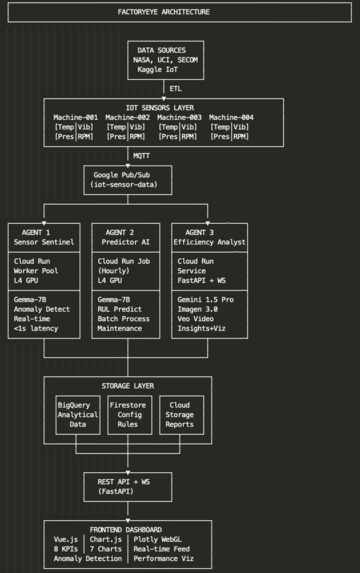
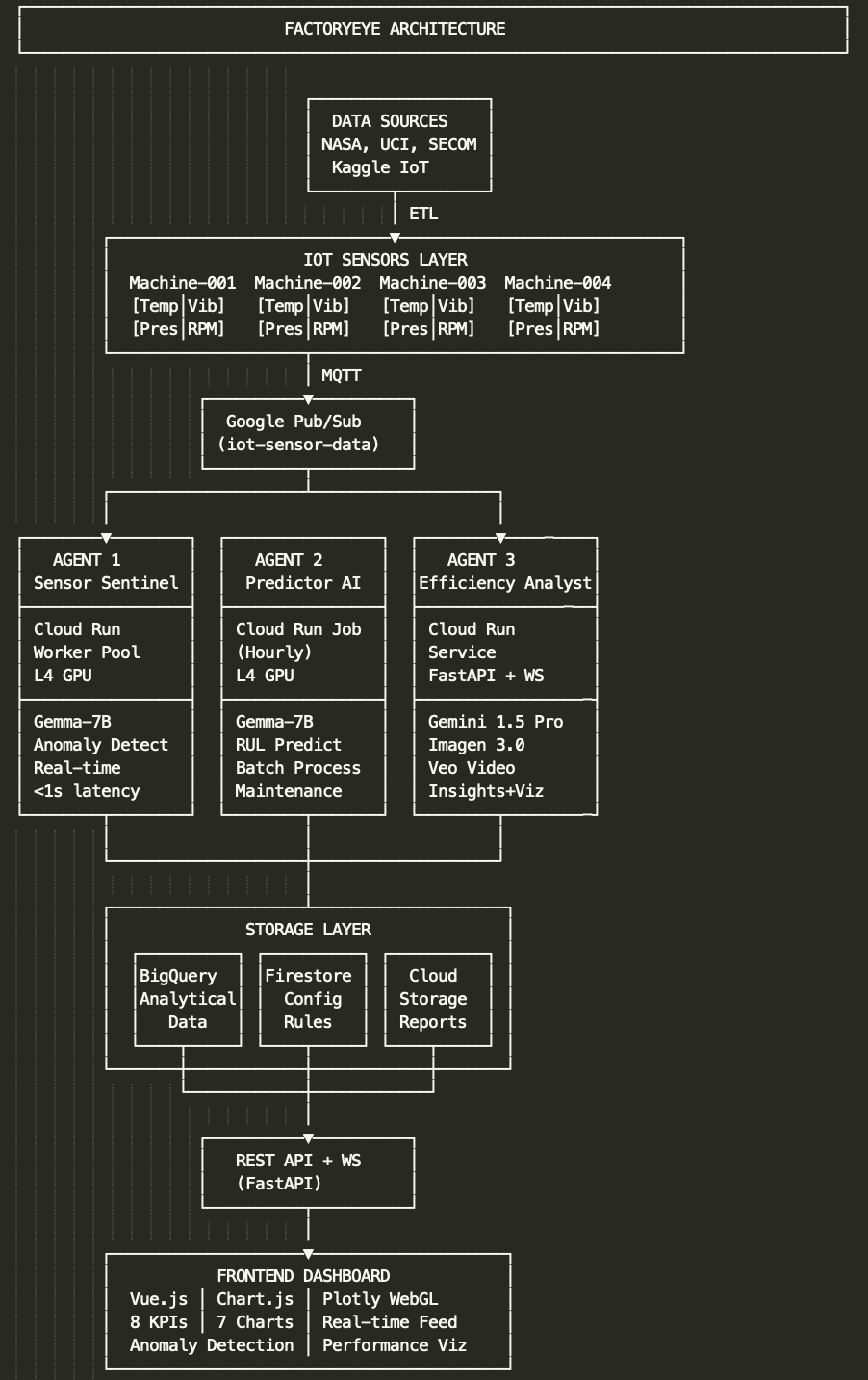
Architecture Diagram
Inspiration
Manufacturing facilities lose billions annually to unplanned downtime because operators cannot detect subtle equipment degradation patterns in high-frequency multi-sensor IoT data before failures occur.
What it does
FactoryEye monitors industrial equipment sensors in real-time using AI agents to detect anomalies within seconds, predicts equipment failures 72+ hours in advance, generates maintenance schedules prioritized by urgency and provides explainable insights through an interactive dashboard.
How we built it
The system uses three AI agents (Sensor Sentinel, Predictor AI, Efficiency Analyst) running on Google Cloud Run with NVIDIA L4 GPUs, processes data through Pub/Sub from MQTT IoT sensors, employs Gemma for anomaly detection and RUL prediction with Gemini for insights generation, stores results in BigQuery/Firestore/Cloud Storage and visualizes through a Vue.js dashboard with Plotly WebGL and Chart.js. Used Datasets: NASA Turbofan Engine Degradation Dataset, UCI Hydraulic System Condition Dataset, SECOM Manufacturing Dataset, Kaggle IoT Sensor Logs
Challenges we ran into
Handling large time-series datasets (1000+ points) required implementing multiple performance optimizations (downsampling, windowing, dynamic resolution, WebGL rendering), integrating four heterogeneous public datasets (NASA, UCI, SECOM, Kaggle) demanded custom ETL pipelines with feature engineering, achieving sub-second anomaly detection latency required ensemble methods combining statistical and deep learning approaches.
Accomplishments that we're proud of
Successfully deployed three GPU-accelerated AI agents on serverless Cloud Run infrastructure, achieved real-time anomaly detection with multiple visualization modes optimized for performance, integrated four public industrial datasets with automated preprocessing, implemented comprehensive predictive maintenance with specific failure mode identification, created production-ready system with full REST API and WebSocket support.
What we learned
GPU-accelerated serverless computing (Cloud Run with L4) enables real-time AI inference at scale, ensemble anomaly detection methods outperform single-model approaches for industrial data, WebGL rendering and data windowing are essential for visualizing large time-series datasets, feature engineering (rolling statistics, rate of change, cross-sensor interactions) significantly improves prediction accuracy, explainable AI through Gemini provides actionable insights operators can trust.
What's next for FactoryEye
Implement Veo video generation for maintenance timeline animations, add multi-tenancy support for managing multiple facilities, integrate reinforcement learning for automated parameter optimization, develop mobile application for field technician alerts, expand dataset integration to include additional industrial domains (power generation, oil/gas, pharmaceuticals), implement federated learning for cross-facility model improvements while preserving data privacy.
Built With
- aiohttp
- asyncio
- bash
- bigquery
- black
- bootstrap-5
- chart.js-4.4
- cloud-pub/sub
- cloudstorage
- css3
- docker
- europe-west-region
- fastapi
- firestore
- flake8
- gemini-1.5-pro-(natural-language-insights)
- gemma-7b-(anomaly-detection
- google-cloud
- google-cloud-aiplatform
- google-cloud-bigquery
- google-cloud-firestore
- google-cloud-pubsub
- google-cloud-run-(services
- google-cloud-sdks
- html5
- httpx
- imagen-3.0-(visualization-generation)
- javascript-es6
- jobs
- jsonschema
- kaggle-iot-sensor-logs
- matplotlib
- mypy
- nasa-turbofan-engine-degradation-dataset
- numpy-1.24
- nvidia-l4
- pandas-2.0
- plotly
- plotly.js
- pyarrow
- pytest
- pytest-asyncio
- python-3.11
- python-multipart
- pytorch
- rul-prediction)
- scikit-learn-1.3
- scipy
- scripts
- seaborn
- secom-manufacturing-dataset
- terraform
- transformers-4.35
- uci-hydraulic-system-condition-dataset
- uvicorn
- veo
- vertexai
- vue.js-3
- webgl
- websockets
- worker-pools)

Log in or sign up for Devpost to join the conversation.