-
-
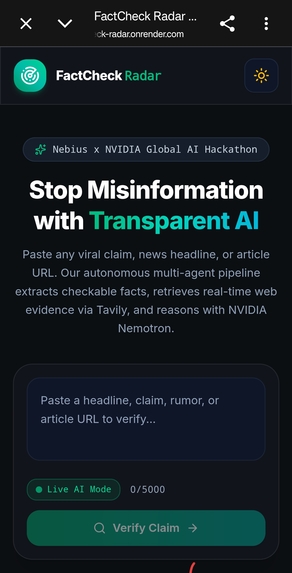
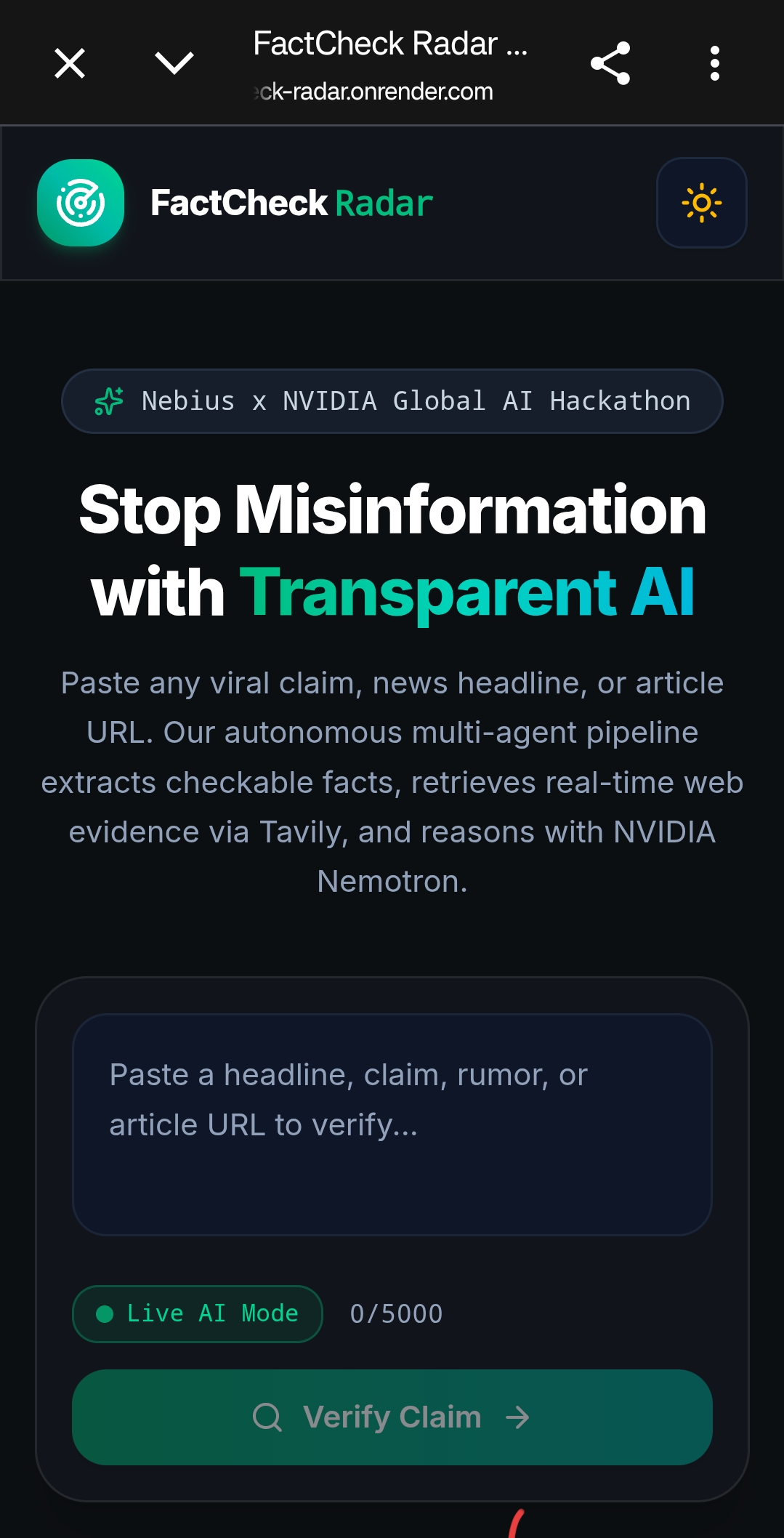
1.starting page
-
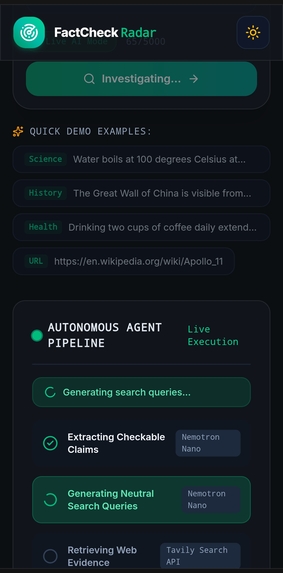
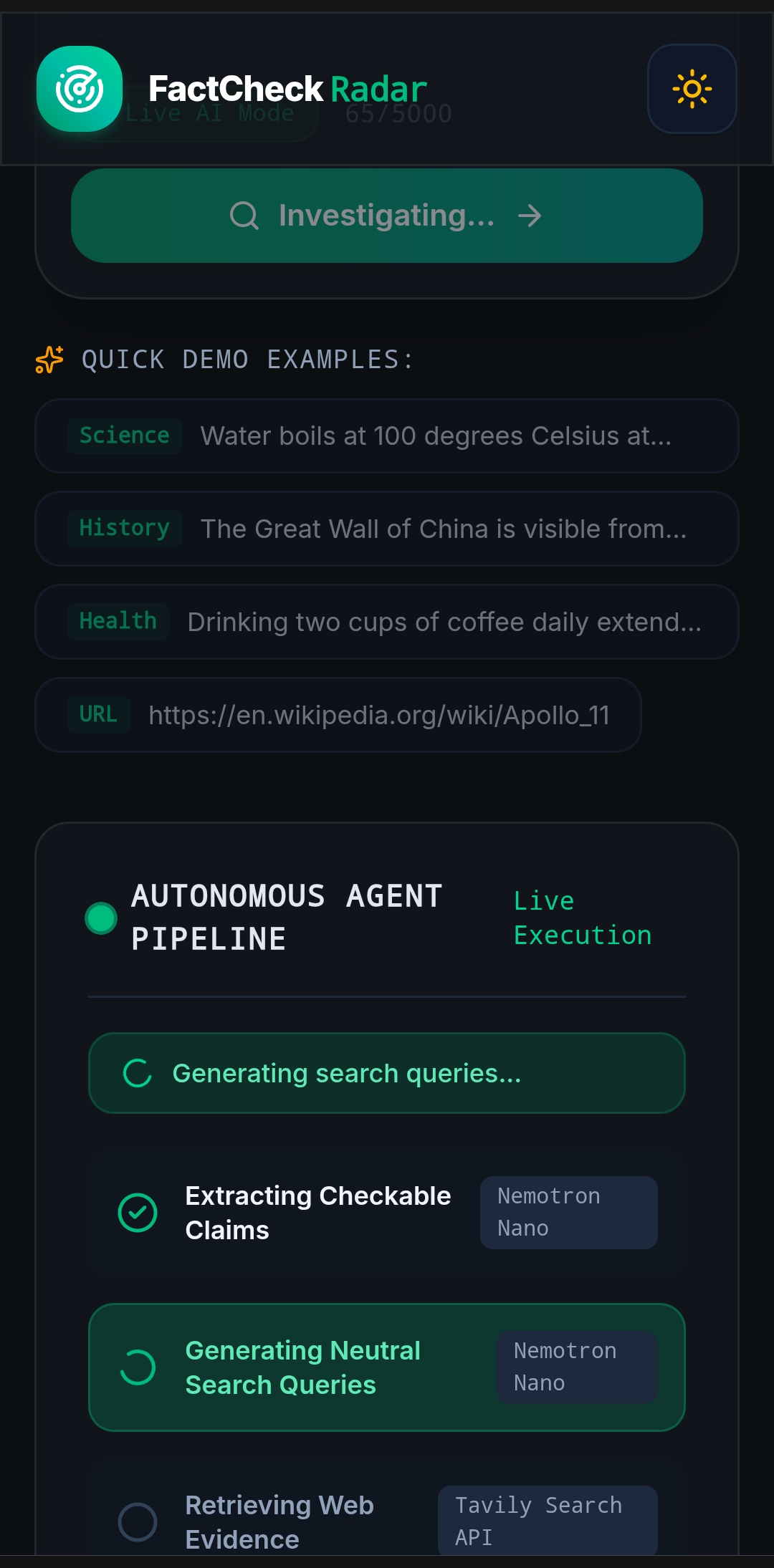
2. Text page
-
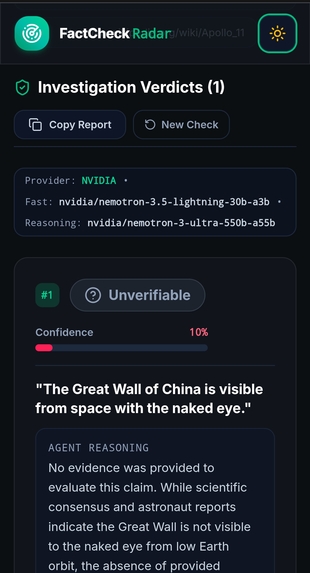
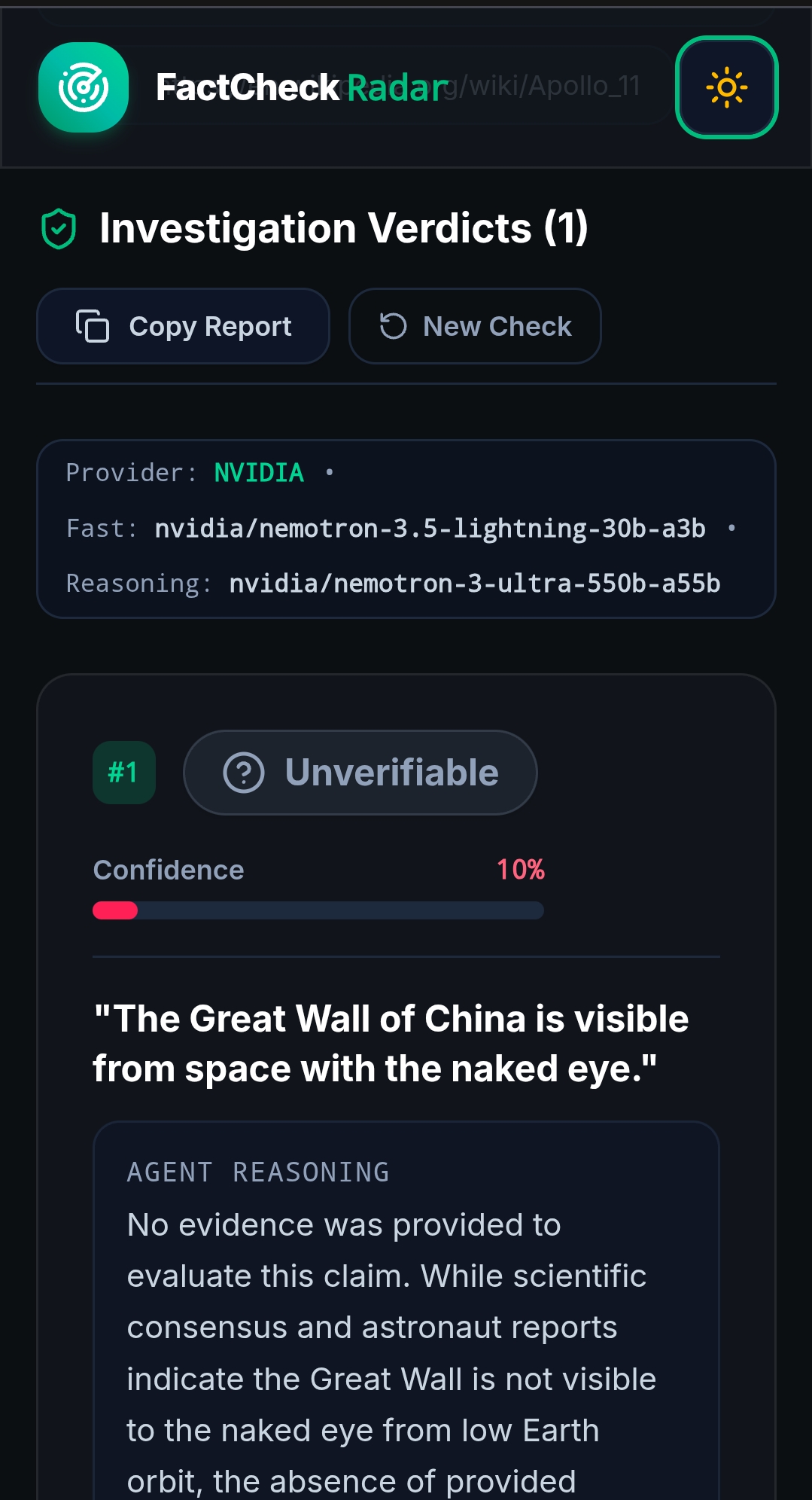
3.output page
-
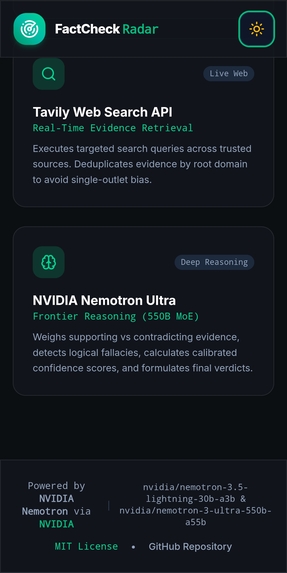
4. Intelligence
-
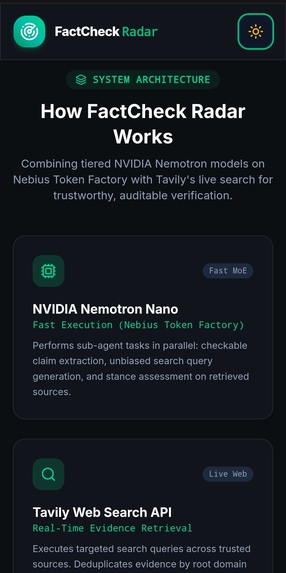
5. End page
Inspiration
What it does
How we built it
Challenges we ran into
Inspiration
Every breaking news cycle follows the same pattern: an unverified headline drops on X or Reddit, spreads through group chats within minutes, and shapes public opinion long before a debunking is published.
Using a standard LLM to check claims hits two walls:
- Hallucination & knowledge cutoffs: it cites defunct links or guesses at current events.
- Confirmation bias: ask "Is it true that X happened?" and it tends to lean into the premise instead of playing devil's advocate.
We wanted an agent that works like a skeptical senior investigative journalist: break a claim into atomic checkable facts, search both sides with neutral queries, verify sources, weigh conflicting stances, and only then write an evidence-weighted verdict.
What it does
Paste a claim, a spicy headline, or an article URL. FactCheck Radar takes over:
- URL & text ingestion: fetches and extracts article text, with built-in SSRF protection.
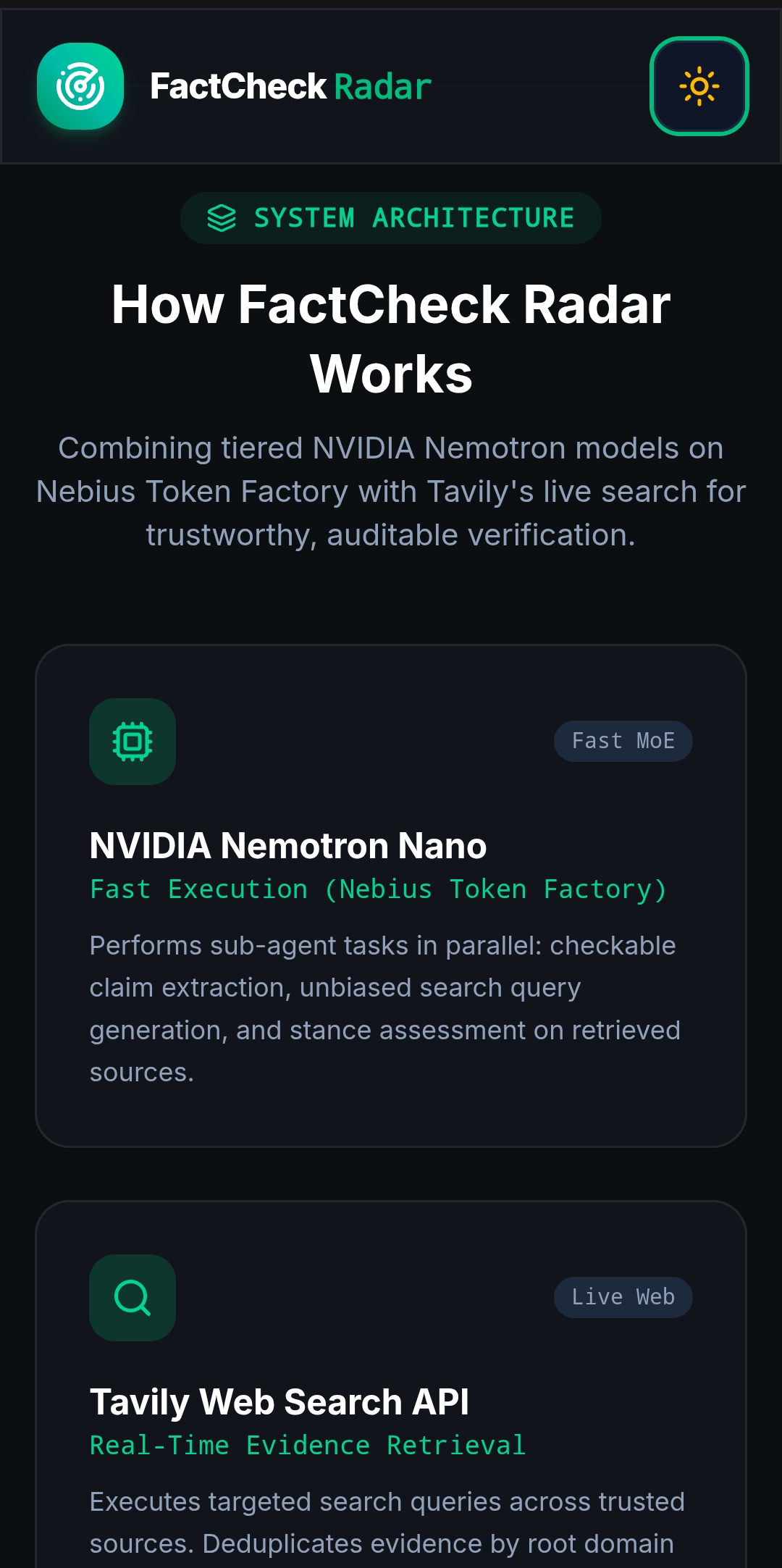
- Atomic claim extraction: isolates up to 3 distinct, checkable assertions using Nemotron Fast.
- Neutral query synthesis: generates balanced search phrases that retrieve both supporting and debunking evidence.
- Live evidence retrieval: Tavily AI Search, deduplicated across domains so one SEO-heavy site can't dominate.
- Stance analysis: labels each source as supports, contradicts or neutral, with a one-sentence justification.
- Deep reasoning & verdict: True, Mostly True, Mixed, Mostly False, False or Unverifiable, with a calibrated confidence score (0–100%) and hyperlinked citations.
- Real-time streaming: Server-Sent Events drive a live progress timeline, animated confidence gauge, and dark/light UI.
- Quota protection: 10 requests/min/IP sliding-window rate limit.
How we built it
Specialized Nemotron models with switchable providers. A unified OpenAI-compatible client factory supports:
- NVIDIA Build NIM (
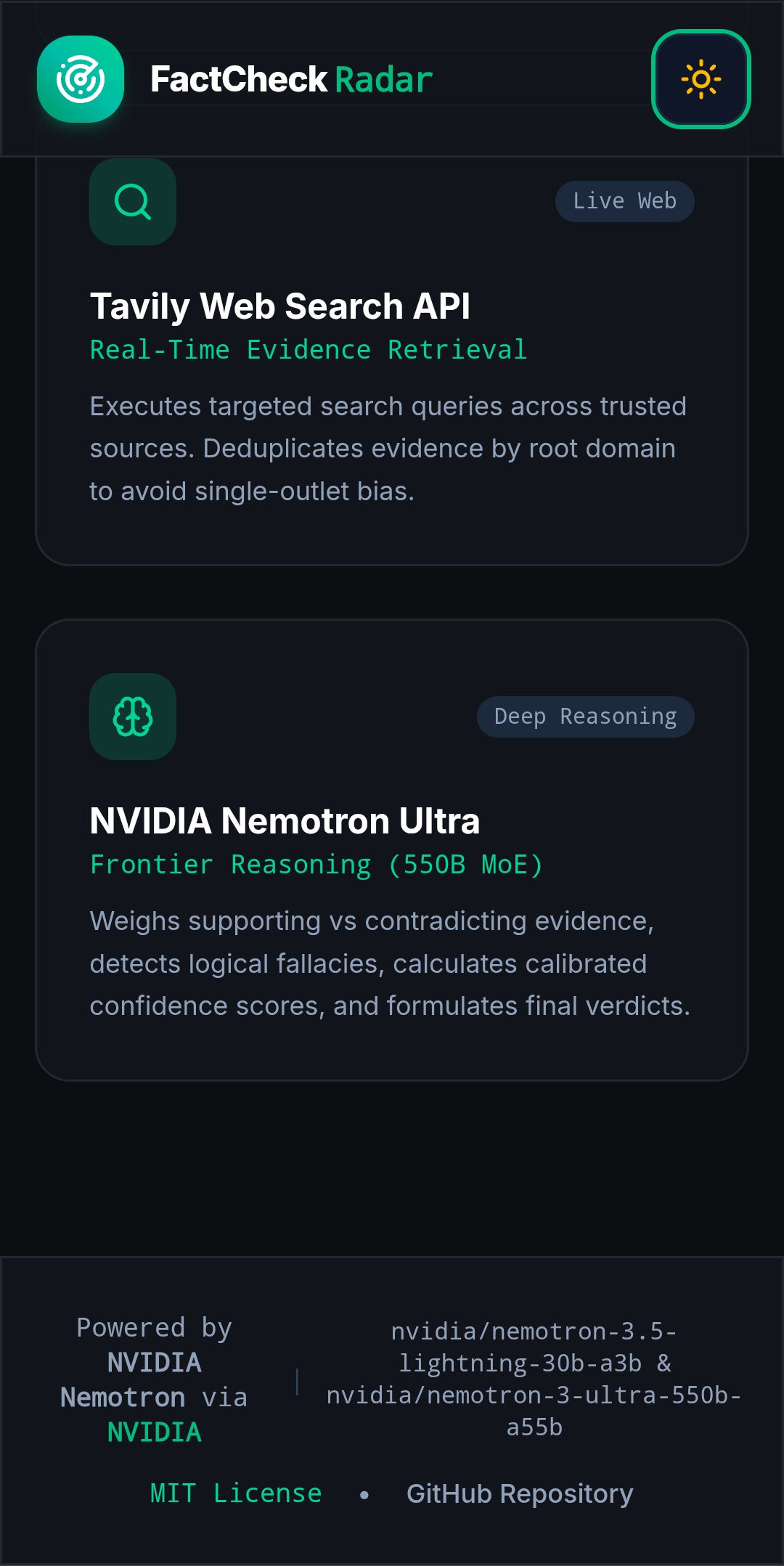
LLM_PROVIDER=nvidia, used by the live demo):nvidia/nemotron-3.5-lightning-30b-a3bfor sub-30s agentic cycles, withnvidia/nemotron-3-ultra-550b-a55bas fallback. - Nebius Token Factory (
LLM_PROVIDER=nebius): routes tonvidia/Nemotron-3-Nano-30B-A3Bandnvidia/Nemotron-3-Ultra-550b-a55b.
At startup the backend validates credentials, calls /models on the active provider, logs the discovered Nemotron IDs, and resolves to the closest valid endpoints. Switching to Nebius takes two settings: LLM_PROVIDER=nebius and NEBIUS_API_KEY.
Stack
- Backend: FastAPI (Python 3.11+), async SSE streaming, Pydantic v2 schemas, proxy-aware rate limiting, in-memory LRU cache (15-min TTL), Trafilatura
- Frontend: React 19, Vite, Tailwind CSS v4
- Deployment: multi-stage Docker container on Render
Challenges we ran into
- The event loop trap: the OpenAI and Tavily SDKs make blocking calls, which starved FastAPI's event loop under concurrent traffic. We wrapped every SDK call in
asyncio.to_thread. - LLM JSON resiliency: even with
response_format={"type": "json_object"}, models sneak in markdown fences or extra text. We built a sanitizer (_clean_json_str) and a self-healing retry that re-prompts for an in-band correction. - Latency: the 550B model can take 80+ seconds. Using the 30B-A3B Lightning model by default brings full runs to 15–25 seconds, with 35s per-request timeouts and helpful retry messages.
- Honesty in AI results: we removed silent fallbacks to sample data. If a live call fails, the app shows an error banner. Demo data appears only when the user explicitly enables Demo Mode.
Accomplishments that we're proud of
- 20/20 automated tests passing, covering schemas, cache, rate limiting, fail-fast provider validation, and pipeline orchestration.
- A strict live smoke test (
scripts/smoke_test.py) that validates extraction, retrieval, source assessment and verdict synthesis end-to-end, failing fast on any 401 or empty result. - Real latency optimization: fast extraction handoffs keep the full cycle snappy despite deep web searches.
What we learned
Fast and deep models work best in specialized roles. Agents earn trust through transparency: showing every step, naming the provider and model, and never passing off sample data as live.
Deployment truthfulness notice
The hosted demo runs on Render (Docker) using the hosted NVIDIA NIM API (https://integrate.api.nvidia.com/v1) with nvidia/nemotron-3.5-lightning-30b-a3b. Nebius Token Factory is a supported, swappable provider in the codebase (LLM_PROVIDER=nebius) but was not used for the hosted demo. We do not claim the demo runs on Nebius Serverless Endpoints or AMD Genoa.
