

Inspiration
Our team was inspired by the social dynamics of party games like Jackbox and Quiplash to address the growing issue of political misinformation. In a world where democracy feels struggling and communities are divided by confusing information, we wanted to build a tool that brings people back into the conversation. By gamifying the act of spotting fake news, we aim to make media literacy an engaging, social experience.
What it does
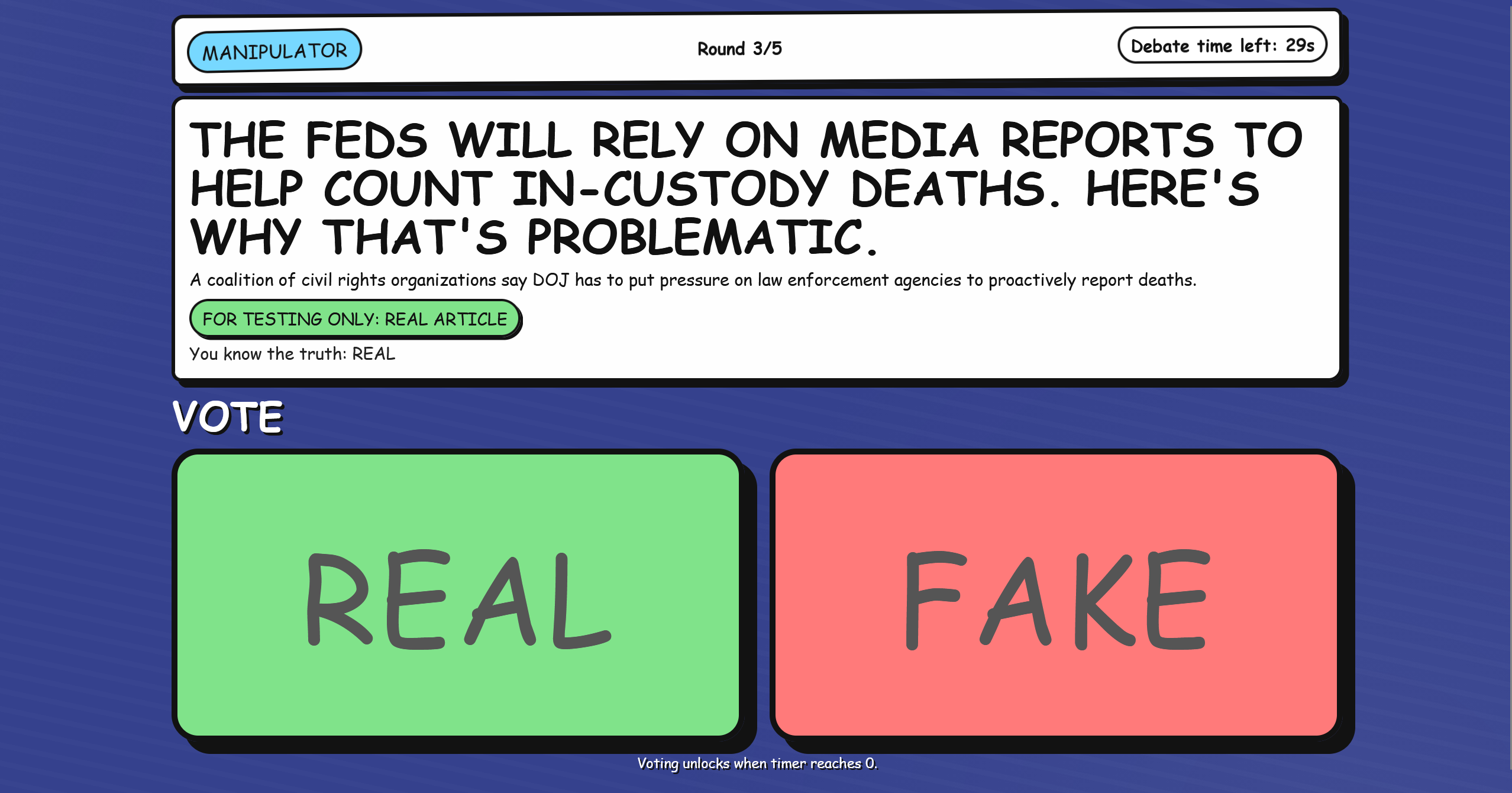
Fact or Cap is a fast-paced, asymmetrical web game where players must distinguish between real and AI-generated news headlines or laws. While citizens discuss the validity of a prompt, a hidden Manipulator who knows the truth tries to subtly mislead the group. The game features a core loop of discussion, voting, and score reveals, designed to spark political discourse and encourage users not to believe everything they see instantly.
How we built it
We developed a responsive web application using a modern tech stack focused on real-time interaction. The frontend is built with React and Tailwind CSS to handle the lobby, game screens, and live voting UI. Our backend utilizes Socket.IO for real-time room management and game state synchronization. We also leveraged the Anthropic API (Claude) to dynamically generate believable fake headlines and filter real news content to ensure prompts were tricky but fair.
Challenges we ran into
One of the primary hurdles we faced was balancing the prompt engineering to ensure that the AI-generated news was indistinguishable from reality without being completely impossible to guess. We had to iterate extensively on our API calls to generate fake headlines that mirrored the tone and syntax of actual journalistic writing. Additionally, synchronizing the game state across multiple devices in real-time presented a significant technical challenge. Managing the transition between the discussion phase, where voting was disabled, and the reveal phase required precise coordination using Socket.IO to ensure no player was left behind or saw the answer prematurely.
Accomplishments that we're proud of
We are particularly proud of creating a seamless asymmetrical gameplay loop that successfully fosters the success test we set out to achieve, which is seeing players actively argue and laugh over whether a headline is real or cap. Building a fully responsive interface that looks as good on a mobile phone as it does on a desktop was a major win for us, as it ensures the game is accessible in any social setting. Furthermore, we successfully integrated the Anthropic API to act as a dynamic content engine, allowing the game to feel fresh every time it is played rather than relying on a static, pre-written database.
What we learned
This project taught us that the most effective way to promote media literacy is through community deliberation and social interaction rather than dry, lecture-based education. On the technical side, we gained a much deeper understanding of real-time state management and how to handle the nuances of asymmetrical roles where different players need to see different information on their screens simultaneously.
What's next for Fact or Cap
Looking ahead, we plan to expand Fact or Cap beyond just news headlines by introducing a Historical Mode and a Legislation Mode that focuses on actual pending bills to help with legislative transparency. We also want to implement a more robust chat system and a variety of specialized roles, such as an Investigator who can verify one person’s vote. Ultimately, our goal is to partner with nonpartisan voter education organizations to turn this party game into a widespread tool for fighting misinformation and helping citizens stay informed in an increasingly confusing digital landscape.


Log in or sign up for Devpost to join the conversation.