-
-
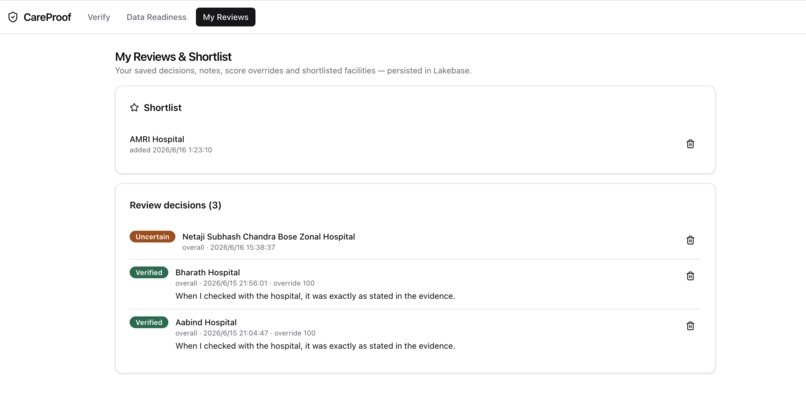
My Reviews Page
-
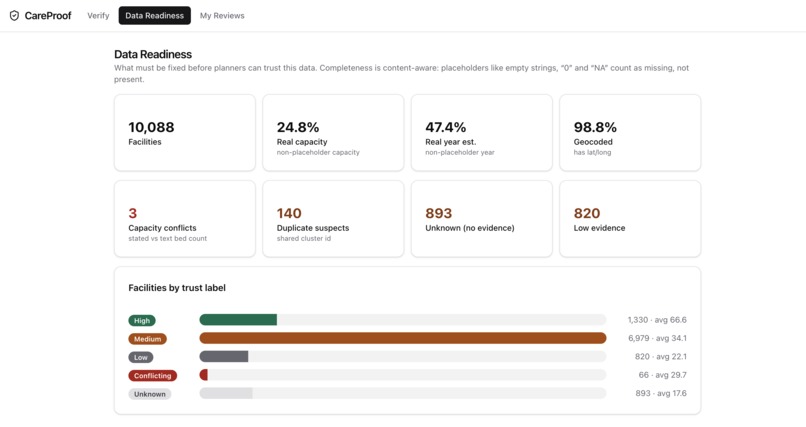
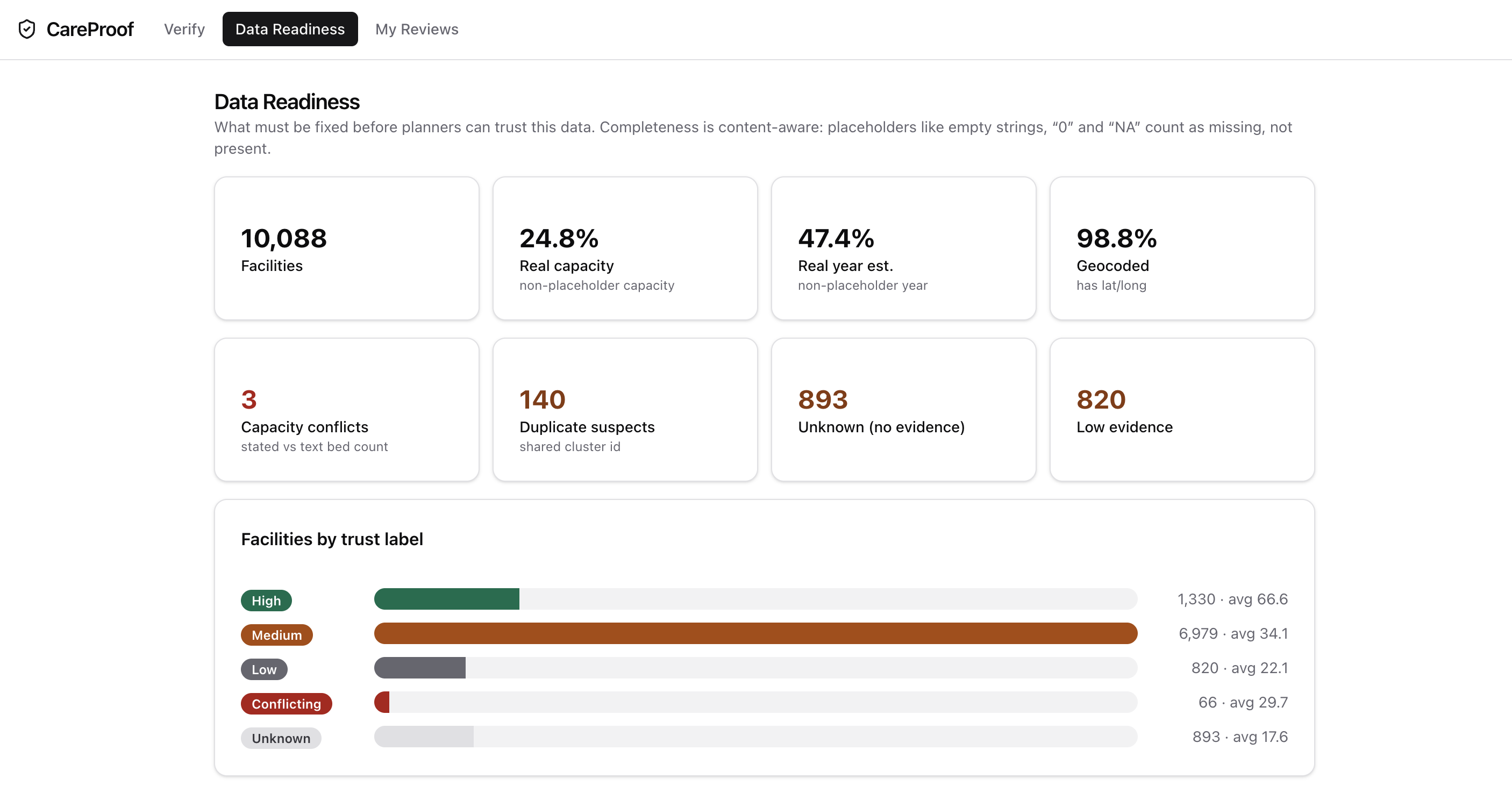
Data Readiness page
-
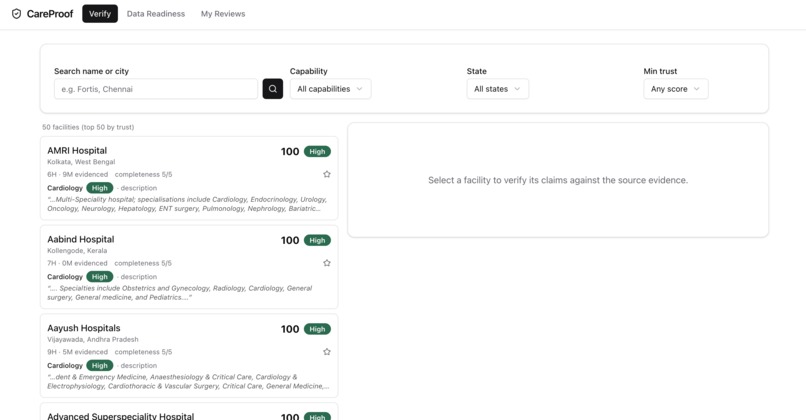
Verify page

Inspiration
Healthcare facility data is often collected from websites, public registries, and AI-assisted extraction pipelines. While these sources provide valuable coverage, they can also contain missing information, outdated records, contradictions, and unverified claims.
For healthcare planners, NGOs, and decision-makers, blindly trusting this data can lead to poor decisions and resource allocation. We wanted to create a system that makes trust visible, transparent, and explainable.
This inspired us to build CareProof, a platform that helps users verify whether a healthcare facility can actually do what it claims.
What it does
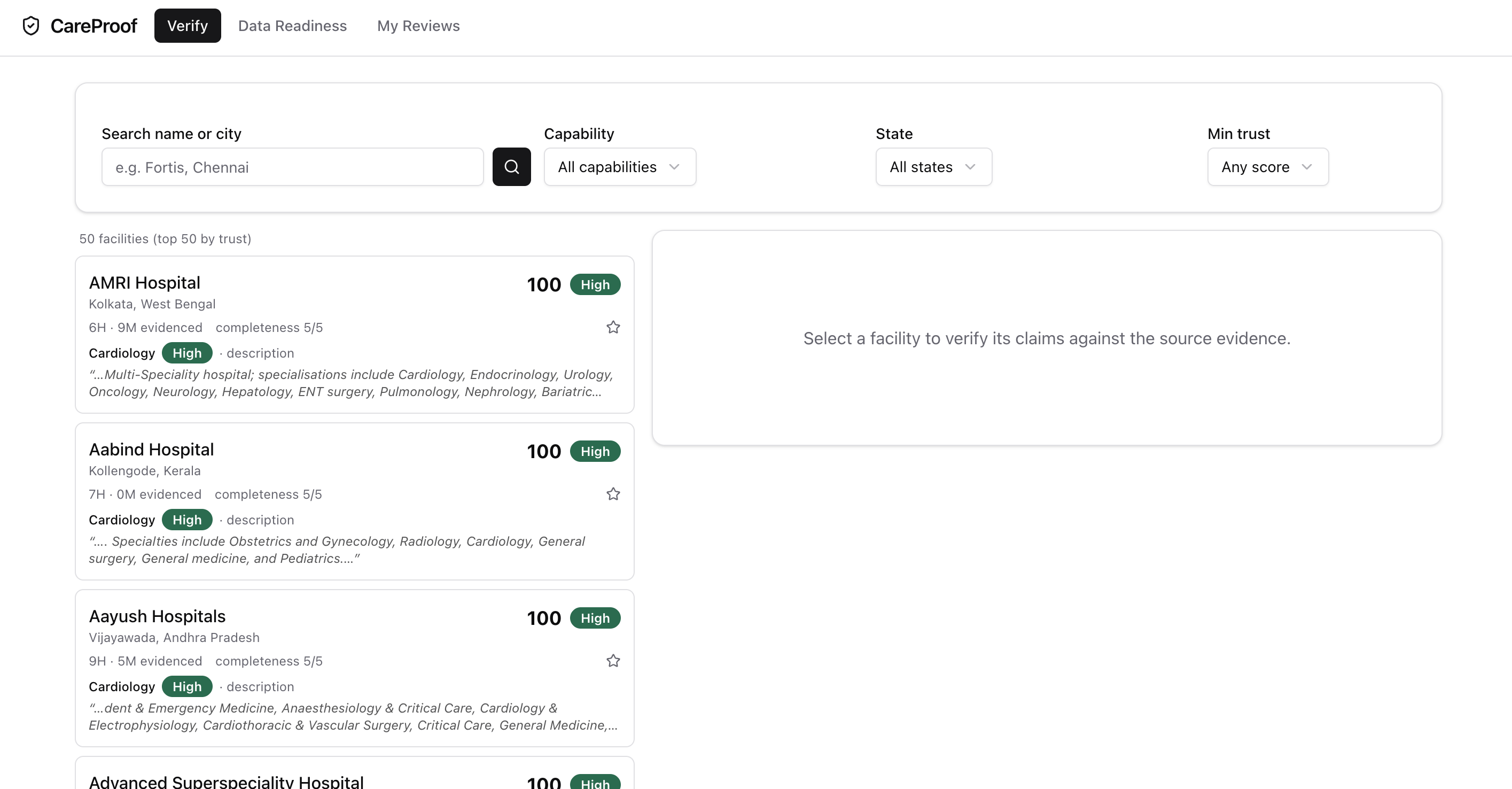
CareProof evaluates healthcare facilities using evidence-backed trust signals.
The platform:
- Calculates trust scores using deterministic verification rules
- Identifies supporting evidence and contradictions
- Explicitly surfaces uncertainty and missing information
- Generates AI-powered plain-language explanations grounded on verified evidence
- Enables human reviewers to validate findings and record decisions
Rather than hiding uncertainty, CareProof makes it visible and actionable.
How we built it
CareProof was built entirely on Databricks.
Our architecture consists of:
- Delta Sharing datasets as the source of healthcare facility information
- Deterministic SQL-based verification pipelines that normalize facility data and calculate trust metrics
- Analytical queries that aggregate evidence, identify contradictions, and generate trust signals
- AI-powered explanations using Databricks AI functions
- A Databricks App that provides Verify, Readiness, and Review workflows
- Lakebase PostgreSQL for persistent reviewer decisions and shortlists
The system combines rule-based verification with AI-generated explanations while keeping humans in control of final decisions.
Challenges we ran into
One of the biggest challenges was balancing explainability and automation.
LLMs can generate convincing summaries, but trust decisions require verifiable evidence. We therefore designed the system so that AI explanations are grounded strictly on verified evidence and cannot become the source of truth themselves.
Another challenge was handling incomplete and conflicting facility information while still producing meaningful trust assessments.
Accomplishments that we're proud of
We are particularly proud of three aspects of CareProof:
- Every trust score is supported by evidence
- Uncertainty and missing information are explicitly surfaced
- Human reviewers remain in control through a persistent review workflow
These principles make the platform transparent, auditable, and suitable for high-stakes decision-making.
What we learned
We learned that trustworthy AI systems require more than model accuracy.
Evidence, uncertainty awareness, explainability, and human review are equally important when decisions affect real-world outcomes.
We also gained practical experience building AI-assisted workflows on Databricks using Lakebase, SQL analytics, AI functions, and Databricks Apps.
What's next for CareProof
Future improvements include:
- Geographic coverage analysis using map-based visualizations
- Spatial joins with additional healthcare and demographic datasets
- Enhanced evidence quality scoring
- Reviewer collaboration and audit workflows
- Expanded support for healthcare planning and facility benchmarking
Our long-term vision is to help organizations make better healthcare decisions using transparent, evidence-driven AI systems.
Source Code Availability
The application is fully accessible through the deployed Databricks App and can be evaluated through the live application and demonstration video.
Due to corporate security policies, GitHub access is restricted from the development environment used for this project. As a result, we are unable to publish the source repository publicly.
All project functionality, architecture, and implementation details are demonstrated in the submitted application and demo video.
Built With
- databricks-ai-functions-(ai-query)
- databricks-apps
- databricks-free-edition
- delta-sharing
- express.js
- lakebase-postgresql
- node.js
- react
- sql-analytics
- typescript
- vite

Log in or sign up for Devpost to join the conversation.