-
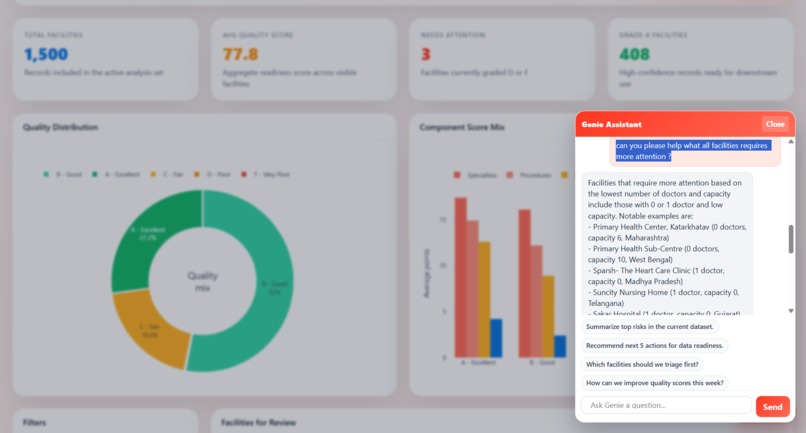
Conversation GENIE
-
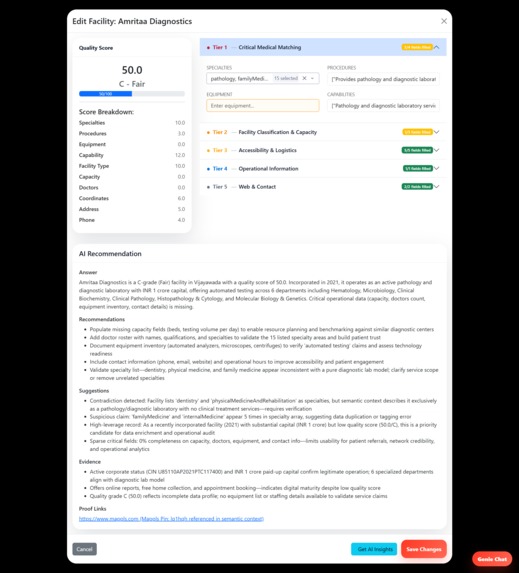
AI Insights
-
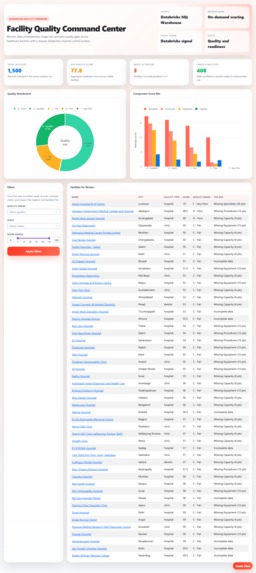
Dashboard KPI
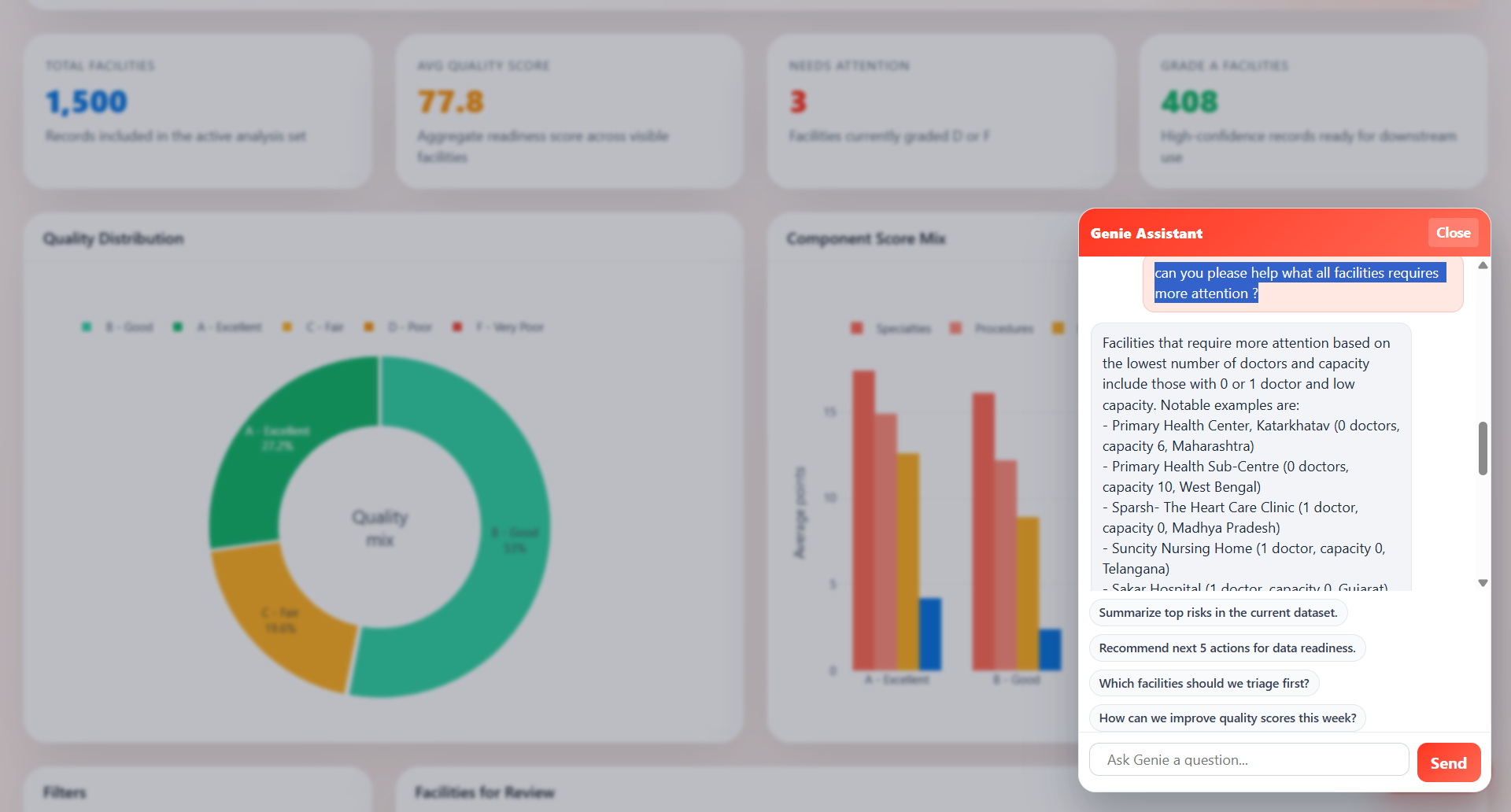
Data Readiness Desk What must be fixed before planning can trust it?
Healthcare planning decisions are only as good as the data behind them. Capacity planning, service coverage analysis, outreach strategy, and operational prioritization all depend on facility records being complete, current, and trustworthy. In practice, that data is often fragmented, inconsistent, and missing critical context. Teams are asked to plan with confidence before they can even verify whether the underlying records are ready for use.
Data Readiness Desk was built to solve that problem.
Our project turns data quality from a passive reporting exercise into an active operational workflow. Instead of simply showing incomplete records, we help users understand what is missing, why it matters, what should be fixed first, and how confident they can be in the result. The app gives planners, analysts, and operations teams a readiness-focused workspace where they can score data quality, inspect specific facility records, request AI-backed recommendations, and ask follow-up questions conversationally in real time.
At the product level, the experience is centered on one question: before planning can trust this data, what must be fixed?
What the product does
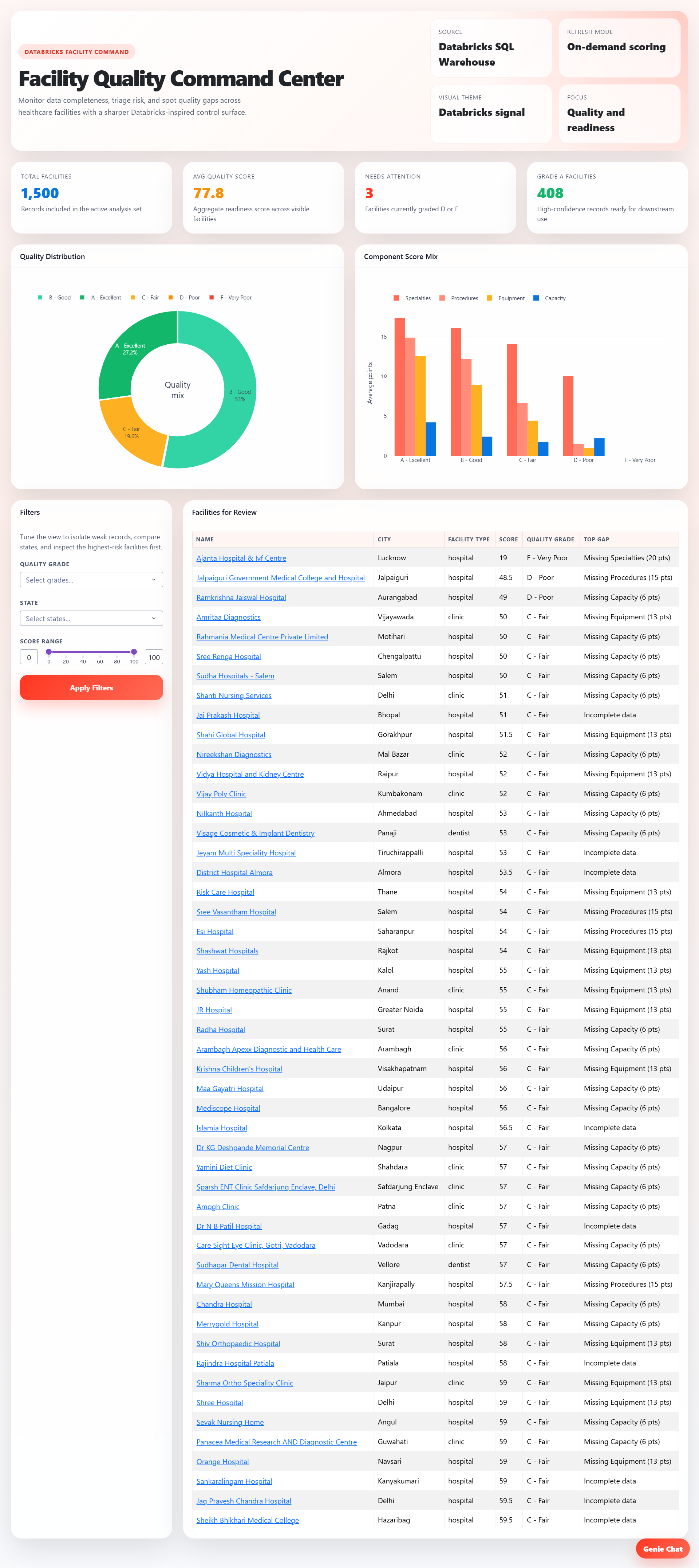
Data Readiness Desk evaluates facility records across high-value readiness dimensions such as specialties, procedures, equipment, capabilities, location, contact information, and other operational attributes. It then translates those signals into an actionable readiness score so users can quickly identify which records are decision-ready, which ones are risky, and which fixes will deliver the highest impact.
Users can:
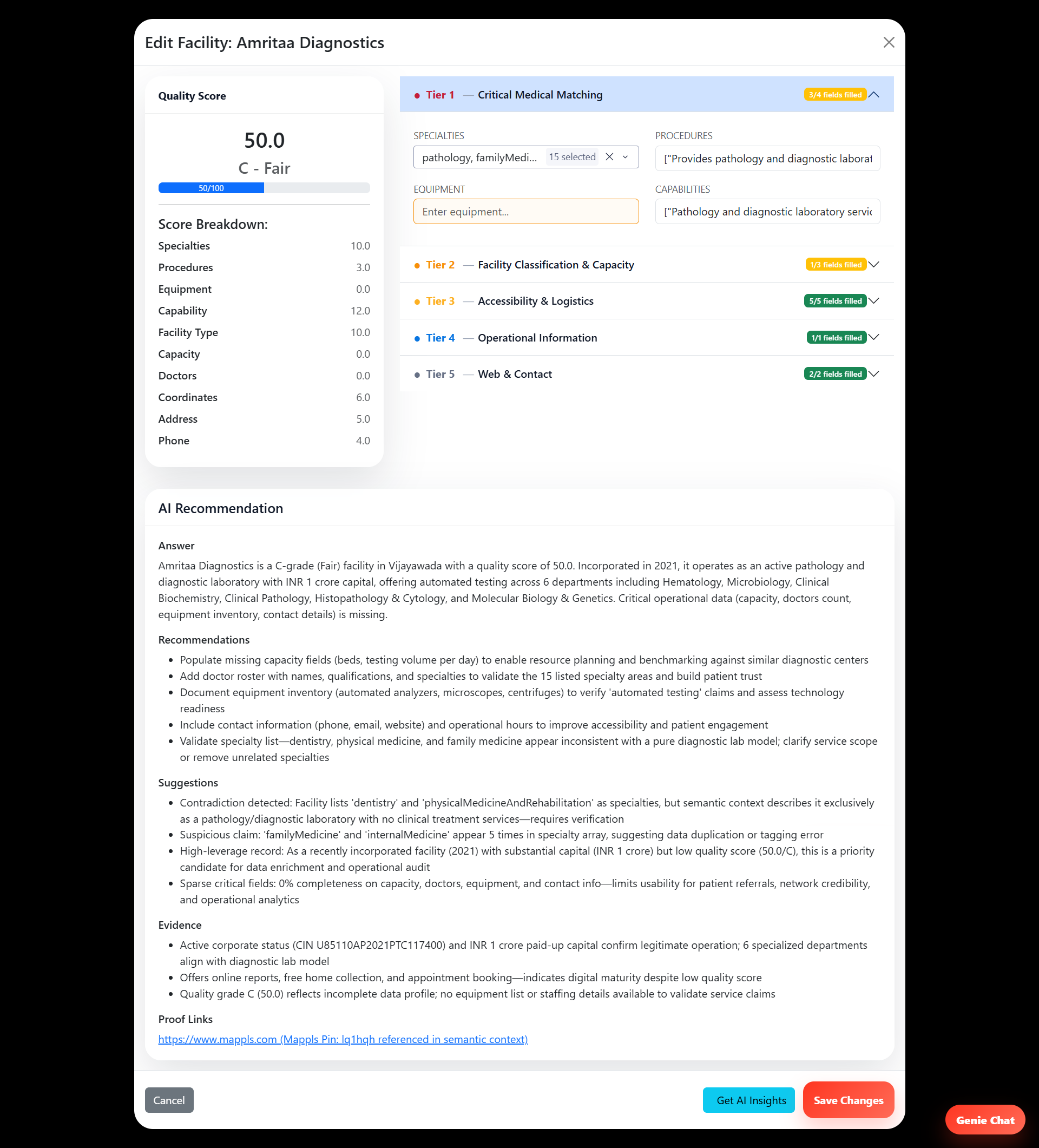
view facility readiness scores and quality grades filter and triage weak records across the portfolio inspect and edit facility records directly recalculate quality/readiness in real time as fields are updated request structured AI insights for a selected facility ask broader questions through a conversational Genie interface receive grounded recommendations, evidence, and follow-up guidance The result is a workflow that moves from observation to action. Instead of discovering poor-quality data too late, users can proactively improve it before it affects planning decisions.
Why this matters
In healthcare operations, low-quality data creates hidden risk. A missing specialty, incomplete equipment listing, stale location field, or absent capability marker can distort how teams assess readiness, resource distribution, or service coverage. Traditional dashboards surface the symptoms, but they rarely help users decide what to do next.
We wanted to build something more useful than a scorecard. Data Readiness Desk is designed to function like a readiness co-pilot: it highlights where trust breaks down, recommends high-leverage fixes, and helps users navigate uncertainty honestly instead of masking it behind a single score.
How AI is used
We deliberately designed the solution with multiple AI surfaces, each serving a different user need.
- Structured AI Insights through an Agent Bricks model serving endpoint Inside the Edit Facility workflow, users can request AI-generated insights for a specific facility. This path is powered by a model serving endpoint built with Agent Bricks and designed around a supervisor-style agent pattern. Rather than returning freeform chat alone, it produces structured output that can be rendered directly in the UI, including:
a concise summary prioritized recommendations supporting evidence proof links where available This makes the experience practical for operational decision-making. Users are not just asking “what is wrong?” but “what should I fix first, and why?”
- Conversational analytics with Genie We also integrated Genie to support a more exploratory, conversational experience. Genie allows users to ask natural-language questions about data readiness, missing evidence, prioritization, and planning implications. This gives users a flexible interface for iterative analysis and real-time follow-up.
Where the AI Insights panel is optimized for structured, record-level guidance, Genie is optimized for conversational discovery and rapid exploration.
Grounding with VSE To improve the quality and relevance of recommendations, we use a semantic retrieval layer so that AI responses can be informed by relevant contextual evidence rather than relying only on generic prompting. This helps the system stay more grounded and improves its ability to explain why a recommendation was made.
Bidirectional governed data flow with Unity Catalog and Lakebase A core architectural goal was to connect governed enterprise data with operational workflows. Data Readiness Desk is designed around a bidirectional flow between Unity Catalog and Lakebase:
governed data assets inform readiness analysis and recommendations operational edits and remediation workflows can feed back into the broader governed data ecosystem This closes the loop between analytics and action. Instead of analysis being disconnected from remediation, the product helps teams move from insight to data improvement within the same workflow.
Key features
Facility readiness scoring and grading Portfolio-wide filtering and triage Visual breakdown of quality/readiness components Edit Facility workflow with live rescoring Structured AI Insights for record-specific guidance Genie-powered conversational analysis Semantic retrieval to strengthen evidence and relevance Governed data integration across Unity Catalog and Lakebase Real-time workflow designed for live operational use How the project meets the judging criteria
Product judgment The user is clear: operations teams, planners, and data owners who need to know whether facility data is trustworthy before making decisions. The workflow is intentionally designed around that question. We distinguish between structured insights for record-level action and conversational analysis for broader exploration, which creates a more thoughtful and useful user experience than a one-size-fits-all chatbot.
Evidence and uncertainty A central design principle is that outputs should be grounded and honest. Recommendations are paired with supporting evidence and proof links where possible, and the system surfaces uncertainty directly through missing-field analysis, readiness gaps, and incomplete evidence rather than hiding it. This makes the product more credible for operational decision-making.
Technical execution The app is built as a live Databricks-native experience and uses platform capabilities in a meaningful way:
model serving endpoints Agent Bricks Genie semantic retrieval Unity Catalog Lakebase-connected workflows It is not just a concept demo. The system supports live scoring, record editing, structured AI generation, and conversational exploration in an integrated interface.
- Ambition We went beyond the minimum workflow by combining multiple modes of intelligence into one operational product:
scoring and diagnostics live editing and recalculation supervisor-style agent outputs conversational analytics grounded evidence retrieval governed, bidirectional data flow That makes Data Readiness Desk more than a dashboard and more than a chat assistant. It is a readiness operating surface for planning-quality data.
Closing summary
Data Readiness Desk helps healthcare teams answer the question that comes before every planning decision: can we trust this data, and if not, what do we fix first?
By combining readiness scoring, structured AI insights, Genie conversation, semantic grounding, and governed Databricks data workflows, the project transforms data quality from a static measurement into an actionable planning capability.

Log in or sign up for Devpost to join the conversation.