-
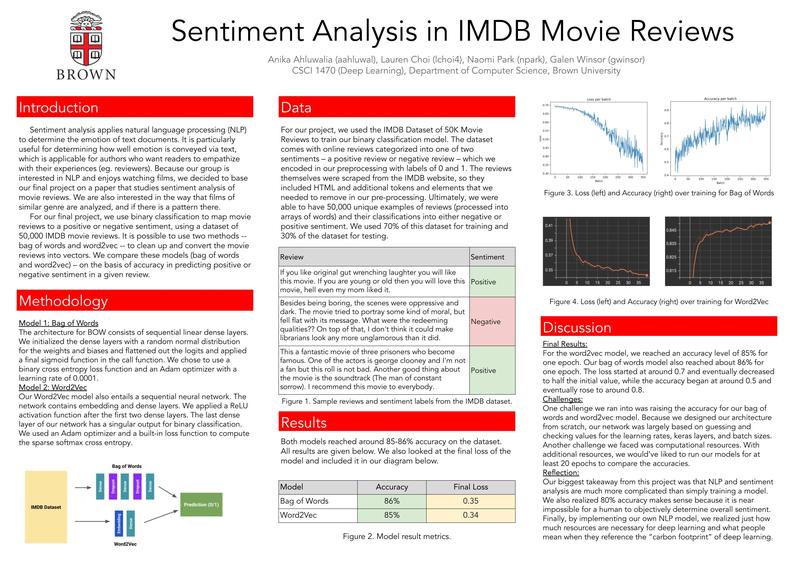
Final Poster

Analyzing Sentiment in IMDB Movie Reviews
Disclaimer
You must install pandas, nltk, and beautifulsoup (pip3 install pandas, pip3 install nltk, and pip3 install bs4) in order to run our project.
Introduction
Sentiment analysis applies natural language processing (NLP) to determine the affect of text documents. It is particularly useful for determining how well emotion is conveyed via text, which is applicable for authors who want readers to empathize with their experiences (eg. reviewers). Because our group is interested in NLP and enjoys watching films, we decided to base our final project on a paper that studies sentiment analysis of movie reviews. We are also interested in the way that films of similar genre are analyzed, and if there is a pattern there. For our final project, we use binary classification to map movie reviews to a positive or negative sentiment, using a dataset of 50,000 IMDB movie reviews for training and testing. It is possible to use two methods -- bag of words and word2vec -- to clean up and convert the movie reviews into vectors. We compare these models (bag of words and word2vec) – using different classifiers (random forest vs SVM) and feature mappings (averaging vs clustering) to compare their accuracies on the same dataset.
Related Work
Our project was based on this Stanford paper. The study compares different NLP models with various classifiers to examine the accuracy of sentiment analysis on movie reviews. Results showed that the word2vec model with averaging feature mapping and a logistic regression classifier was the most accurate (86.6%), although most models hovered at around 84-85% accuracy. Although sentiment analysis in any context poses an interesting problem, we decided to choose this paper because it is particularly interesting in the context of movie reviews, since horror/rom-com movies are usually described using inherently positive/negative words (eg. "scary," "gory," "love," "happy").
One related paper is this article on sentiment analysis of tweets. It presents an interesting issue because tweets are limited to 140 characters, which may result in different results from sentiment analysis of regular text. Additionally, tweets have different sentence structures from academic texts and websites because of commonly-used slang and acronyms, which means training datasets must also include slang and acronyms.
Here is a running list of publicly available implementations: Sentiment Analysis of Movie Reviews Movie Review Sentiment Analysis EDA and Models
Data
We will be using the IMDB Dataset of 50K Movie Reviews to train our binary classification model, which labels reviews as either a positive or negative sentiment. As described in the paper, we will clean up the data during preprocessing to remove stop words, tags, irrelevant punctuation, and convert words to lowercase as needed.
Methodology
Model
Because we are implementing binary classification, we will implement two different models with two different feature vector mappings to compare the models’ accuracies on the same IMDB dataset. First, we will use the preprocessed data to generate feature vectors using both bag of words and word2vec. Then, for word2vec, we will map the feature vectors to movie reviews by either (1) averaging the word vectors of all words in a review, or (2) clustering similar words together to find the differences between clusters. Once we’ve generated all feature vectors and mapped them to movie reviews, we will implement different classifiers – namely random forest and SVM – to compare different combinations of models, mappings, and classifiers.
Training/Testing
The model will be trained on the IMDB Dataset with 25,000 training data points, and we will test the model on the IMDB Dataset with 25,000 test data points. We plan to test the following four model-classification combinations: Bag of words + random forest Bag of words + SVM Word2vec + averaging + random forest Word2vec + clustering + random forest After training and testing the four combinations, we will compute the accuracy of each test set and compare the accuracies across models.
Metrics
We plan to separate out the dataset that we found into two sections: one for training and one for testing. The dataset comes with reviews categorized into one of two sentiments; positive or negative. We will begin by training our model on half of the data and then seeing how the sentiment matches up. Because we are solving a problem of binary classification, our accuracy measure will be fairly simple. We can simply look at the percentage of examples in our training data that are matched to the correct label. The authors of the paper also used this accuracy measure when computing the accuracy of their model.
As we expand our project into our reach goal (predicting the number of stars that a review received), the accuracy measure will get a bit more complicated. We will take a measure of how close the rating is (exactly the correct number of stars, one star off, two stars off, etc) and will use that to compute how accurate our model is.
Goals
Base: We would like to create a bag of words model that can successfully analyze the sentiment in movie reviews on IMDB.
Target: We hope to expand to a bag of words and word-2-vec model that is able to analyze the sentiment of movie reviews from IMDB with at least 75% accuracy.
Final Submission
Built With
- python
- tensorflow


Log in or sign up for Devpost to join the conversation.