inspiration could be a desire to create a tool that can help individuals with communication difficulties, such as those on the autism spectrum or those who have suffered a stroke, to better express their emotions. Another source of inspiration could be a desire to improve the accuracy of emotion recognition in artificial intelligence applications, such as virtual assistants or autonomous vehicles. Additionally, some researchers may be motivated by the desire to understand how emotions are expressed and perceived in the human face in order to improve mental health diagnosis and treatment
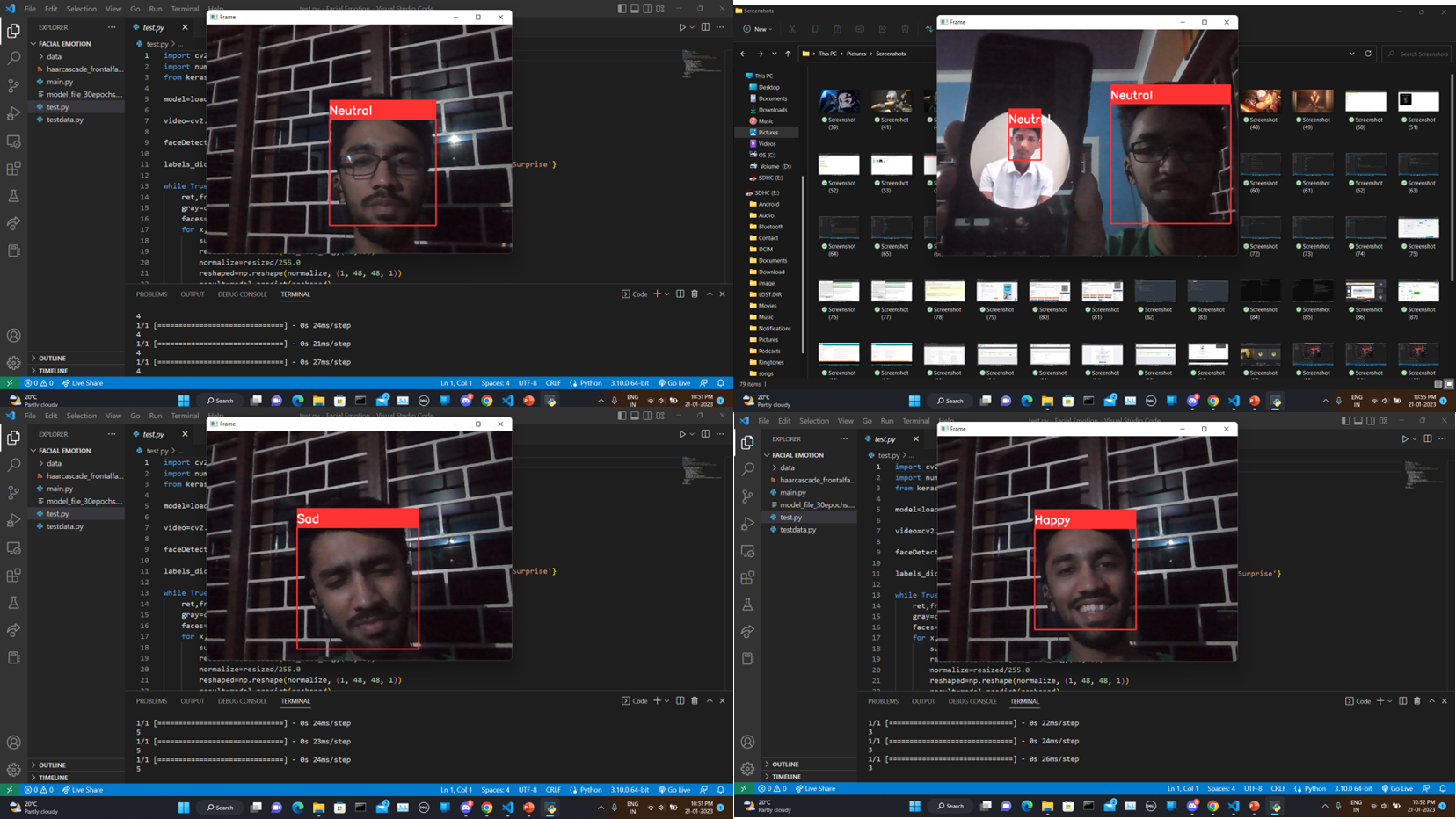
Facial emotion of a person can be recognised with our project
Steps in building
- Getting data
- Preparing data
- Image augmentation
- Build model and train
- Use the web cam for detection
Through this project we learnt a basic idea on machine learning model. A facial emotion recognition project can provide a lot of insight into how emotions are expressed on the face and how they can be detected and interpreted by computer algorithms. Some of the key things that can be learned from such a project include:
The specific facial features and movements that are associated with different emotions (such as a smile for happiness or furrowed brows for anger).
The nuances and variations in how individuals express emotions, and how these variations can be taken into account by the recognition algorithm.
The importance of having a diverse dataset for training the recognition algorithm, in order to handle different skin tones, ethnicities and ages.
The limitations and challenges of current technology in terms of accurately detecting and interpreting emotions, as well as the potential for future improvements.
The ethical and privacy concerns surrounding the use of facial emotion recognition technology, such as the potential for misuse or abuse.
The potential applications of facial emotion recognition technology in fields such as healthcare, marketing, and security.
Built With
- cv2
- keras
- numpy
- visual-studio

Log in or sign up for Devpost to join the conversation.