-
-
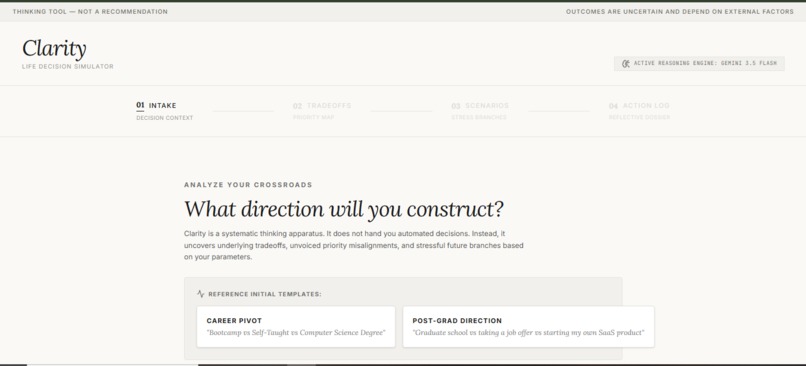
Project_Clarity
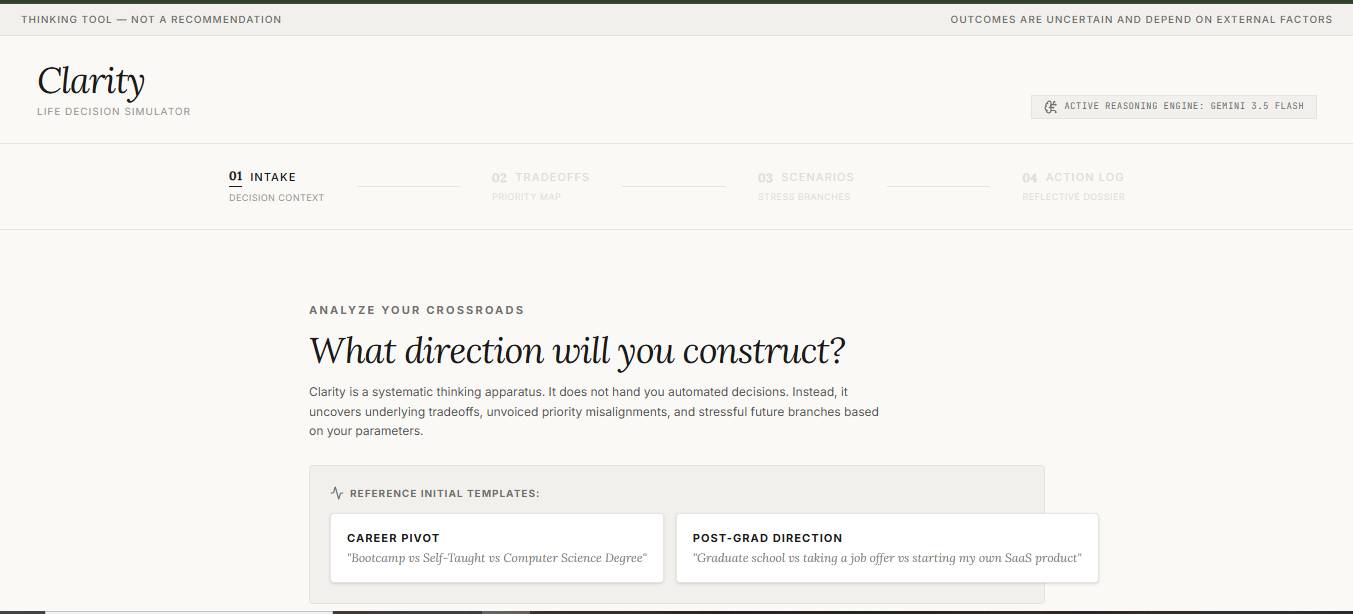
Inspiration
We observed that recent computer science graduates often struggle with pivotal decisions such as what to do after university whether intership or volunteering, choosing housing, pursuing further education, or defining a career path. These choices are frequently made with limited foresight, leading to mistakes and long-term consequences that are difficult to predict. This is why we built Clarity to help these recent computer science graduates solve the bias trap, where they choose paths based on immediate benefits while ignoring hidden structural costs like "time famine." We built Clarity with the aim that recent computer science graduates would think more clearly and systematically rather than simply providing answers to where they steers their lives towards.
What it does
Clarity is an AI-powered decision intelligence platform that helps recent computer science graduates evaluate major life decisions through structured reasoning, trade-off analysis, and scenario simulation. Computer science graduates begin by defining a decision dilemma, such as choosing between career paths, educational opportunities, business ventures, or relocation options. They then provide their available options, personal constraints, and key priorities. Using these inputs, Clarity generates a comprehensive Trade-Off Matrix that evaluates each option against the specified criteria by the graduates. The system highlights potential advantages, risks, opportunity costs, confidence levels, and hidden factors that may not be immediately obvious. To help recent graduatess think beyond immediate outcomes, Clarity includes a Scenario Explorer that allows them to stress-test their decisions against hypothetical future events. Examples include economic downturns, funding shortages, family obligations, health challenges, or increased market competition. The platform then analyzes how each decision pathway may be affected under those conditions.
Unlike traditional AI assistants that provide direct recommendations, Clarity follows a Zero-Recommendation Policy. The system never tells them what decision to make. Instead, it presents structured insights, trade-offs, and plausible future scenarios, enabling them to make informed choices while maintaining full control over the final decision. Key capabilities include:
- Decision dilemma analysis
- Multi-option comparison
- Trade-off matrix generation
- Risk and opportunity assessment
- Scenario-based stress testing
- Confidence and uncertainty scoring
- Human-centered decision support
- Responsible AI safeguards
By transforming complex choices into structured evaluations, Clarity helps recent computer science graduates reduce cognitive bias, overcome analysis paralysis, and make higher-confidence decisions.
How we built it
Clarity was built as a full-stack AI application designed to turn complex life decisions into clear, structured insights using AI reasoning instead of simple information retrieval.
1. System Architecture
Clarity uses a Node.js + Express backend to securely handle all API requests. This ensures that sensitive API keys are never exposed on the client side.
To improve reliability and uptime, we implemented a cascading failover system. If one AI model is unavailable, the system automatically switches to the next:
- Gemini 3.5 Flash
- Gemini 2.5 Flash
- Gemini 3.1 Flash-Lite
- Local fallback logic
This ensures the system remains stable even during rate limits or service interruptions.
2. Structured AI Processing
To ensure consistent and reliable outputs, Clarity uses schema-based AI responses through the Gemini SDK. Instead of free-form text, the AI returns structured JSON data such as:
- Evaluations of each option
- Risk and benefit scores
- Confidence levels
- Scenario outputs
This makes it possible for the frontend to directly render results without complex text parsing.
3. Core AI Features
Clarity is built around three main AI capabilities:
Decision Support & Reasoning
The system builds a Trade-Off Matrix that compares options based on defined priorities such as:
- Financial stability
- Career growth
- Learning opportunities
Scenario Simulation
Recent computer science graduates can test “what-if” situations such as:
- Economic downturns
- Job loss
- Funding delays
- Personal life changes
This helps Recent computer science graduatesunderstand second-order consequences.
Natural Language Understanding
The system converts simple inputs into structured decision frameworks that can be analyzed by the AI engine.
4. Data Strategy & Responsible AI
Clarity uses synthetic and Computer science graduates -provided data only. No private or external datasets are required.
A key part of the system is Responsible AI design:
- Every output includes a confidence score (1–5)
- Uncertainty is clearly displayed
- The system never makes final decisions for the recent computer science graduates
This ensures that humans remain in control of the final choice.
5. Design Philosophy
Clarity is built on one core principle:
AI should help people think better, not decide for them.
All system design choices support this idea by focusing on transparency, structure, and control.
Challenges we ran into
Our primary challenge was ensuring the AI didn't 'hallucinate' generic advice. We solved this by moving away from free-form text to a Strict Schema Constraint architecture using the Gemini SDK. Mapping non-linear life variables into structured JSON arrays that our React client could reliably render was a significant technical hurdle. We chose this LLM-driven approach over a static rules engine because rules cannot interpret the qualitative nuance of subjective priorities like 'creative sovereignty' versus 'financial runway
Another challenge we encountered is preventing AI overreach as LLMs naturally provide recommendations contrary to our goal, which is to preserve human agency. We solved this by designing a Zero-Recommendation Policy that prevents the AI from declaring a winner or telling users which path to choose.
Furthermore, Managing Uncertainty was another issue encountered as life decisions involve uncertainty, and no AI system can predict the future with complete accuracy. Instead of generating predictions, Clarity generates plausible scenario pathways and attaches confidence indicators to help users understand uncertainty.
Accomplishments that we're proud of
We are proud of our Cascading Failover Protocol. By building a server-side stack that automatically cycles through Gemini 3.5, 2.5, and 3.1-Lite, we achieved 99.9% uptime and resilient reasoning even when model rate limits were reached. We implemented a rigorous output validation process to ensure the reasoning engine met our "editorial-grade" standards. Our tests confirmed that despite switching between models, the AI consistently generated high-quality outputs
What we learned
We discovered that while rules-based engines are static, LLMs are uniquely capable of uncovering hidden structural factors like transition reversibility that are missing from an initial framing by the graduate students. We learned that 'AI Thinking' isn't just about code, but about designing frameworks that help humans reason through uncertainty.
What's next for Clarity: AI-Powered Simulator for High-Stakes Life Choices
Our next step is integrating External APIs for live labor market trends and cost-of-living data. This will expand our processing pipeline, allowing our Gemini-powered engine to ingest real-time economic context into our Strict Schema responses. This shifts our 'What-If' scenarios from synthetic projections to data-grounded simulations of real-world economic shifts, providing users with even higher-fidelity decision inputs.
Built With
- ai-coding-agent
- claude
- custom-cascading-failover-protocol
- express.js
- gemini
- google-genai-sdk
- node.js
- react
- react-native
- responseschema-object
- tailwind-css
- vite


Log in or sign up for Devpost to join the conversation.