-
Face the Facts - Enhance the Automation of Depression Diagnosis and Treatment
Inspiration:
According to NHS, depression can be detected through physical-, psychological-, and symptoms. Psychological symptoms are commonly known, containing symptoms like feeling hopeless and helpless, or having thoughts of harming oneself. Physical symptoms include examples like changes in appetite or weight, or changes of sleeping habits. Social symptoms are seen in less social activities than usual. However, existing diagnosis of depression relies on subjective answers to mental health questionnaires, which is based on the patients' memory of the past weeks or months. Even if a patient is diagnosed and gets access to depression care, consistent and customised treatment is challenging to provide.
What it does:
Face the Facts is aim to combine voice/face/text recognition and privacy preserved ML to support diagnosis and treatment of people with depressions. The purpose is to support a higher level of automation in either self-diagnosis of clinical identification of depression levels, which improves self-awareness of mental health and allows accurate depression detection at an early stage. Meanwhile, our proposed smart watch enhances treatment of depression in a more consistent manner.
How we built it:
We checked on the state-of-the-art solutions that use artificial intelligence to support depression diagnosis and treatment. We compared the drawbacks and strengths of the existing solutions, which leads to our proposed smart watch prototype.
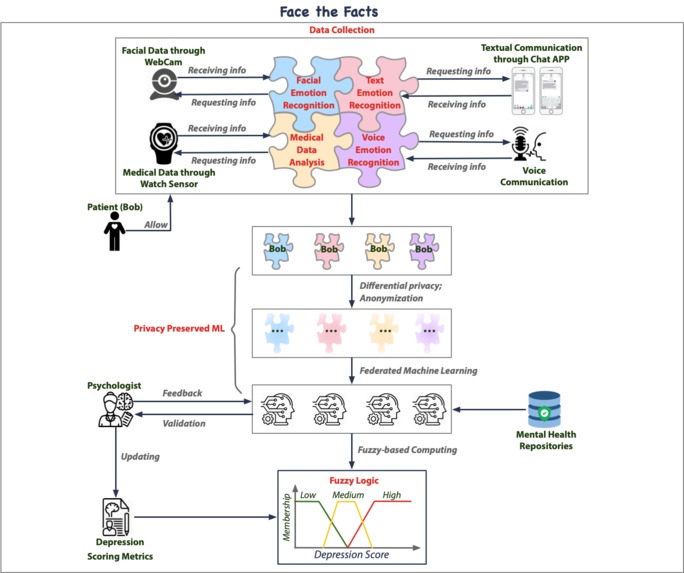
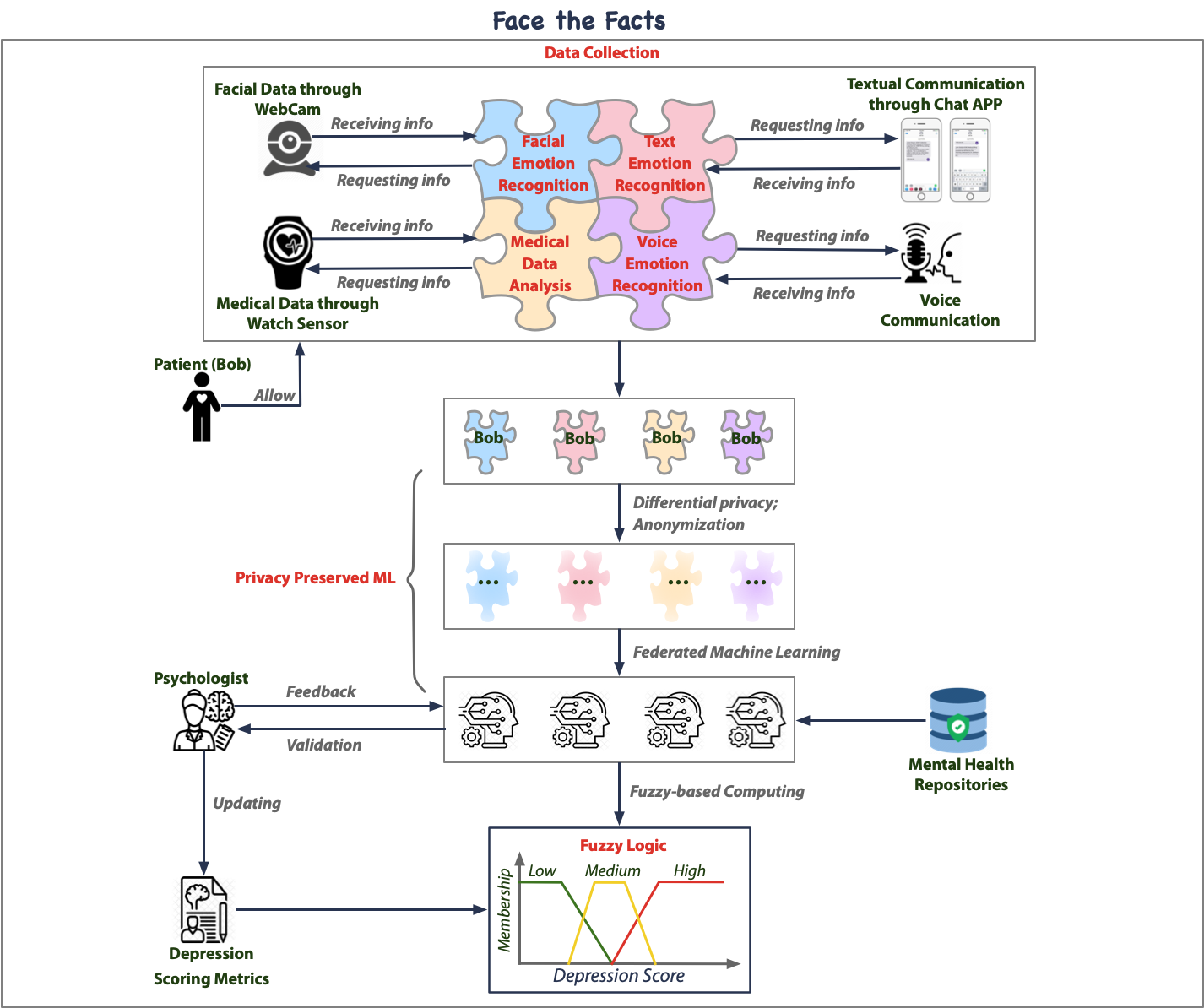
Step 1 - Data Collection: We collect mainly four types of data, namely facial data collected through webcams, speech data collected through microphone, text communication data extracted from socialisation APP, as well as medical data collected through sensors or health APP.
Step 2 - Privacy-Preserved Machine-Learning Training/Testing: We maintain four tracks of federated learning processes, for which the collected data are applied differential privacy policies and anonymised for training and testing. Note that historical data is trained in offline mode. Newly recorded data is trained in online mode.
Step 3 - Fuzzy-Logic Based Computing: The categorisation results from the previous step is fetched and delivered into a fuzzy-logic based computing process. Combined with depression membership defined by psychologists, we generate a depression score of the user.
Challenges we ran into:
Firstly, emotion detection and categorisation is a challenging topic in machine learning, which is particularly true for voice/speech emotion identification. Secondly, interoperability of our designed modules needs to be taken into consideration. Thirdly, our solution deploys a smart wearable watch, and requires further connectivity to other devices to complete the functions. And therefore, cybersecurity of each employed module needs to be carefully taken care of.
IoT-based attacks may appear in the smart watch and result in DoS (Denial of Services). Possible mitigation examples are OS (operating system) hardening and adoption of secure firmware update mechanisms. Attacks on communication protocols may be exploited, such as eavesdropping and replaying attacks. Possible mitigation example is applying secure key exchange protocols. Attacks in medical record system may be exploited to extract or modify patients' data. Possible mitigation example is following advanced encryption standard. Attacks against ML training/testing system may be triggered, such as stealthy attack. Possible mitigation example is employing encrypted transfer learning approach.
Accomplishments that we're proud of:
We are proud of contributing a possible solution to enhance the awareness of mental health. We also validate the technical feasibility of our solution. Moreover, patients' data is collected only under the agreement of the patients, and would be trained after removing personal identity information.
What we learned:
Techniques like artificial intelligence and emotion detection have been worked on by brilliant researchers and programmers. By carefully integrating these techniques together, one can contribute to the society and solve practical problems.
What's next for Face the Facts:
Our code examples in the Github project is for this Hackathon demonstration purpose only. We plan to work out our own code in the future.
Built With
- framework
- python


Log in or sign up for Devpost to join the conversation.