-
-
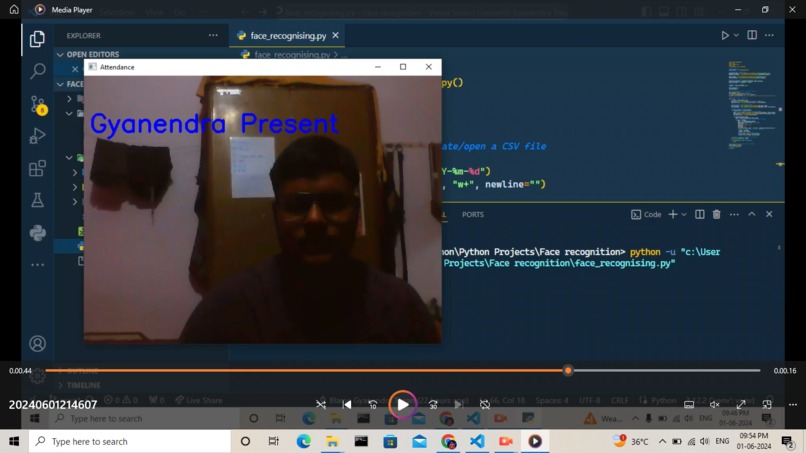
This image shows my program taking attendance after recognizing a face.

Inspiration
The inspiration for this project came from the need to modernize and streamline traditional attendance systems. Manual sign-ins and card-based systems are often inefficient and prone to errors. With advancements in facial recognition technology, I saw an opportunity to create a contactless, automated solution that ensures accurate and efficient attendance tracking.
What it does
This project utilizes facial recognition technology to automatically record attendance. By comparing real-time video feed images to pre-saved images of individuals, the system can accurately identify and log attendance without the need for manual input.
How we built it
The project was built using Python and key libraries like OpenCV and dlib for real-time image processing and facial recognition. The development process included:
Environment Setup: Installing and configuring necessary libraries. Face Detection: Implementing Haar cascades and dlib for real-time face detection. Face Recognition: Using pre-saved images for face recognition. Attendance Logging: Developing a system to log recognized faces into a CSV file for easy access and analysis.
Challenges we ran into
Several challenges were encountered during the development:
Ensuring Accuracy: Achieving high accuracy in facial recognition under various lighting conditions and angles. Optimizing Performance: Ensuring the system processes video feeds in real-time without lag. Data Privacy: Securing facial data and implementing measures to protect user privacy.
Accomplishments that we're proud of
We are proud of successfully creating a functional face recognition system that accurately logs attendance in real-time. Overcoming the technical challenges of accuracy and performance optimization has been a significant achievement.
What we learned
Through this project, we learned a great deal about computer vision, machine learning, and the practical application of Python. We also gained insights into the importance of data privacy and the challenges associated with managing and securing personal data.
What's next for Face recognition
Future plans for this project include:
Improving Accuracy: Enhancing the recognition algorithm to handle a wider range of conditions. Scalability: Making the system scalable to accommodate larger numbers of users. Integration: Integrating the system with other platforms for broader applications, such as access control and security. User Interface: Developing a more user-friendly interface for easier interaction and management.


Log in or sign up for Devpost to join the conversation.