Inspiration
When we can't be there, we ship, and shipping limits us to whatever stores already sell. For a birthday across the country, that means a generic gift arriving days late, when what you wanted was something made only for them.
Meanwhile, capable machines sit idle between projects in garages, dorms, libraries and makerspaces: 3D printers, photo printers, sticker printers, laser cutters. We asked: what if, instead of moving things across distance, we moved the design and made it right next to the person who needs it?
But a network like that can do far more than birthday gifts. Consider a major earthquake. Stores close and emergency response lags behind, while a shelter needs things no shelf stocks: cot labels, wayfinding signs, privacy partitions. The idle machines already in that neighborhood could make them.
What it does
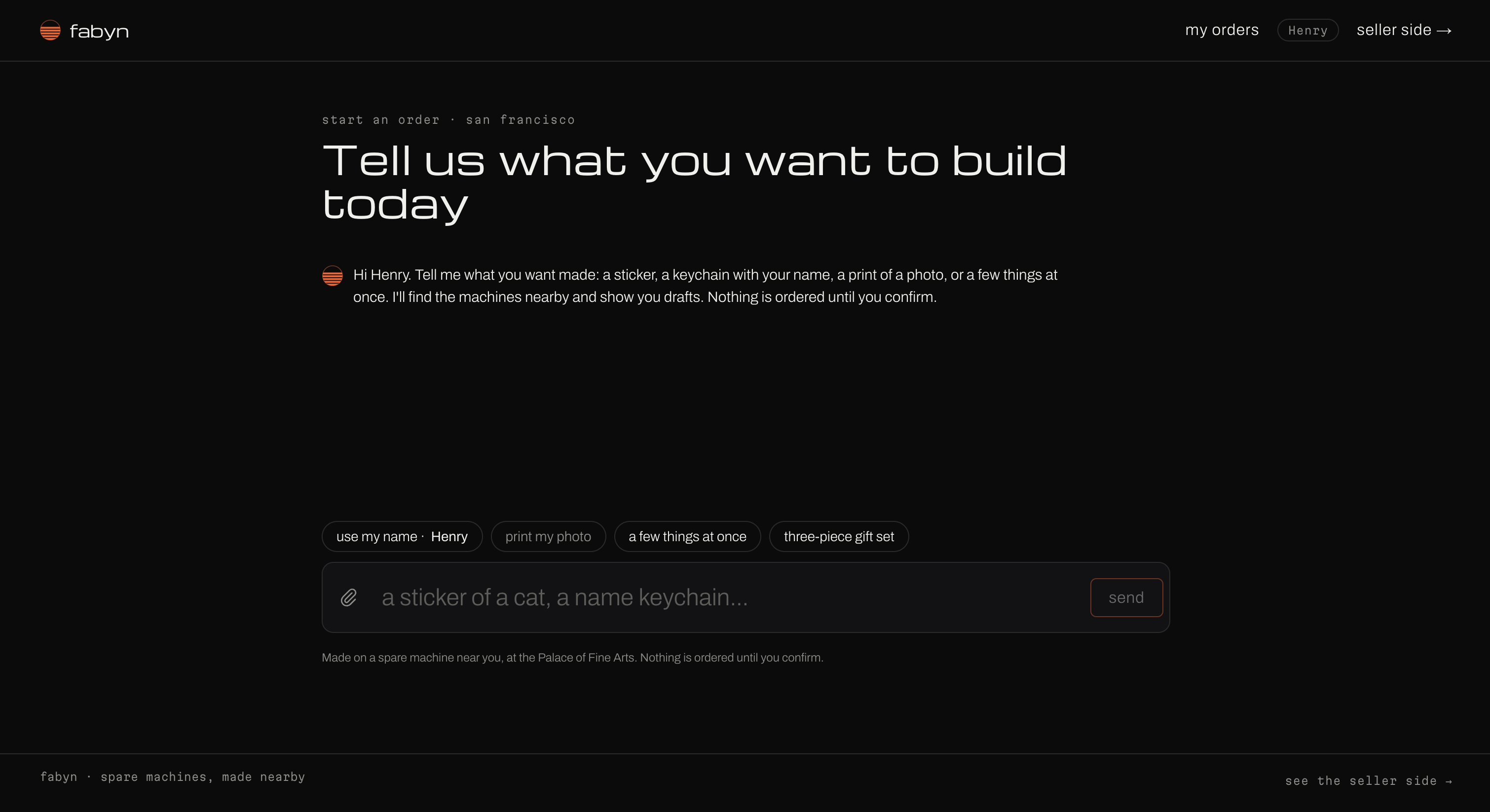
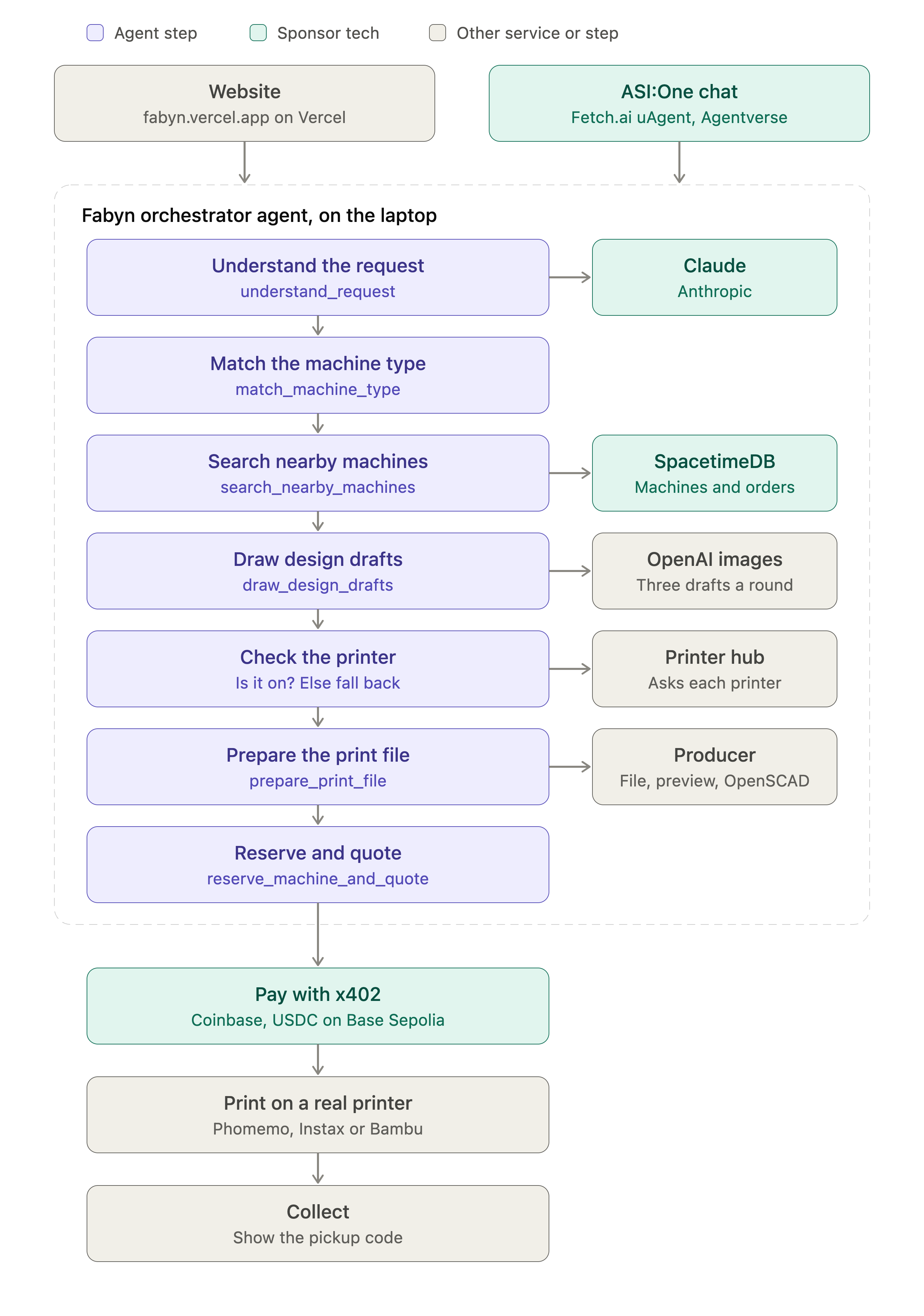
Fabyn turns the world's idle machines into one local factory. Describe what you want or upload a picture. Fabyn's agent drafts designs if you need them, picks a machine near the recipient that can actually make the item, and prepares the exact production file. Then it shows you the real preview and the full price. One confirmation later, it takes payment and sends the job. Machine owners register their spare machines, set their prices and hours, and get paid for the work it does.
You start the request, pick a design and confirm once; the agent and the machine handle everything else.
We show it at two scales, running on the same code.
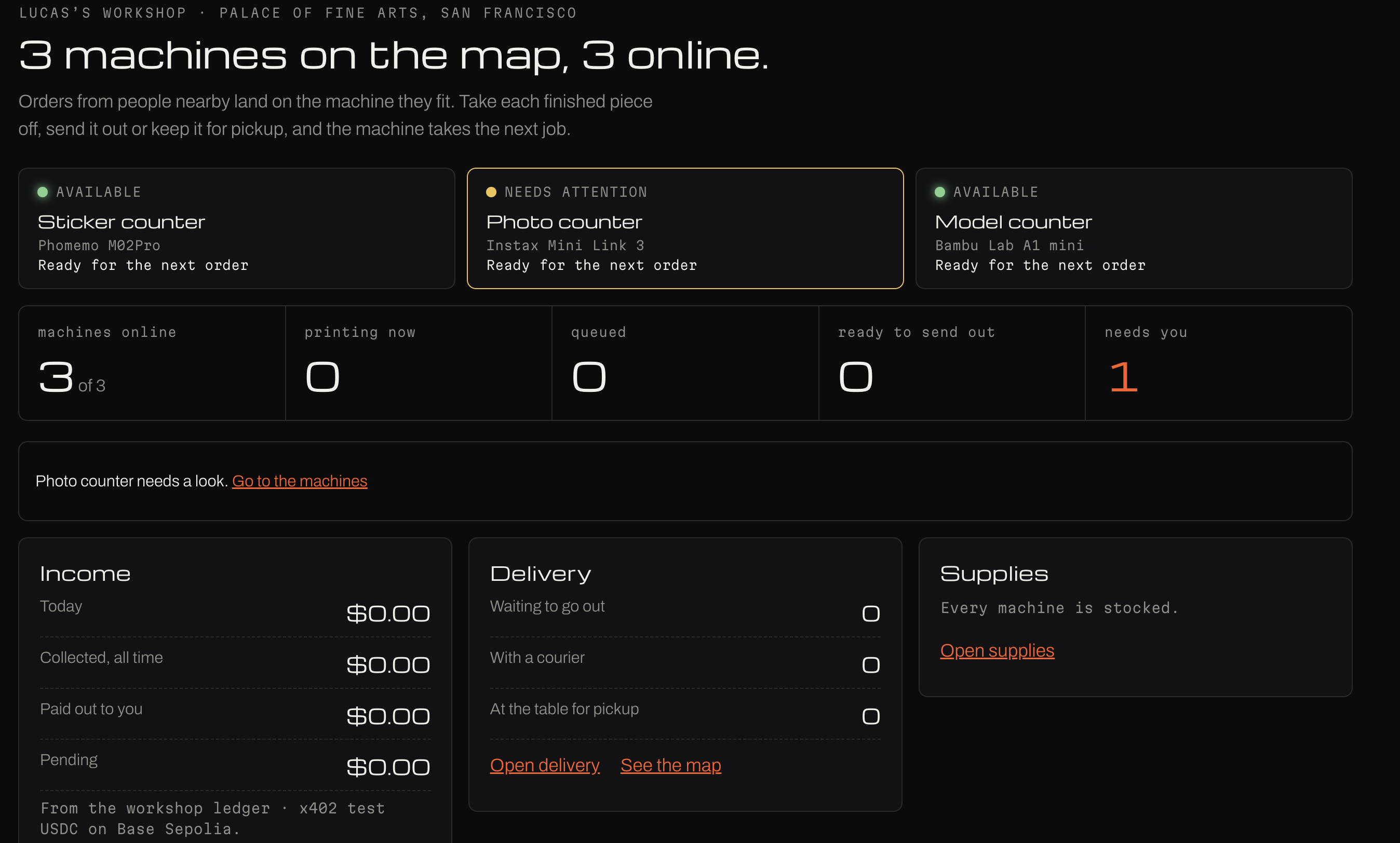
One gift, made near someone you love. A friend's birthday is across the country. The sender types a request or adds photos, and Fabyn plans a three-piece gift on three real machines near the recipient (for our current demo):
- a sticker on a Phomemo M02 Pro thermal printer
- an instant photo on an Instax Mini Link 3
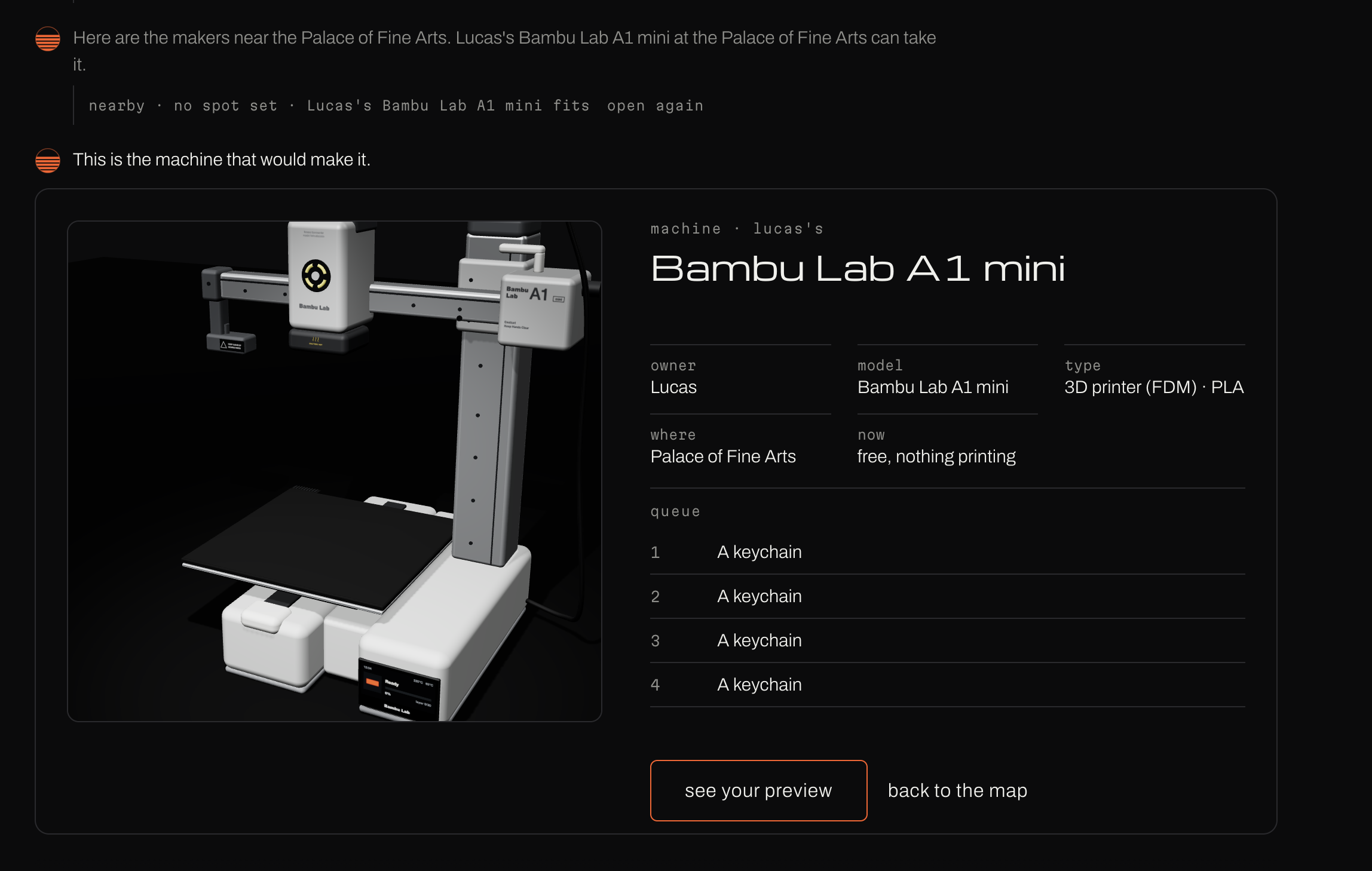
- a name-tag keychain 3D-printed on a Bambu Lab A1 mini
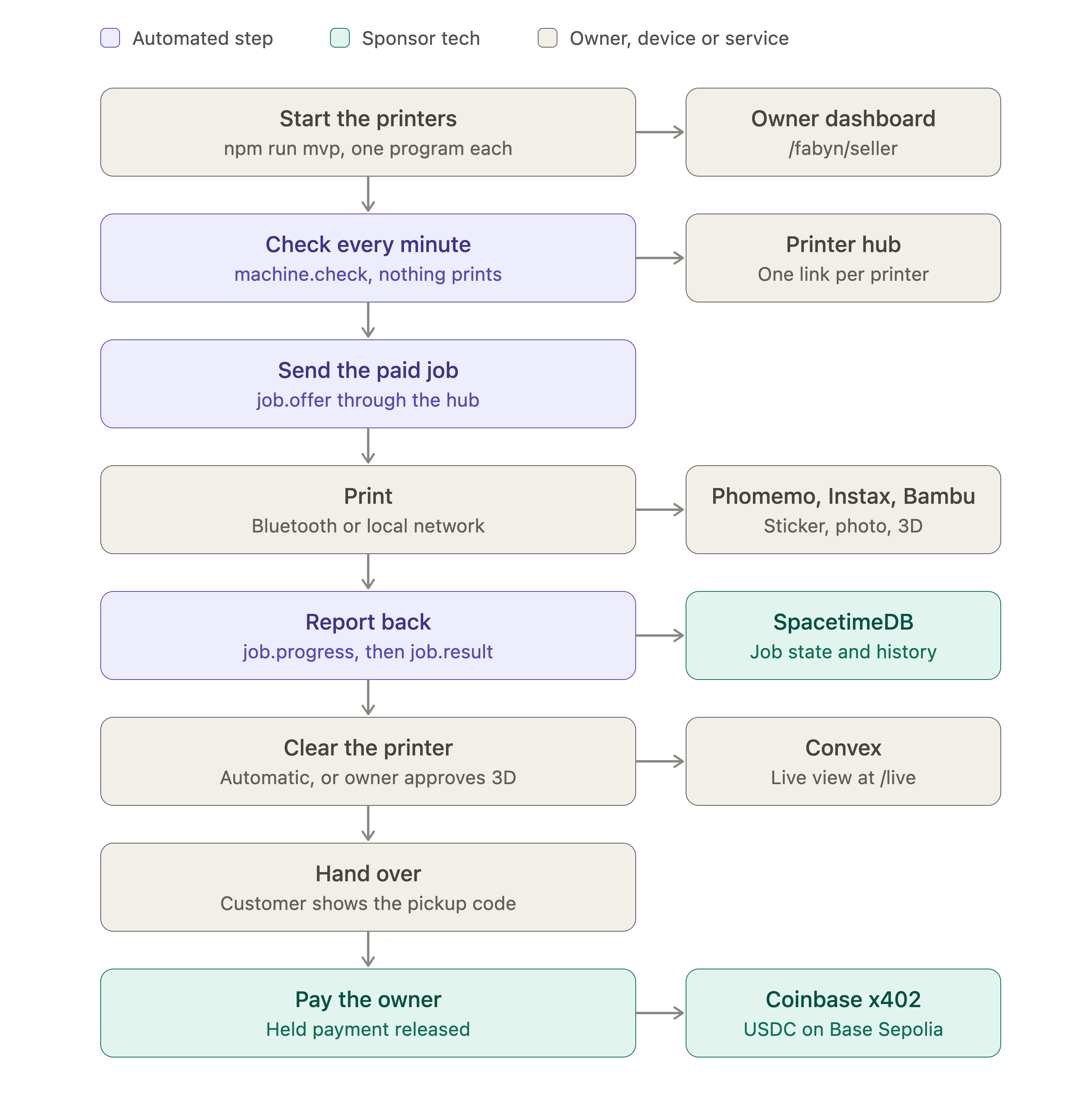
Checkout runs on Coinbase's x402: payment settles in test USDC on Base Sepolia, and production waits until the payment confirms on-chain. The sender then watches each printer's progress live, streamed through Convex. The recipient collects the gift with a pickup code. You can also order by chatting with the Fabyn agent in Fetch.ai's ASI:One.
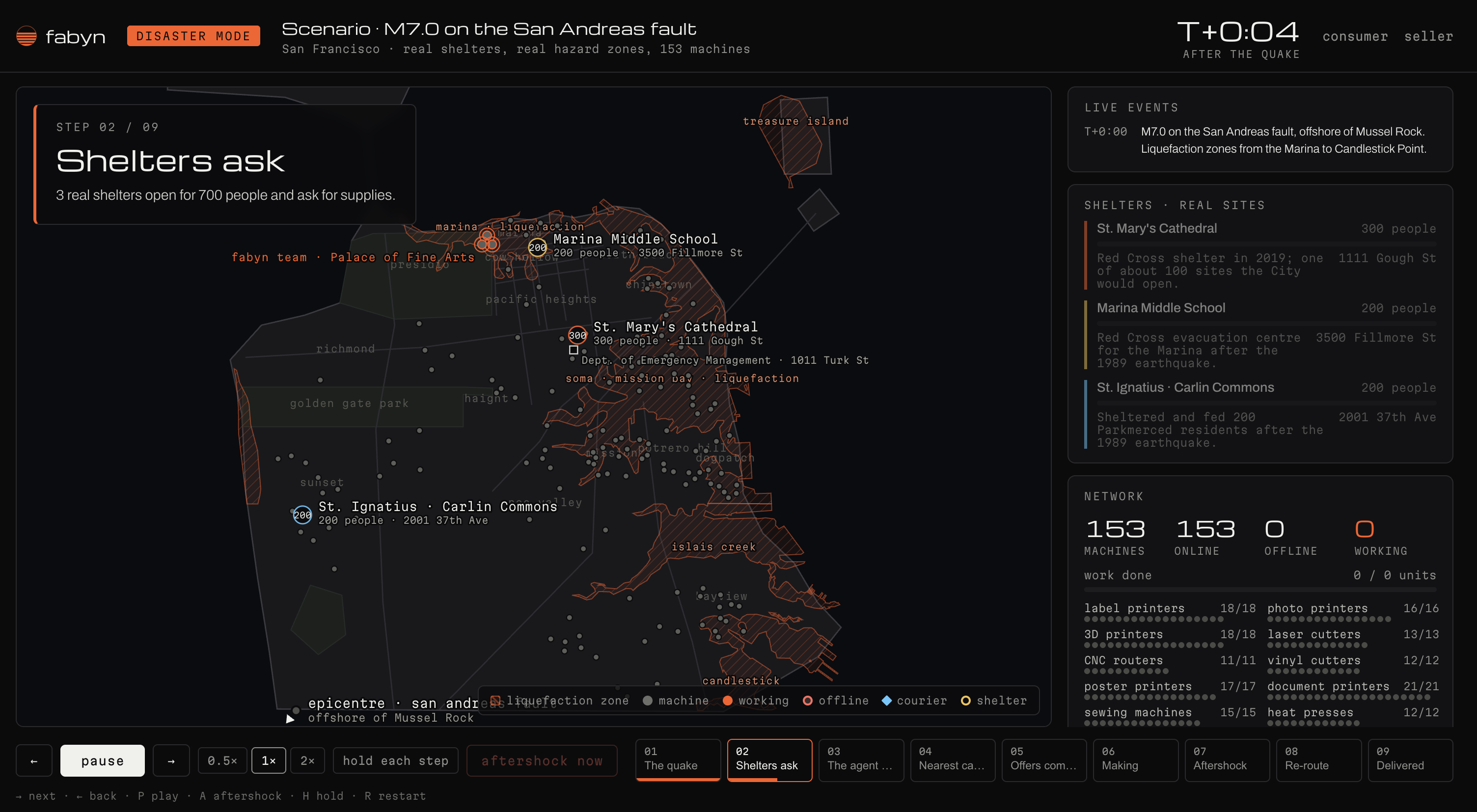
One shelter, a whole city's machines (simulated). After a hypothetical M6.8 Hayward Fault earthquake, a coordinator requests what a 300-person shelter needs: cot labels, lost-pet photo cards, wayfinding signs, privacy partitions, floor decals, volunteer vests and more. Fabyn splits that order across 10 machine types, starting with our three real machines and then a network of 150 simulated ones. It shows the plan live on a map. When an outage knocks a zone offline, Fabyn re-plans in seconds. It moves only work that hasn't started, so nothing already in progress is thrown away. Simulated machines are labeled everywhere and never charged.
How we built it
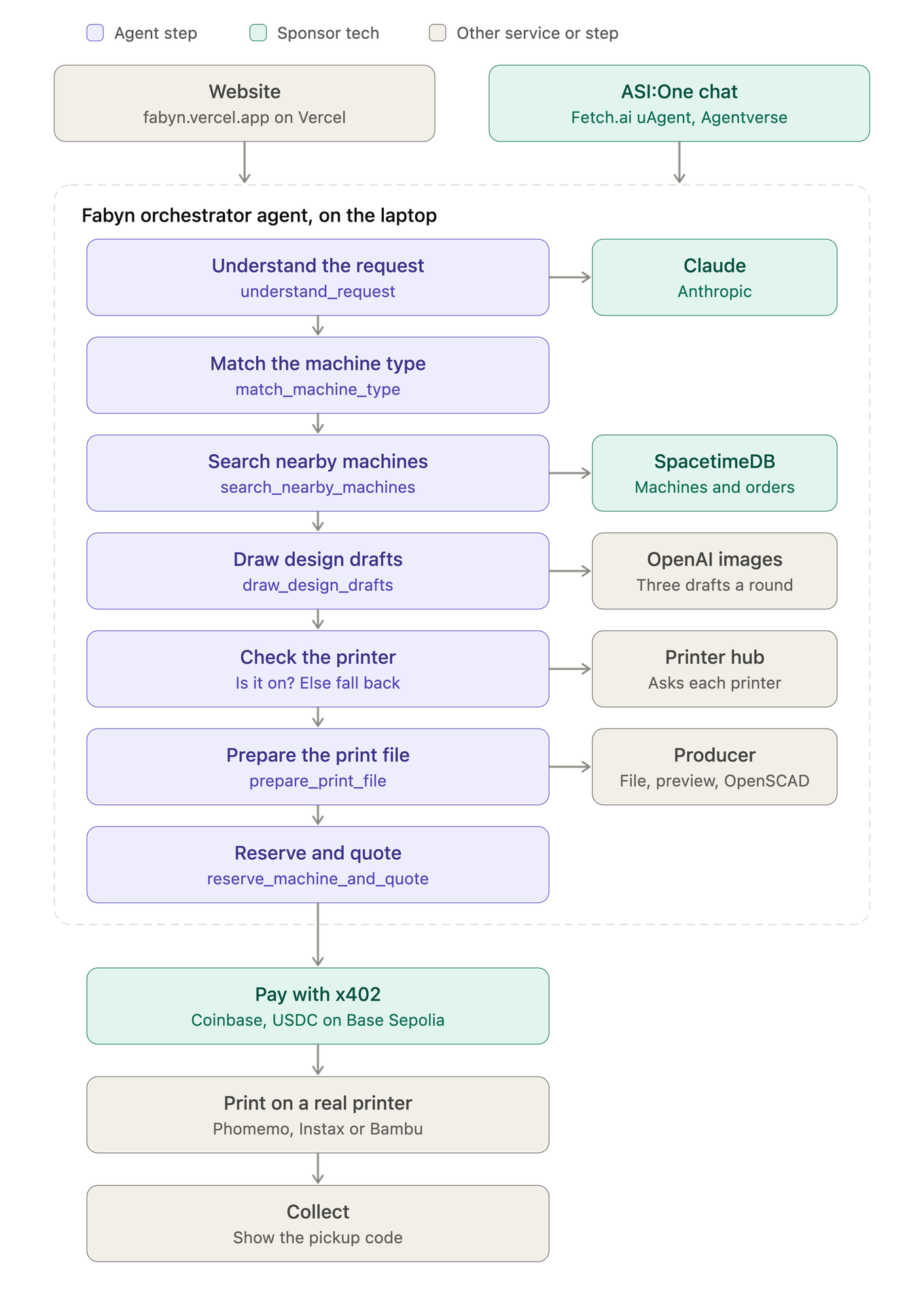
- Claude as the front door (TypeScript/Express): every request, whether words, photos or both, goes to Claude (Anthropic) first. Claude works out what the person wants and which workflow fits: a sticker, a photo print or a 3D-printed item. A matcher then picks the best machine for it by what machines do, never by brand, and by whether they can achieve the intended result. A color photo never goes to a black-and-white thermal printer.
- Sticker workflow: OpenAI or Google's Gemini API (Nano Banana) draws three black-and-white line-art drafts per round. The chosen one becomes a dithered 1-bit 300 dpi file for the Phomemo.
- Photo workflow: the same image models draw color drafts, or the person's own photo is used. It becomes a 600×800 image for the Instax.
- 3D printing workflow:
- Type a name, and OpenSCAD engraves it into a 20 mm plate with a keyring hole.
- The A1 mini's node slices it with Bambu Studio's standard A1 mini settings and prints it over LAN, in about 13 minutes for a short name.
- When the print finishes, the owner takes it off the plate and clears the printer, which releases the pickup code.
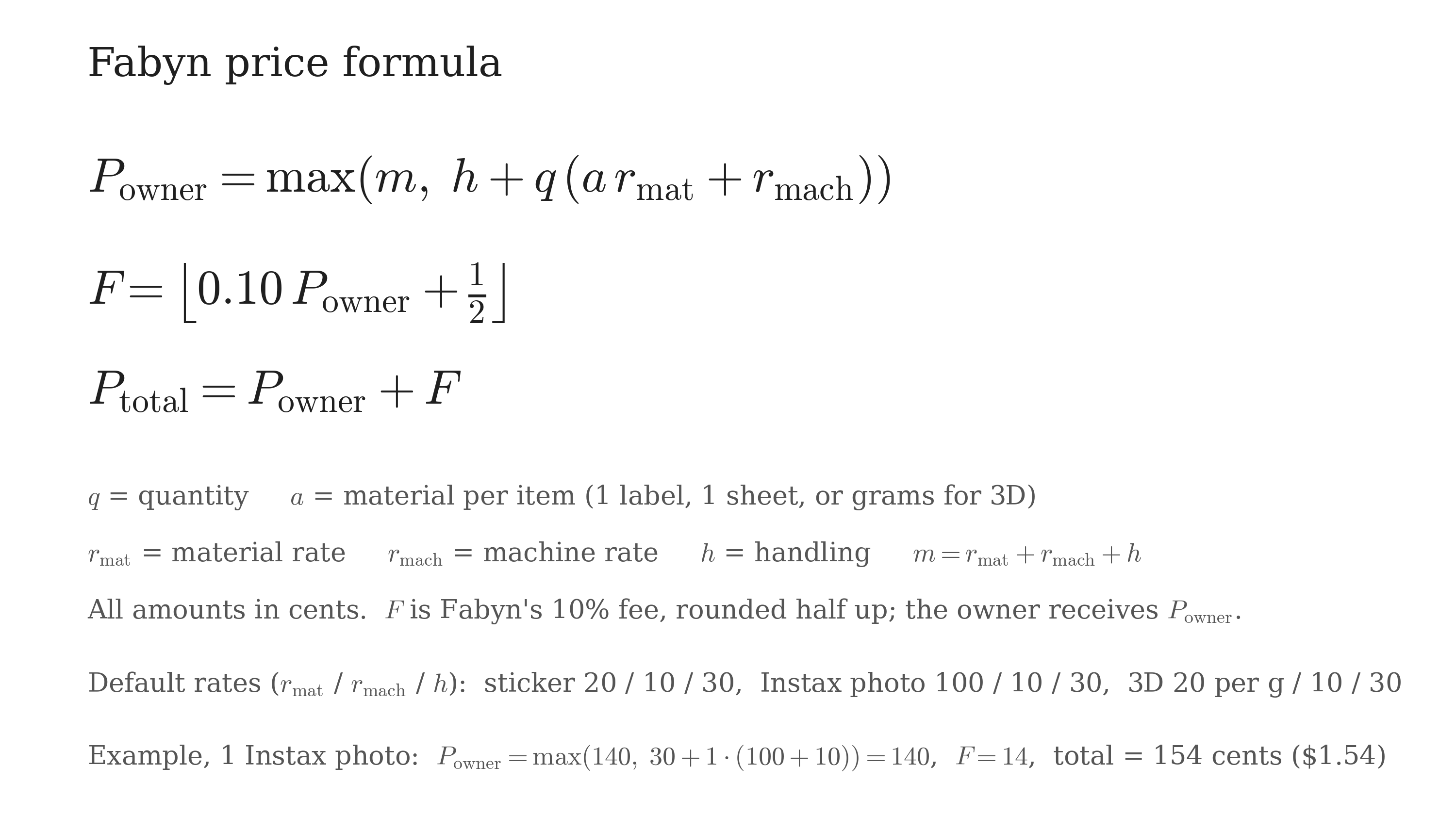
- Shared by all three: prices are computed in integer cents from the machine owner's price card, and the exact production file and preview exist before anyone is asked to pay. The owner's price is max(minimum, setup + quantity × (material per unit × material rate + unit cost + minutes per unit × time rate)), and the buyer pays that plus a 10% platform fee, rounded half up once.
- Machine knowledge: Claude reads a machine's label when an owner adds it, and context.dev reads each model's official product pages when a machine is onboarded. Fabyn keeps a spec only if the page actually states it, which is how we confirmed the M02 Pro's 300 DPI.
- Machines (Python):
- Each real machine runs a node behind one common job interface.
- Adapters cover the Phomemo printer over Bluetooth, the Instax printer over Bluetooth Low Energy, and the Bambu A1 mini over LAN.
- Payments: Coinbase's x402, using the official v2 client with a browser wallet on Base Sepolia. A signature alone never counts as payment; only confirmed settlement starts production.
- Live state (Convex): Convex is the live layer every screen watches. Our order app and our machine gateway each publish machines, orders, jobs and events into Convex, and the sender's progress view and the live dashboard read them through live queries. The order app's own database stays the source of truth, so a Convex outage never stops an order or a print.
- Agents: a Fetch.ai uAgent registered on Agentverse speaks the Agent Chat Protocol, so people can order by chatting in ASI:One.
- Relief engine: a seeded 150-machine network, a min-heap planner that splits quantities across machines, and a time-scaled simulation (1×, 10×, 60×) that re-plans on outages and newly added machines.
- Pricing policy: owners set the prices, Fabyn does the arithmetic, and the same formula applies to every machine, so a quote never depends on whose machine makes the item.
- Owners set their terms on a price card: a minimum, a setup charge, a material rate, a per-item cost that covers wear, power and their margin, and a rate per machine minute.
- Fabyn does the measuring. Material and machine minutes per item come from the slicer's print statistics for 3D prints, and from the label or sheet used plus each printer's timing for the others, so owners never have to estimate.
- Buyers see the whole price first. Every term appears on the plan card before payment, and the 10% platform fee is a flat addition on top of the owner's price, never baked in or hidden.
- Simulated machines are priced by the same formula for planning, and nobody is ever charged for them.
Challenges we ran into
- Three machines, three languages. Each printer speaks a different protocol over a different connection. The Phomemo stops answering us if its phone app is connected. The A1 mini only worked once we gave the laptop a dedicated network setup for the phone hotspot.
- The physical world can't be retried. A repeated API call is free; a repeated print wastes material and someone's money. We built every step so that a lost connection or an uncertain result pauses for a person instead of printing again.
- Knowing when a print is really done. We started with camera checks on finished items. They were too unreliable to trust, so we cut them, and jobs now complete from the machine's own status report.
- Mixing real and simulated work in one plan without ever charging for, or claiming, simulated output.
Accomplishments that we're proud of
- One request turns into real objects from three different manufacturers' machines, through one common job format.
- Real on-chain settlement: a full Pay & make order paid 0.66 test USDC over x402, confirmed on BaseScan.
- A relief plan across 150 machines and 10 processes that re-plans after an outage without discarding work already in progress.
- An interface with one next step per screen. You never pick a machine, a file format or a print setting.
What we learned
- Let the model read, let rules decide. Claude interprets requests and reads machine labels, but eligibility, price and dispatch follow fixed rules. That keeps money and machines predictable.
- Match on process, not brand. Describing machines by what they do ("sticker print," "laser cut") is what let one planner handle a gift and a 10-type relief network.
- Hardware time is real time. A 13-minute name tag changes how you design queues, pricing and the demo itself.
What's next for Fabyn
- A public hub, so anyone can order from their phone and have it made anywhere.
- Supervised onboarding for unfamiliar machine models, plus mailing when nothing capable is nearby.
- Printing any model from MakerWorld, not just our generated name tags.
- Real payouts to machine owners.
- Pilots with campus makerspaces and libraries as the first supply.
- Working with local emergency managers to pre-register machines, so the relief network exists before the earthquake does.


Log in or sign up for Devpost to join the conversation.