Inspiration
We've built many multi-agentic and agentic systems and we've worked at companies building agentic systems. We have become frustrated that the patterns underlying these systems are repeated and reimplemented over and over again; it wastes time, it wastes money, and is a sore inefficiency in deploying agentic solutions.
What it does
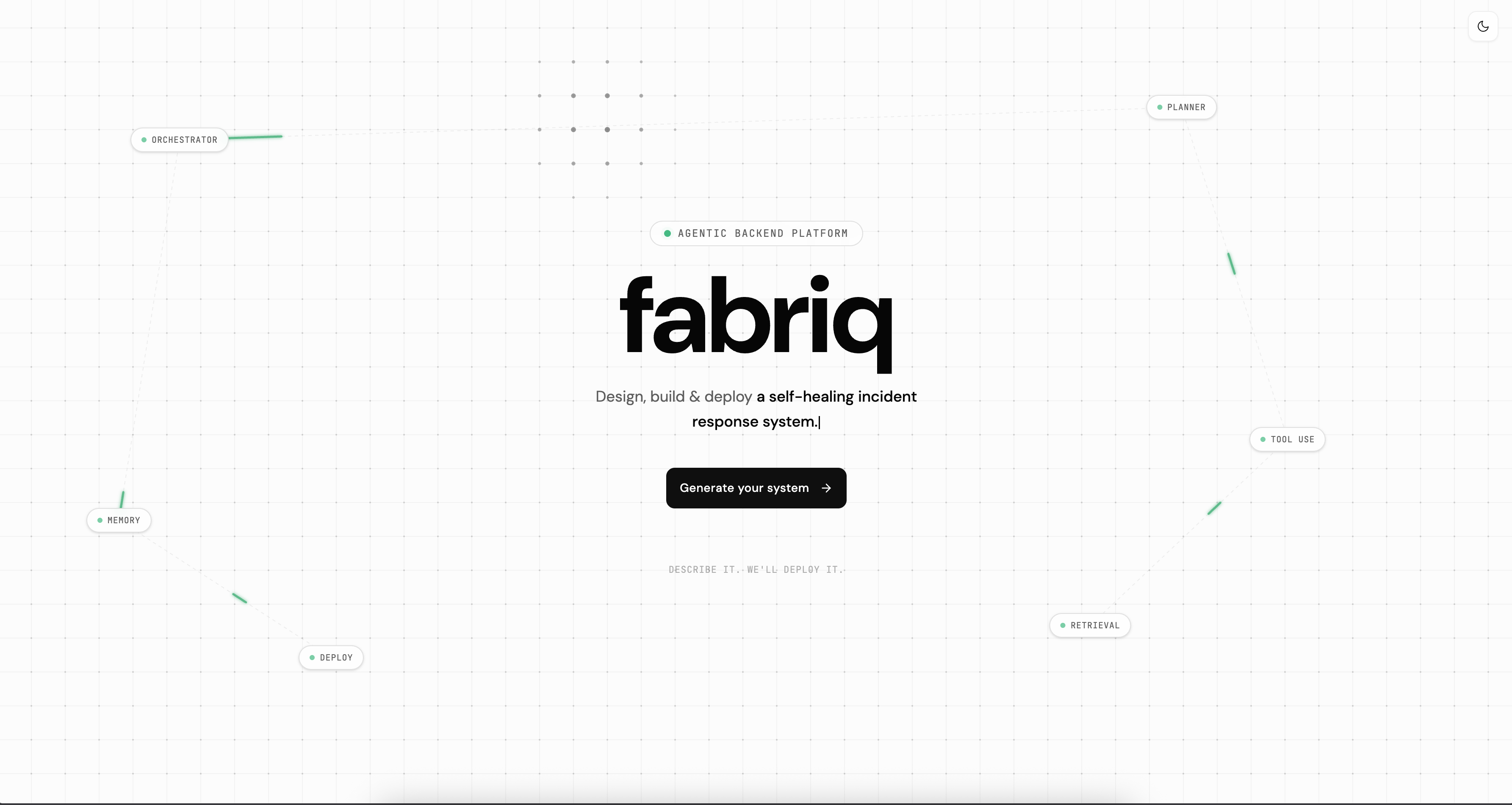
Fabriq understands your frontend and business context to design, deploy and maintain agentic backends. Everything starts from giving Fabriq your frontend GitHub repository. A team of agents scour the code to understand intent and functionality, you are kept in the loop with options to clarify intent. Every agent and sub-agents are specifically trained to do one specific thing in this process. The resulting agentic systems which process each endpoint are tailor made using state-of-the-art techniques for your specific technical and business needs.
How we built it
We orchestrate a team of 20 specialised agents to understand the provided repo, business needs and human-in-the-loop feedback. This information is passed into the final architect which actualises the system via a custom configuration files which fully encompass the backend system. The architect chooses agentic network topologies. It's prompts are tuned to implement the most suited system for each endpoint. It calls mini-architects which use RAG to assign tools agents for each system. These systems are then integrated into each of the endpoints. Different endpoints can have the same system, but each endpoint has a different prompt, so you can use one system for multiple endpoints. Different endpoints can have the same system, but each endpoint has a different prompt, so you can use one system for multiple endpoints.
Then these mini architects report back to the architect and the architect judges if they're good or not. If they're not good enough, it will just redeploy them and keep on a reiteration look until it works.
The architect can use pre-baked agents or built its own. It also defines the database schemas needed. The backend container is deployed on railway or any hosting system. Everything is automatically connected, frontend, backend, database. This system is tested and iterated on.
So you basically have a frontend, you put it in a website and then it goes zero to one in 10 minutes.
Challenges we ran into
We tried our best to get the hallucination rate as low as possible and create the best results from the first iteration to avoid wasting tokens, wasting user time and wasting money. Also, there is a reason this costs so much in consulting, because it's really hard to implement.So we needed to really iterate on the prompts and really give it good examples so you could do well.Also, connecting the entire system as a whole was very, very complex and we spent six hours just doing this.
lowering the complexity to make it super accessible to less tech savvy people about machine learning because otherwise what's too complex to actually understand what's it gonna do or happen and we had to remove loads of failure points to avoid having multiple problems and to get the most deterministic success rate and getting an average of 95% accuracy rate at the first iteration and we managed to get the lowest amount of hallucination in our different iteration and all also the biggest challenge of them all was trying to collaborate on git all together with four different people building codeat the same time so building merging branches doing pull requests push requests all at the same timetrying to fix rebates and so on and so forth
Accomplishments that we're proud of
We managed to recreate Open Claw in less than three minutes Getting the full text Getting the heartbeat, the auto texting the acting stage email integrations Web search and so on so many features Also, we managed to recreate Jack and Jill full stack just by pasting front end and Just by lighting our product build the full agent back end
What we learned
We learned about using Langraph, how to actually orchestrate huge size AI agent systems,how to perfectly structure the best prompts, best tools, and how to integrate everything flawlessly, how to get the lowest hallucination rate, what are the best models for the best options, how to deploy to production every time, and how to reiterate on an agentic loop to make everything work on the first tryand make the experience frictionless for the user.And also how to work on Git with more than two people all at once committing into many different branches.
What's next for fabriq
Our vision is to revolutionise the engineering experience by creating AI agents back-end in just two minutes. Naval Ravikant talks about a world where everyone is an engineer and everyone can bring their own creativity and their ideas into life. We're going to make that real by giving the same tools to everyone.We're democratizing AI.
Built With
- claude
- gemini
- paid.ai
- python
- stripe
- supabase
- typescript
- zed


Log in or sign up for Devpost to join the conversation.