-
-
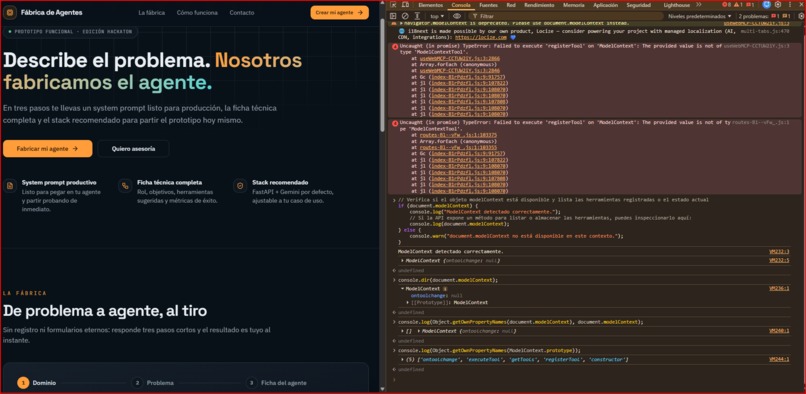
WebMCP
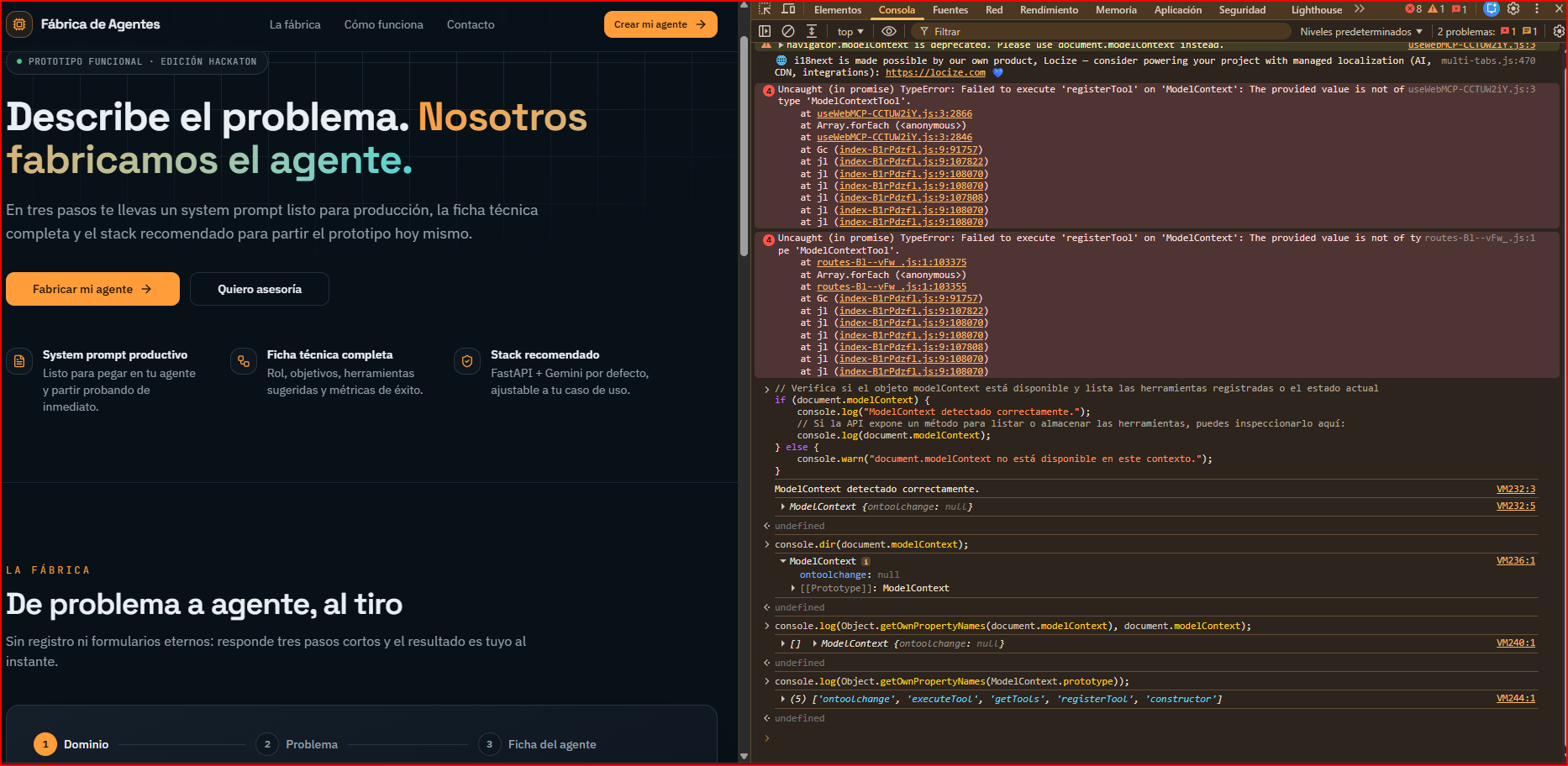
Inspiration
As an independent AI consultant working with small businesses across Chile and Latin America, I kept running into the same wall: entrepreneurs know they need AI agents for their business, but the gap between "I need an agent" and "I have a working agent" feels impossibly technical. Meanwhile, most agent-building demos are static — they describe what an agent could do instead of letting you build one. Fábrica de Agentes de IA started from a simple question: what if the landing page itself was the product demo, and visitors could co-create a real agent with it in real time, live in the browser?
What it does
Fábrica de Agentes de IA is an interactive web experience where visitors build a micro-agent for their own project step by step: they choose their business domain (services, e-commerce, accounting, freelance work), describe the problem they want the agent to solve, and the page — powered by WebMCP — exposes tools that an LLM calls directly to generate a working system prompt plus a technical card summarizing the agent's role, suggested tools, and stack. Visitors leave with something tangible they can actually use, not just a description of what's possible.
How we built it
The site is deployed on Netlify and built around WebMCP, which lets the page expose browser-side tools that an LLM can invoke directly — turning the landing page into an agentic surface rather than a static UI. The generation flow calls an LLM to produce the system prompt and technical card in a consistent, structured format, following the same "technical card" pattern I'd already developed for an internal agent-cataloging project. The interaction was designed with two paths in mind: a guided UI for visitors clicking through forms, and a direct MCP-client path for anyone who wants to connect their own agent straight to the page's exposed tools.
Challenges we ran into
Getting WebMCP to expose tools cleanly — reliable enough for both a human clicking buttons and an external MCP client calling them directly — took more iteration than expected, since both paths needed to hit the same underlying tool calls without diverging behavior. Prompt design was the other major challenge: getting the LLM to consistently return a well-structured technical card (not just freeform text) across very different business domains, without the output feeling generic or copy-pasted between users.
Accomplishments that we're proud of
Getting a genuinely functional live demo working — not a mockup — where a visitor can go from "I run a small accounting firm" to a usable system prompt in under a few minutes. Also proud of making the page dual-purpose: it works as a simple, approachable builder for non-technical visitors, while still being a real demonstration of WebMCP's agentic capabilities for a technical audience.
What we learned
WebMCP genuinely changes what a landing page can be — it stops being a static pitch and becomes a live capability surface. I also learned a lot about the gap between "an LLM can generate a system prompt" and "an LLM can generate a consistently structured, production-ready system prompt" — the latter needed much more careful prompt engineering than I initially expected.
What's next for Fábrica de Agentes de IA
Next steps are connecting the generated agents to a "request production version" flow tied to my AI consulting practice, adding domain-specific templates informed by real client work in the Chilean SME market, and exploring multi-agent orchestration so visitors can co-create a small team of agents instead of just one. I'd also like to open the page to accept connections from external MCP clients more broadly, so it becomes a reusable building block other developers can plug into, not just a standalone demo.

Log in or sign up for Devpost to join the conversation.