-
-
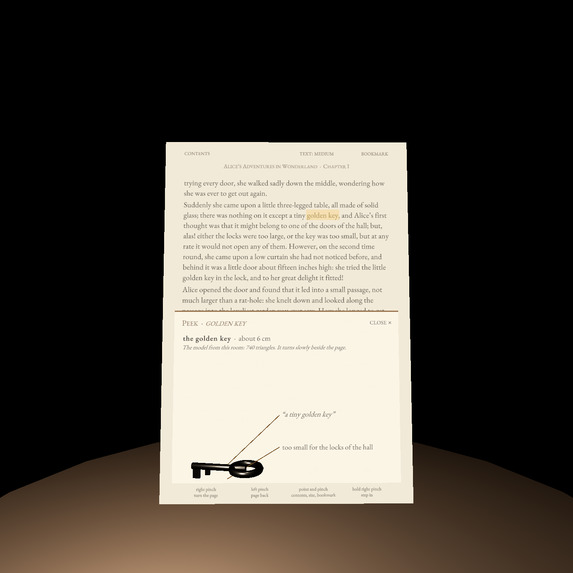
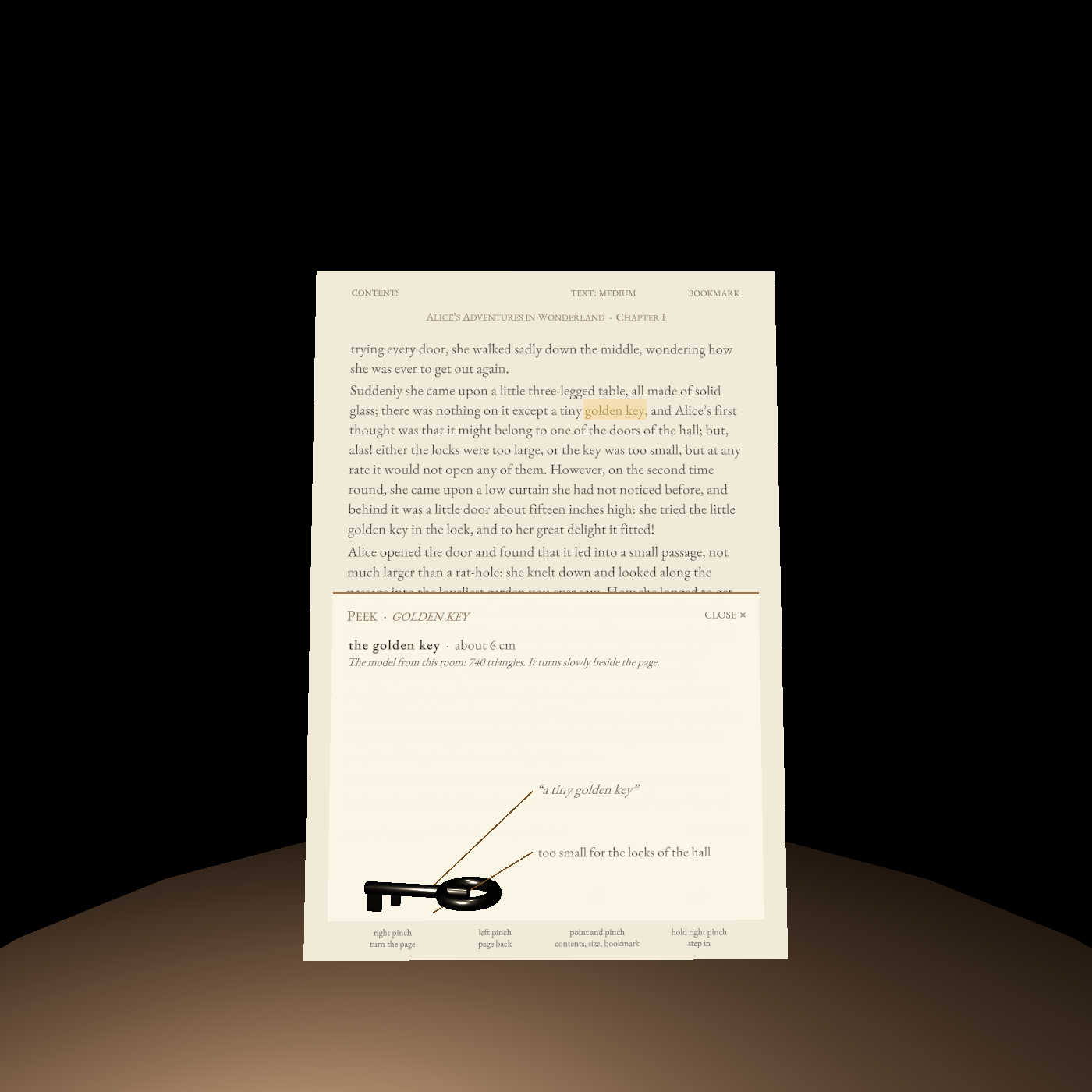
Highlight the words golden key and Peek builds a small model of it (Unity editor preview)
-
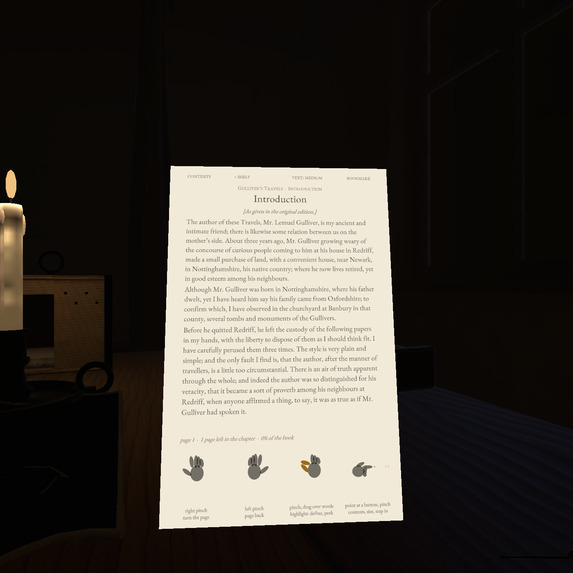
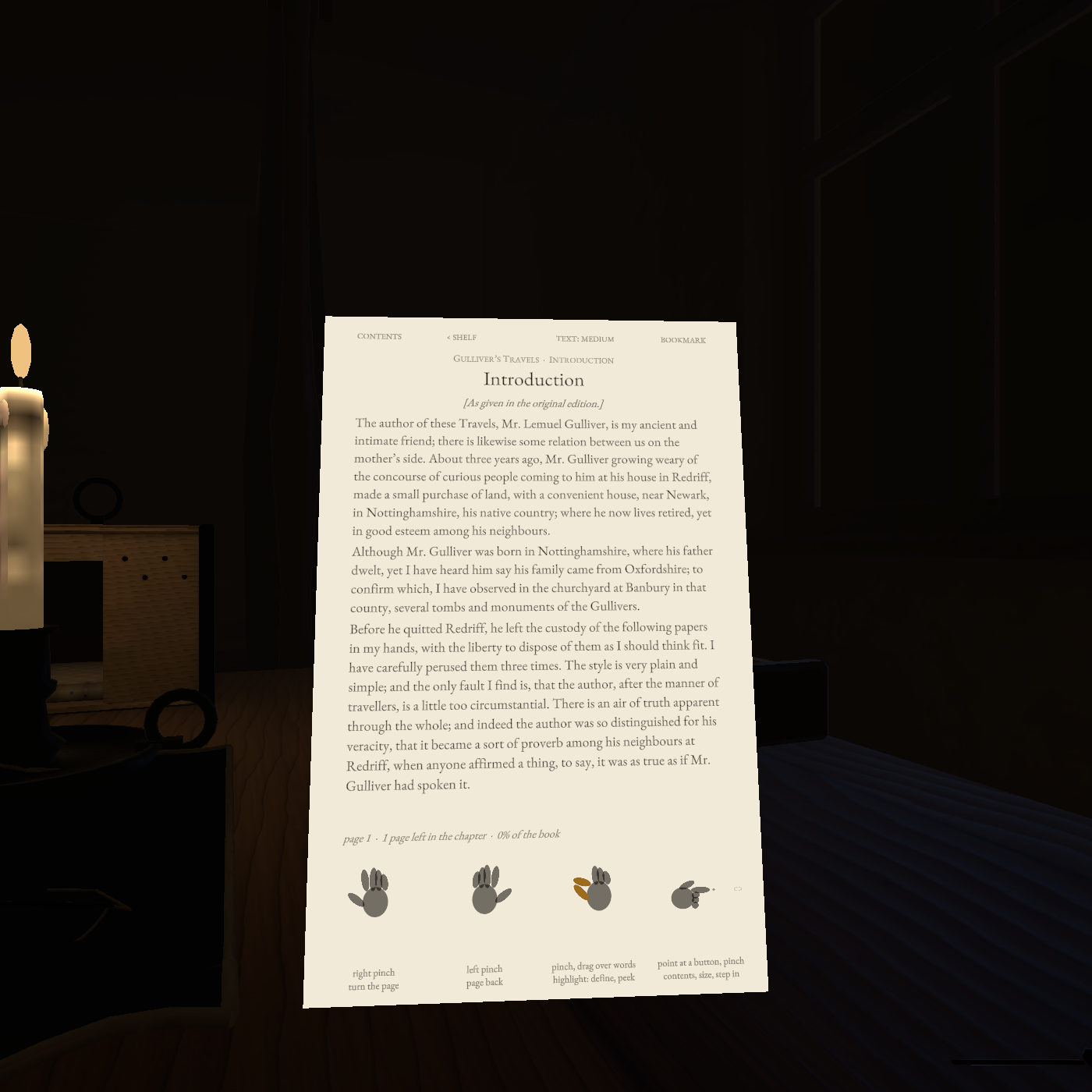
Gulliver read on a giant's table in Glumdalclitch's room (Unity editor preview)
-
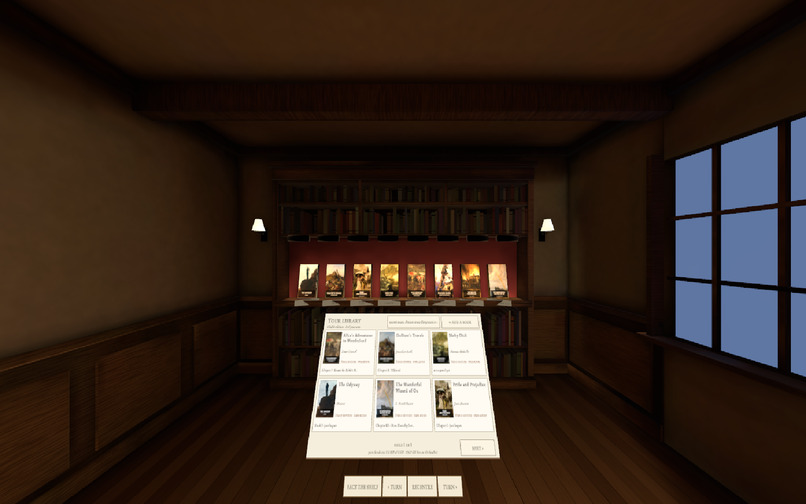
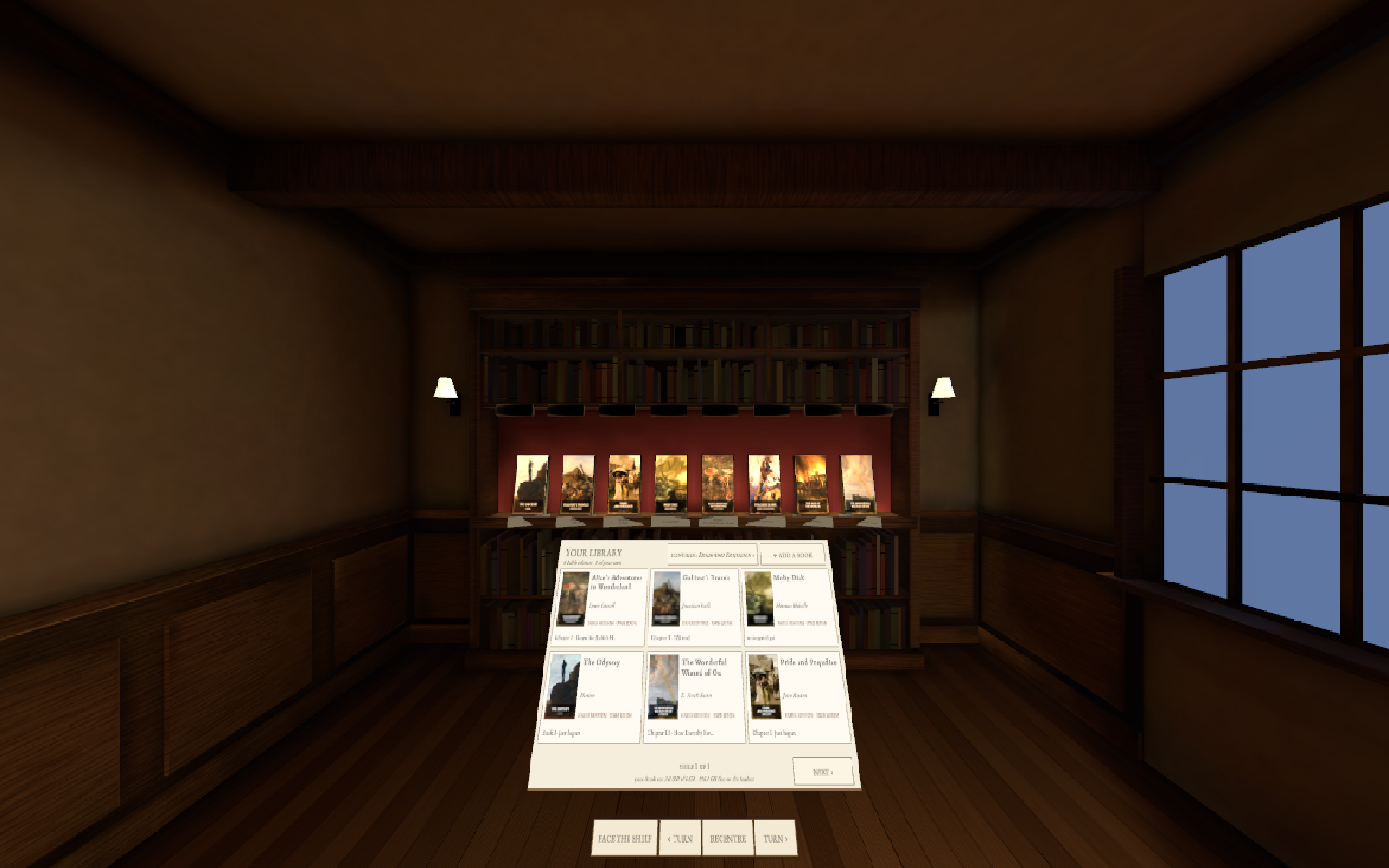
The lobby shelf in an early build, now ten books (Unity editor preview)
-
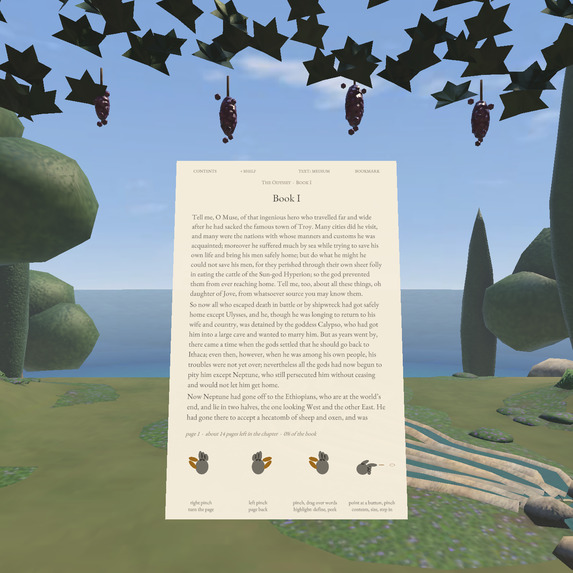
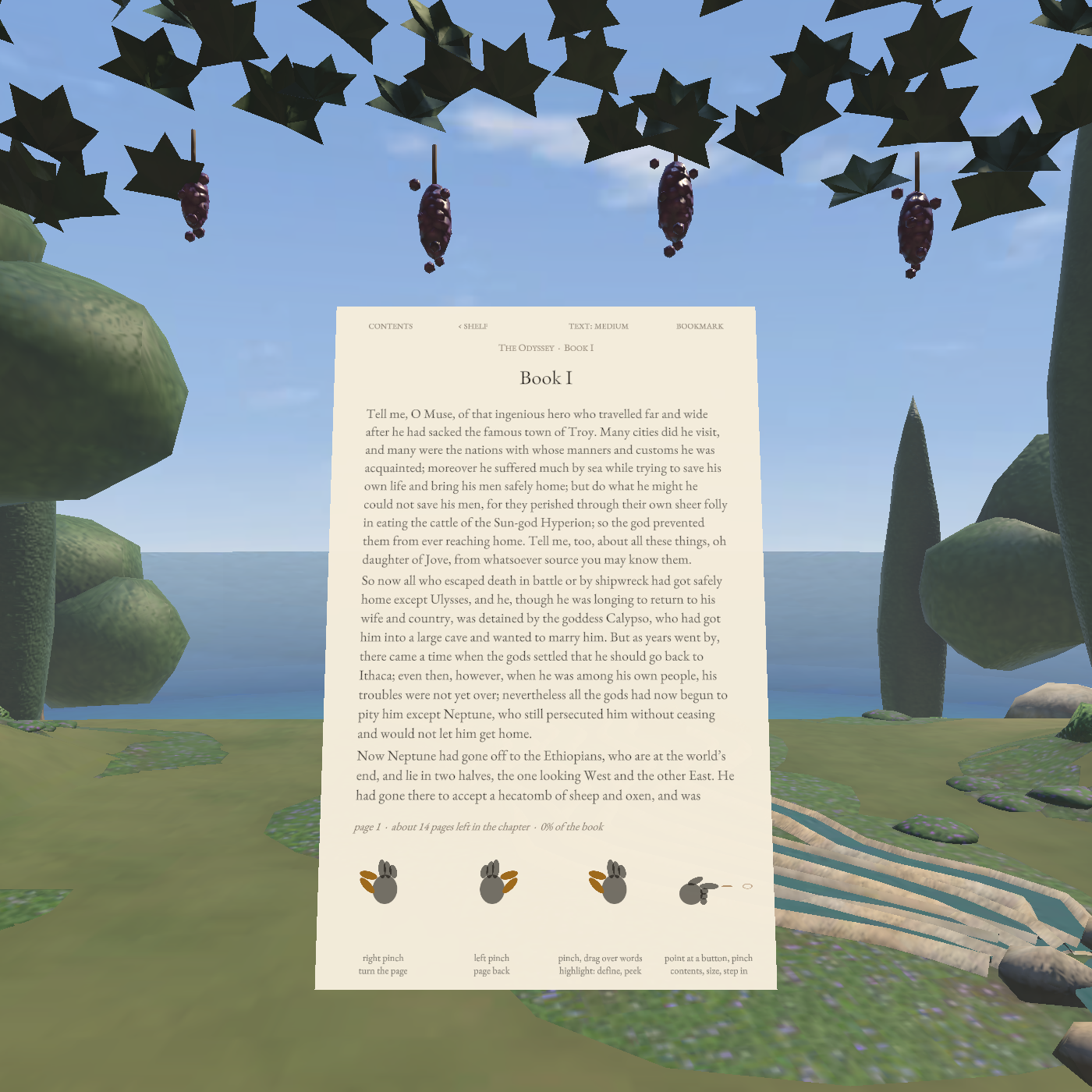
The Odyssey read in Calypso's cave (Unity editor preview)
-
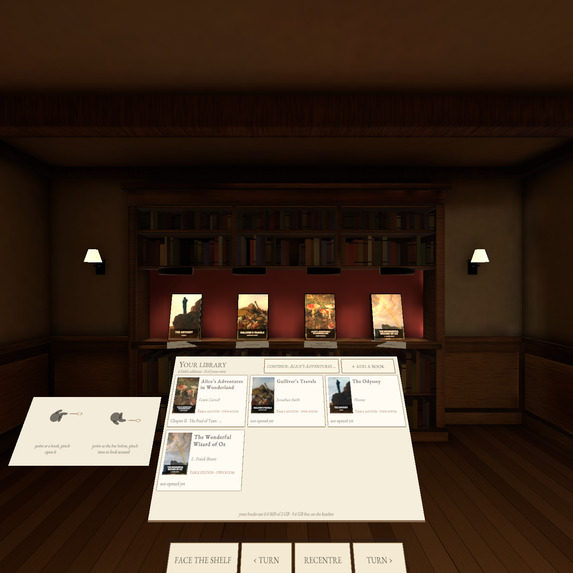
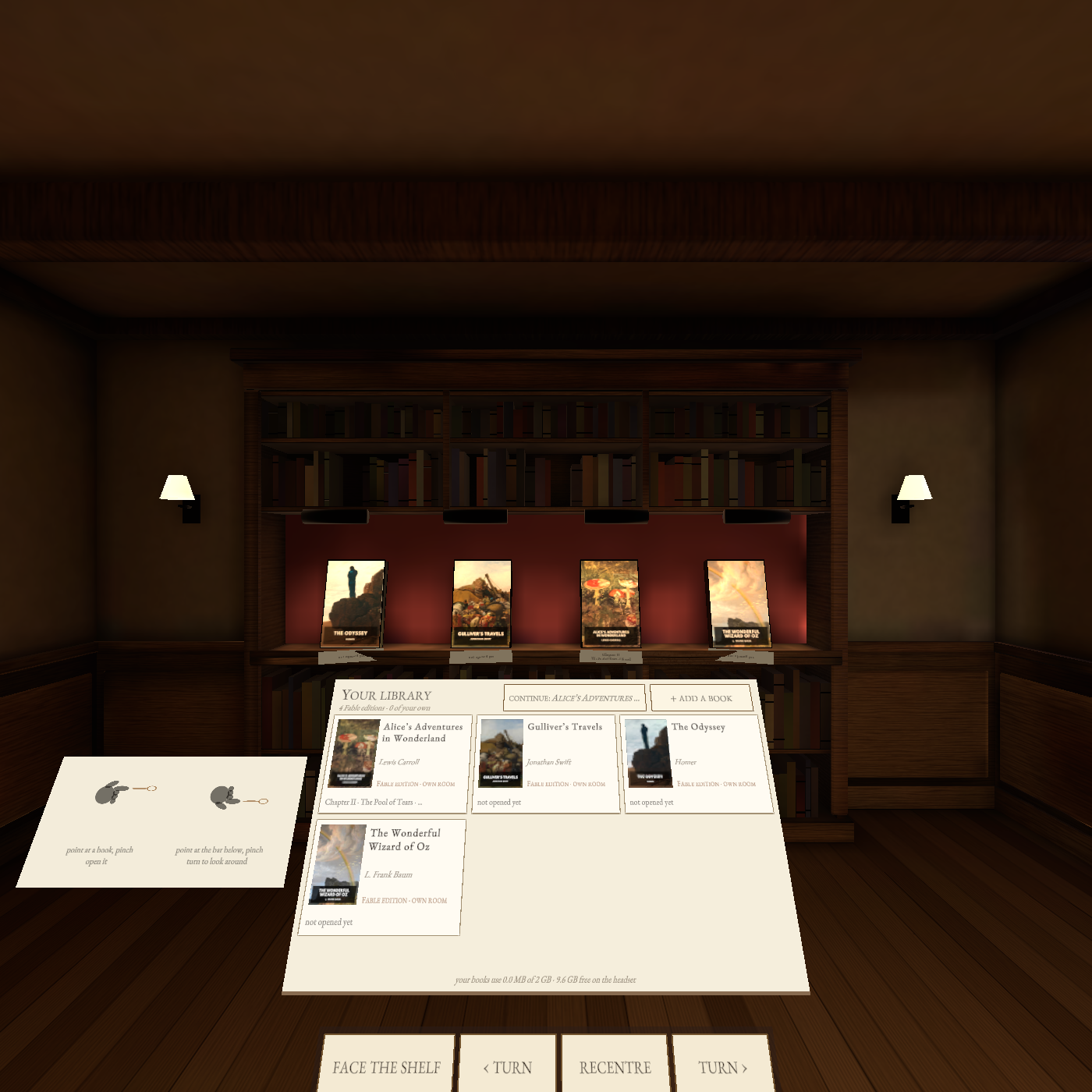
The library board with the view toolbar and the drawn gesture cues (Unity editor preview)
-
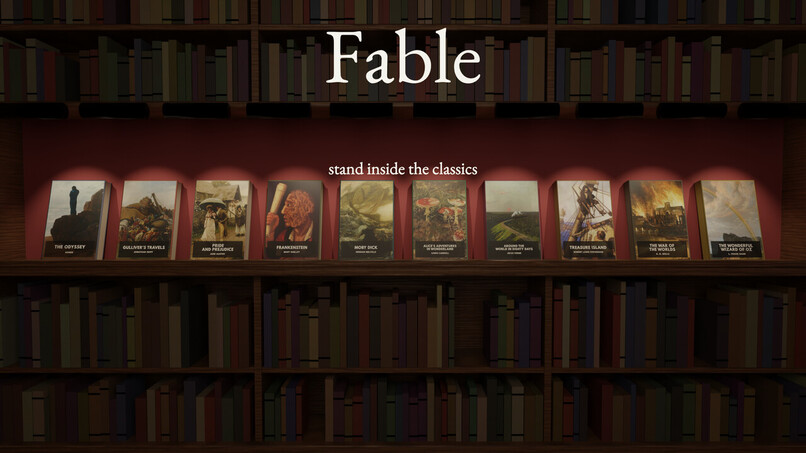
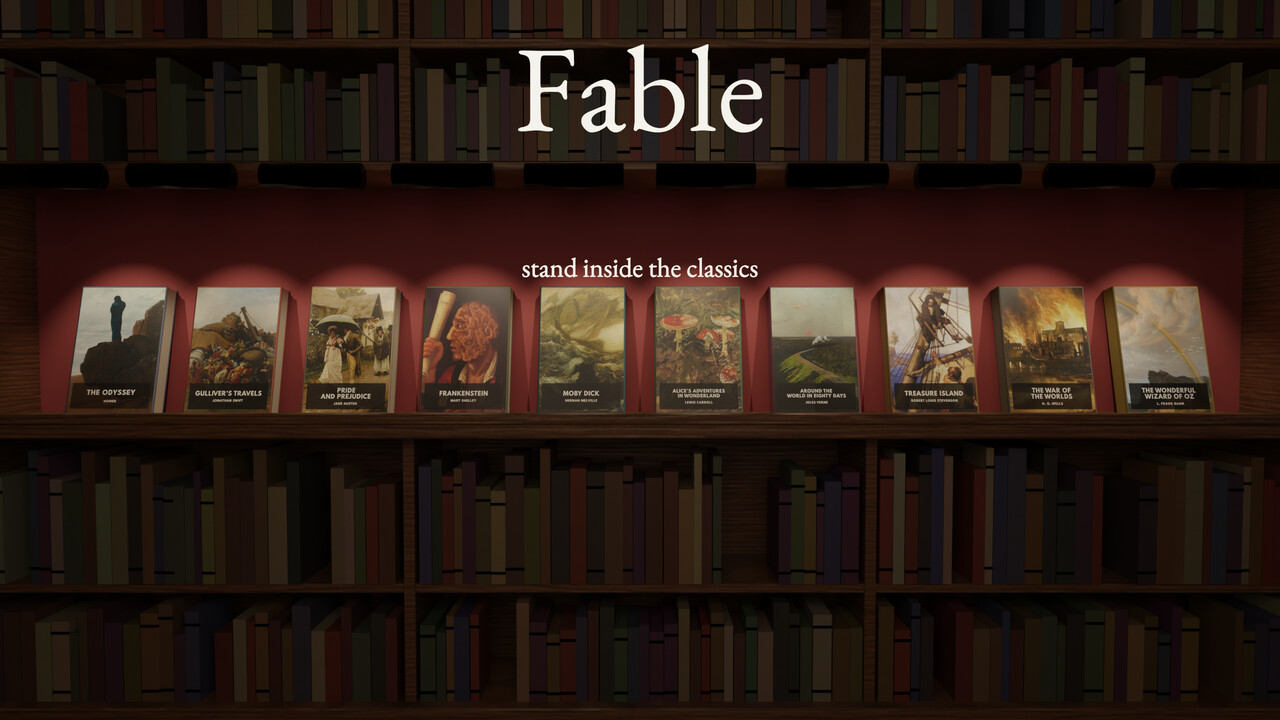
The library, ten classic books on the shelf (Blender render of the lobby)
Inspiration
Reading on a headset usually means a flat page floating in a dark void. We wanted every book to have a place. Often, readers want to visualize how a world looks, or a particular scene, and Fable gives them exactly that, i.e. the ability to bring worlds from text to life with you in them.
What it does
Fable is an e-reader built for the Meta Quest that lets you step inside the worlds of your books. Perhaps one of its most impressive parts is the ability to fully immerse yourself into the exact environment the book is describing.
Our demo comes packaged with ten classic books (all in the public domain) on the shelf:
Alice in Wonderland, The Wizard of Oz, The Odyssey, Gulliver's Travels, Pride and Prejudice, Moby-Dick, Frankenstein, Treasure Island, The War of the Worlds, and Around the World in Eighty Days.
Each book has three settings (or reading rooms) from moments in the book that users can choose to read in. While the goal is to eventually offer on-demand room and scene generation for uploaded books, and even have users build their own rooms or license art from 3D artists, our MVP shipped with 30 rooms (3 pre-built reading rooms for each offered book). For instance, you could read Moby-Dick in the Spouter-Inn or on the Pequod's deck, Frankenstein on Walton's ship in the Arctic ice, or Pride and Prejudice in the Netherfield drawing room.
Beyond the reading rooms, Fable lets you step into the chapter you just finished. These chapter experiences cover chapters one through ten of each book, with 57 rooms available so far. Each room downloads from our server when you reach the chapter, letting you explore a setting from what you have just read. You could find yourself in the Admiral Benbow’s parlor or on the yellow brick road, then return to your page when you are ready to continue.
Readers can also highlight words on the page to open a ring of options. Define looks up a word in an offline copy of Webster’s 1913 dictionary. Translate shows the selected line in any of 54 languages, and Search helps you find where a sentence appeared earlier in the book. Peek brings up a small, labeled 3D model of the object you highlighted. If you select a place name, it opens the book’s map and highlights that location instead. Real places appear on a globe you can rotate by hand, while fictional places appear on an old scroll map.
The whole experience works with hand tracking. You can point and pinch to open a book, turn pages, highlight text, or press buttons. A left-palm pinch opens the menu, and pointing at the floor and pinching lets you move around a room. While this is hands-first, controllers are supported too. Readers can also upload their own EPUB or PDF books to the headset over Wi-Fi and read them in the library. This feature is currently in early preview, and uploaded books do not yet support Peek or Step-In experiences.
How we built it
The two of us built Fable from scratch after the competition opened on 24 September.
We used Unity 6000.3 with URP and the Meta XR Core SDK, targeting Android ARM64 with IL2CPP and Vulkan. Each room is built through a Blender script that creates the geometry, bakes the lighting, and exports a glTF file. This lets us rebuild or update a room with a single command. The 57 chapter rooms go through an additional baking step that bakes lighting into textures, allowing the headset to load them at runtime.
A Go service running on a small DigitalOcean droplet prepares chapter experiences, Peek models, and translations, and serves the chapter rooms. It asks Claude to produce a scene script, validates the result against a JSON schema and the room’s manifest, and allows one repair attempt if needed. To prevent spoilers, Claude only receives the book’s text up to the reader’s current position.
We import books from Standard Ebooks and Project Gutenberg, dividing them into chapters, paragraphs, and sentences with stable IDs. Pages are laid out using TextMesh Pro, with EB Garamond available in four text sizes.
All text, images, fonts, and recordings are public domain or Creative Commons, with credits listed in CREDITS.md.
Challenges we ran into
Getting Fable to feel comfortable and run consistently on the Quest 2 took a lot of iteration. Vertical stripes appeared in both eyes, which we eventually traced to depth submission under Vulkan with MSAA. Hand pointing was misaligned because of an extra rig transform. In another case, seven real-time lamps took up 25 milliseconds per frame, so we switched to baked lighting.
We also learned to simplify the interactions. As we added more pinch gestures, readers started triggering actions by accident. We moved those actions to visible buttons, each activated with a single pinch.
Our last-day surprise was a build targeting Android SDK 36 that the Meta dashboard would not accept.
Accomplishments that we're proud of
Fable includes ten complete books you can read cover to cover, thirty pre-built reading rooms, and 57 chapter rooms, all built as quickly as possible. We achieved 72 frames per second in every room we measured on a Quest 2. We are also proud of the scene interpreter and its validation process, which has never allowed an invalid scene script to reach a headset.
What we learned
Comfort comes first when reading in VR. The position of the page and whether someone can comfortably read with one hand matter as much as the environment around them.
We learned that the rooms work best as a reward for reading. The text gives readers a reason to care about a place, and stepping into that place adds to what they have just imagined.
What's next for Fable
We want to expand Fable’s default library so readers have many more books to choose from, extend chapter experiences beyond the first ten chapters, and bring people and animals into the rooms.
We also plan to improve support for user-uploaded books and their generated previews. Eventually, we want to create a marketplace where artists and readers can share or sell handcrafted and AI-generated rooms, scenes, and related art.
We’re excited to redefine what reading looks like!

