Project Name
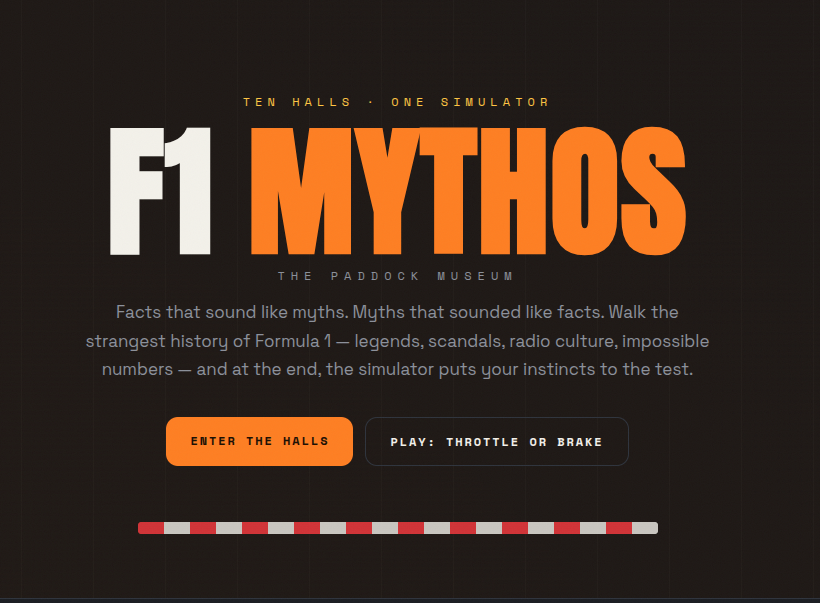
F1 Mythos
Walk the legends. Challenge the myths.
A bilingual interactive Formula 1 museum that turns motorsport history into an experience—and then proves what you've learned.
Elevator Pitch
Most Formula 1 websites ask you to read.
F1 Mythos asks you to explore.
Instead of scrolling through articles or statistics, visitors walk through ten immersive museum halls filled with legendary stories, infamous scandals, forgotten engineering tricks, iconic radio moments, bizarre regulations, and the human side of Formula 1.
Then the experience changes.
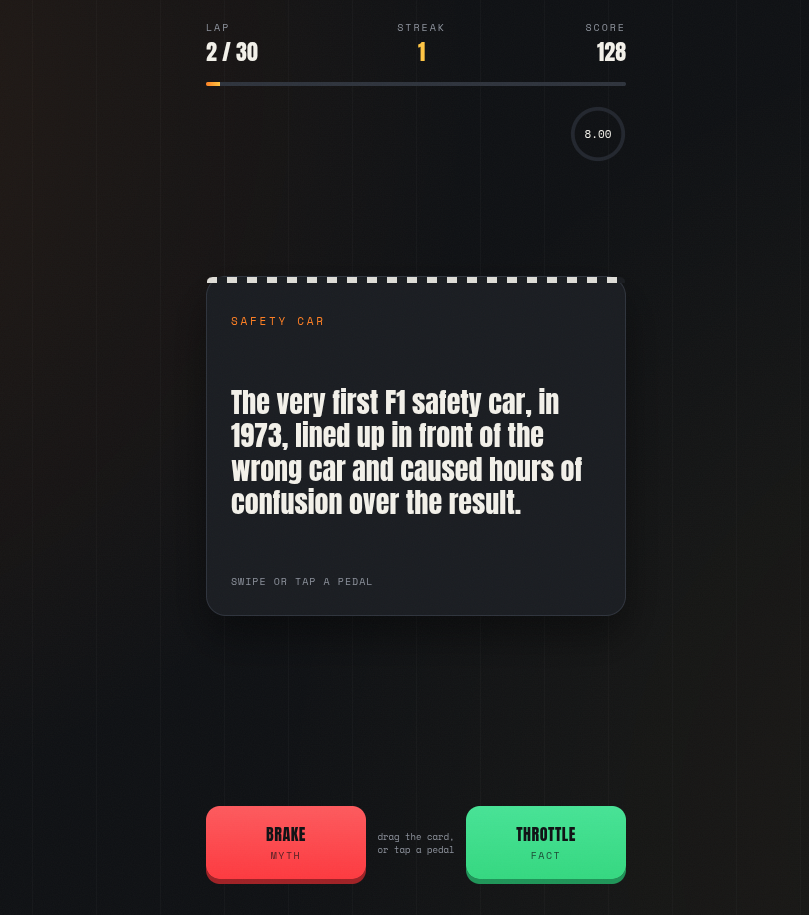
The museum seamlessly transforms into Throttle or Brake, a reaction-based trivia simulator where players must decide—under time pressure—whether each unbelievable F1 story is fact or myth.
The result is an educational experience that feels closer to visiting an interactive exhibition than browsing a website.
Inspiration
Formula 1 is full of stories that sound completely fictional.
A world champion won by half a point.
A driver literally stopped his own race to save another driver's life.
A team became world champion after being purchased for £1.
The first Safety Car accidentally led the wrong driver.
The problem is that these stories are scattered across interviews, documentaries, Wikipedia pages and decades of racing history.
I wanted to build the experience I always wished existed:
a place where someone who knows nothing about Formula 1 could walk in curious—and leave genuinely fascinated.
Rather than making another statistics page or highlight compilation, I designed F1 Mythos as an interactive museum where exploration comes first and learning happens naturally.
What it does
F1 Mythos consists of two connected experiences.
The Interactive Museum
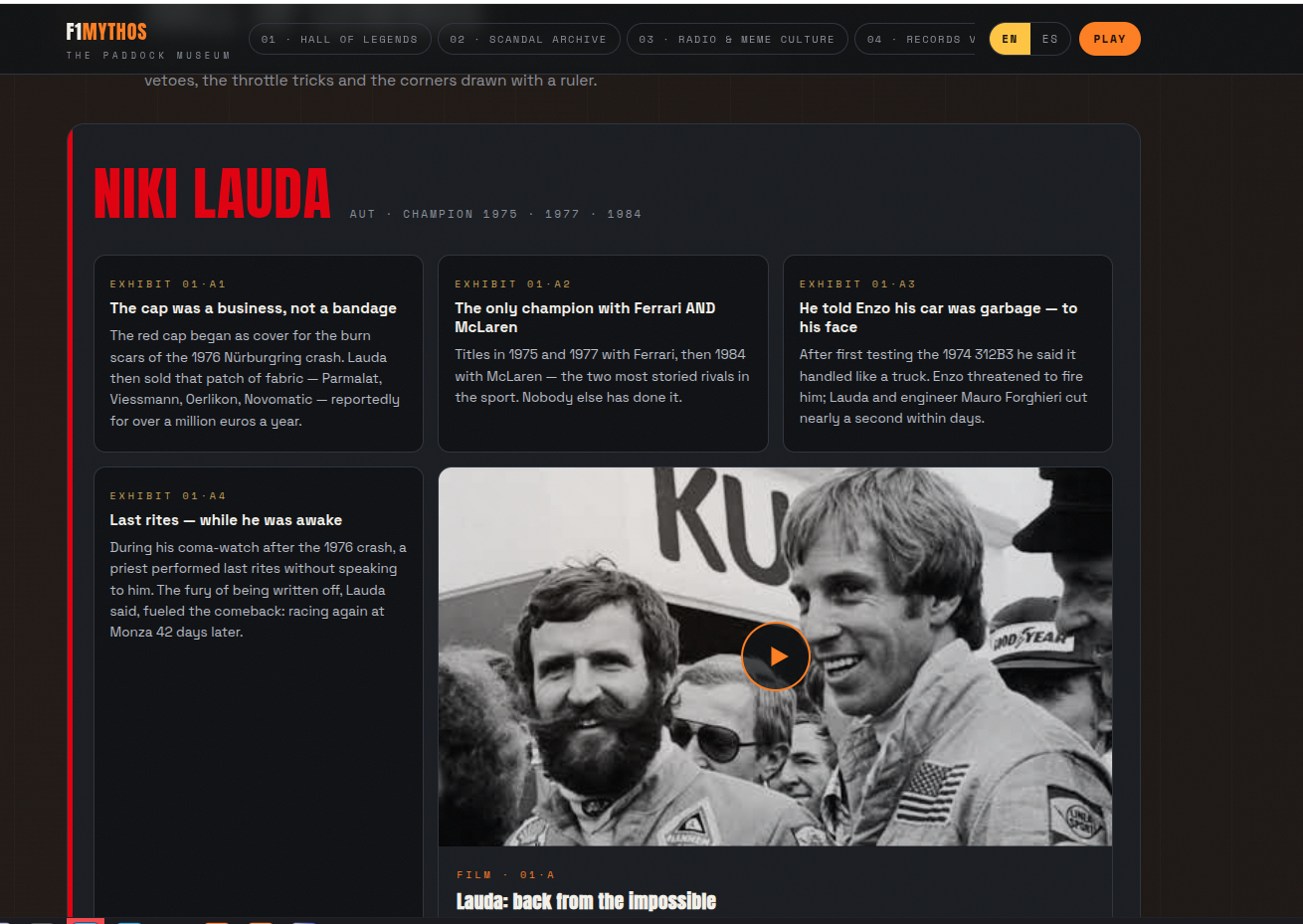
Ten curated halls transform Formula 1 history into a digital exhibition.
Visitors can explore:
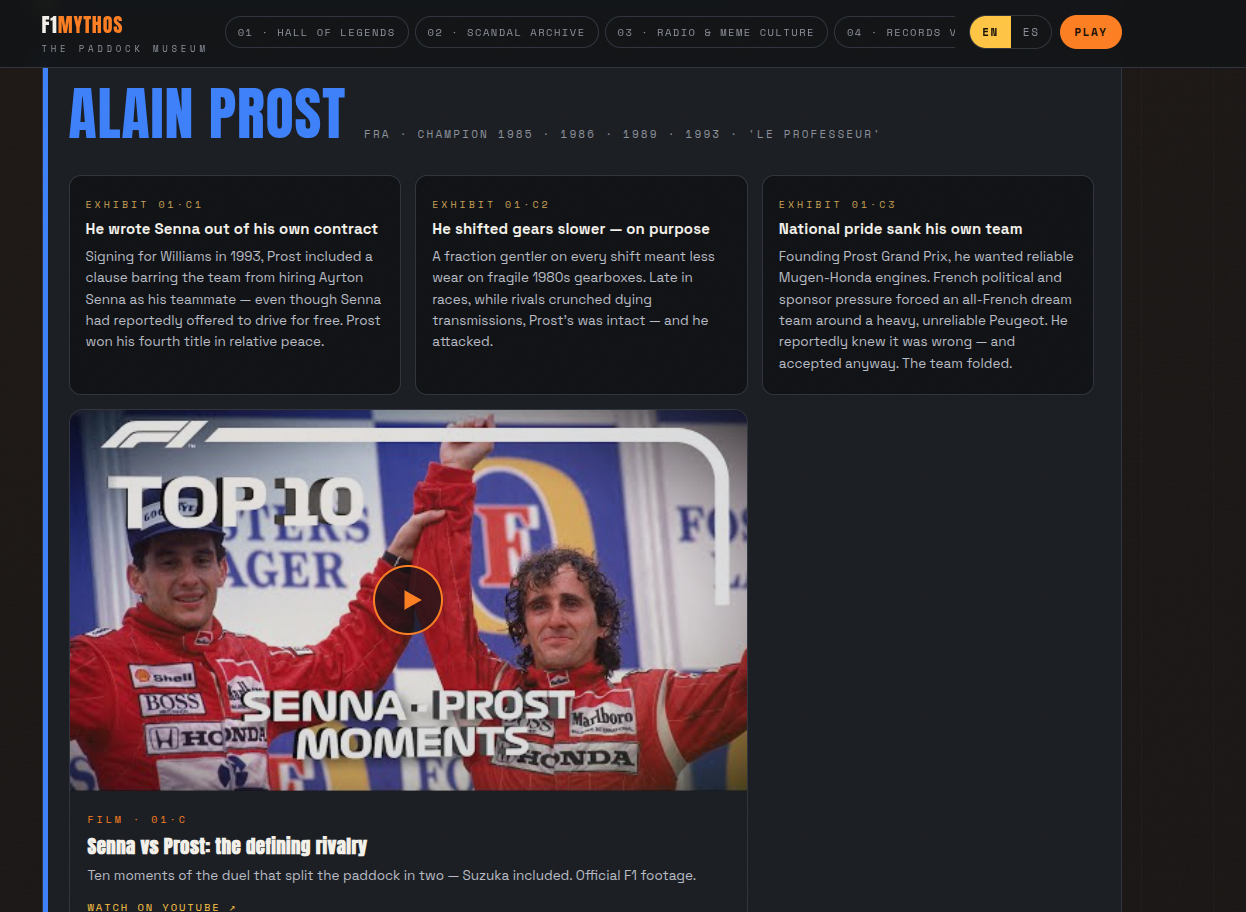
- Legendary drivers and forgotten stories
- Scandals that changed the sport
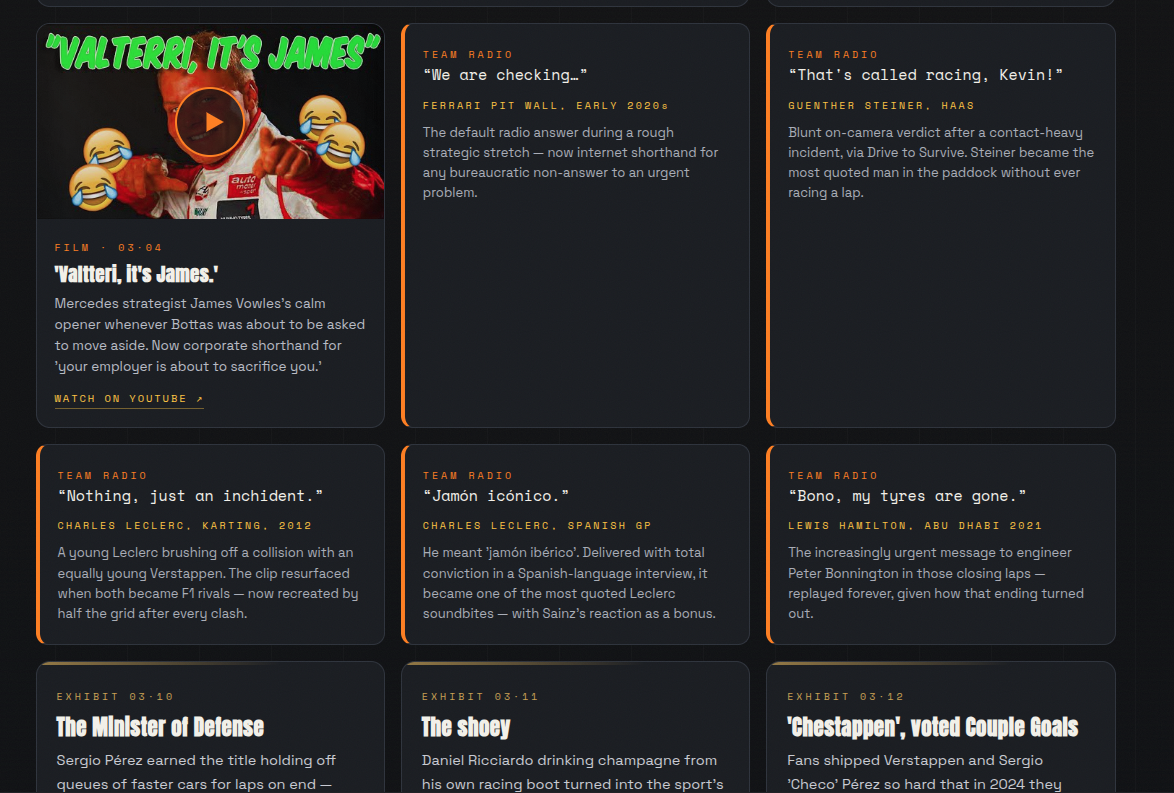
- Radio messages that became internet culture
- Engineering loopholes
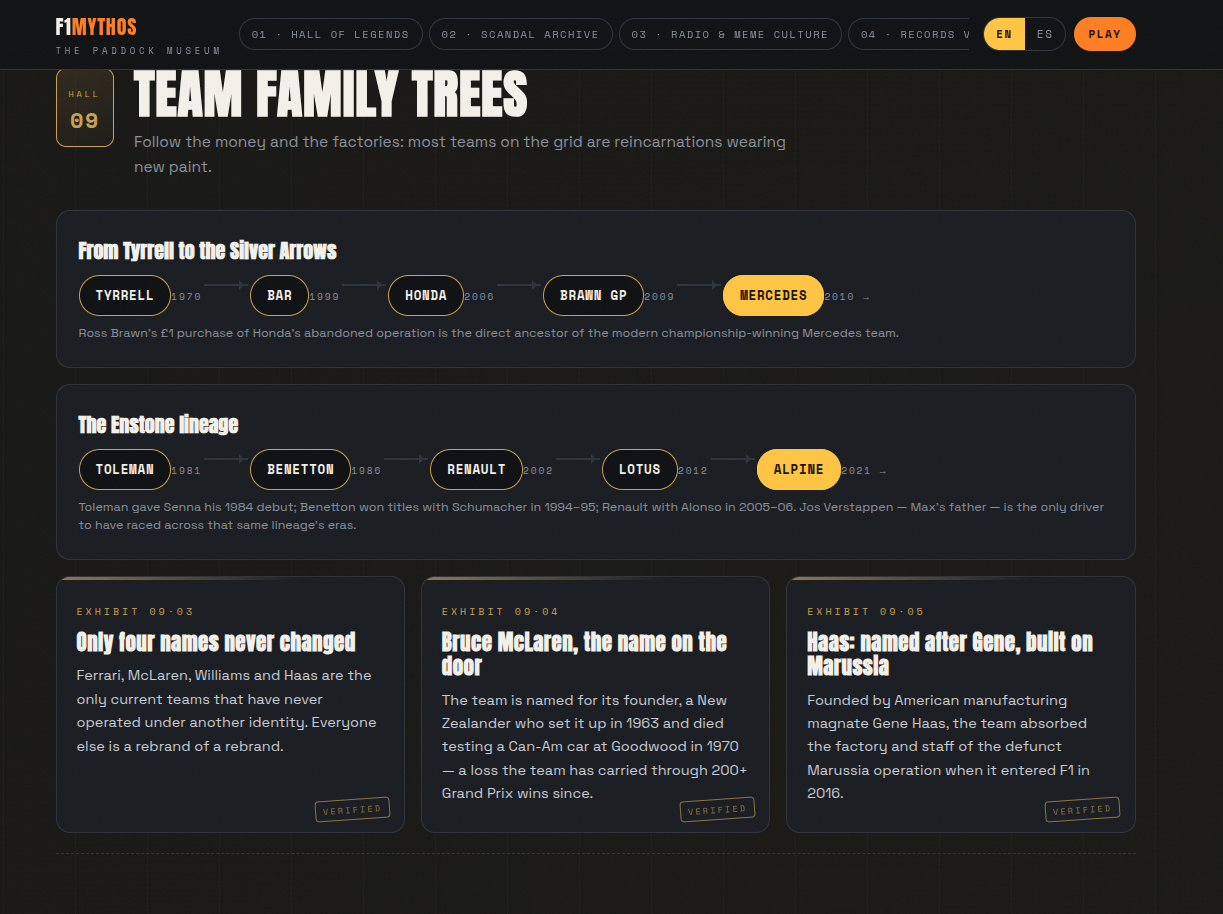
- Team family trees
- Strange regulations
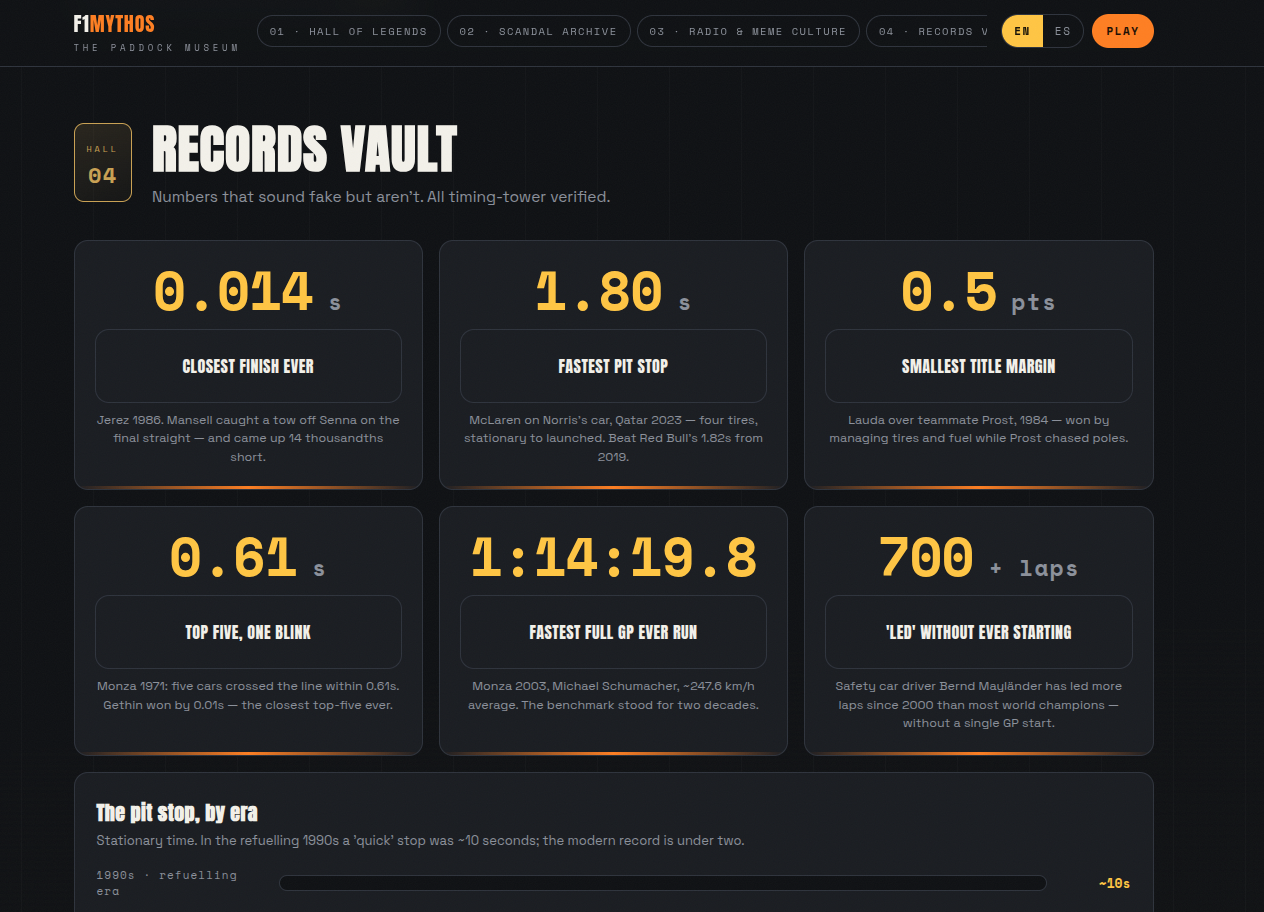
- Records that sound fake—but aren't
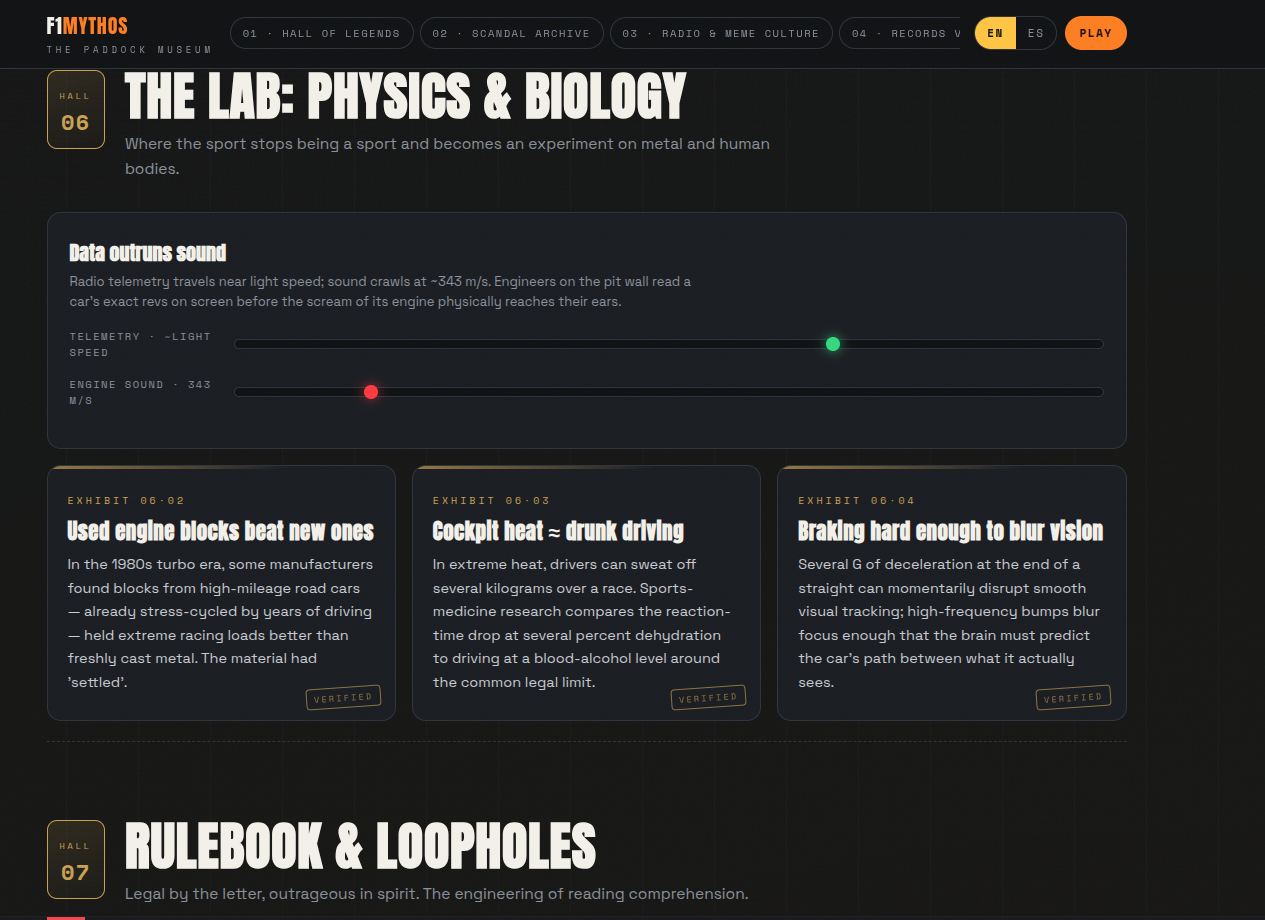
- Physics and biology behind driving
- Rituals and superstitions
- Historic Safety Cars
Instead of long paragraphs, every section uses purpose-built visual storytelling:
- animated statistics
- museum-style information plaques
- interactive timelines
- responsive diagrams
- animated charts
- embedded official Formula 1 footage
Every interaction is designed to encourage curiosity instead of passive reading.
Throttle or Brake
Learning is immediately converted into play.
Players face 30 incredible Formula 1 stories.
Swipe right.
Throttle.
"I think that's true."
Swipe left.
Brake.
"That has to be a myth."
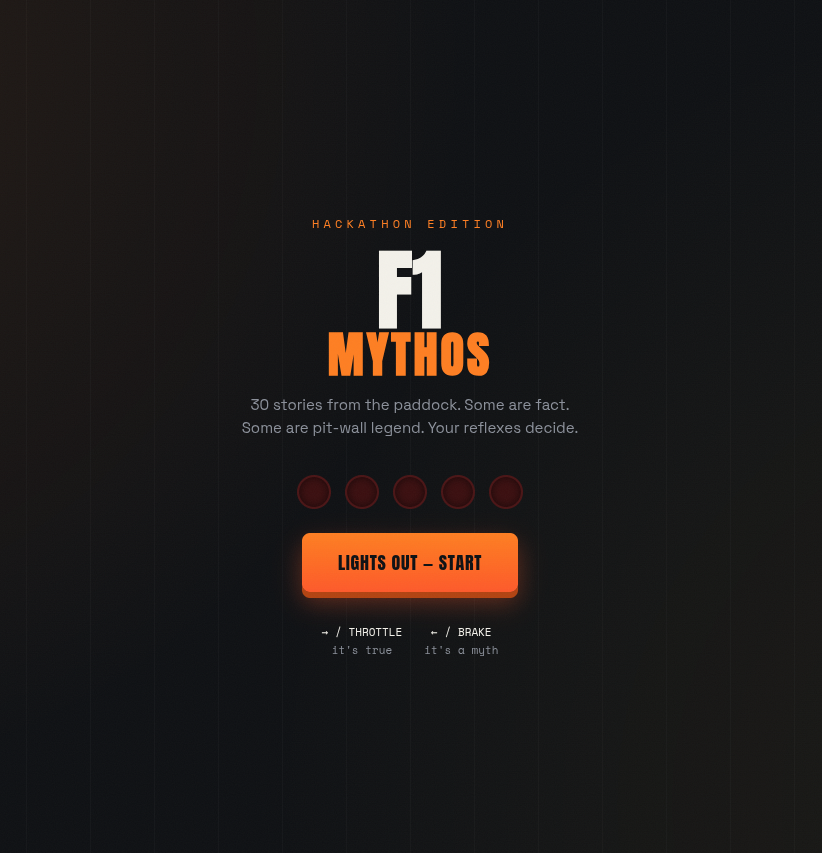
A real five-light starting sequence launches the game before the first question.
Every answer is timed.
Correct streaks increase the score multiplier.
At the finish line players receive their own paddock identity—from Back of the Grid all the way to Paddock Historian.
Instead of asking players what they remember, the simulator measures how much the museum actually taught them.
Native bilingual experience
Every sentence, exhibit and interaction exists as handcrafted English and Spanish content.
Nothing is machine translated.
The language switch instantly rebuilds the interface without reloading the page, making both languages first-class citizens rather than an afterthought.
How I built it
One design constraint shaped the entire project:
Zero installation. Zero setup. Zero dependencies.
The museum and simulator are delivered as two completely self-contained HTML files.
No framework.
No npm.
No bundler.
No backend.
No build process.
Open the file.
The experience starts.
Behind that simplicity sits a custom architecture:
- vanilla JavaScript rendering engine
- shared bilingual content model
- component-style template rendering
- IntersectionObserver-powered reveal animations
- requestAnimationFrame animation loops
- pointer-event gesture engine
- SVG reaction timer
- lazy-loaded video embeds for performance
The result is a project that behaves like a modern web application while remaining completely portable.
Challenges I ran into
Designing for "wow" without frameworks
Most interactive experiences rely on animation libraries.
I wanted the opposite.
Everything—from museum transitions to swipe physics and animated counters—was written manually in vanilla JavaScript and CSS.
The final experience feels polished without requiring a single external runtime.
Making the project impossible to break
Originally the trivia simulator depended on multiple external files.
If someone opened only the HTML file, everything silently failed.
That is exactly the kind of first impression that hurts during judging.
I redesigned the architecture so each experience became entirely self-contained.
Every HTML file now contains everything it needs.
No missing assets.
No missing scripts.
No installation.
Mobile interactions
Desktop swipe gestures worked perfectly.
Phones didn't.
The browser interpreted every drag as page scrolling.
The solution was surprisingly small—a missing touch-action: none declaration—but it completely transformed the mobile experience.
Accomplishments I'm proud of
- Built an entire interactive museum inside a single ~76 KB HTML file.
- Created a complete educational experience with 10 themed exhibition halls.
- Curated 30 real Formula 1 stories that genuinely sound fictional.
- Integrated 11 official Formula 1 videos without sacrificing loading performance.
- Designed a trivia experience that feels like a game rather than a quiz.
- Delivered everything in two portable files with zero installation required.
- Wrote every piece of content natively in English and Spanish.
What I learned
Constraints create better design.
Removing frameworks forced every animation, interaction and architectural decision to justify its existence.
I also learned that credibility comes from authenticity.
Real archival footage.
Verified historical stories.
Thoughtful curation.
Those choices create far more impact than adding another visual effect.
Finally, I realized the biggest bugs are rarely technical—they're experiential.
If a project doesn't immediately work on the first click, nothing else matters during a hackathon demo.
What's next
F1 Mythos is designed as a platform rather than a finished exhibit.
Next steps include:
- expanding the museum with dozens of additional halls from the research archive
- adding spatial audio and engine-inspired sound design
- persistent leaderboards and player profiles
- achievement system
- multilingual support beyond English and Spanish
- adaptive difficulty that learns each player's knowledge level
- museum analytics to discover which stories surprise visitors the most
LINKS:

Log in or sign up for Devpost to join the conversation.