Accessing the App Without Extracting Files or Using GitHub:
- https://flare-bice.vercel.app/
- Disclaimer: Only the drought and wildfire options are fully complete. The other natural disaster scenarios are still a work in progress. Our primary focus was on wildfires, while the additional disasters were included as bonus content during our spare time.
Video Demo 2
We have another video that presents the project's purpose, provides a brief explanation of how it works, and highlights its potential impact on society. YouTube Link: https://youtu.be/GG4Me0lkFbo
Inspiration
The idea for "F.L.A.R.E" was born out of another scheduling conflict where I had to choose between attending my NASA L'SPACE training meeting to know how NASA API's works (https://www.lspace.asu.edu/) and participating in the Emory Hackathon by not flying to Kennedy Space Center (Both events were scheduled to be on Friday-Sunday). To make this a win-win situation and contribute to both initiatives, I decided to enhance the potential of wildfire forecasting by developing an AI-powered wildfire forecasting tool that leverages data from the NASA Software Catalog and Earth observation APIs. By integrating what I learned through NASA L'SPACE with the hands-on problem-solving environment of the Emory Hackathon, I created a system designed to predict and alert communities about wildfire risks in real-time. This not only helps mitigate property damage but also reduces respiratory and emergency health issues by enabling faster response and evacuation strategies. In merging these two opportunities, I aimed to turn a scheduling conflict into a meaningful innovation. LinkedIn: https://www.linkedin.com/in/brandonkjlin/
After witnessing the hazardous damage caused by the California fire, we became deeply aware of the severity of wildfires. We believed that if people had been notified earlier, much of the damage could have been reduced. Even after the embers faded, many regions remained affected by dust and air pollution. That’s why we decided to build this system—to create an efficient way to notify people when a wildfire occurs.
What It Does
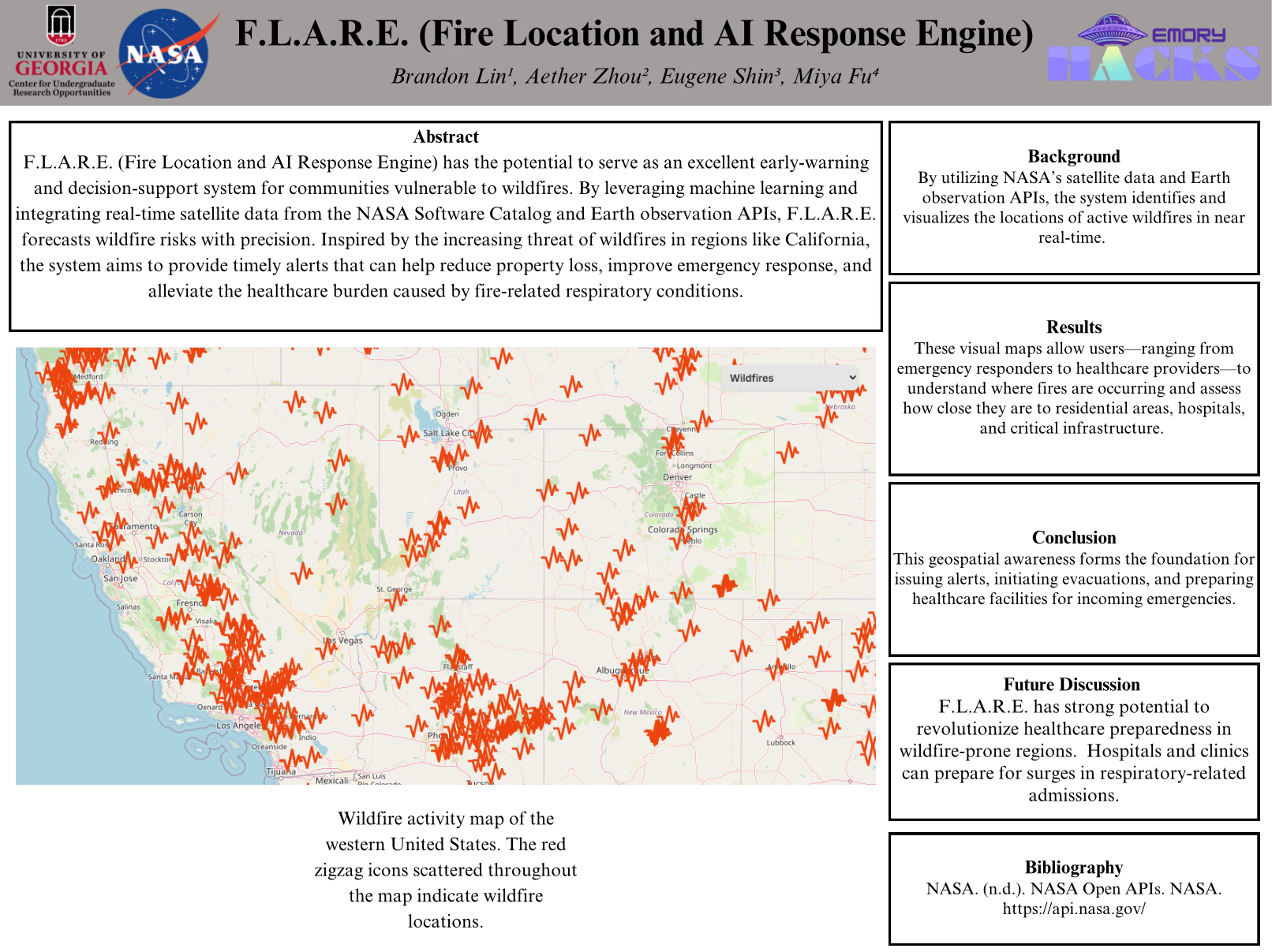
F.L.A.R.E. (Fire Location and AI Response Engine) is an AI-powered wildfire forecasting system that uses satellite and Earth observation data from the NASA Software Catalog to predict wildfire risks in real-time. It sends alerts to affected regions, helping communities prepare for evacuation and enabling healthcare systems to respond proactively.
How We Built It
We integrated NASA APIs and datasets with machine learning models trained on historical wildfire data, weather patterns, and vegetation indices. Data pipelines were created to pull and process satellite imagery and relevant metadata in near real-time.
Challenges We Ran Into
- Learning how to navigate and extract meaningful data from NASA’s complex API endpoints in a short time.
- Most of us don't have much coding experience nor how to use NASA API.
Accomplishments That We're Proud Of
- Bridging two major opportunities—NASA L’SPACE and the Emory Hackathon—into one impactful project.
- Successfully integrating real NASA data into a functioning prototype.
- Creating a working AI model capable of forecasting wildfire-prone areas.
- Designing a tool that has real-world applications in disaster response and public health.
Built With
- css
- davinci-resolve
- javascript
- nasa-api
- nasa-moderate-resolution-imaging-spectroradiometer
- node.js
- react
- visual-studio


Log in or sign up for Devpost to join the conversation.