Inspiration
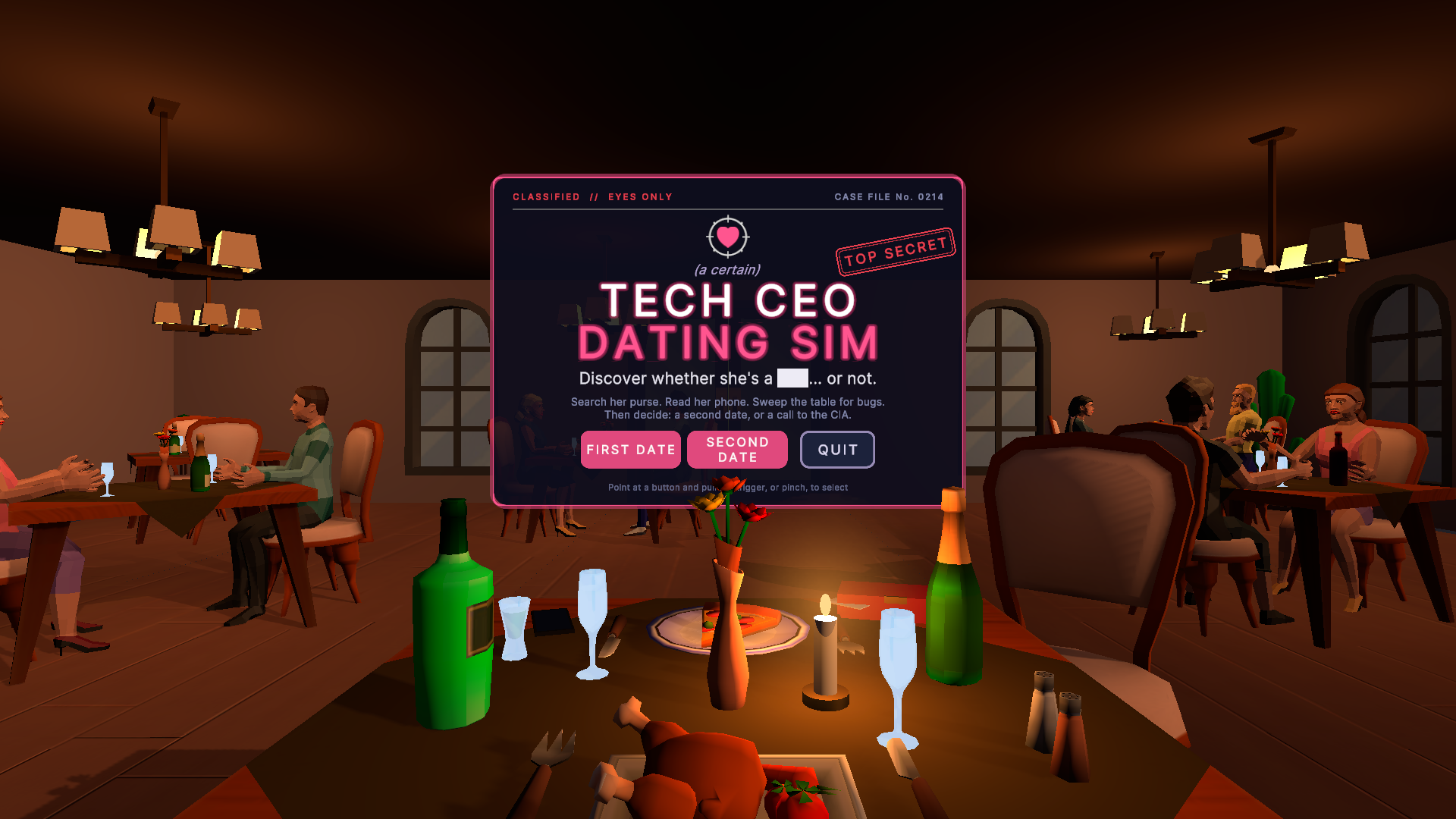
We keep up with the news like everyone else, and lately a few headlines about tech billionaires' personal lives have turned into very public workplace problems. Naturally, we wanted to help. We created a game where the player is challenged to identify whether or not their affair partner is a spy looking for valuable information or is genuinely interested in you.
What it does
You play a billionaire tech CEO on a date at a very fancy restaurant. You must find out by the end of the date whether she would make a nice love affair or is secretly a foreign national spy. Meet Emily, a charming international business consultant, as well as Jessy, a marketing executive from Tokyo, and piece together clues (primarily from stolen personal belongings) to find discrepancies in their story. There are three rounds in the game. First, introductions: ask friendly or probing questions to find out as much information as you can about your date. But be careful not to make her angry, or else she might end the date with a slap. Second, when your date leaves to use the restroom, you have just a short time to grab her purse, check her belongings, and cross-reference dates, pictures, and more with her story before she returns. Lastly, you have the opportunity to look through her phone. While she orders, scroll through her phone and check her notifications. Search her messages, photos, email, and calendar to find any clues to her deceit. Some messages may sound cryptic but are totally innocent. Be sure to put her belongings away before she comes back, or else, she’ll end the date! At the end of the night, the CIA calls and you must make a decision: spy or no spy? Make the right decision, and you stay the most successful tech CEO in the world. Pick wrong, and your wife, the CIA, and the world might discover you're having a secret love affair!
How we built it
We built our game in Unity 6.6 for the Meta Quest 3S using the XR Interaction Toolkit to handle the controllers and grab functions. We combined assets from the Unity Asset store to create a dining scene and programmed breakable table objects. The overall system controls (scene timing, animations, physics, etc) are implemented on a single gameObject. The whole game is at one restaurant dining table and each part of the date (conversation, bathroom trip waiter and ending) fires an event signal that is listened to by the next part of the code. Characters are described by a JSON file, with their dialogue and the items to be found in their purse and phone. The character pack only had a sitting animation, so we gave them walking, slapping, and standing-up animations with Unity’s humanoid muscle system. We used Attractor Labs’ SATIE to create the background restaurant ambience, and had Claude implement many of the other sounds with sine waves and noise.
Challenges we ran into
Responses to questions must be natural and informative, giving at least some valuable information about the character while still making it difficult to tell whether she’s a spy. We dealt with this by creating a persona for each character and planting small hints (such as discrepancies in dates or her background) or larger ones (such as text messages that show potentially malevolent planning). These hints coincide with the multiple conversations, so a player is bound to stumble upon at least one discrepancy. This is the first time anyone on our team has collaborated on a programming project, so we faced significant difficulties with merge conflicts and had to learn to resolve them. We also discovered that when several people edit one Unity project, even unexpected files such as the headset settings file can clash. We also struggled to make the clutter on the table engaging and interactive while ensuring that objects weren’t too difficult to break. At the same time, they couldn’t be so fragile where everything on the table would shatter instantly.
What we learned:
VR games have quirks that are difficult to identify when testing without a headset. Text might need to be larger, the character's head position is crucial for immersion, and you need to make items feel intuitive and make them behave like real life, such as pouring wine and smashing objects, or making boxcolliders more exact so that objects move properly throughout space and hands do not go through walls. We quickly learned that it’s instrumental to have many different people test the game to tell.
When making a story-based game, it’s very important to keep in mind that clues and explanations must both be accessible to the player. To make sure this happens, it’s important to meet with the team constantly and build a deep understanding of each character, their background, and what exactly the hints and red herrings will look like. This makes a person’s story feel real and plausible enough that the player can’t easily tell a genuine clue from a red herring.
What's next
We plan to incorporate more dates and more suspects, including a variety of maps with new challenges and better character animations. We also would like to integrate AI to make the women' s behavior and dialogue more natural. We also hope to create a final scene where you can watch the CIA's response play out based on whether your choice was correct.


