Our pitch / Deck Slides:- https://docs.google.com/presentation/d/1X3BQHKpHgvrPVMWmrFm0bt5PppL0wMNW/edit?usp=sharing&ouid=100901711963368226381&rtpof=true&sd=true
Inspiration
Have you ever been in a fast-paced workshop or a hackathon and realized that starting a "quick" collaborative note required a 2-minute sign-up flow, team invites, and complex permissions? We found that modern productivity tools like Google Docs and Notion are powerful but "heavy"—they create a friction point that kills the creative spark. We wanted to build something "ephemeral yet permanent": a collaborative space that spawns instantly, exactly when you need it, with zero barriers to entry. Ezyjot was born from the desire to make digital collaboration as fast as a handwritten note.
What it does
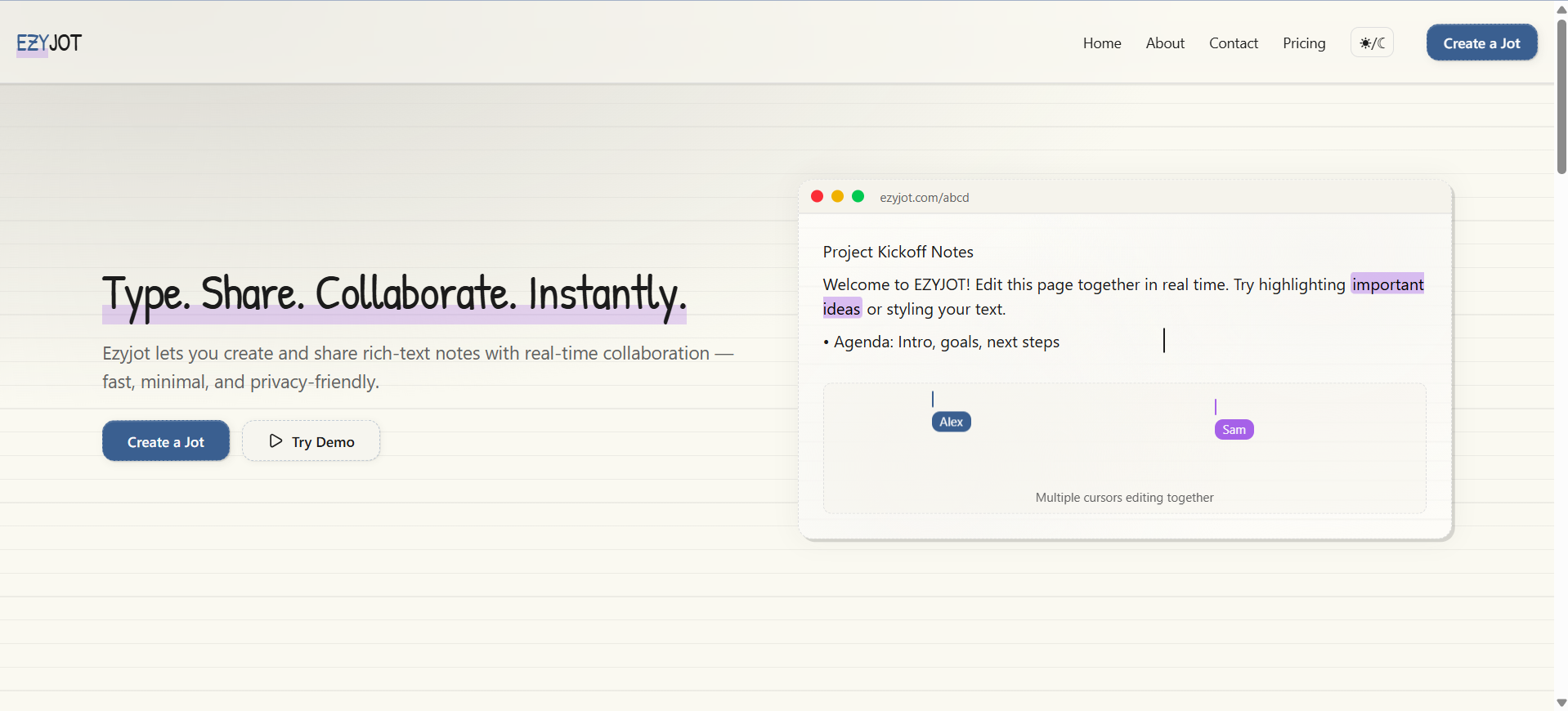
Ezyjot is a high-performance, real-time collaborative rich-text editor built for teams who need to move fast.
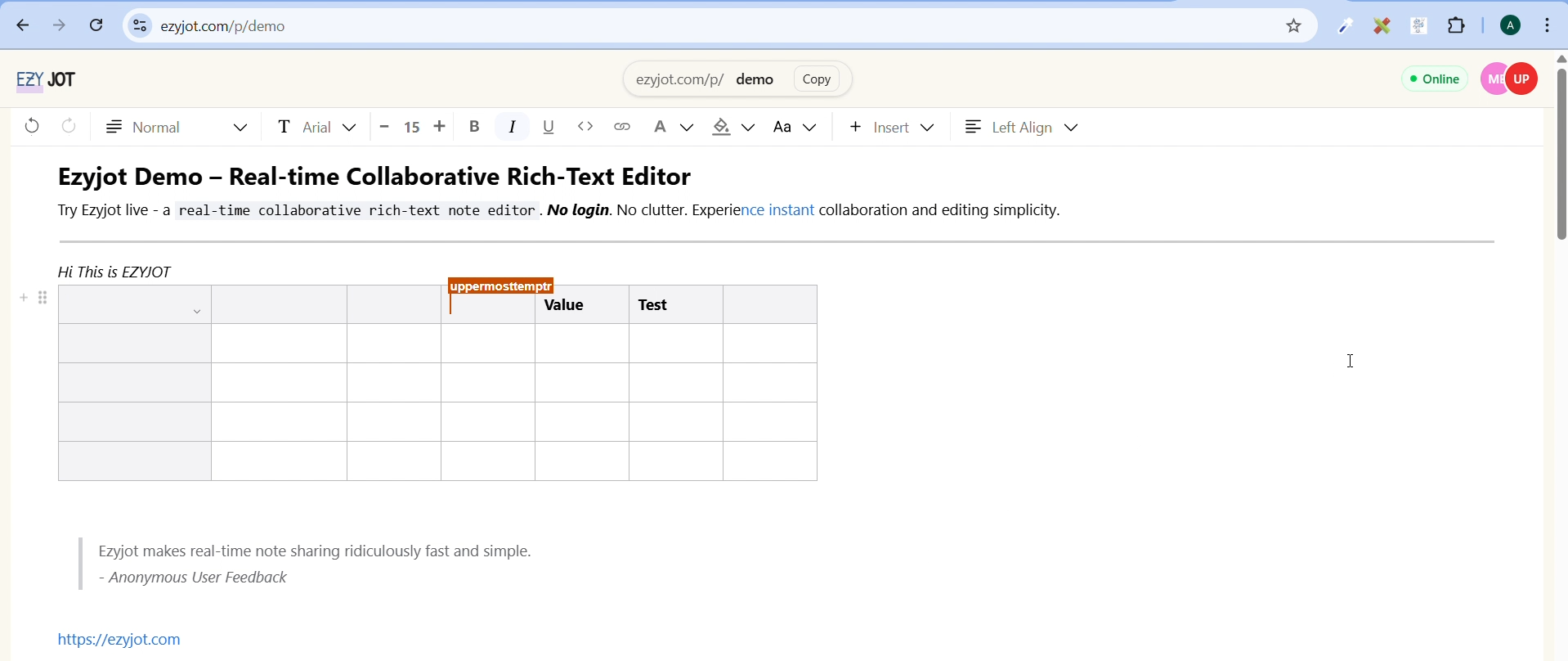
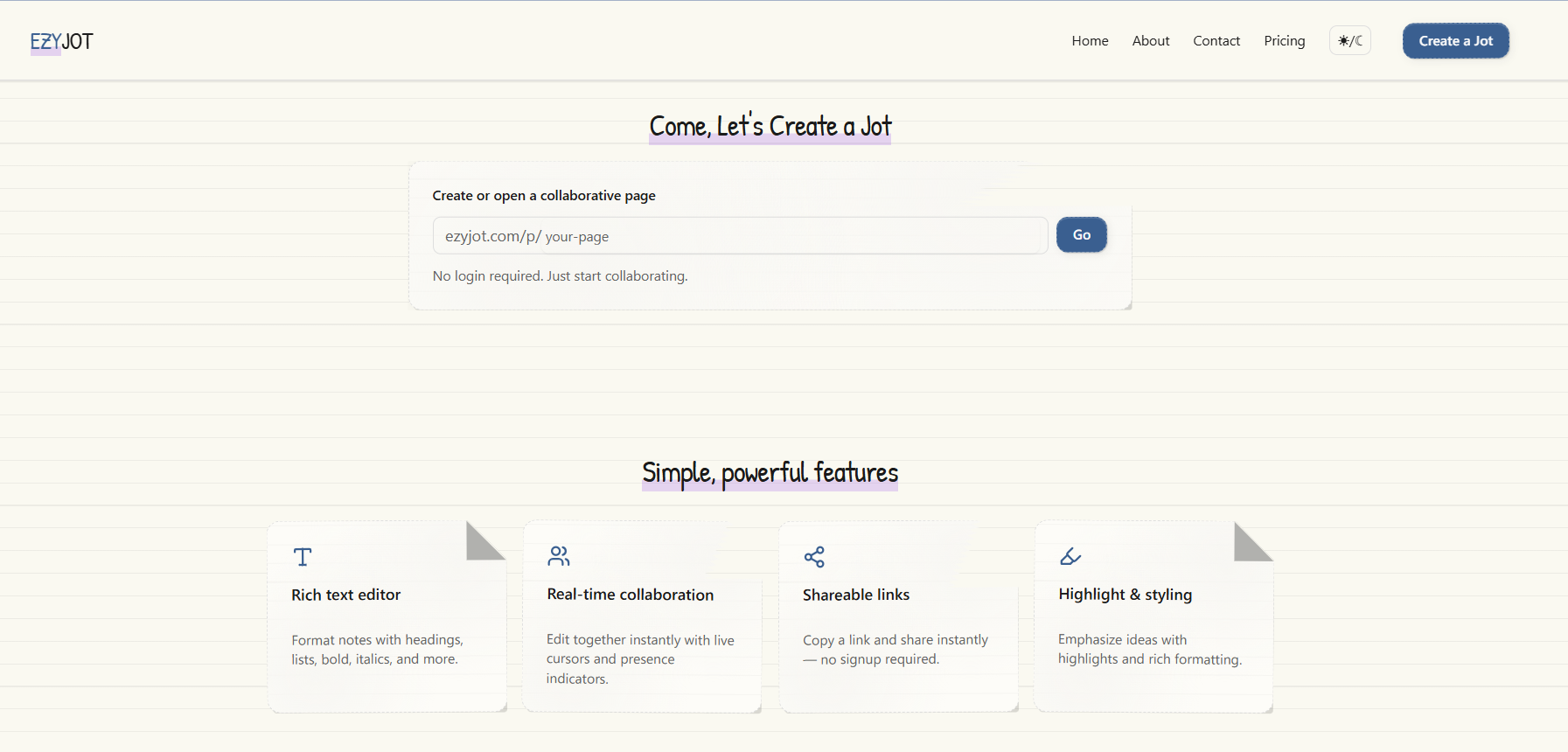
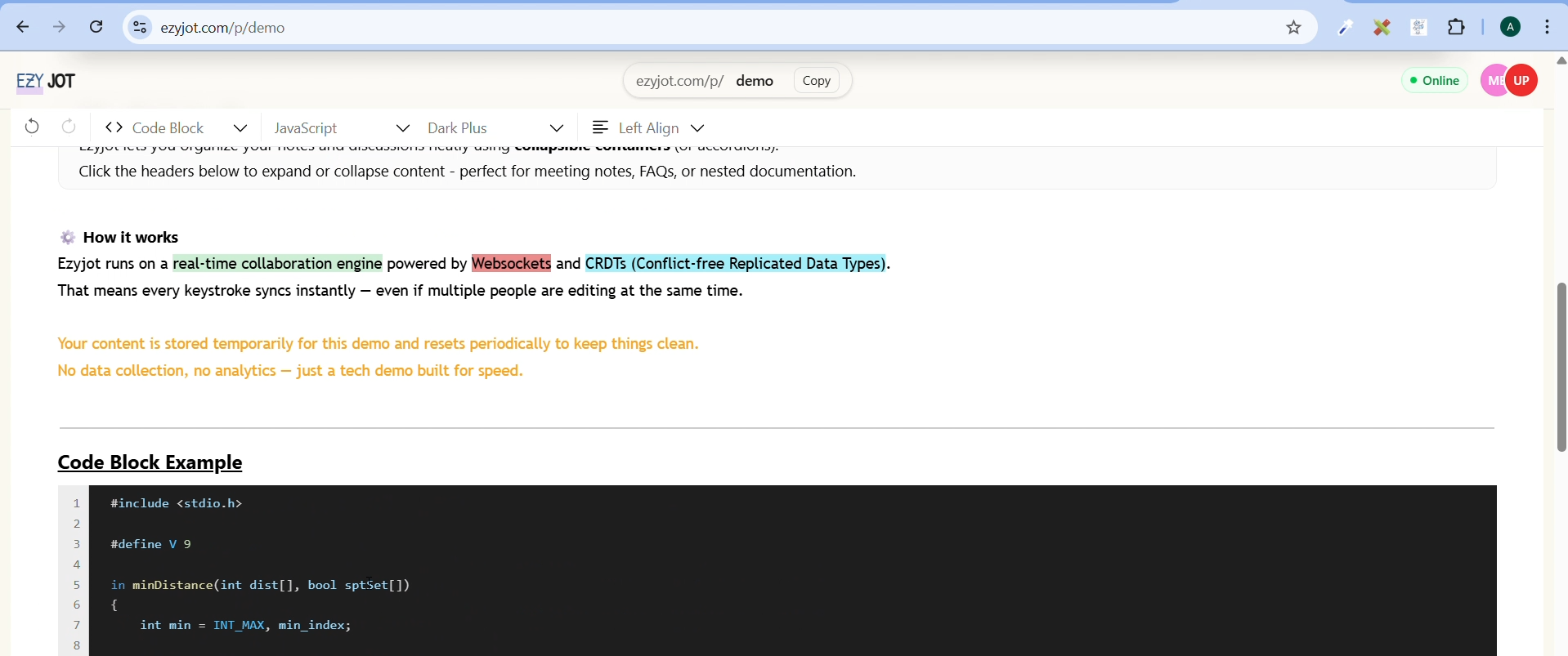
Zero Friction: No sign-up required. Just type a unique URL slug and start collaborating instantly. Real-Time Synergy: Powered by CRDT technology, multiple users can edit the same document with zero conflicts and sub-millisecond latency. Live Awareness: See exactly where your teammates are with live cursor tracking and user presence indicators. Premium Writing Experience: A sleek, minimal editor that supports rich-text formatting, tables, and more, without the clutter of traditional word processors. Secure Persistence: Your notes are stored as binary state in our database, meaning you can close your tab and return to your work anytime via your custom link.
How we built it
We chose a cutting-edge "Local-first" inspired tech stack to ensure the smoothest user experience:
Frontend: Built with React and Vite for a snap-to-action interface, using TypeScript for rock-solid reliability. Editor Engine: We integrated Lexical (Meta’s extensible editor framework) to provide a premium, accessible writing experience. The Sync Engine: We used Yjs, a high-performance CRDT (Conflict-free Replicated Data Type), to handle complex data merging automatically. The Bridge: Hocuspocus serves as our WebSocket provider, managing real-time communication and "cursor awareness" between clients. Backend: A Node.js/Express server serves as the authority, persisting Yjs document states as binary Buffers in MongoDB for long-term storage. Aesthetic: Styled with TailwindCSS and custom "sketch-inspired" UI elements to give it a creative, human feel.
Challenges we ran into
The biggest challenge was the "State Reconciliation". Syncing a complex rich-text editor state (Lexical) with a distributed network state (Yjs) is notoriously difficult. We had to dive deep into Lexical's internal reconciliation logic to ensure that remote updates from other users didn't interrupt the local "typing flow." Additionally, managing the binary persistence of Yjs documents in MongoDB required us to build custom middleware to handle data serialization without bloating the database.
Accomplishments that we're proud of Zero-Latency Typing: We achieved a "local-only" feel where users don't feel the network lag of the WebSocket. The "0-Click" Workflow: We are incredibly proud of our UX—the time from "idea" to "shared document" is literally seconds. Reliable Persistence: Successfully implementing a system that saves concurrent edits perfectly, even if users disconnect and reconnect at different times. What we learned We gained a massive appreciation for Distributed Systems. Learning how CRDTs mathematically solve the problem of data conflicts was a "lightbulb moment" for us. We also learned the importance of Modular Architecture; by using Lexical's plugin system, we were able to add features like "Live Awareness" and "Table Support" without rewriting the core editor.
What's next for Ezyjot
Encrypted JotPads: Introducing optional password protection for private brainstorming. Offline-First Support: Using IndexedDB to allow students to continue jotting notes without an internet connection and sync once they're back online. Export Suite: One-click export to Markdown, PDF, and GitHub Gists. AI Spark: Integrating local AI models to help students summarize their notes or generate mind-map structures directly from their collaborative sessions.
Built With
- express.js
- hocuspocus
- javascript
- lexical
- mongodb
- node.js
- react
- tailwindcss
- typescript
- vite
- yjs

Log in or sign up for Devpost to join the conversation.