
Inspiration
The inspiration for Eyrie comes from the tragic crowd crush incidents that have occurred during large public gatherings, such as religious festivals in India and music events worldwide. One of the most devastating examples is the Itaewon crowd crush in Seoul, South Korea, during Halloween festivities in 2022. Over 150 people lost their lives, and hundreds more were injured in what became one of the deadliest crowd-related disasters in modern history. This event highlighted how quickly overcrowding in tightly packed spaces can escalate into disaster, often without any warning and with little time for intervention.
With Eyrie, we aim to address this critical issue by leveraging computer vision and real-time crowd analysis to predict and prevent dangerous situations before they occur. By detecting crowd density and tracking movement patterns, our tool equips event organizers and security teams with the data they need to take proactive action, helping reduce the risk of such tragedies. Our goal is to create a safer environment in high-density settings and provide a solution that can prevent these incidents in the future.
What it does
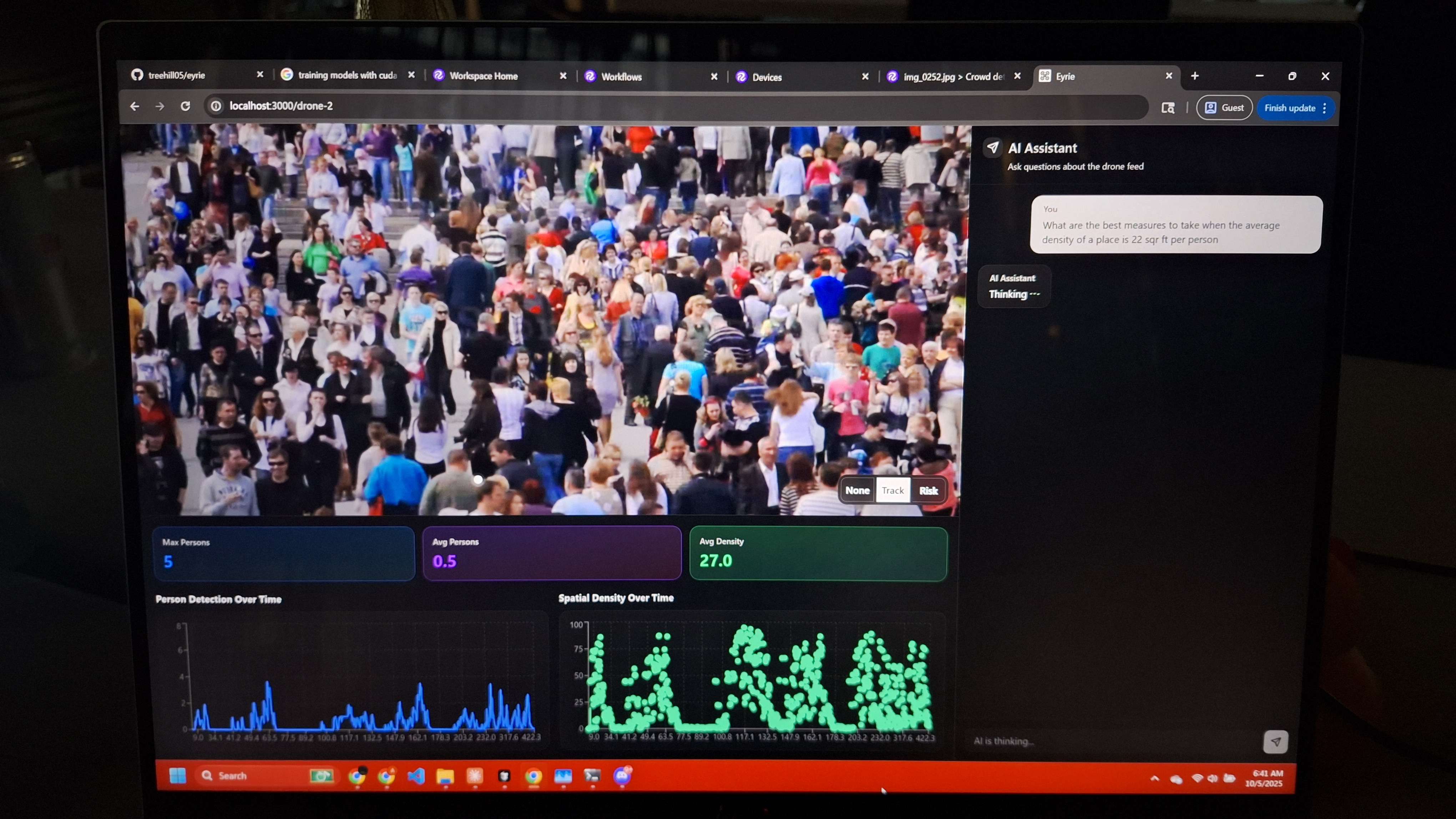
Eyrie is designed to prevent crowd crushes by continuously monitoring crowds in real time and identifying dangerous situations before they escalate. Using video feeds from cameras, Eyrie tracks how many people are in a crowd, calculates how tightly packed they are, and watches how the crowd moves. It sends alerts if there’s sudden congestion or unusual behavior that could indicate a potential danger.
By analyzing crowd patterns, Eyrie predicts if a dangerous situation, such as a crowd crush, is developing. If a risk is detected, it immediately sends alerts to event staff, enabling them to take timely action such as adjusting crowd flow, opening additional exits, or deploying other safety measures.
How we built it
Eyrie was built using a combination of modern web technologies, machine learning models, and real-time communication systems to ensure fast and reliable crowd monitoring. We used WebRTC for live video streaming, which allowed us to transmit video feeds from cameras to the system without noticeable delays. This ensures that we could monitor crowds as events unfold.
The frontend was developed with Next.js, creating a fast, responsive, and intuitive platform for event organizers and security teams to monitor crowd data in real time. On the backend, we used Python and FastAPI, which allowed us to build a scalable server that could process real-time data and handle communication between the frontend and backend.
The core of the system relies on the YOLOv8 model, a powerful object detection tool that identifies heads in the crowd. By training this model, we can calculate crowd density, monitor movement, and detect potential risks, enabling us to provide real-time alerts based on crowd behavior.
Challenges we ran into
Throughout the development of Eyrie, we encountered several challenges that pushed our problem-solving abilities. One of the most difficult tasks was training the YOLOv8 model to accurately detect individuals in a crowd. Working with large amounts of real-time data meant that training the model took considerable time and computational resources. Fine-tuning it to work well in various crowd conditions was essential for reliable detection and density estimation.
Another challenge was incorporating principles from fluid dynamics to better understand and predict crowd behavior. We explored how fluid dynamics could help model crowd congestion and provide more accurate predictions about when a crowd might become dangerously dense. This was complex and required deep research, but it was necessary for improving the accuracy of Eyrie's predictions.
Lastly, setting up WebRTC for live video transmission proved tricky, as we had limited prior experience with it. Integrating this system smoothly with our backend took time and effort, but it was crucial for ensuring that the video data could be processed and transmitted in real time.
Accomplishments that we're proud of
We are particularly proud of how we managed to bring together various technologies to create a working prototype of Eyrie in just 36 hours. Developing a system that integrates real-time video streaming, machine learning for crowd detection, and a user-friendly interface in such a short time frame was a huge accomplishment.
More importantly, we are proud of the potential impact of our project. Crowd crushes are a serious global issue that claim lives each year, and knowing that Eyrie could help prevent such tragedies provides us with a deep sense of fulfillment. By detecting and alerting authorities to dangerous crowd conditions in real time, we believe that our solution could save lives and improve safety at public events.
What we learned
In just 36 hours, we gained a great deal of knowledge, not just about the technical aspects of the project, but also about how technology can be applied to public safety. We learned to work with WebRTC for live video streaming, YOLOv8 for crowd detection, and FastAPI for backend development.
The most valuable lesson we learned was the importance of adaptability. We were faced with many new challenges, but by collaborating and learning quickly, we were able to overcome them. Additionally, we gained a deeper understanding of crowd behavior and how technology like AI and computer vision can be used to address urgent, real-world problems. The experience also reinforced the importance of teamwork and fast problem-solving when working under tight deadlines.
What's next for Eyrie
Looking forward, there are several directions we plan to take Eyrie. First, we aim to improve the system's prediction accuracy by refining the machine learning model. We also plan to integrate additional data points, such as thermal imaging or sensor data, to enhance crowd detection and make predictions more reliable.
We are also working on incorporating principles from fluid dynamics into the prediction algorithms. By better understanding crowd flow, we can more accurately simulate crowd behavior and predict when dangerous levels of congestion are imminent. This will help Eyrie provide even earlier warnings and offer a more proactive approach to crowd safety.
In addition, we want to deploy Eyrie in real-world settings to test its effectiveness. Collaborating with event organizers and public safety agencies will allow us to gather valuable feedback and continue improving the system.
Ultimately, we hope to scale Eyrie to accommodate larger venues and integrate it with other public safety systems. We also see potential for partnerships with commercial entities and public safety agencies to make Eyrie a globally adopted tool for preventing crowd-related disasters.
Built With
- cloudflare
- gemini
- godaddy
- nextjs
- python
- typescript
- webrtc
- yolo-v8


Log in or sign up for Devpost to join the conversation.