Eyra
Inspiration
Eyra was inspired by a simple but powerful problem: everyday mobility is still a major challenge for visually impaired people. Something as basic as identifying the correct bus, detecting stairs, reading signs, or safely navigating crowded public spaces can require constant assistance from others.
We wanted to build something that improves independence rather than dependence.
As students working in AI, accessibility, and real-world problem solving, we believed technology should create inclusion, not just convenience. We were especially motivated by the idea that AI should empower people instead of replacing them. That became the foundation of Eyra.
Our goal was to create an accessibility-first assistant that helps visually impaired users navigate daily life more safely and confidently.
What it does
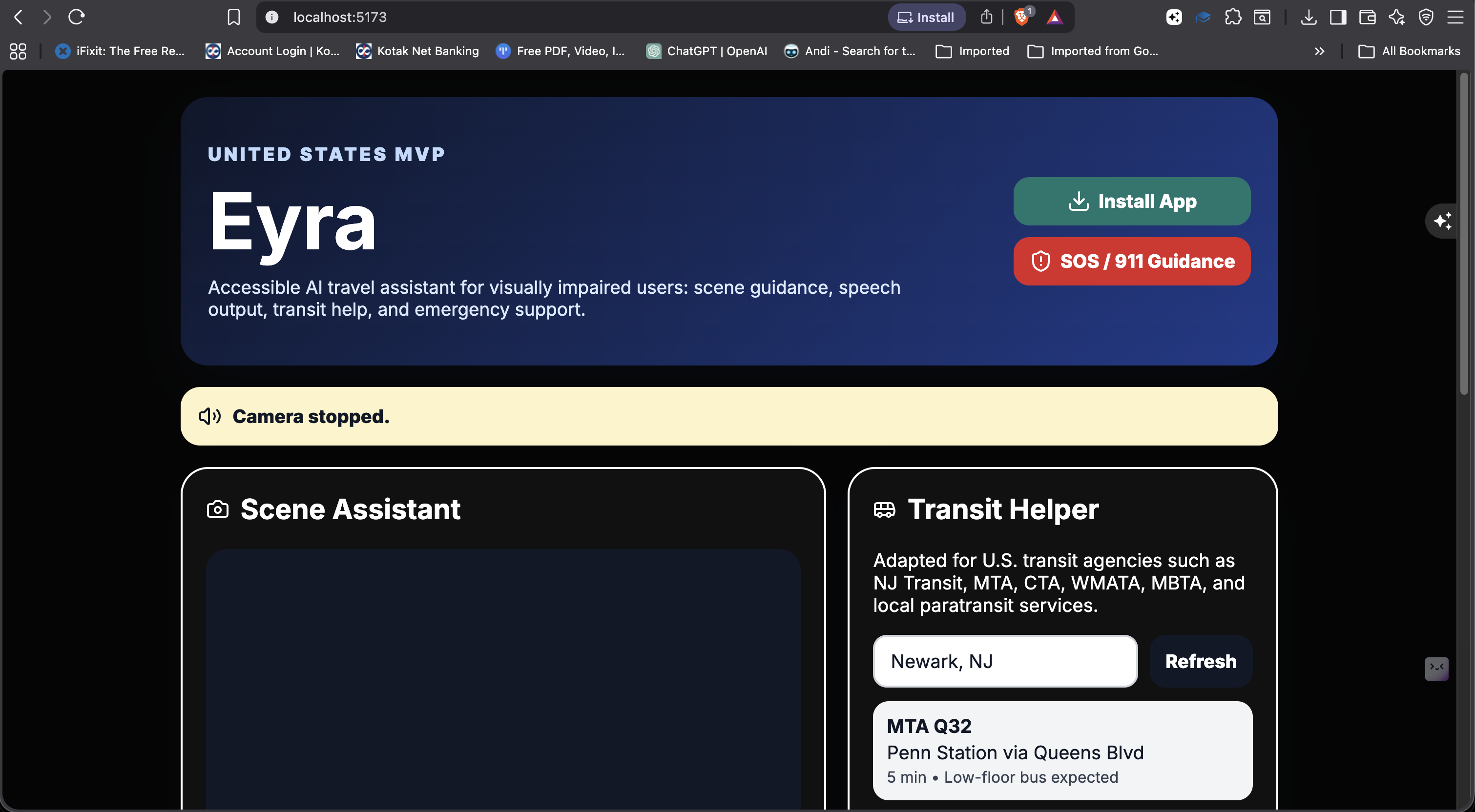
Eyra is an AI-powered assistive web application designed for visually impaired users in the United States.
It provides:
- Camera-based scene understanding
- Voice guidance using text-to-speech
- Obstacle and hazard awareness
- Transit support for buses and trains
- Emergency SOS support with location access
- Caregiver and emergency contact features
- High contrast accessibility mode
- Large text and keyboard-friendly navigation
Instead of making decisions for users, Eyra gives real-time information such as:
- “Crosswalk ahead”
- “Stairs detected nearby”
- “Bus route identified”
- “Platform edge ahead”
This helps users stay in control while receiving meaningful support.
How we built it
We built Eyra as a full-stack web application.
Frontend
- React + Vite
- Accessibility-first UI design
- Browser Camera API
- SpeechSynthesis API for voice feedback
- Responsive design for mobile and desktop use
Backend
- Node.js
- Express.js
- REST API architecture
- JSON-based local prototype storage
- Future-ready endpoints for Claude API integration
AI Approach
For the MVP, we designed the structure for scene understanding and AI interpretation using Claude-ready API architecture.
The workflow:
- Capture scene input
- Process environmental understanding
- Generate simplified user guidance
- Deliver voice feedback instantly
This allows future integration with real computer vision and GTFS real-time transit systems.
Challenges we ran into
1. Accessibility-first design
Building for visually impaired users means the UI itself must be extremely simple, readable, and reliable.
This required rethinking normal UI design:
- Larger buttons
- Minimal clutter
- High contrast colors
- Keyboard navigation
- Screen-reader compatibility
- ARIA labels and live regions
Designing for accessibility was much harder—and much more important—than standard UI work.
2. Ethical responsibility
Healthcare and accessibility tools require trust.
We had to make sure Eyra does not create false confidence or unsafe dependency.
This meant:
- Avoiding “AI makes decisions for you”
- Adding safety disclaimers
- Encouraging human verification
- Including emergency handoff to 911
- Making limitations transparent
The challenge was balancing helpfulness with responsibility.
3. Real-world transit complexity
Transit systems differ across cities like NJ Transit, MTA, CTA, and WMATA.
Creating a scalable architecture for transit support without depending on paid APIs required careful backend planning.
We designed the MVP to be lightweight now, but expandable later.
What we learned
This project taught us that accessibility is not a feature—it is a responsibility.
We learned:
- Human-centered AI matters more than impressive AI
- Simplicity is often harder than complexity
- Ethical design must be part of technical design
- Real impact comes from solving specific problems for real people
Most importantly, we learned that the best technology does not replace people.
It helps people become more independent.
That is what Eyra stands for.
Future improvements
Next versions of Eyra will include:
- Live object detection with computer vision
- Real GTFS transit integration
- Indoor navigation support
- Wearable device compatibility
- Smart glasses integration
- Multilingual voice guidance
- Caregiver live tracking system
- Hospital and emergency response integrations
Our long-term vision is for Eyra to become a trusted daily mobility companion for visually impaired users everywhere.
Final Thought
Technology should not just be smart.
It should be useful.
It should be inclusive.
It should help people live better.
Eyra is our step toward that future.
Built With
- api
- browser
- camera
- css3
- express.js
- html5
- javascript
- keyboard-navigation
- node.js
- react.js
- reader
- rest
- screen
- vite

Log in or sign up for Devpost to join the conversation.