-
-
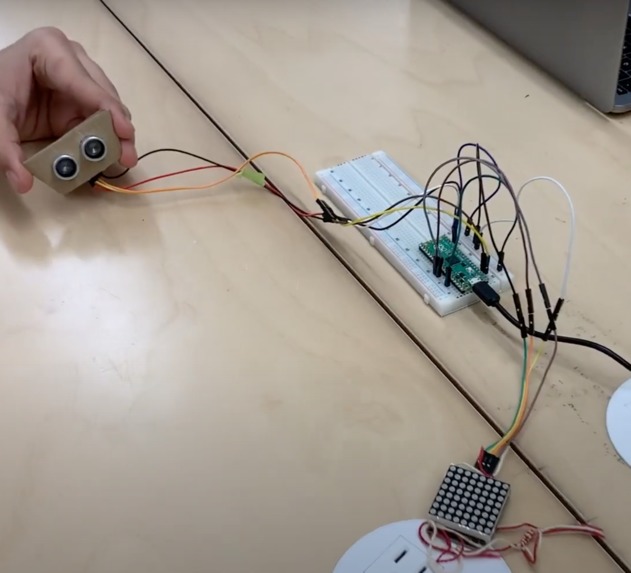
Main components of the eyeWatch
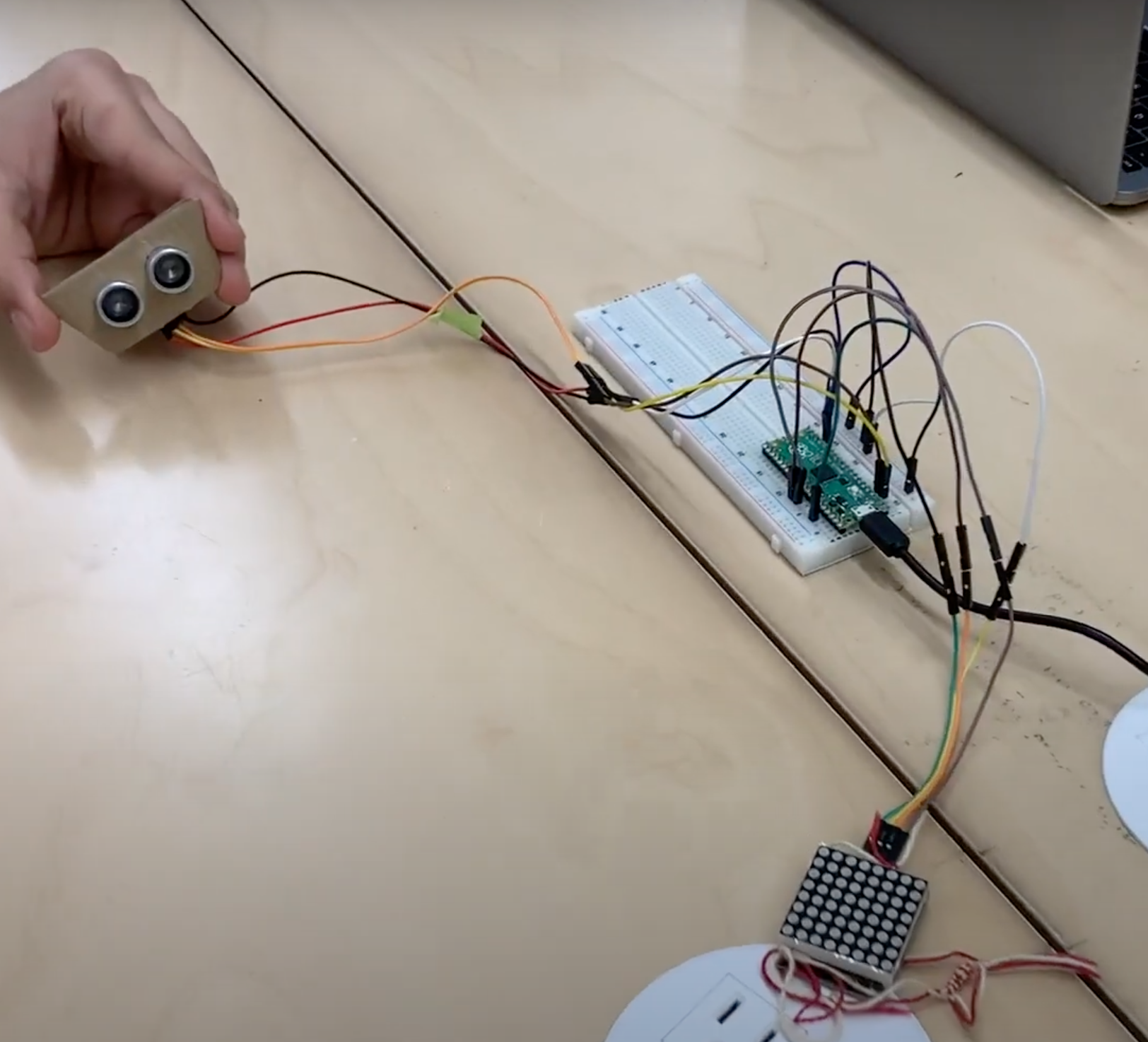
Inspiration
During COVID-19, members of our team completed our first years of university remotely from our home countries. As a result we had to spend a lot of time on screens, which affected our eyesight and posture. We wanted to design a device that assisted us in maintaining a healthy distance from our laptop screens, especially since the "at home" culture that has sprouted from the pandemic is widespread.
What it does
The eyeWatch is a wearable that complements an ultrasonic sensor latched onto a laptop. When the user is within the 47 cm safe distance from the screen the wearable begins flashing, alerting the user to move back. If the user gets closer, the flashing increases in frequency.
How we built it
We split work between two parts: the ultrasonic sensor and the LED 8x8 matrix display. Our team was divided into two, each exploring the libraries, circuitry, and code needed for their respective parts. We used the Raspberry Pi Pico to program both parts, and integrated our respective parts into the final solution.
Challenges we ran into
Integrating the two parts took time, especially since code was written separately for distance input to the sensor and LED display output. We had to iron out nuances in the interaction between these parts, such as what distance should trigger flashing, and formulating an equation for flashing rate based on distance. With the sensor being imperfect, there were occasional anomalous readings that could've interrupted the continuity of the flashing. To account for this, we set calibration limits to the flashing rate, such that flashing would not suddenly stop after flashing rapidly.
Accomplishments that we're proud of
This was our first hackathon, and we were proud to produce a functional, multi-part system that we personally found useful.
What we learned
We learnt how to read data sheets and search for libraries to program hardware. We also learnt that design is an iterative process, and combining the two parts of our system involved iteratively altering code for each individual part.
What's next for eyeWatch
Firstly, we want to implement a lithium ion battery to make the wearable wireless. We would also need Bluetooth to communicate with the sensor, as opposed to the wires we have now. Secondly, from a structural perspective, we would like to use CAD and 3D print casings for the display and the sensor, as well as design a strap for the wearable.

Log in or sign up for Devpost to join the conversation.