Inspiration
Traditional CAD (Computer-Aided Design) tools are powerful, but interacting with complex 3D models often requires navigating complicated interfaces, using a mouse and keyboard, and switching between multiple tools. We wanted to explore a more natural, futuristic way to interact with 3D engineering models.
Inspired by holographic interfaces in science fiction, gesture-controlled technology, and the vision of making engineering accessible and interactive, we created HoloCAD-3D — a step toward bringing the experience of a futuristic engineering workshop into a web browser.
Our goal was to make 3D machine exploration feel more intuitive by allowing users to interact with digital components through hand gestures. Instead of relying entirely on conventional controls, users can use their hands to navigate an interactive 3D workspace and explore machine designs.
We believe the future of engineering interfaces should be more immersive, accessible, and intuitive. HoloCAD-3D is our attempt to bring that vision closer to reality.
What it does
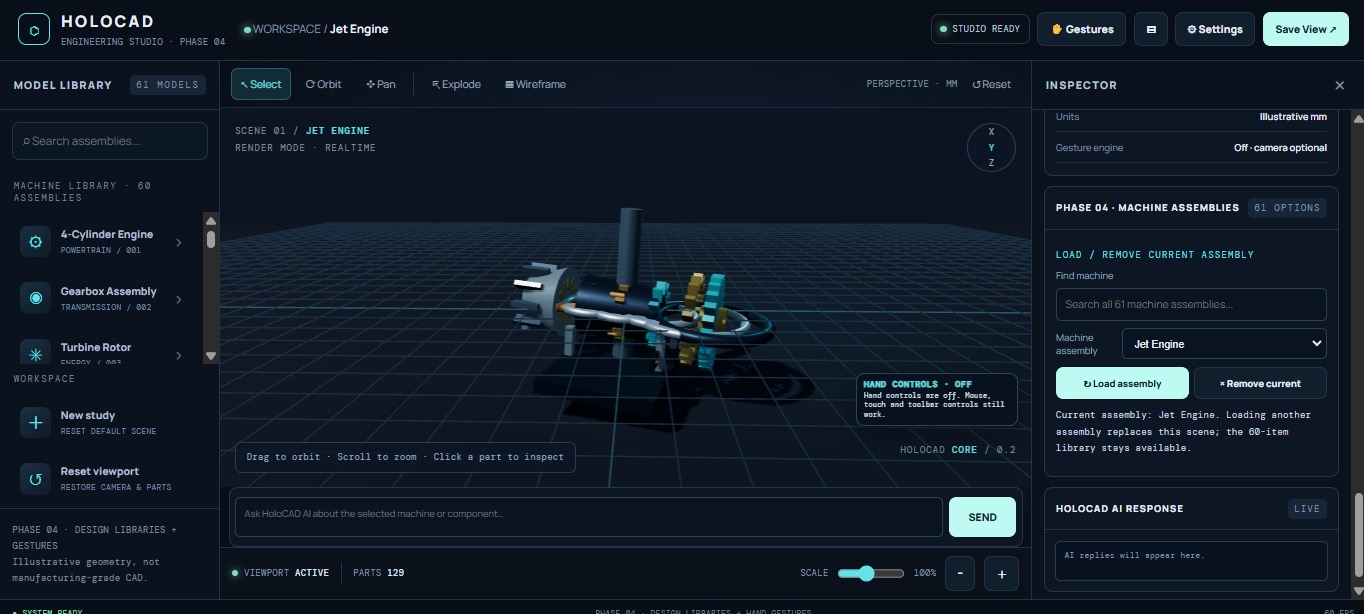
HoloCAD-3D is an interactive 3D engineering and machine-exploration platform that combines a futuristic workshop interface with hand-gesture interaction.
Its key capabilities include:
- Interactive 3D Workshop: Explore and interact with machine models inside a dedicated 3D workspace.
- Hand-Gesture Controls: Use hand tracking to control an on-screen cursor, providing an alternative to conventional mouse-based interaction.
- Gesture-Based Interface Interaction: Move the hand-controlled cursor toward interface controls and use a pinch gesture to activate supported actions.
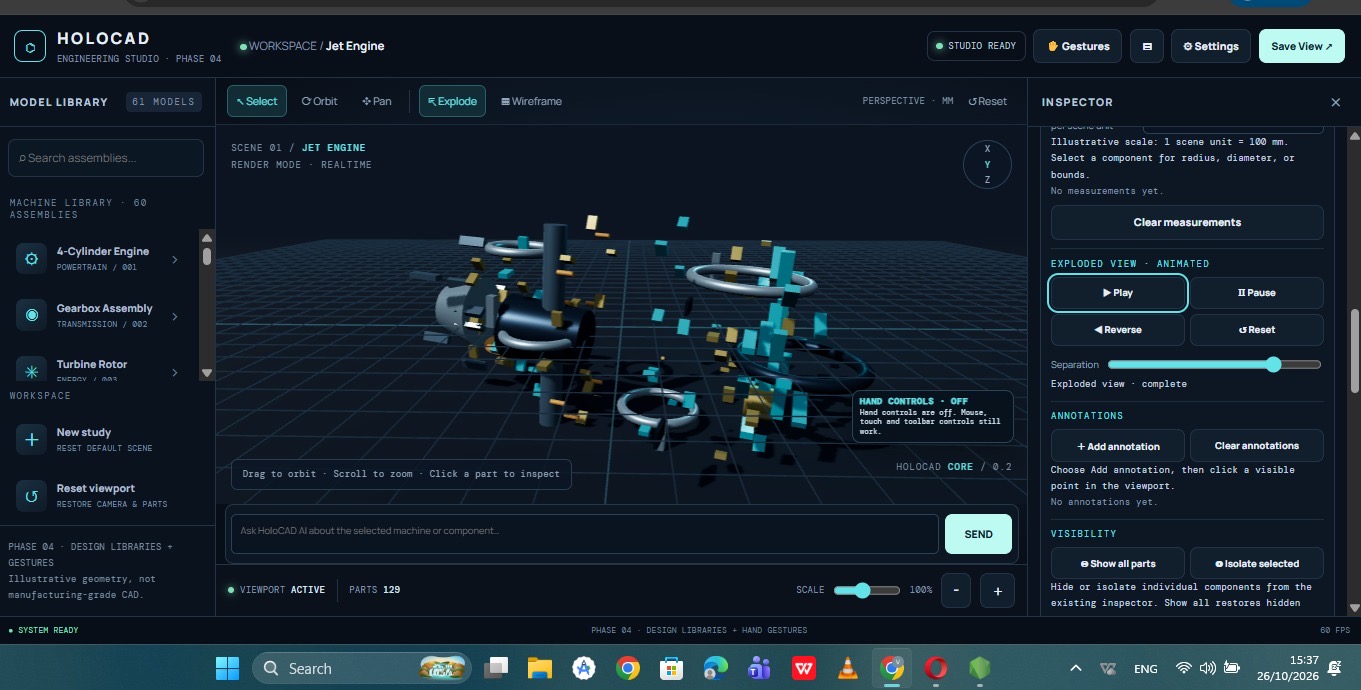
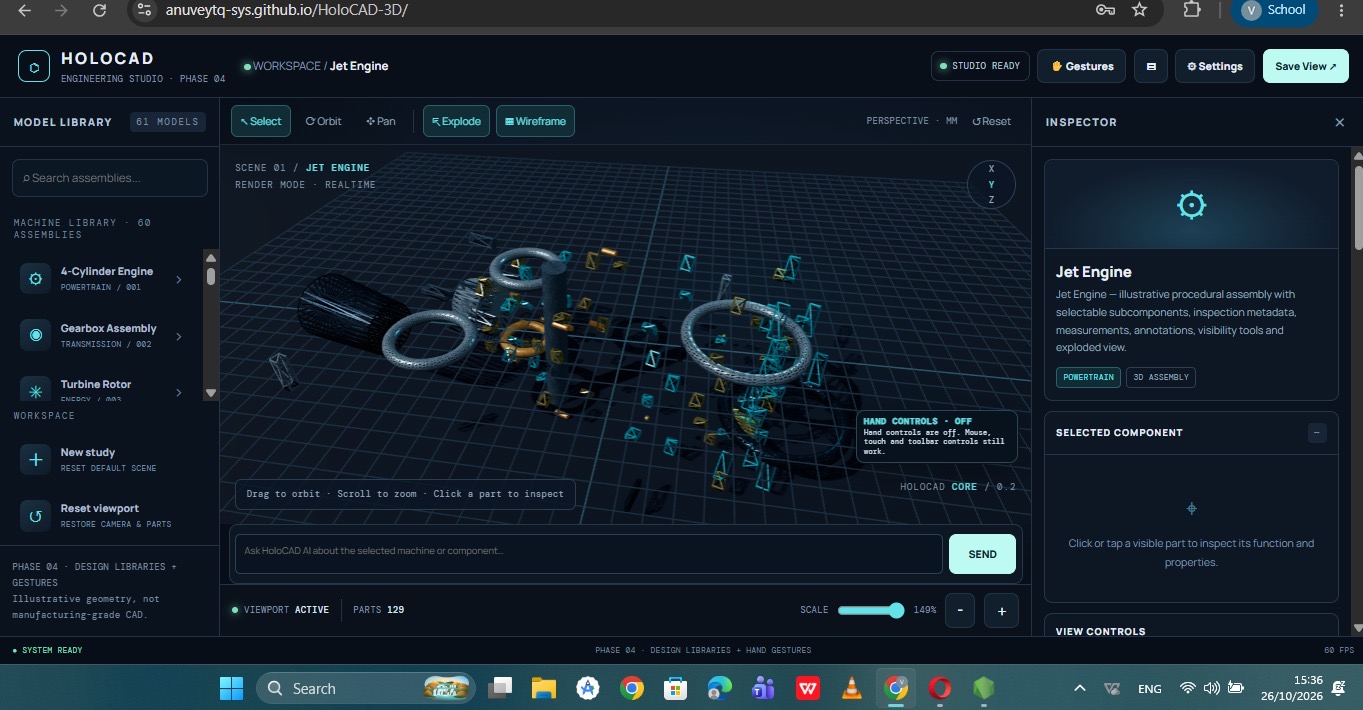
- Explode and Wireframe Modes: Use the available Explode and Wireframe controls to inspect machine structures and visualize their components in different ways.
- Machine Component Exploration: Explore individual parts of 3D machine models to better understand their arrangement and structure.
- A Collection of 61 Machines: HoloCAD-3D features a collection of 61 machines, providing a broad range of models to explore.
- Futuristic User Interface: A workshop-style interface brings together machine visualization, interactive controls, and gesture-based input.
- Browser-Based Experience: The project brings interactive 3D machine exploration to the web, making it accessible without requiring a traditional desktop CAD installation for the browser-based experience.
The larger vision is to make complex machine designs easier to explore, understand, and demonstrate through a combination of 3D visualization and natural interaction.
How we built it
We developed HoloCAD-3D as a browser-based 3D engineering experience, bringing together interactive machine visualization, a custom workshop interface, and hand-gesture controls.
The project focuses on three major areas:
- Interactive 3D Visualization
The 3D workshop serves as the main environment for exploring machine models. We focused on making the models interactive and providing visualization controls that help users examine their structures from different perspectives.
- Hand-Gesture Interaction
We integrated hand tracking to allow users to control an on-screen cursor using their hands. This creates an alternative interaction method that moves beyond conventional mouse-and-keyboard controls.
The gesture interface is designed to connect physical hand movements with digital actions, creating a more natural way to interact with the workshop.
- Workshop Interface and Machine Exploration
We developed a dedicated interface that brings the 3D workshop, machine models, and visualization controls together. Features such as Explode and Wireframe modes provide different ways to examine machine structures.
We also organized the experience around a collection of 61 machines, making the project a broader machine-exploration platform rather than a demonstration of a single 3D model.
Throughout development, our priority was to preserve the smoothness of the existing gesture controls while exploring ways to make machine interaction more intuitive.
Challenges we ran into
Building HoloCAD-3D presented several interesting challenges.
Making Hand-Gesture Interaction Feel Natural
One of the biggest challenges was creating a usable connection between physical hand movements and the on-screen cursor. Gesture-controlled interfaces need to feel responsive and predictable, especially when users interact with small interface elements.
Connecting Gestures to Interface Actions
Controlling a cursor is only the beginning. Turning gestures into meaningful actions requires careful coordination between hand tracking, cursor positioning, and interface interactions. Making pinch gestures work reliably with supported controls is an important part of this process.
Exploring Complex 3D Machine Structures
A machine is often made up of multiple interconnected components. Providing useful ways to examine these structures requires more than simply displaying a model. Visualization modes such as Explode and Wireframe help users investigate machine designs from different perspectives.
Maintaining a Smooth User Experience
Combining 3D rendering, hand tracking, and interface interactions creates several systems that must work together. Maintaining responsive controls while preserving the existing workshop experience has been an important development consideration.
Building Beyond a Single Demonstration
Supporting a collection of 61 machines creates a broader challenge: designing an interaction experience that can accommodate different machine structures rather than focusing on one specially prepared model.
These challenges helped shape our approach to HoloCAD-3D and reinforced the importance of making advanced technology practical, responsive, and intuitive.
Accomplishments that we’re proud of
We are proud to have developed HoloCAD-3D into an interactive engineering experience that brings together several exciting technologies and ideas.
Our key accomplishments include:
- Building an interactive 3D workshop where users can explore machine models in a dedicated digital environment.
- Integrating hand-gesture controls that allow users to move an on-screen cursor using their hands.
- Creating gesture-driven interface interactions that provide a foundation for more advanced hands-free engineering workflows.
- Including Explode and Wireframe visualization modes to offer different ways to inspect machine structures.
- Bringing together 61 machines in a single machine-exploration platform.
- Developing a distinctive futuristic interface that gives the workshop its own identity.
- Exploring a more natural way to interact with engineering models rather than depending exclusively on traditional input methods.
One of our proudest achievements is the hand-gesture experience. We have worked to make the controls feel smooth and usable, creating a foundation for expanding gesture-based interaction throughout the workshop.
HoloCAD-3D represents more than a 3D viewer. It is an exploration of how engineering software could become more interactive, immersive, and accessible.
What we learned
Developing HoloCAD-3D taught us that creating an innovative interface is about much more than adding advanced technology. Every feature must work together to create an experience that users can understand and control.
We learned several important lessons:
Natural Interaction Requires Precision: Hand tracking can make an interface feel futuristic, but the interaction must also be responsive and predictable to be useful.
Visualization Can Improve Understanding: Different visualization modes can reveal aspects of a machine’s structure that may be difficult to understand from a single view.
User Experience Matters as Much as Technology: A sophisticated 3D environment is only useful when its controls are understandable and its interactions feel smooth.
Scalability Requires Flexible Design: An interaction system designed for one machine may not work equally well for every machine. Supporting a larger collection encourages us to think about reusable interaction patterns.
Innovation Is an Iterative Process: Building a working experience is an important milestone, but testing, refinement, and feedback are essential for making it better.
Most importantly, we learned that the gap between science-fiction-inspired interfaces and practical engineering tools can be explored through real, working browser-based applications.
What’s next for HoloCAD-3D
Our vision is to evolve HoloCAD-3D into a more capable, immersive, and intelligent engineering workspace.
Some of our planned directions include:
- Advanced Gesture-Based Machine Interaction
We want to expand gesture controls so users can interact with more workshop features directly through hand movements, reducing their dependence on conventional input devices.
- Pinch-and-Move Component Manipulation
We aim to develop a more advanced interaction that lets users select a machine component, detach it from the assembly, and move it independently for closer inspection. The goal is to support this interaction across all 61 machines, wherever the model structure permits it.
- Expanded Gesture-Controlled Visualization
We plan to extend gesture interaction to additional visualization controls, including more seamless access to supported Explode and Wireframe actions.
- More Detailed Engineering Exploration
Future improvements could include component identification, clearer structural views, improved model inspection, and additional tools for understanding how machine assemblies fit together.
- Improved Accessibility
We want to continue exploring alternative interaction methods that can make 3D engineering experiences more comfortable and accessible for users with different interaction needs.
- AI-Assisted Engineering Exploration
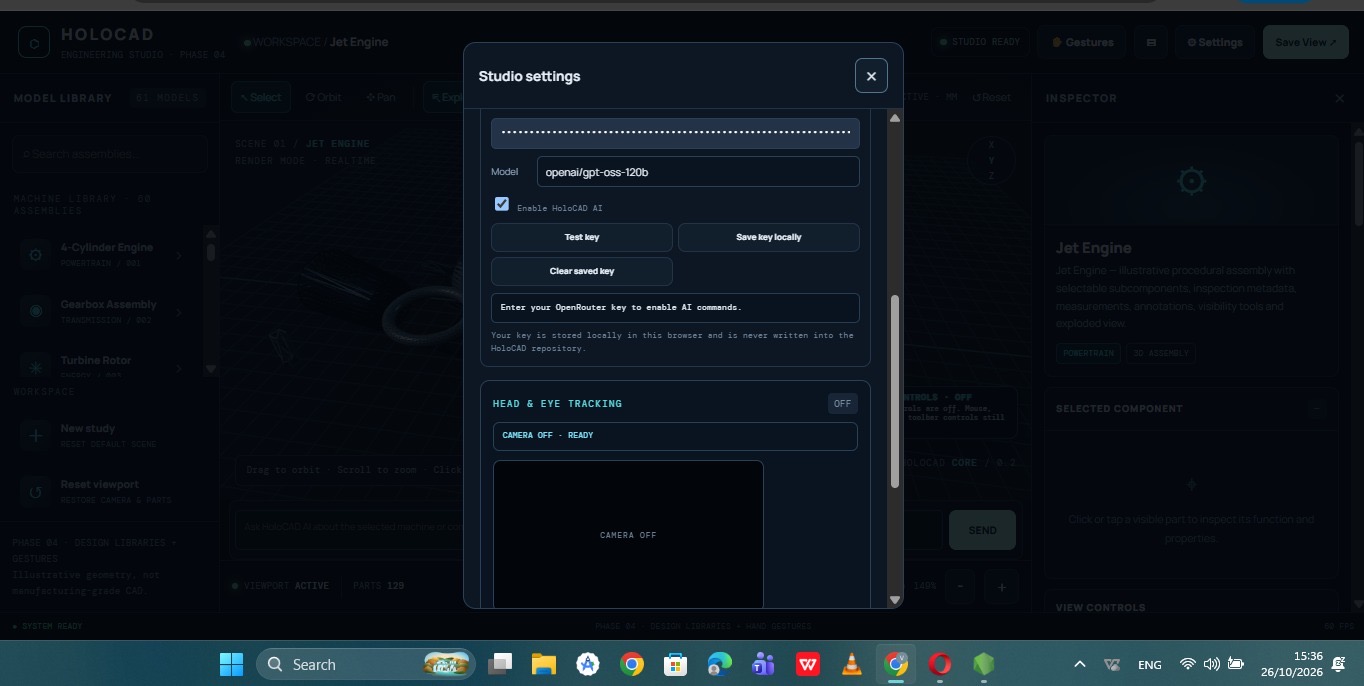
A longer-term possibility is to introduce an AI assistant that can help users identify machine components, explain their functions, and answer questions about the models they are exploring. This would be a future extension rather than a claim about existing functionality.
- A More Immersive Digital Workshop
We envision an environment where users can explore machine assemblies, manipulate individual components, switch visualization modes, and interact with engineering models through a combination of gestures and intelligent assistance.
Our ultimate goal is to make HoloCAD-3D a platform where interacting with complex machine designs feels less like navigating software and more like working directly with a digital engineering model.
HoloCAD-3D is our step toward a future where engineering interfaces are not just controlled by us — they respond more naturally to the way we interact with the world.
Built With
- backend
- chatgpt
- claude
- codex
- css
- frontend
- html
- javascript
- python

Log in or sign up for Devpost to join the conversation.