-
Eyemergency Logo
-
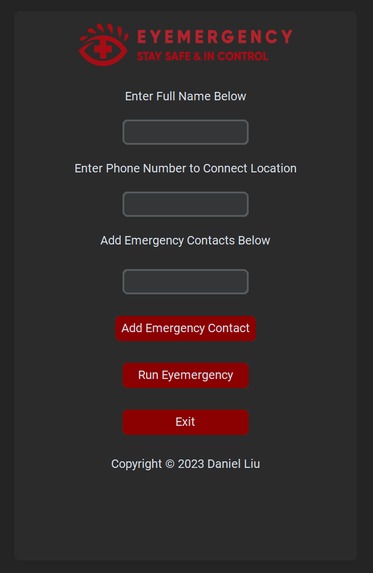
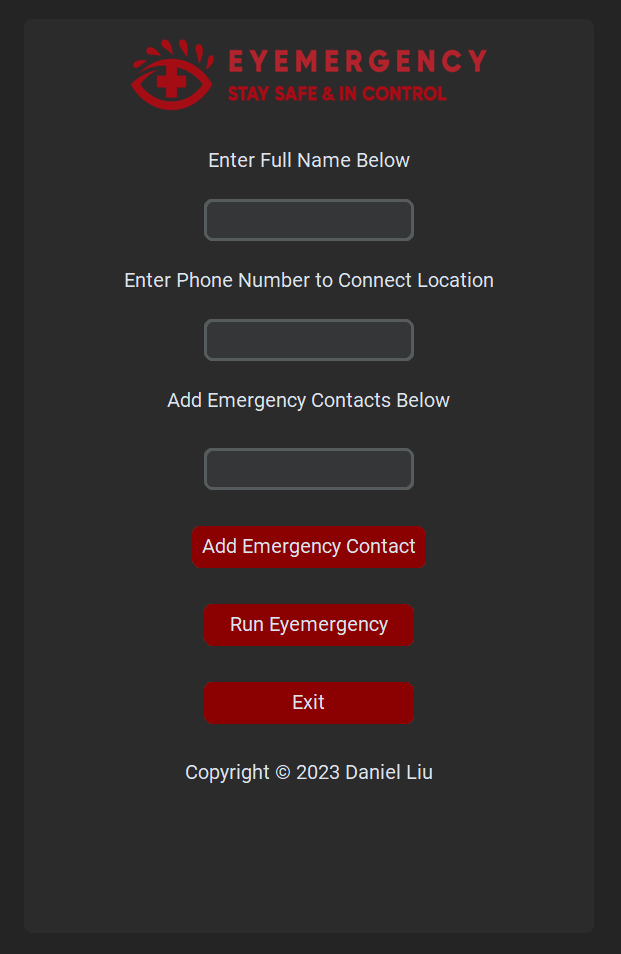
The frontend for Eyemergency, featuring input for name, phone number, and emergency contact list
-
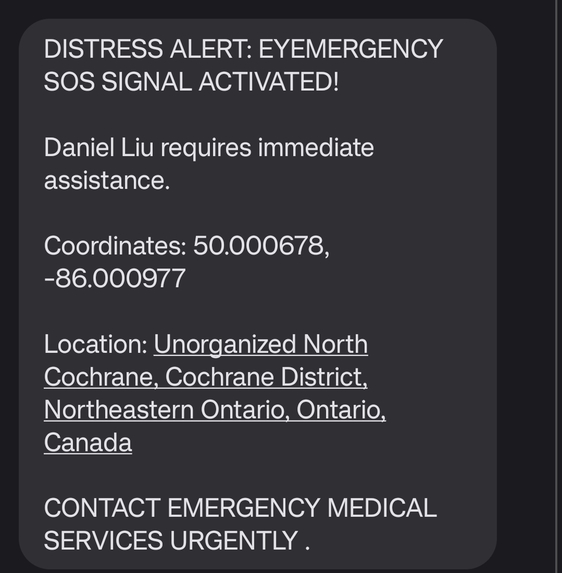
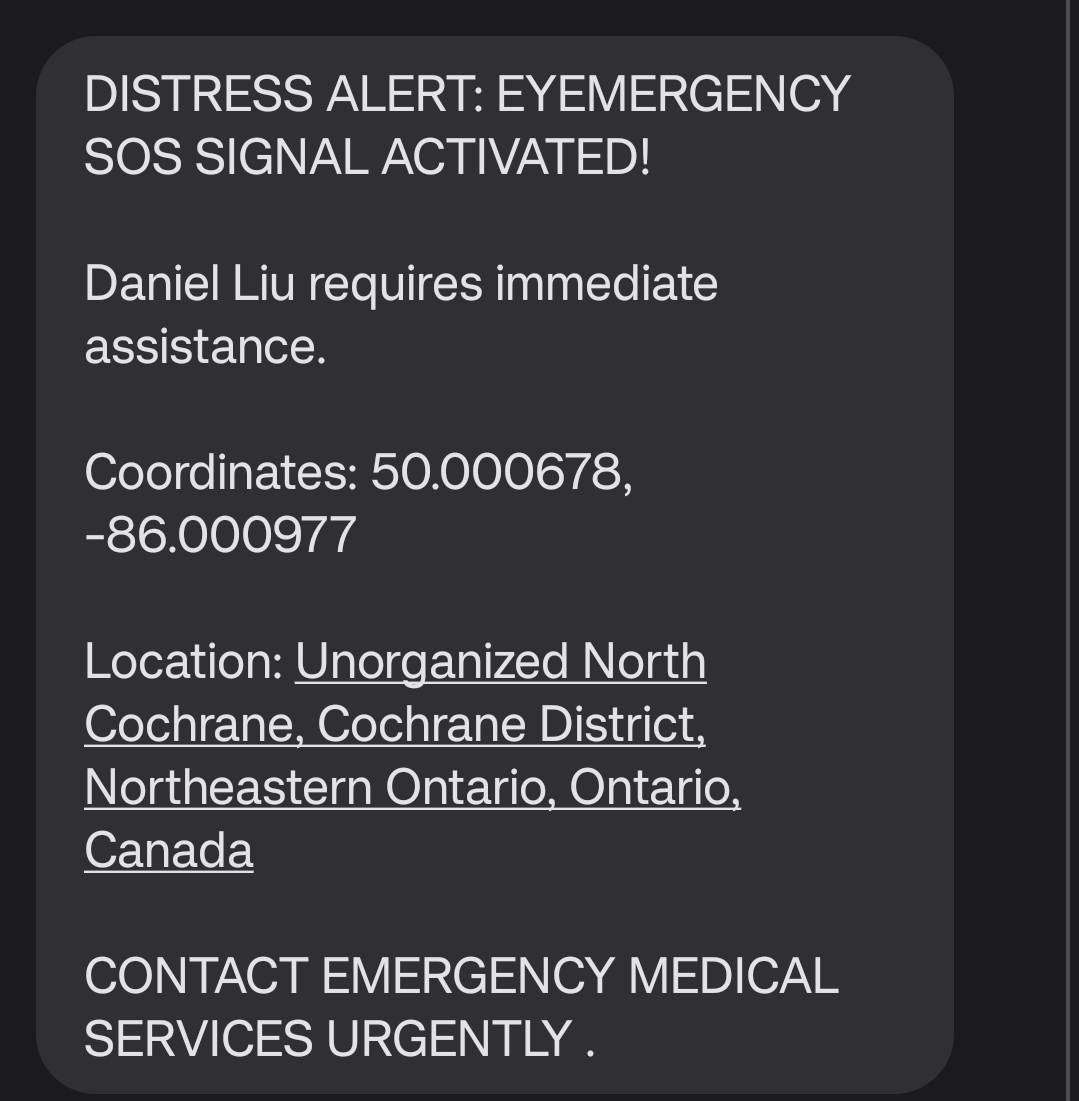
Emergency Distress signals that are generated by Eyemergency and sent to each person in the emergency contact list
Inspiration
In may instances when a person is in danger, they can just pull out their phone, dial 911, and easily reach a helpline. But what if people find themselves in a high-stress, potentially life-threatening situation, where traditional means of communication are just not practical or safe to use? For example, in home invasions, kidnappings, and abductions, grabbing your phone and calling 911 is practically impossible. Another example could be medical emergencies, where people are unable to speak of communicate verbally, such as if they're choking, having allergies, or other life-threatening symptoms. Finally, individuals with disabilities or special needs, who may have limited mobility or speech impairments will have an extremely hard time trying to call for emergency services in many everyday situations.
For Hack The North 2023, one of the first things that caught my eye were the AdHawk MindLink Glasses showcased at the sponsor booths. Although they look like ordinary glasses, MindLink glasses have incredibly powerful and useful abilities, such as determining user blinks and blink durations. This is essentially what prompted me to begin developing Eyemergency, and my vision only got clearer as the project grew bigger and bigger.
What it does
Eyemergency is a cutting-edge eye tracking application designed to detect and respond to emergency situations using intuitive blink patterns. With the power of your eyes, it can trigger life-saving alerts or actions when you need them most.
If users ever find themselves in a dangerous situation where they are unable to contact the proper emergency services, they can blink the SOS morse code (3 short, 3 long, 3 short) to send a distress signal to a list of emergency contacts. This allows users to reach others in a safe and discreet way, without drawing attention using their voice or body gestures.
Importance of Eyemergency
Eyemergency provides a discreet and non-verbal method for individuals to send an SOS signal. This can be especially crucial in situations where speaking aloud may not be possible or safe, such as during a medical emergency, a home invasion, or when someone is trapped in a dangerous situation.
Eyemergency's SOS pattern is also based on a simple and internationally recognized code, making it accessible to people from various linguistic backgrounds. It doesn't rely on specific languages or dialects.
Being wirelessly connected via bluetooth, Eyemergency operates without the need for additional hardware or devices, reducing the need for individuals to carry specialized equipment. It seamlessly integrates with existing eye-tracking hardware, making it accessible to a broader audience.
How we built it
For the Frontend, I decided to create a simple but intuitive UI using tkinter and customtkinter, python packages that act as frameworks to create customizable interfaces.
In terms of Backend, Eyemergency was built entirely using python. I also utilized Twilio, an API for creating programmable communication tools such as text messages, Geocoder, a python package that allowed me to calculate longitude, latitude, precise locations, and even perform reverse geolocation to convert a coordinate to a specific location.
Interfacing with the MindLink hardware was also done on Python using AdHawk's SDK and AdHawkAPI python packaging.
Challenges we ran into
One of the hardest challenges I faced when developing this project was the initial setup of AdHawk's SDK. Diving head-first into a hardware AND software I had absolutely no idea how to use was probably not the smartest choice, but I'm glad it payed off in the end. It also took me many hours just to get the example project running, and to properly calibrate, configure, and connect the glasses wirelessly to my laptop.
Another challenge I faced when developing this project was the sheer amount of work I had to finish, as a single person. Again, this was probably not the smartest choice, but I enjoyed the freedom of learning new software and hardware at my own pace, and having the freedom to design and code anything I want whenever I want.
Accomplishments that we're proud of
Although I have previously attended Hack The North virtually in 2021, this is my first time ever attending any in-person Hackathon, and it's been an amazing experience. This is also the first time I ever completed a hackathon solo, so I'm really proud of everything I was able to accomplish being just one person.
Additionally, this is the very first time I've ever tinkered with anything hardware-related. I've always stuck closely to software in past hackathons, or relied on the same programs/sponsors to create my projects, but this was the first time I decided to go outside my comfort zone and tackle something that was entirely new to me. I've never programmed in Python to this extent, or used any of the APIs and softwares in this project before, so I'm really proud of the complexity of my project, and the polish I was able to put into it.
What we learned
I learned so much during this Hackathon, and am so excited to continue developing my skills and passion in these areas in the future. In the past, the whole concept of APIs was really unclear to me, but after having been exposed to a multitude of APIs such as Twilio, Geocoder, and even AdHawk's very own API, I finally feel like I have a solid grasp on these topics.
I've also learned a lot about Python, and how the environment works. I learned how packages and libraries worked, how to import and use each package's various methods and tools, how to integrate APIs into Python, how to code both frontend and backend in python, and much much more.
Of course, I learned so many new things about AdHawk's MindLink hardware, especially how the backend side of things handles events such as blinking. I also learned how to properly calibrate eye-tracking devices using AdHawk's interactive fitting application, which was really interesting to learn the intricacies of these kinds of devices.
What's next for Eyemergency - Stay Safe & in Control
One important feature that still needs to be implemented it to package Eyemergency into an apk so that it could run on an android device. To accomplish this, I will use Kivy, a python framework for mobile app development, and Google Colab and Buildozer to package and initialize the app into an apk.
Currently, Eyemergency uses the users SMS to determine an approximate location, which isn’t very accurate. To solve this, I plan to use Google’s Geocoder API to provide some much needed location precision.


Log in or sign up for Devpost to join the conversation.