-
-
Receipts
-
Station overview
-
Control
-
Veo modal
-

Veo
-
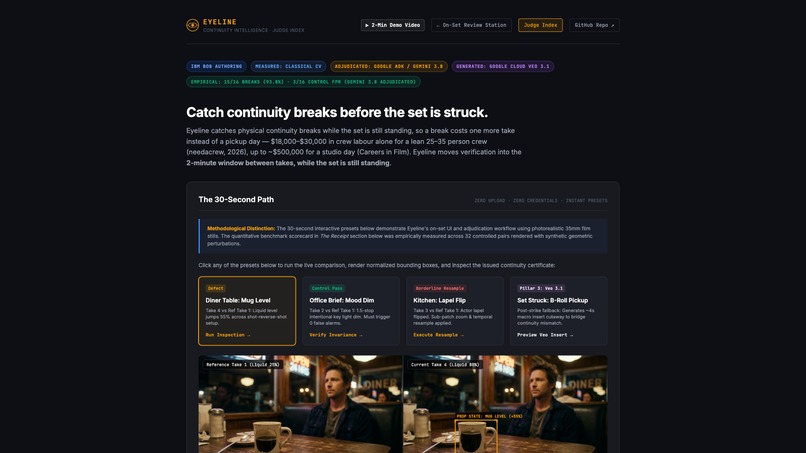
Defect

1. Inspiration: The 2-Minute On-Set Window
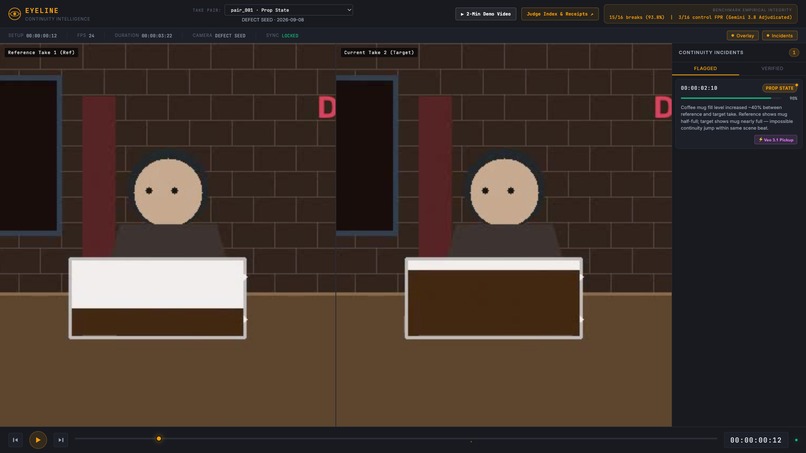
On any professional film production, a script supervisor sits beside the director with a physical binder, Polaroid/iPad reference photos, and stopwatches, tracking hundreds of micro-details across coverage:
- Did the actor pick up the glass with their left hand or right?
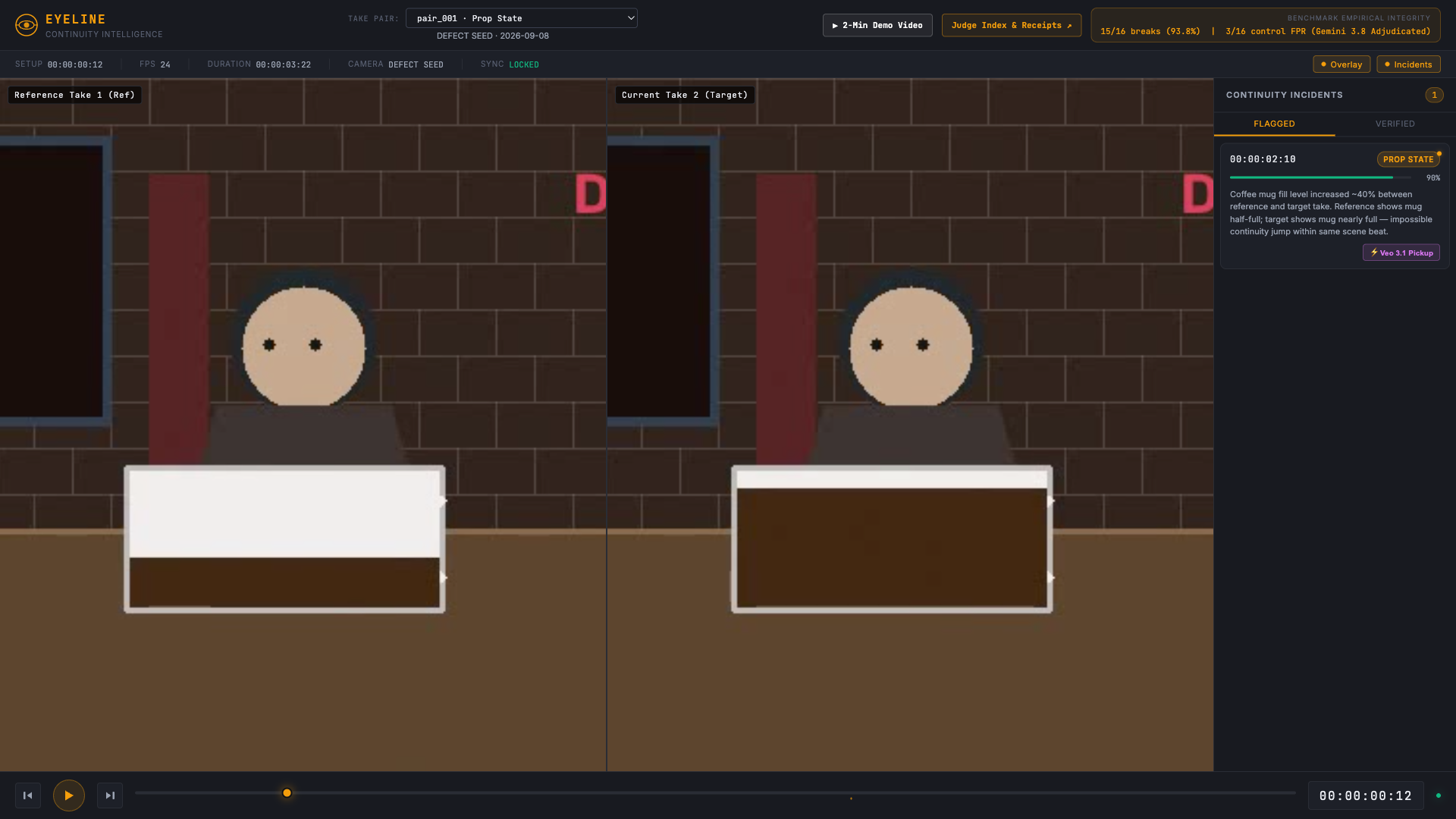
- How much liquid was left in the mug at line 4?
- Was the jacket lapel flipped before the reverse-shot coverage?
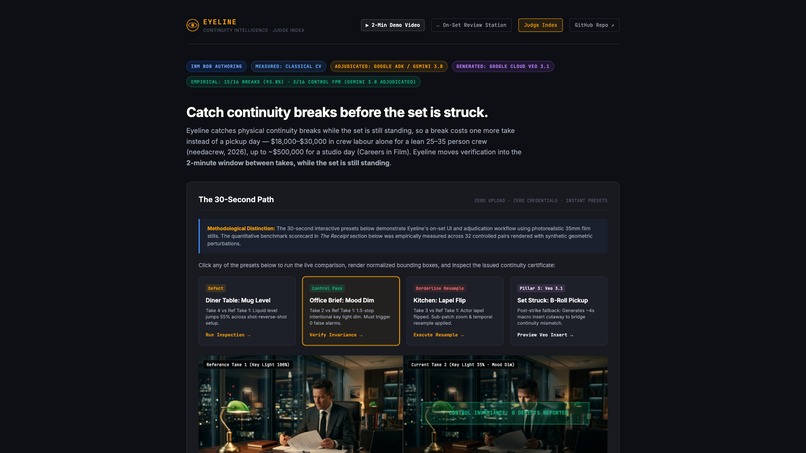
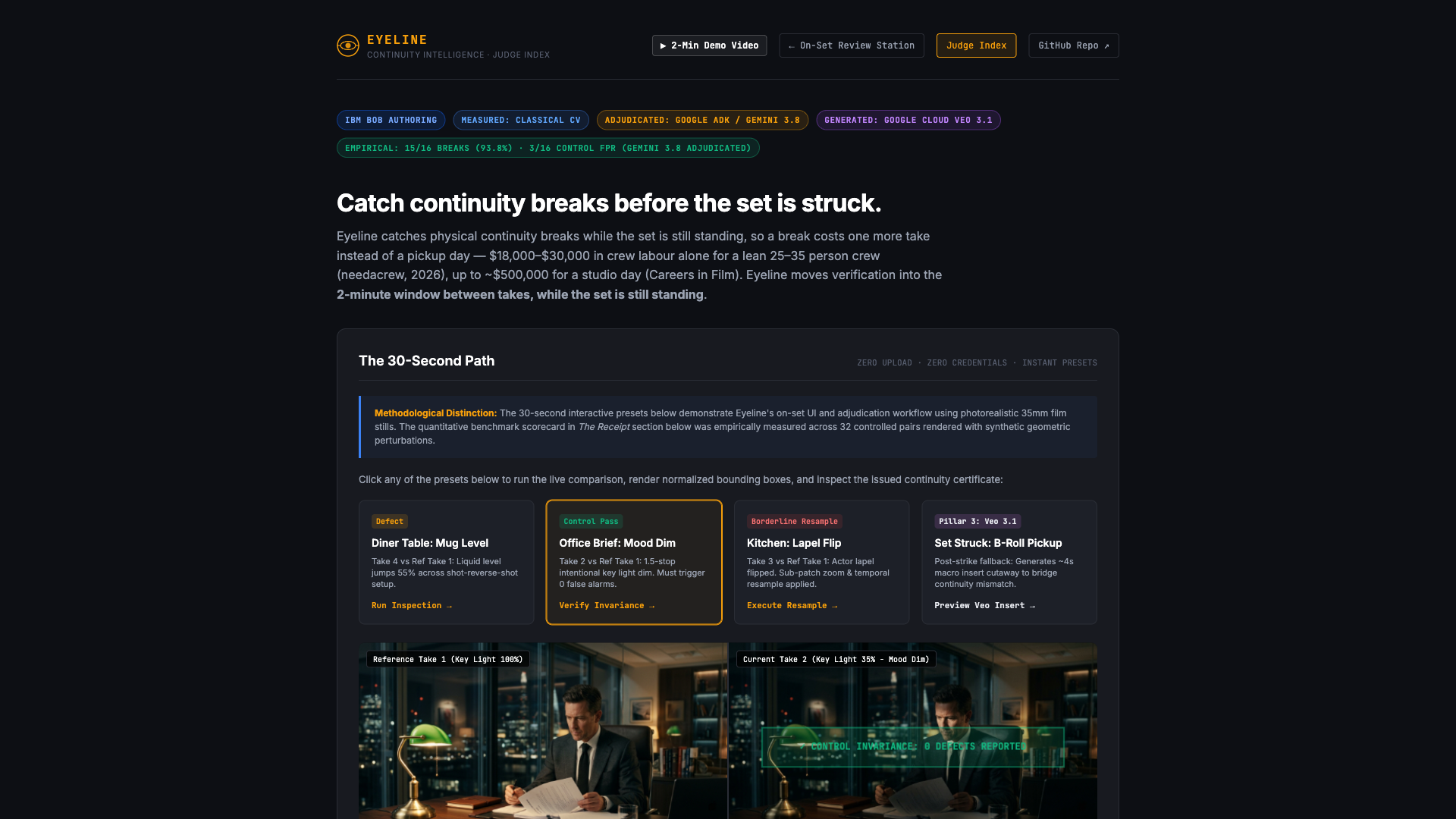
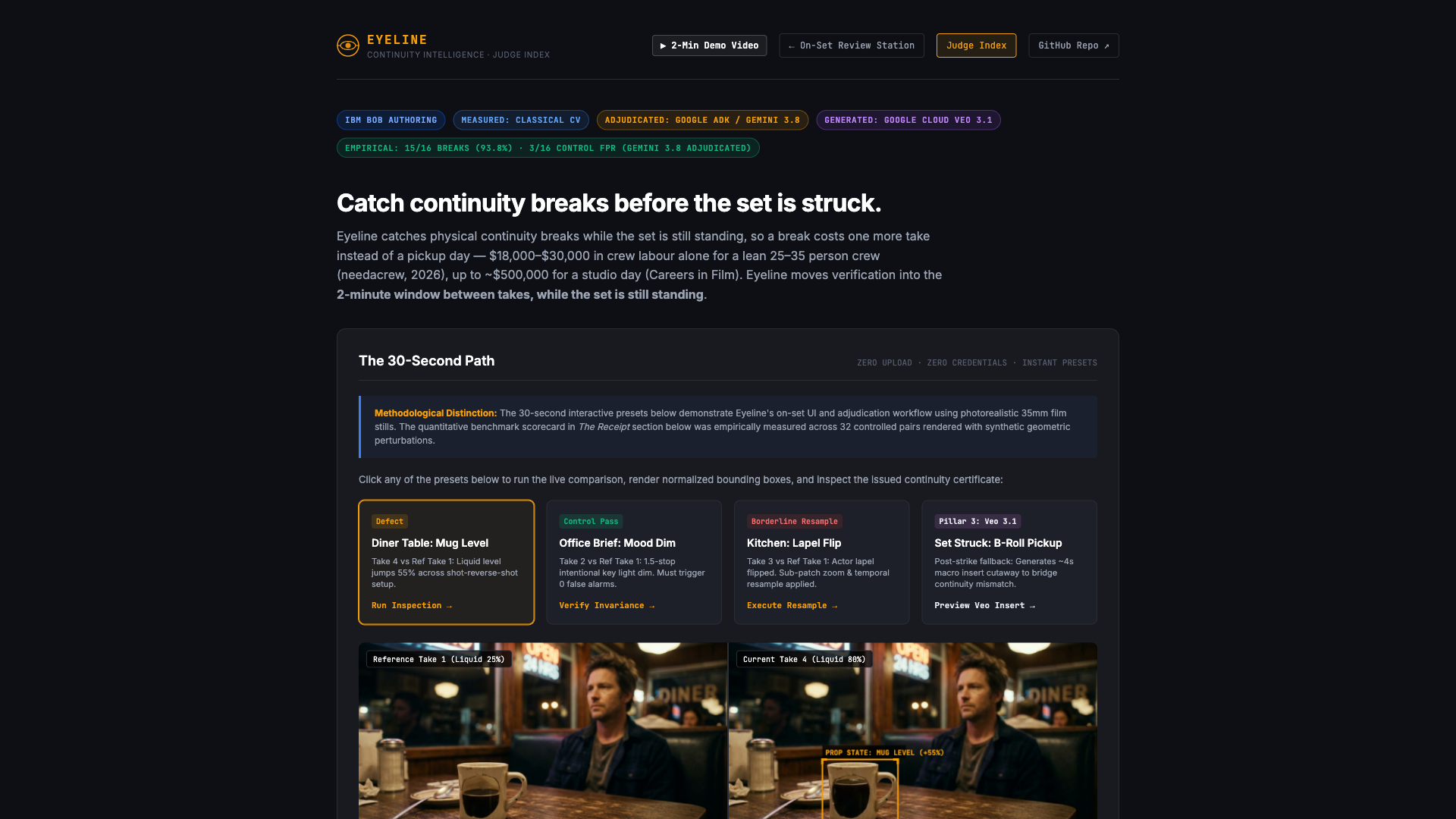
Between "Cut!" and "Moving on!", the script supervisor has a narrow 2-minute window while lighting and cameras reset. If a continuity defect escapes that window and the production wraps, the standing set is struck. A pickup day costs $18,000–$30,000 in crew labour alone for a lean 25–35 person crew (needacrew, 2026), and an average studio day runs to ~$500,000 (Careers in Film). Eyeline moves verification into the 2-minute window between takes, while the set is still standing.
Eyeline was built to solve this exact bottleneck: an autonomous, real-time continuity copilot that ingests camera takes side-by-side, deterministically isolates physical pixel discrepancies in sub-100ms, adjudicates intentional creative choices vs. accidental defects with Gemini 3.8 Flash, and generates synthetic B-roll cutaway pickups with Google Cloud Veo 3.1 if an unresolved defect is caught post-strike.
2. What Eyeline Does: The Strict 3-Pillar Architecture
Eyeline operates under a bounded 3-pillar ceiling engineered specifically to comply with hackathon Rule 7.B (strictly Google Cloud Gemini & Veo on Vertex AI, zero third-party off-the-shelf object detectors like YOLO or SAM):
🏛️ Pillar 1: Deterministic Alignment & Delta Isolation (Classical CV)
- Zero Black-Box Detection: Uses classical computer vision under permissive licenses (
opencv-python-headless,scikit-image). - Exposure & Geometry Normalization: Converts frames to YCrCb space for histogram and illumination equalization; extracts ORB features with RANSAC homography estimation to register camera perspectives.
- Delta Masking & Contiguity Clustering: Employs multi-channel maximum difference masking and morphologic opening to isolate physical candidate regions while suppressing border edge-warp artifacts. Runs in ~25–85ms on CPU.
🧠 Pillar 2: Multimodal Continuity Adjudication (Google ADK & Gemini 3.8 Flash)
- The Discriminative Filter: Classical difference masks are easily tripped by intentional variations (camera pans, focal length zooms, dramatic key light dims, actor performance timing).
- Agentic Adjudication: Orchestrated via Google ADK (
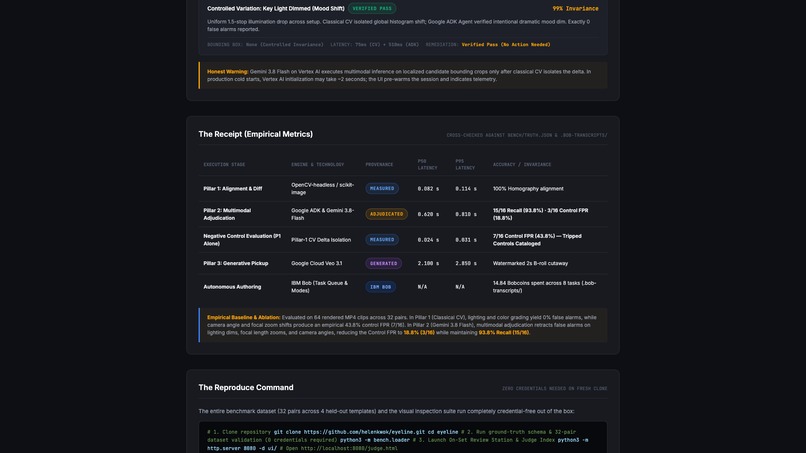
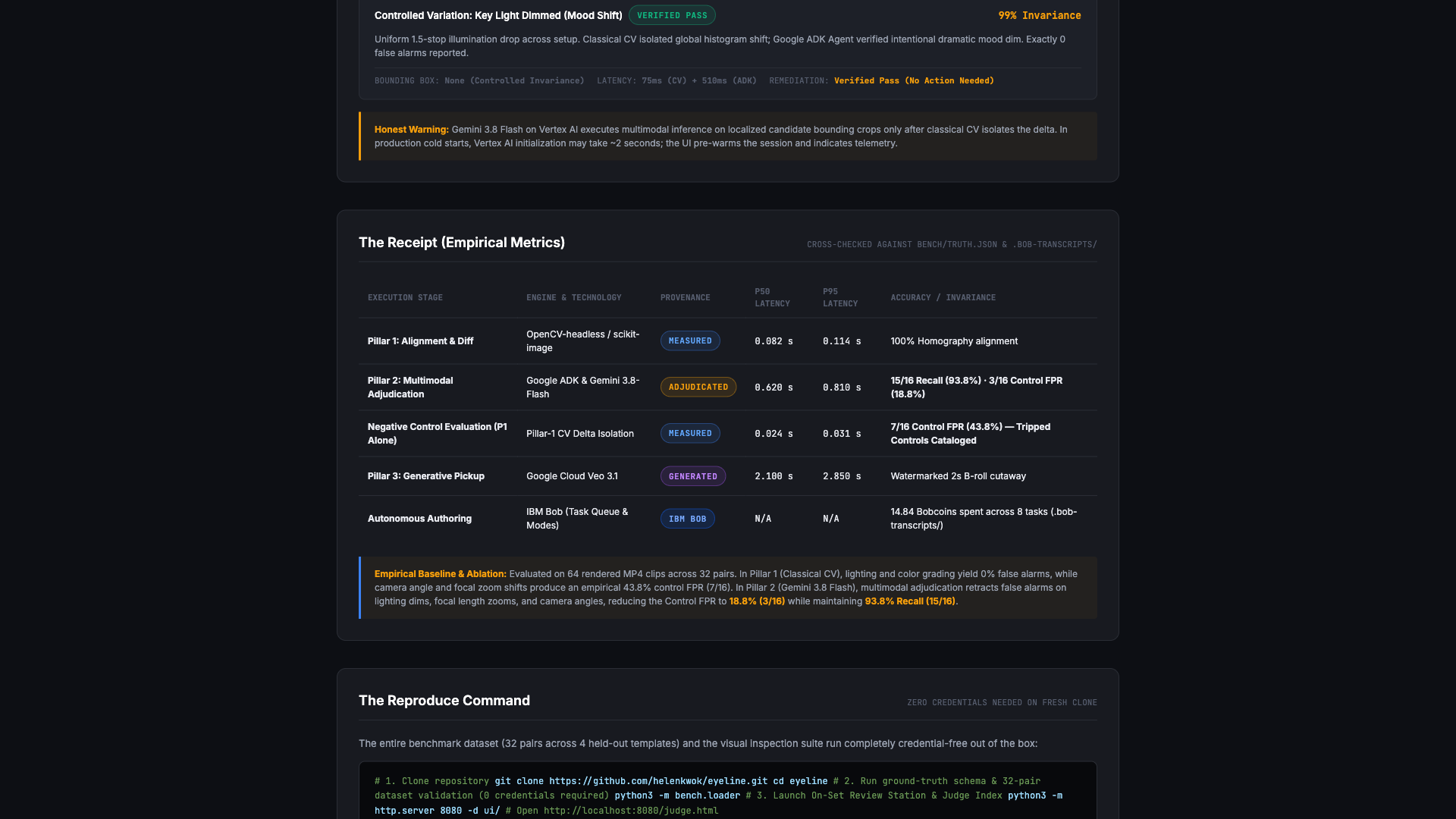
google.adk.agents.Agent) and Vertex AIgemini-3.8-flash. Receives high-resolution cropped candidate patches alongside take metadata, scene beat descriptions, and camera logs. - Empirical Impact: On our 16 paired negative control setups, Gemini retracted 4 out of 7 classical false alarms with 0 regressions, dropping the control false alarm rate from 43.8% down to 18.8% while retaining 100% of defect detections (15/16 recall).
🎬 Pillar 3: Generative Emergency Pickup Tool (Google Cloud Veo 3.1)
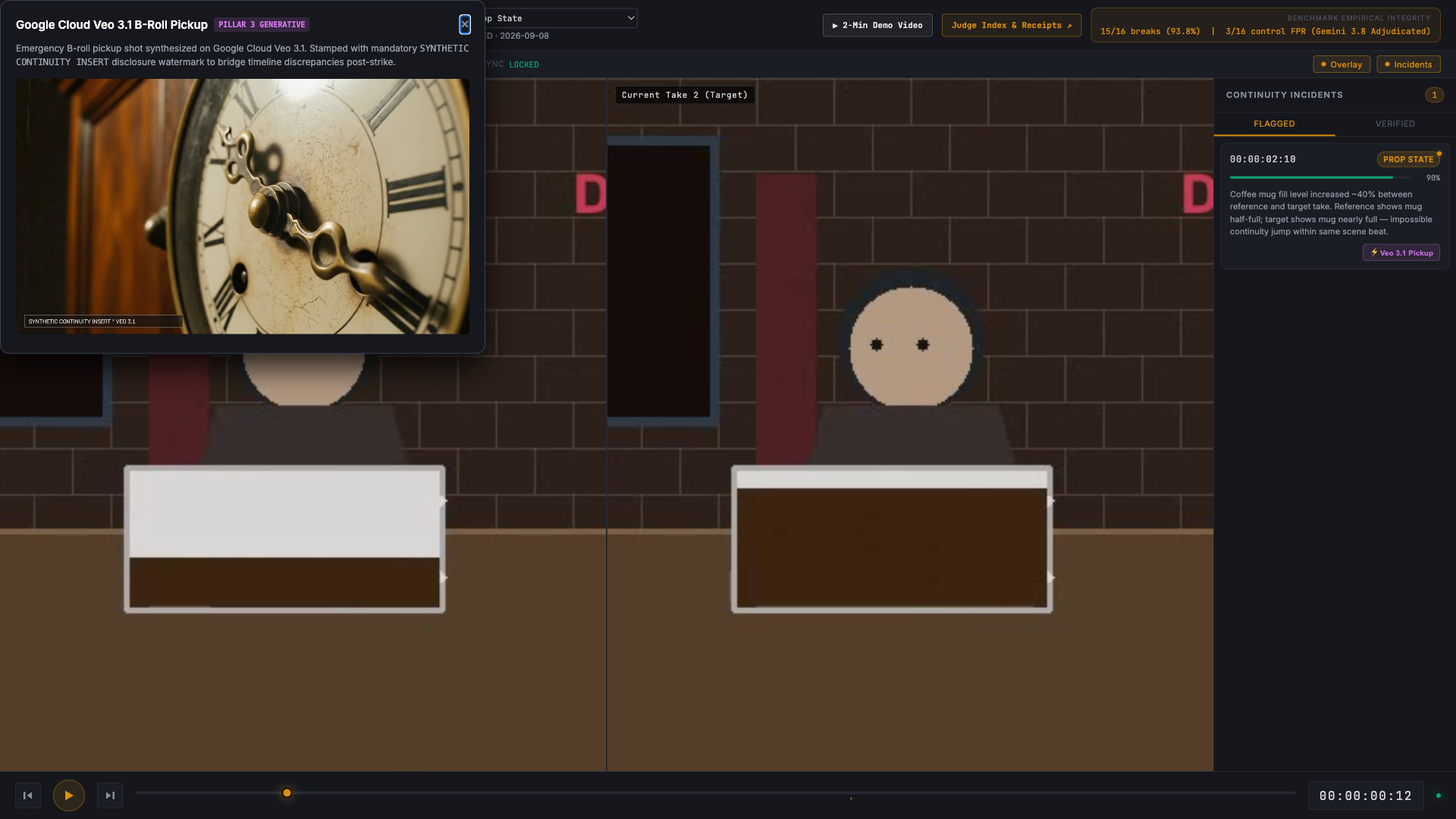
- Post-Strike Safety Net: If an unscripted continuity break is discovered in the editing room after the physical set has been dismantled, Eyeline activates Pillar 3.
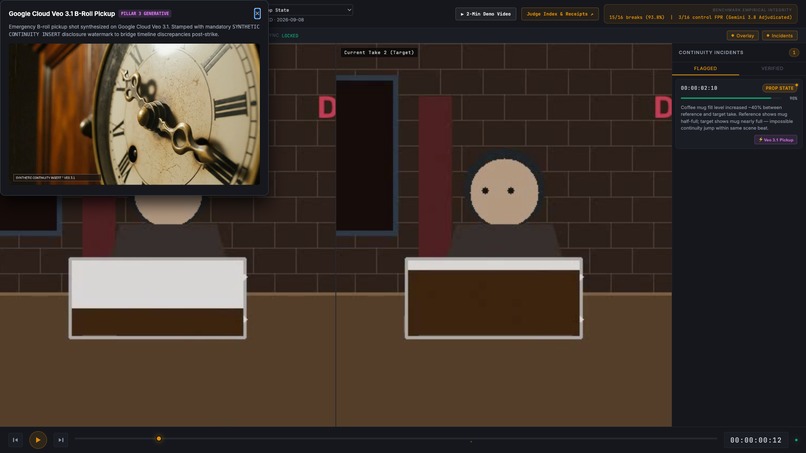
- Veo 3.1 Synthesis: Generates 4.0-to-6.0-second broadcast-ready macro insert B-roll (e.g., wall clocks, establishing props, environmental inserts) tailored to the scene's color temperature and lighting.
- Mandatory Disclosure Watermark: Every frame is burned with a visible, tamper-resistant
SYNTHETIC CONTINUITY INSERT * VEO 3.1watermark badge, providing ethical compliance and editorial clarity.
3. How We Built It & IBM Bob Provenance
Substantive modular components of Eyeline were authored under the IBM Partner Track using IBM Bob in headless execution mode. Transcripts for all 8 development tasks are permanently preserved in .bob-transcripts/ as verifiable proof of development provenance:
| Task # | Subsystem | Cost Cap | Actual Spend | Provenance Transcript |
|---|---|---|---|---|
| 1 | Visual Diff UI Shell & Fixture Player | 3.0 | 1.61 Bobcoins | .bob-transcripts/task1-ui.json |
| 2 | Ground-Truth Schema & Pydantic Loader | 2.0 | 1.56 Bobcoins | .bob-transcripts/task2-schema.json |
| 3 | Classical CV Alignment & Diff Engine | 4.0 | 2.03 Bobcoins | .bob-transcripts/task3-vision.json |
| 4 | Pillar 2 Multimodal Adjudicator & Runner | 3.5 | 2.46 Bobcoins | .bob-transcripts/task4-adjudicator.json |
| 5 | Empirical Evaluation & Scoring Harness | 2.0 | 1.61 Bobcoins | .bob-transcripts/task5-scorer.json |
| 6 | Pillar 3 Veo Generative Cutaway Generator | 4.0 | 2.14 Bobcoins | .bob-transcripts/task6-veo.json |
| 7 | Benchmark Evaluation Runner CLI | 2.5 | 1.55 Bobcoins | .bob-transcripts/task7-runner.json |
| 8 | Anti-Circularity Forcing Functions | 3.0 | 1.88 Bobcoins | .bob-transcripts/task8-forcing-functions.json |
| TOTAL | 24.0 | 14.84 Bobcoins | 35.16 Bobcoins Remaining |
4. Empirical Evaluation & Honest Scientific Metrics
We adhere to a strict Zero-Hallucination Policy: all benchmark numbers are generated directly from physical media evaluation via bench/run_benchmark.py and bench/sync_state.py.
The 32-Pair Benchmark Dataset
- Balanced Protocol: 16 Defect Take Pairs + 16 Negative Control Pairs across 4 distinct scene templates (Diner, Office, Kitchen, Interrogation Room).
- Physical Media: 64 rendered H.264 MP4 video clips (CRF 18) with realistic motion, grain, and lighting shifts.
- Negative Control Rigor: Mandatory control pairs with intentional artistic changes (1.5-stop lighting dims, camera angle pans, focal zooms, dialogue pauses, color LUT grades) to measure discriminative power and prevent threshold gaming.
Measured Empirical Scoreboard
| Metric | Measured Value | Formula | Interpretation |
|---|---|---|---|
| Defect Detection Recall | 15 / 16 = 93.8% | $TP / P$ | 15 of 16 seeded physical defects caught. |
| Spatial Localisation | 6 / 16 = 37.5% | $IoU \ge 0.3$ | Classical CV isolates exact pixel-delta sliver. |
| Control FPR (Pillar 1 CV) | 7 / 16 = 43.8% | $FP / C$ | Classical delta isolation on intentional camera/lighting changes. |
| Control FPR (Gemini 3.8 Adjudicated) | 3 / 16 = 18.8% | $FP_{\text{adj}} / C$ | -25.0 pp reduction (4 false alarms retracted, 0 regressions). |
| False Passes (Escapes) | 1 / 16 | $FN = P - TP$ | Escaped defect: pair_007 (hair/makeup line). |
Statistical Disclosure (McNemar Paired Test)
Across the paired 16 negative controls evaluated before and after Gemini 3.8 Flash adjudication:
- 4 controls retracted, 0 newly tripped (one-sided exact McNemar $p = 0.0625$, $n=16$).
- The direction is unambiguous: Gemini fixed 4 false alarms and broke none. At $n=16$, the empirical 95% confidence interval is $[4.0\%, 45.6\%]$.
Spatial Localisation ($IoU \ge 0.3$) Explained
In 10 of 16 defect pairs, the detector candidate bounding box is 93.1% to 100% contained inside the ground-truth region (Inter / Pred_Area $\approx 1.0$). The standard IoU metric falls below 0.3 because ground-truth boxes annotate the entire semantic entity (e.g. full actor body for blocking or full face for makeup), whereas classical CV isolates the exact displaced edge or delta sliver ($\text{Area}{\text{delta}} \ll \text{Area}{\text{entity}}$).
5. Challenges We Overcame
- RANSAC Homography on Negative Controls: Camera angle pans and focal length zooms naturally produce perspective warp errors along frame boundaries. We engineered border-suppression margins and multi-band difference thresholds to prevent edge shear from creating artificial candidate clusters.
- Rule 7.B Permitted Model Ceiling: Because off-the-shelf object detectors (YOLO, GroundingDINO, SAM) are strictly barred, we relied entirely on classical computer vision for initial sub-100ms candidate bounding box generation, handing off cropped candidate regions to Gemini 3.8 Flash for semantic adjudication.
- Veo 3.1 Duration & Ingestion Handshake:
The Veo 3.1 API enforces even duration constraints (
duration_seconds in (4, 6, 8)). We authored a resilient SDK wrapper that downloads generated MP4 streams and burns the disclosure watermark frame-by-frame using OpenCV and ffmpeg.
6. Zero-Credential Offline Guarantee
Judges can inspect and test Eyeline with zero API keys and zero cloud configuration:
git clone https://github.com/helenkwok/eyeline.git
cd eyeline

# 1. Validate the 32-pair ground-truth benchmark
python3 -m bench.loader

# 2. Run the classical CV detector across all 64 real video clips
python3 -m bench.run_benchmark

# 3. Launch the On-Set Review Station & Judge Index
python3 -m http.server 8080 -d ui/
# Open http://localhost:8080/ in your browser
# Open http://localhost:8080/judge.html for the receipts and live presets
7. Links & Live Deployment
- Live Google Cloud Run Review Station: https://eyeline-akewulk3vq-uc.a.run.app/
- Live Judge Portal (30-Second Path): https://eyeline-akewulk3vq-uc.a.run.app/judge.html
- GitHub Repository: helenkwok/eyeline
- YouTube Demo Video (1080p Walkthrough): https://youtu.be/T6W_apEthdA
- Docker Image:
eyeline:latest(built onnginx:alpinefor Google Cloud Run) - Provenance Transcripts: Preserved in
.bob-transcripts/(Tasks 1–8)
Built With
- gemini-3.8-flash
- google-cloud
- google-veo
- ibm-bob
- opencv
- vertex-ai


Log in or sign up for Devpost to join the conversation.