Inspiration
bold Me and my team members thought that there are people in the modern world that for some reasons cannot type in a "conventional way" i.e. using keyboard. We were inspired by Intel who made a Stephen Hawking's wheelchair with inbuilt software which enabled him to write and communicate.
What it does
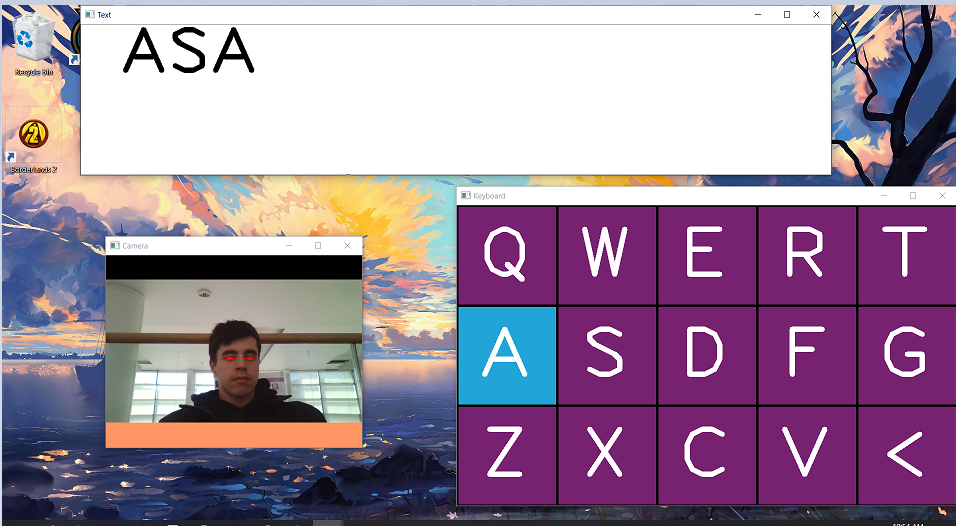
bold Our program uses pre-trained neural network in order to detect edges of the eyes. And then this input is used to estimate what letter is selected.
How I built it
bold First stage: We chose python because it has a lot of useful and easy-to-use libraries. A deep research were conducted on topic of how people blink or/and squeeze their eyes. Then the results were analyzed and evaluated. Second stage: Multiple prototypes were made and later tested by all of our team members in order to find errors and malfunctions of our software. Third stage: Bug fixing and GUI creation
Challenges I ran into
bold The main challenge was that different people have non-identical eye alignment. Thus, we had to readjust your program to work for all types of users, However, small practice is required in order to get familiar with the app.
Accomplishments that I'm proud of
Firstly, we have managed to assemble this program in less than 24 hours. Secondly, a lot of python libraries were used in creation process and we are proud of being able to connect them. Lastly, we are glad that this program might help thousands of people in need.
What I learned
bold We have learnt how to use neural networks in order to create software which might help people. This project has inspired me to learn more about neural networks in the future.
What's next for Eye-traсking visual keybоard (ETVK)
bold We will be honored to work with NHS and help people who cannot speak and give them hope. Prosperous future.
Built With
- dli
- dlib
- machine-learning
- numpy
- nuumpy
- opencv
- python
- tensorflow

Log in or sign up for Devpost to join the conversation.