-
-
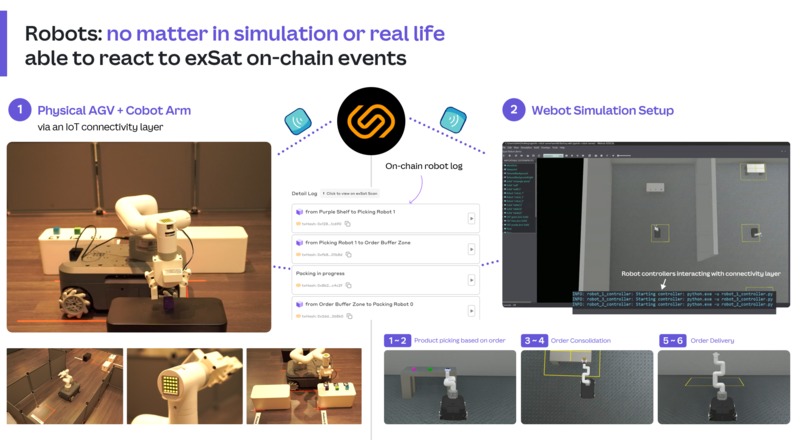
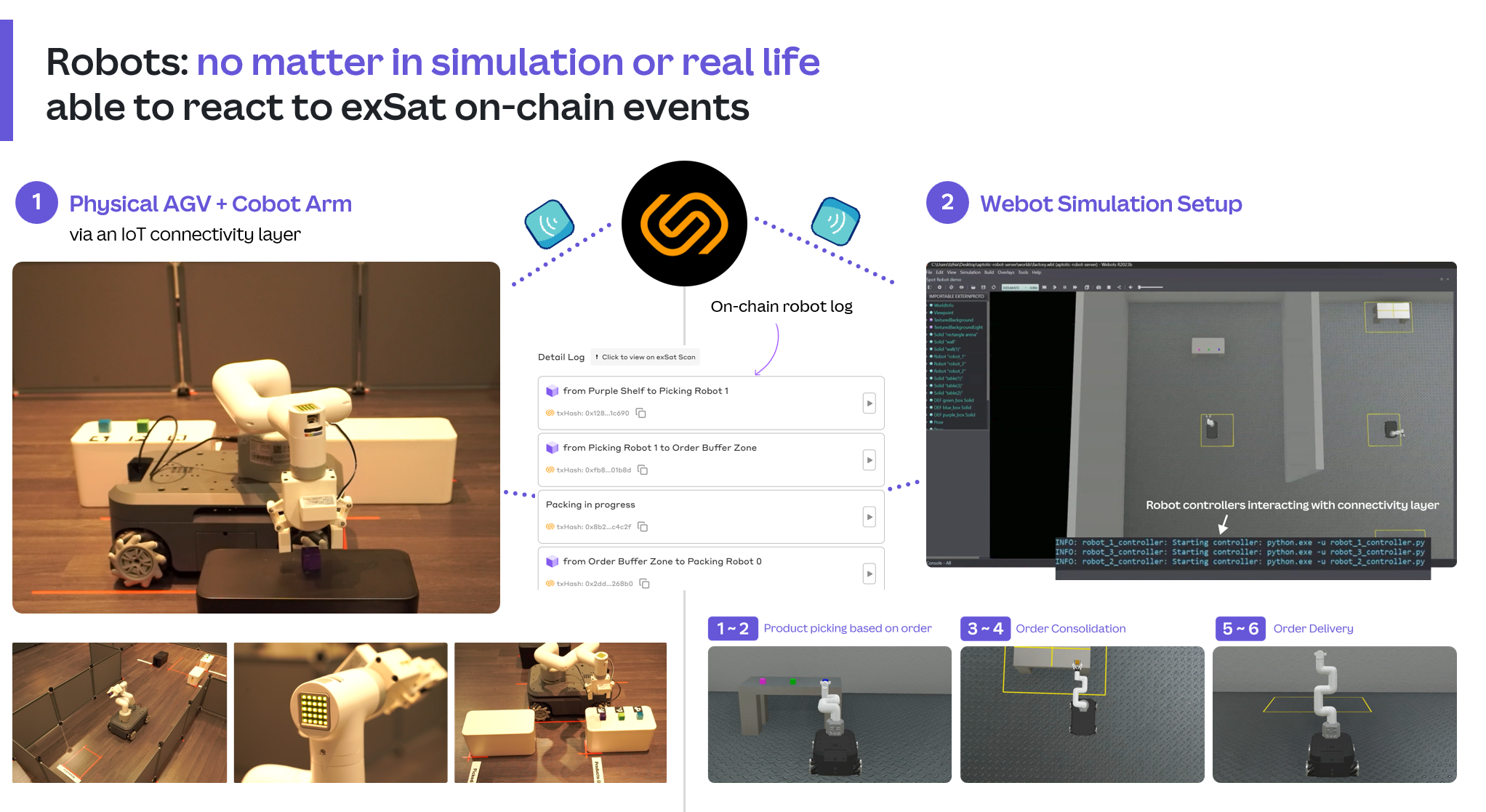
exSat-connected robots reacting to on-chain events in real-life and simulation
-
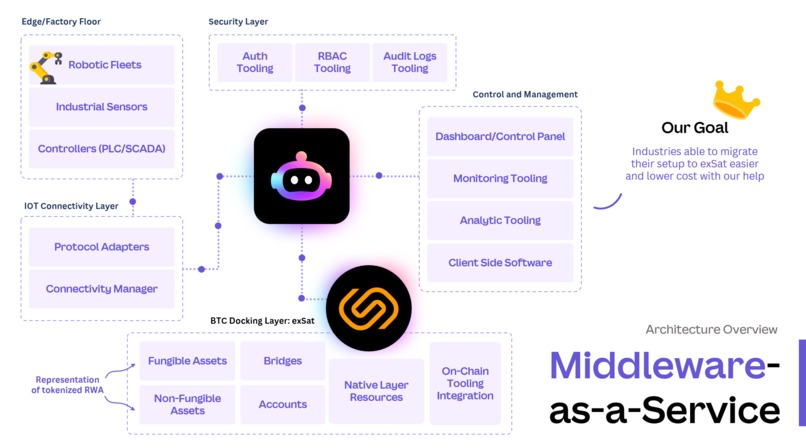
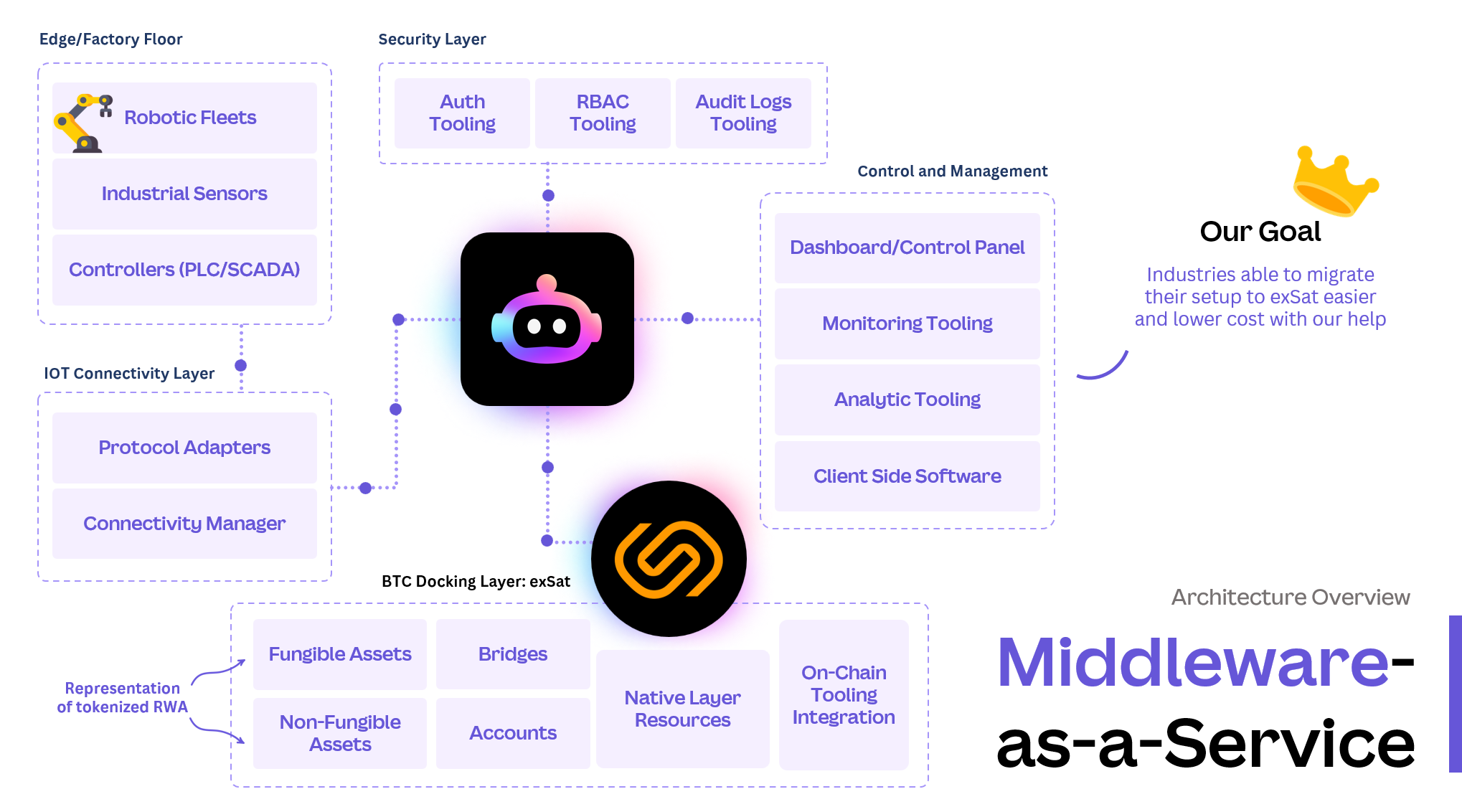
A high-level architecture overview of our hub concept.
-
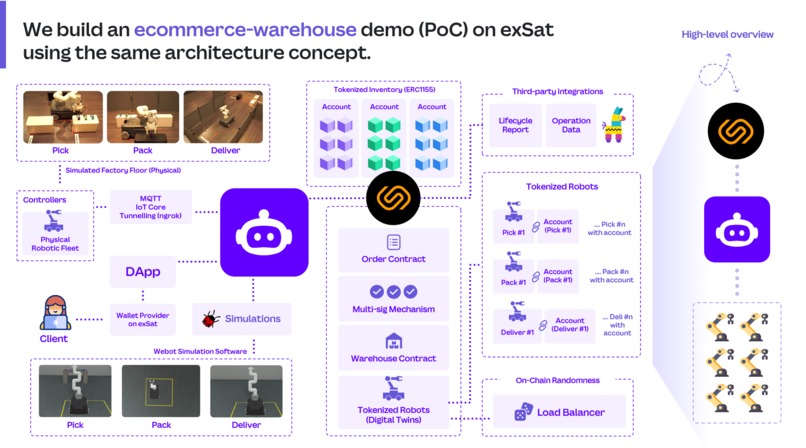
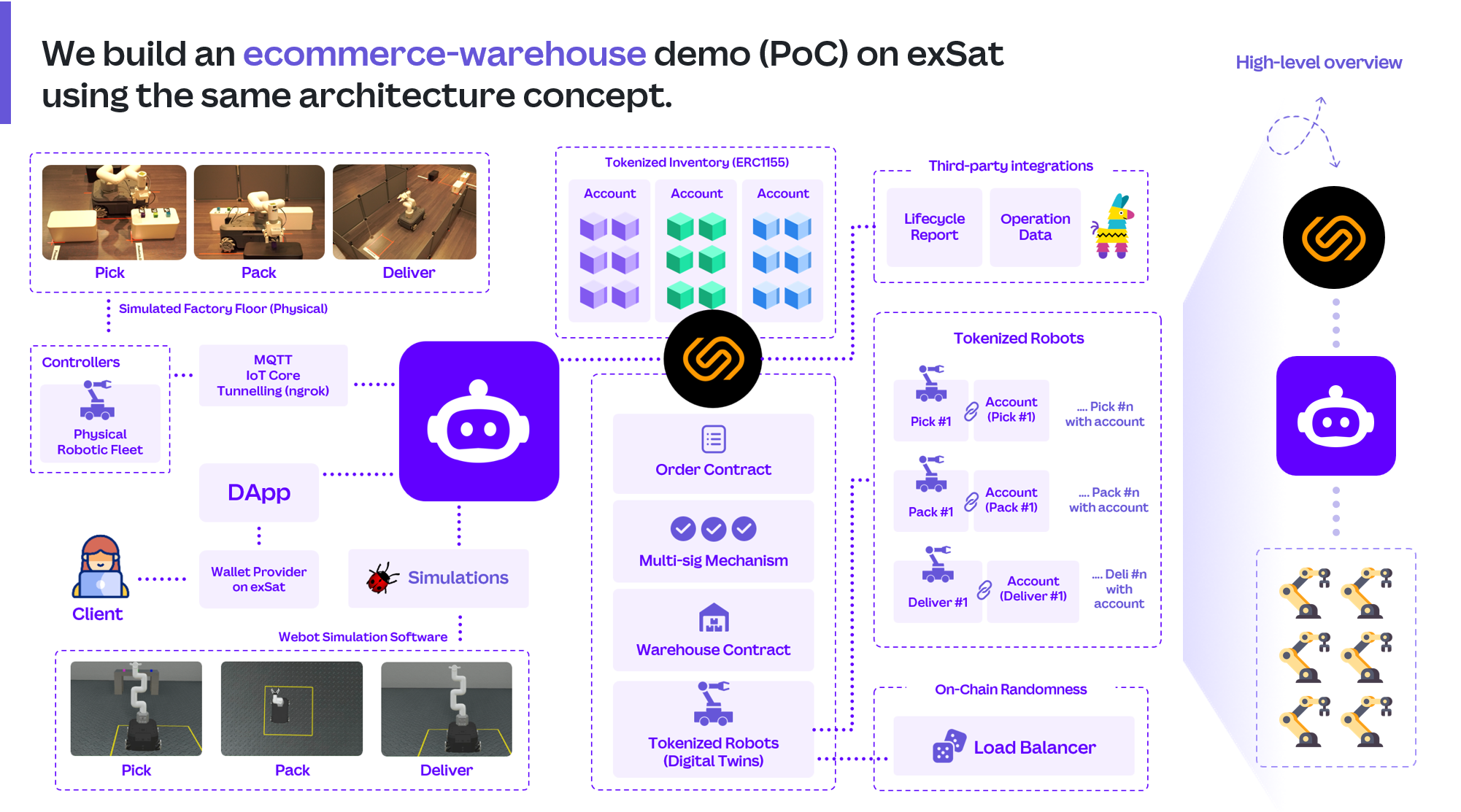
An implementation prototype based on the hub concept.
-
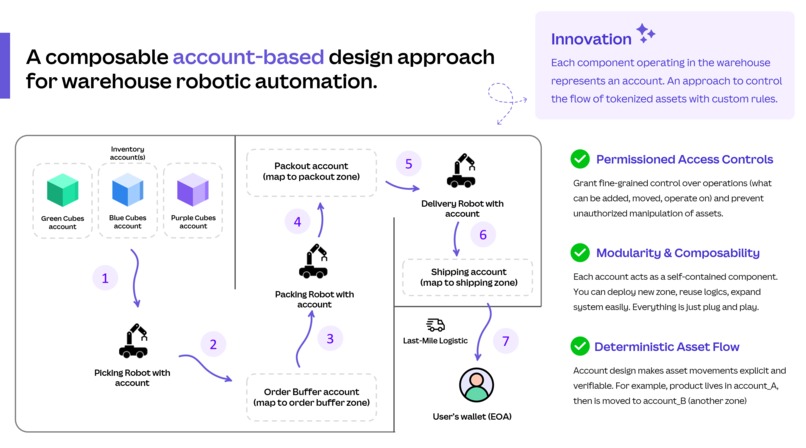
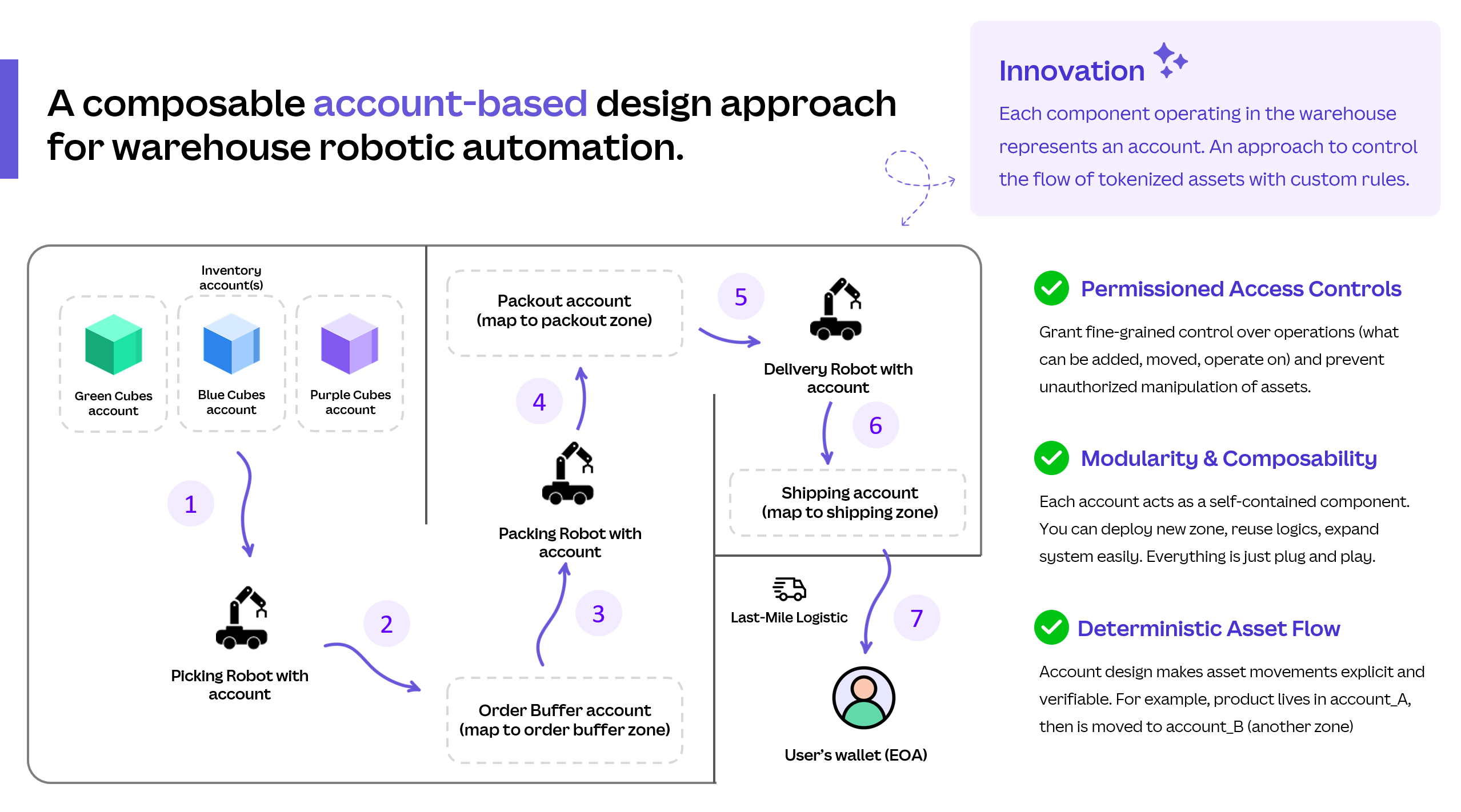
Concept illustration of the account-based design approach for warehouse robotic automation
📍TL;DR 👉 Industry Robots on Bitcoin
ExSat for Robotics is the first Middleware-as-a-Service that helps industries develop custom hubs to seamlessly bridge traditional warehouse robotic automation with the Bitcoin ecosystem. As industries increasingly adopt robotic operations, they often struggle with centralization caused by isolated warehouse data systems. Our tailored bridging solution enables the low-cost migration of complex robotic setups to exSat. Robots are tokenized into exSat-connected digital twins to manage tokenized inventories with on-chain operation records. Plus, our composable, account-based warehouse design provides fine-grained control over asset flow and high tracking efficiency. Load balancing via on-chain randomness, multisig-powered human-robot interactions, and operation components in exSat smart contracts are also combined to form a more robust robotic automation pipeline.
👊 Problem We're Tackling
Industrial warehouses are facing several challenges in 2025, including increased pressure to scale, rising labor costs, and workload spikes that exceed what humans alone can manage. As a result, many industrial warehouses are beginning to adopt robotic automation to enhance workflow speed and efficiency.
One of the key issues in robotic-powered industrial warehouses is data centralization, especially when operating within a Web2-based infrastructure. This challenge is further compounded by the industry's frequent adoption of distributed manufacturing strategies, which create complex supply chains involving multiple stakeholders and manufacturing units spread across various locations.
In a Web2-based robotic infrastructure, these parties often operate in silos due to disjointed and fragmented data systems, leading to information asymmetry. In other words, a robot system in one warehouse may collect data that is not shared with robots in another warehouse, making it difficult to achieve a unified operational view. The problems that arise from this include:
❌ Data is not Transparent:
Factories and warehouses operating their robotic fleets in an isolated data system or across various locations will create a "visibility gap" that limits transparency and access to real-time operational data for stakeholders.
❌ Low Efficiency + Track and Trace Challenge:
Workflow efficiency suffers due to the complex data integration processes that slow decision-making and create operational bottlenecks. This lack of transparency also complicates essential tasks like tracking the history of production or the handling of a product, even among connected facilities. The underlying reason is the lack of clear auditing trails that can be easily accessed, and this is a classic problem in the supply chain sector.
❌ Security Concerns:
Security concerns are heightened in Web2 environments, where mutable data is vulnerable to tampering and counterfeiting, which is considered a damage to the supply chain and distribution trust. Additionally, the risk of a single point of failure can lead to significant disruptions, cascading through the entire robotic automation operation.
💡 Inspirations: Really Motivated Us!
To address the problems, letting current industries' robotic setups transition and utilize an exSat-connected distributed data system is a smart move. The intuition behind it is simple: every action taken by a robot in a factory is recorded on the blockchain, making product movement, quality checks, and production steps fully transparent, traceable, verifiable, and tamper-resistant, significantly enhancing security and auditability for all supply chain stakeholders.
⚔️ Existing Solutions and Challenges
Existing solutions for implementing robotic automation in industries include a variety of software platforms (such as Gazebo and Webots), industry-specific solutions (like those from ABB, KUKA, and Fanuc), and integration tools (including ROS, AWS IoT, and Microsoft Azure IoT Hub). However, challenges emerge when considering the implementation of Web3 solutions in robotic automated operations. A significant hurdle is that the exSat ecosystem lacks robotics-related development tools to facilitate the integration of blockchain solutions with existing legacy systems, which are often incompatible.
A simple example: while developing a prototype for our demo, we found that no industry-grade robotic simulators offer tools for easily interacting with exSat EVM events to conduct simulations.
☹️☹️☹️ Although industries can create their own tools or middleware for exSat integrations, this approach can be costly, time-consuming, and resource-intensive. We need a solution to bridge the gap between industry robotic automation (Web2 layer) and the exSat ecosystem (Web3 layer).
💪 We launch exSat For Robotics (Our Solution)
Hence, our team decided to launch exSat For Robotics as the first B2B Middleware-as-a-Service (MaaS) provider, assisting industries across various sectors with industrial warehouse robotic automation by designing and developing a custom hub. This hub acts like a bridge, which connects all components in their robotic automation setup architecture to the exSat ecosystem. The benefit of using a custom middleware hub is that all of the important layers in the Web2-based robotic automation systems, such as the factory floor (physical hardware and robotics), IoT connectivity layer, security layer, and also control and management layer, are able to interact with the blockchain layer component easily (which involves on-chain tokenized assets, accounts, Bitcoin native layer resources, smart contracts, or any on-chain tooling integration). Our hub will now become the common interface for industries to connect all robotic components built by different languages, frameworks, hardware, and communication protocols into a unified Web3 system on exSat.
How do we help our industry clients? (Not Limited To)
🏭 Manufacturing: On-chain logs of robotic interactions, verifiable compliance, and audit trails for industrial goods.
🚚 3PL (Third Party Logistics) and Ecommerce: Real-time on-chain updates of your parcel handled by order fulfillment robots in the warehouse.
🧬 Pharmaceutical and Biotech: Products handled with robots are able to follow drug transparency regulations easily with verifiable traces.
🍄 Cold Storage: Verifiable robot handling of food and biotech products. Enhanced product lifecycle traceability.
✨ Proof of Concept: An Implementation Prototype
The implementation prototype we showcase in the demo video is built using the hub architecture concept that we proposed, which is able to operate a robotic-powered, small-scale e-commerce warehouse supply chain cycle. Further proving the feasibility of utilizing exSat solutions to solve real-world industry problems in our project. We have attached a high-level architecture diagram of our e-commerce warehouse demo setup above, with our custom hub being the most crucial middleware component to orchestrate the whole order fulfillment workflow.
🧩 Composable account-based design approach for warehouse robotic automation
We introduce an innovative and novel approach that is only possible to implement with blockchain implementation. We use accounts for our inventory and robots, with each digital twin mapped to a unique account. This is our composable, account-based design approach for warehouse automation. Every inventory shelf is treated as an account, and inventory tokens are transferred in. Each zone within the warehouse is also represented as an account, and each robot operating on the floor is assigned an account. During a single operation cycle, an inventory token flows deterministically from one account to another. This architecture provides us with better control and makes the system modular. A concept diagram is attached above to illustrate how a product token flows between each account and ends up being sent to the client for ownership.
🔌Connecting local robotic fleet to exSat
To further validate the feasibility of our implementation, we also perform testing on a physical robot, which we refer to as a local robotic fleet. The system is centered around the Hub as well, enabling industries to interact with an IoT connectivity layer (refer to the above architecture overview). This layer acts as an intermediary between the robotic fleet and the Hub, which is integrated with exSat. The IoT connectivity layer can incorporate various technologies such as AWS IoT Core, Microsoft Azure IoT, Oracle IoT Cloud, and MQTT-based solutions like RabbitMQ or Kafka, etc.
To simplify the demonstration, our team utilized ngrok to establish a secure communication tunnel between our physical robot—a combination of a ROS-powered CoBot and a mobile AGV (Automated Guided Vehicle), with operations built using the Elephant Robotics Python API—and initiated the order fulfillment process on our DApp. As shown in the demo video, the commands assigned from exSat are successfully captured and transmitted to the connectivity layer, where they are received and executed by the robot in real time. Once the task is completed, the operation is logged and sent back via the same route. This process mirrors what can be tested directly on our demo DApp.
We also replicated this functionality using our Webots simulation (hosted locally in Webots software) to control the robotic fleet. By creating an intermediate connectivity layer (via a Flask server) and utilizing the ngrok tunnel, we successfully recreated the same results as with the physical robot. You can see the full demonstration in the video!


Log in or sign up for Devpost to join the conversation.