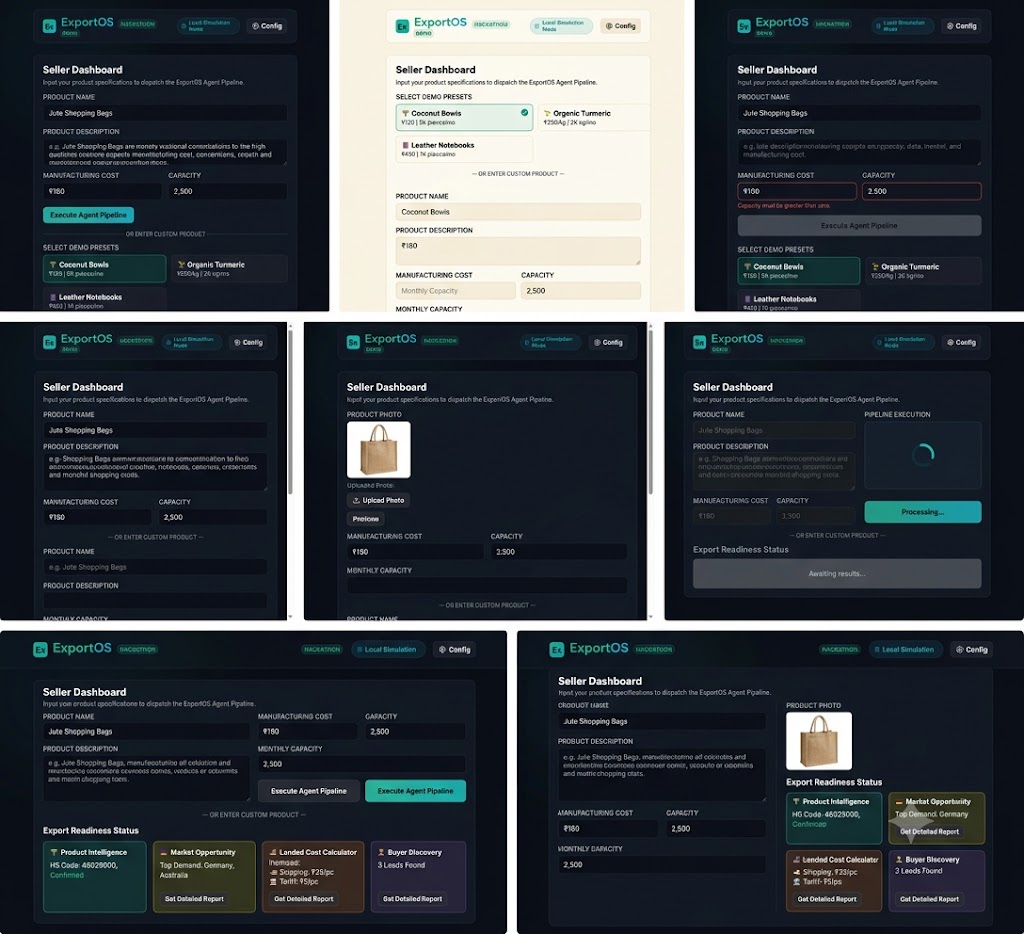
ExportOS
Inspiration
India has millions of manufacturers, artisans, and small businesses capable of producing genuinely world-class products — yet most of them never sell a single unit outside their own state, let alone abroad. The gap isn't quality. It's that exporting requires a small business owner to simultaneously become a market researcher, a cost accountant, a compliance officer, and a sales rep for a country they've never been to.
That gap is what we set out to close. We kept coming back to one idea: what if a business owner could just describe their product in plain language — "I make bamboo kitchenware, my cost is ₹180 a unit, I can make 10,000 a month" — and get back a real, actionable export strategy, the way a $5,000/month international trade consultant would produce one? Not a directory to browse. Not another marketplace to get lost in. An actual plan, with real buyers attached to it.
That question became ExportOS.
What it does
ExportOS takes a seller from "I have a product" to "I have an overseas buyer and a profitable export order." It recommends the best markets for a product, calculates real landed costs and margins, finds and scores actual potential overseas buyers, and drafts the outreach and quotations needed to close a deal — with a human approving every price and every message before it goes out.
How we built it
We designed ExportOS as a pipeline of specialist AI agents rather than one large prompt trying to do everything, because export decision-making genuinely breaks into distinct stages that each need different tools and different kinds of judgment:
- A Product Intelligence Agent classifies the product and drafts a candidate HS code from a description (and optionally a photo).
- A Market Intelligence Agent ranks target countries by demand, competition, and pricing headroom.
- A Landed-Cost Agent builds a full cost breakdown — manufacturing, packaging, freight, insurance, duties, platform fees — and computes margin.
- A Buyer Discovery & Scoring Agent surfaces potential overseas buyers and scores each one on fit, with the reasoning shown, not hidden.
- An Outreach & Sales Agent drafts messages and quotations for the seller to review.
An Orchestrator ties these together, holds session state, and rolls everything up into a single Export Readiness Score.
Two design decisions mattered a lot to us. First, every agent hands off structured JSON, not prose — so the frontend can render real score badges, cost tables, and ranked buyer cards instead of a wall of text the seller has to parse themselves. Second, we made a hard rule that the LLM never does the arithmetic — landed costs are computed by a deterministic calculator function, with the model only estimating input assumptions. Money math is not something we were willing to leave to a language model's arithmetic.
Challenges we ran into
The hardest problem wasn't any single agent — it was the handoffs between them. Getting the Market Intelligence Agent's output into a shape the Landed-Cost Agent could actually consume without re-prompting or losing context took several iterations of tightening our schemas.
Buyer scoring was also trickier than it looked. It's easy to generate a plausible-sounding buyer list; it's much harder to make the scoring consistent and explainable across every buyer, so a seller could trust a 94/100 fit score rather than treating it as a black box.
And we spent real time deciding where the human needs to sit in the loop. It was tempting to let the Outreach Agent auto-send once a buyer looked promising — but a real seller's money and reputation are on the line the moment a message goes out. We built the approval gate as a hard UI blocker rather than a soft suggestion, even though it costs some "wow, it's fully autonomous" demo appeal.
What we learned
We learned that agentic systems get more trustworthy, not less, when you give up some autonomy in the right places — deterministic tools for money, structured data for handoffs, and an explicit human checkpoint before anything irreversible happens. The most convincing part of the demo wasn't the AI acting on its own; it was the AI doing an enormous amount of research and drafting, and then getting out of the way for the human to make the actual call.
We also came away convinced that the underlying problem is bigger than a hackathon weekend can fully solve — but that a working, narrow slice of it (market ranking → landed cost → buyer discovery → outreach drafts) was enough to prove the core idea holds up.
Built With
- agentic-workflows
- fast-api
- gemini-api
- langchain
- next.js
- node.js
- open-ai
- postgresql
- pydantic
- python
- react
- tailwindcss
- typescript

Log in or sign up for Devpost to join the conversation.