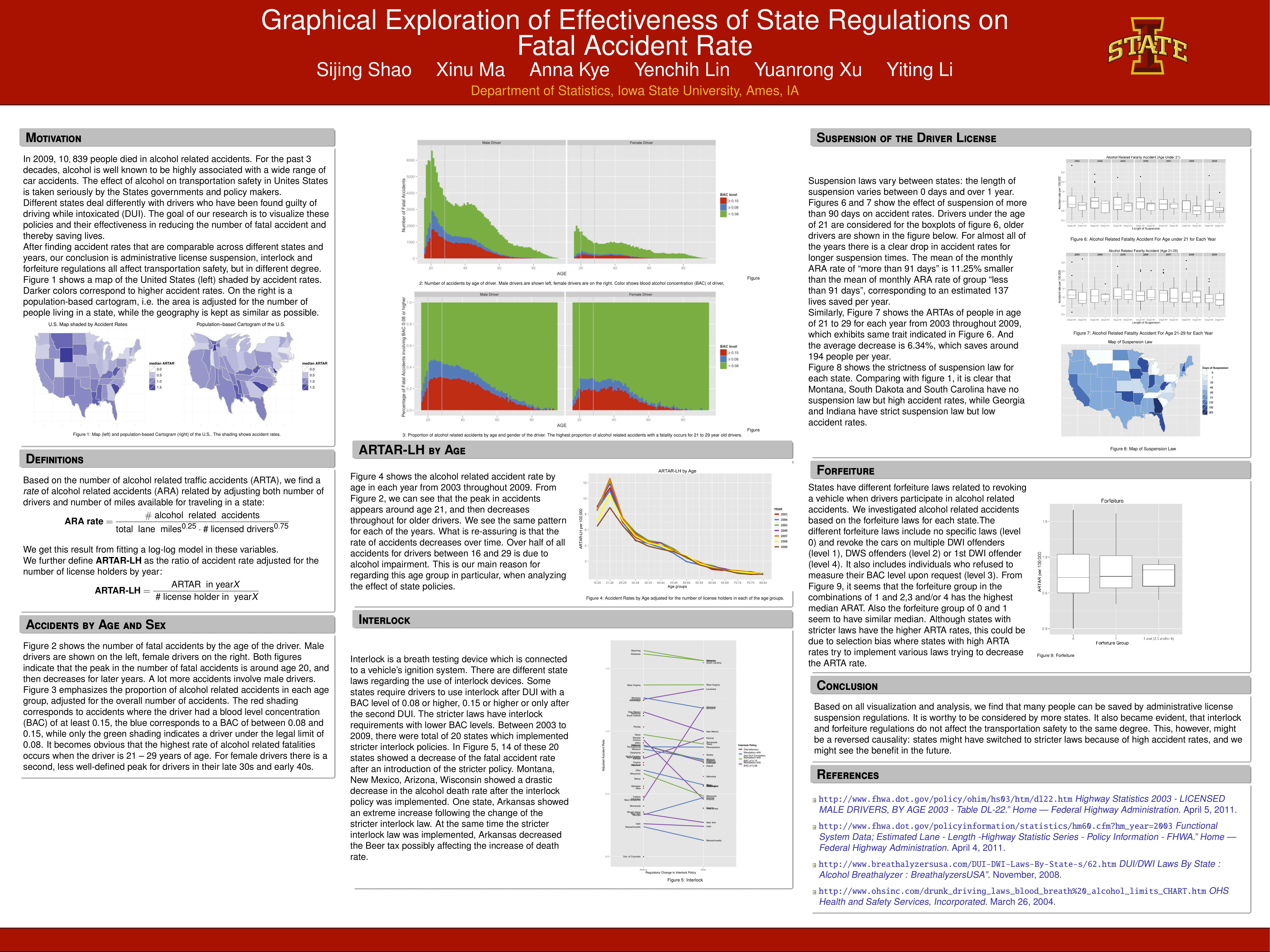
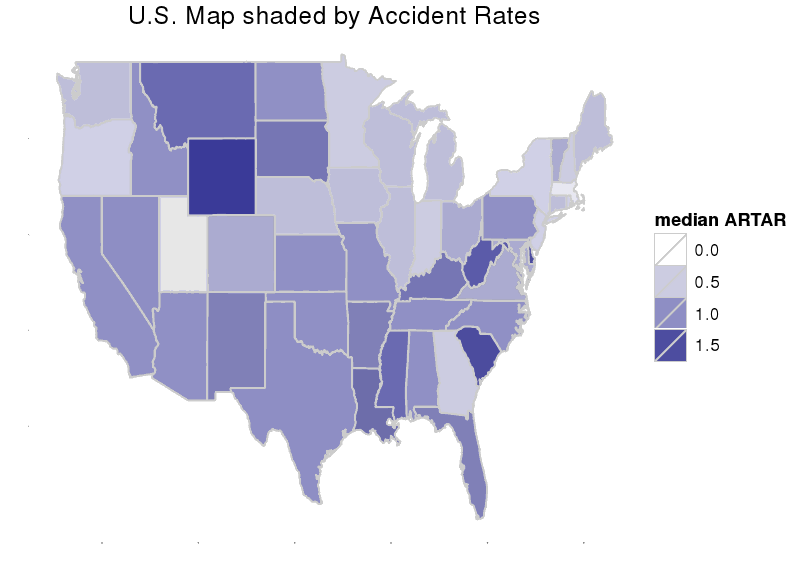
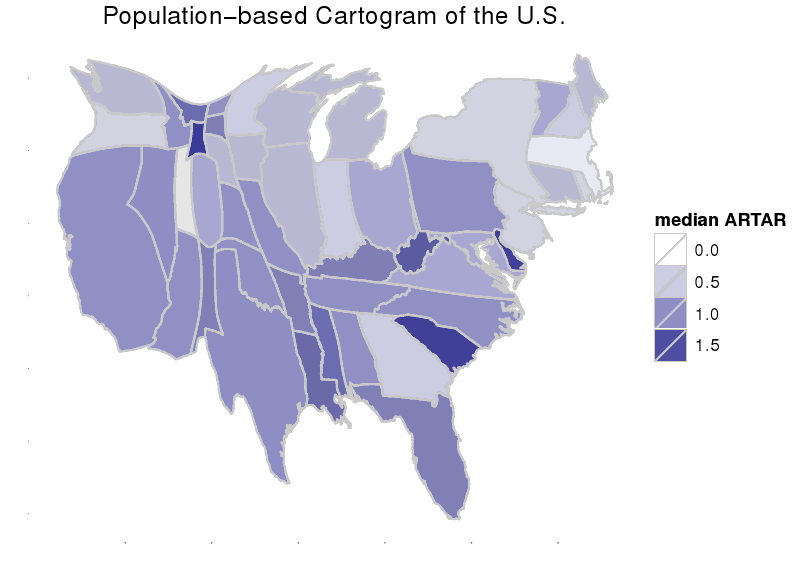
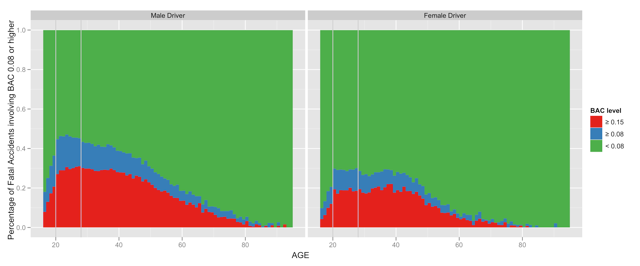
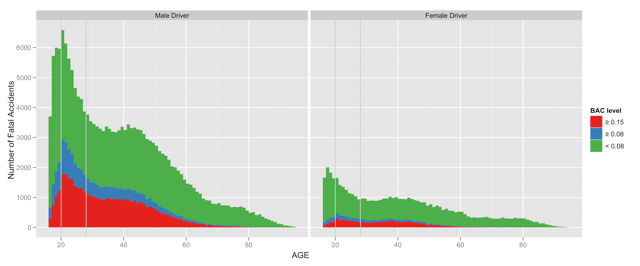
Drunk driving is a serious social problem, which takes thousands of lives per year. In the U.S. during 2009 alone, 10,839 people died in accidents where drinking was a contributing factor. Whole organizations (such as Mothers against drunk driving) are dedicated to reducing drunk driving accidents. We are interested in how dierent U.S. laws are related to the Alcohol Related Traffic Accident (ARTA). We categorized rates by state and then looked at dierences based on age and sex. Also we investigated dierent alcohol related laws to determine which laws relate to a decrease in the ARTA rate for particular age groups. We conclude with some suggestions for reducing the ARTA rate and hopefully saving many lives. Our graphical analysis suggests that younger drivers have higher ARTA rates. We therefore, focused on the two age groups under age 21 and between age 21 and 29. We focused our analysis on three main laws including suspension, interlock and forfeiture. Firstly, administrative license suspension is the law regarding the length of license is revoked after the first DUI. The suspensions laws vary for each state, therefore we investigated the dierence in death rate between states with a suspension of 91 day or less and greater than 91 days. We have created the map, which shows the strictness of suspension law for each state. Comparing states by suspension laws, it is clear that Montana, South Dakota and South Carolina have no suspension law with high accident rates, while Georgia and Indiana have strict suspension law with low accident rates. Secondly, interlock is a breath-testing device that is lined to a vehicles ignition system. There are different state laws regarding the use of interlock devices. Some states require drivers to use interlock after DUI with a BAC level of 0.08 or higher, 0.15 or higher or only after the second DUI. The stricter laws have interlock requirements with lower BAC levels. Between 2003 and 2009, a total of 20 states implemented stricter interlock policies. 14 of these 20 states showed a decrease on the death rate after the stricter policy. Montana, New Mexico, Arizona, Wisconsin showed a dramatic decrease in the alcohol related accident rate after the interlock policy was implemented. One state, Arkansas showed an extreme increase following the change of the stricter interlock law. At the same time the stricter interlock law was implemented, Arkansas decreased their tax on beer possibly acting the increase of accident rate. Lastly, states have different forfeiture laws related to revoking a vehicle when drivers participate in alcohol related accidents. We investigated alcohol related accidents based on the forfeiture laws for each state. The dierent forfeiture laws include no specic laws (and revoke the cars on multiple DWI oenders, DWS oenders or rst DWI oender. It also includes individuals who refused to measure their BAC level upon request. From the analysis, we gured out thatthe forfeiture group in the combinations of these forfeiture laws has the highest median ARAT. Although states with stricter laws have the higher ARTA rates, this could be due to selection bias where states with high ARTA rates try to implement various laws trying to decrease the ARTA rate. Therefore, based on these data, we suggest increasing the usage of interlock and having stricter laws on forfeit and suspenstions. By doing so, it is possible to prevent any tragic deaths and events caused by alcohol related accident.
Exploring the License Suspension Policies Effectivenss on Traffic Safety of Alcohol by Visualization
Updates

Leave feedback in the comments!
Log in or sign up for Devpost to join the conversation.