-
-
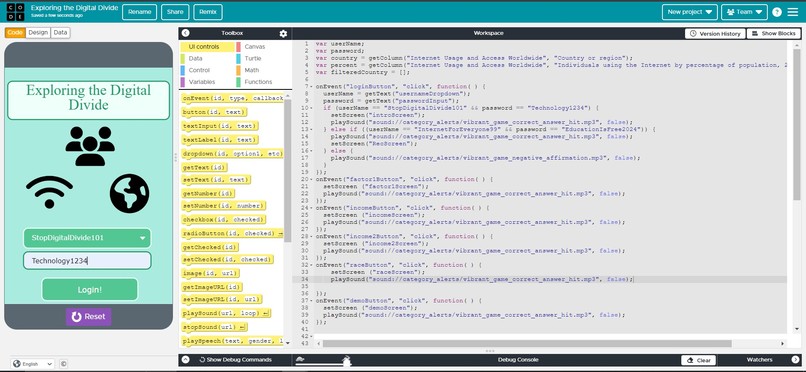
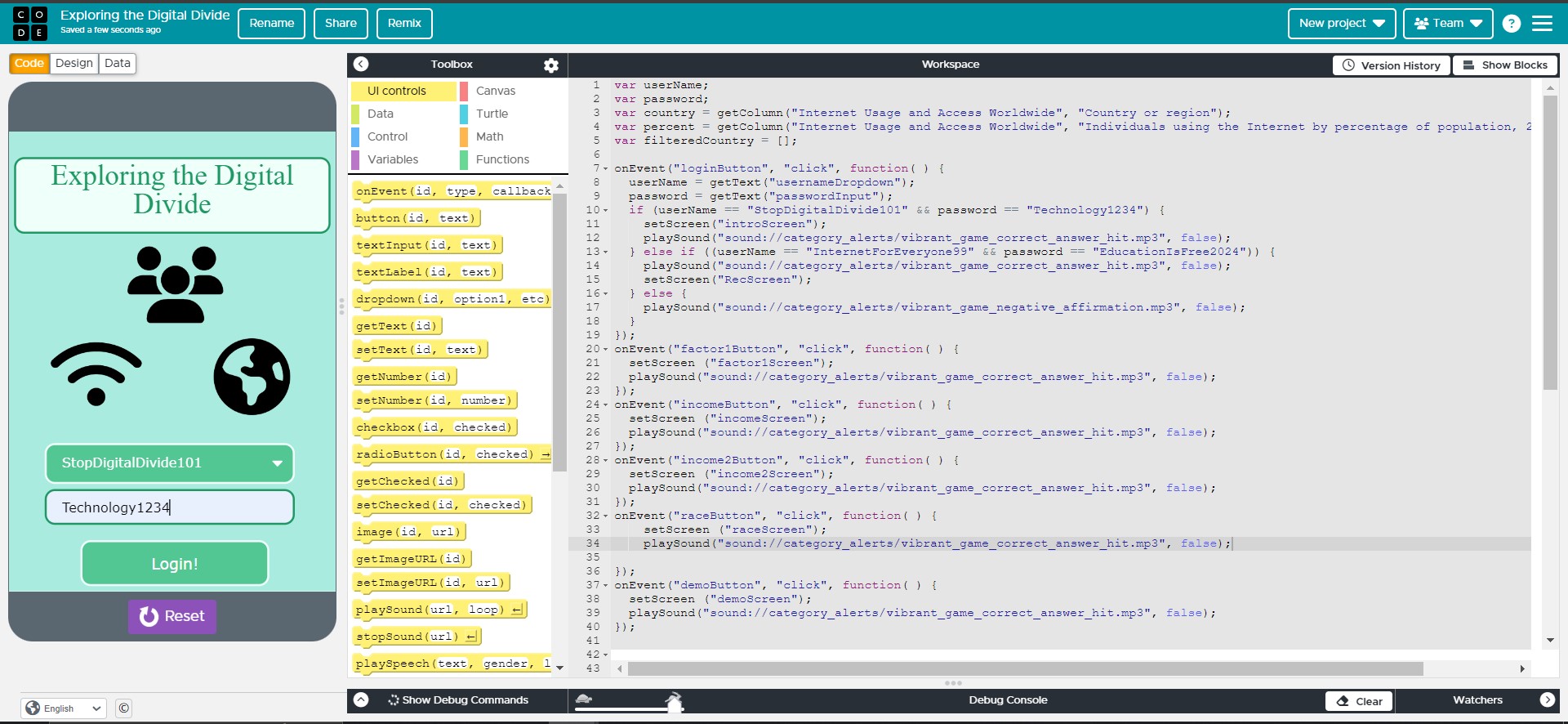
Image of Login Screen and First Half of Code
-
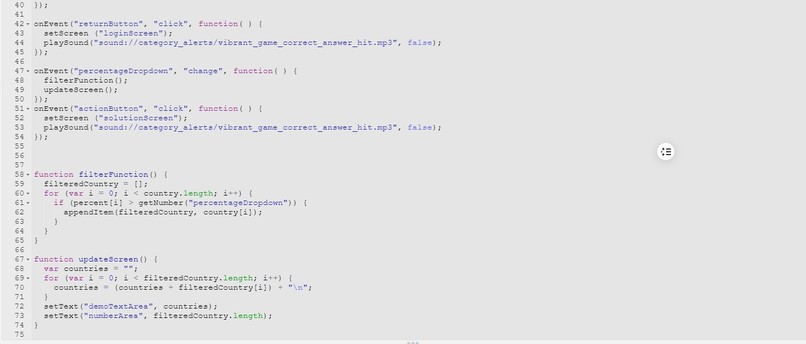
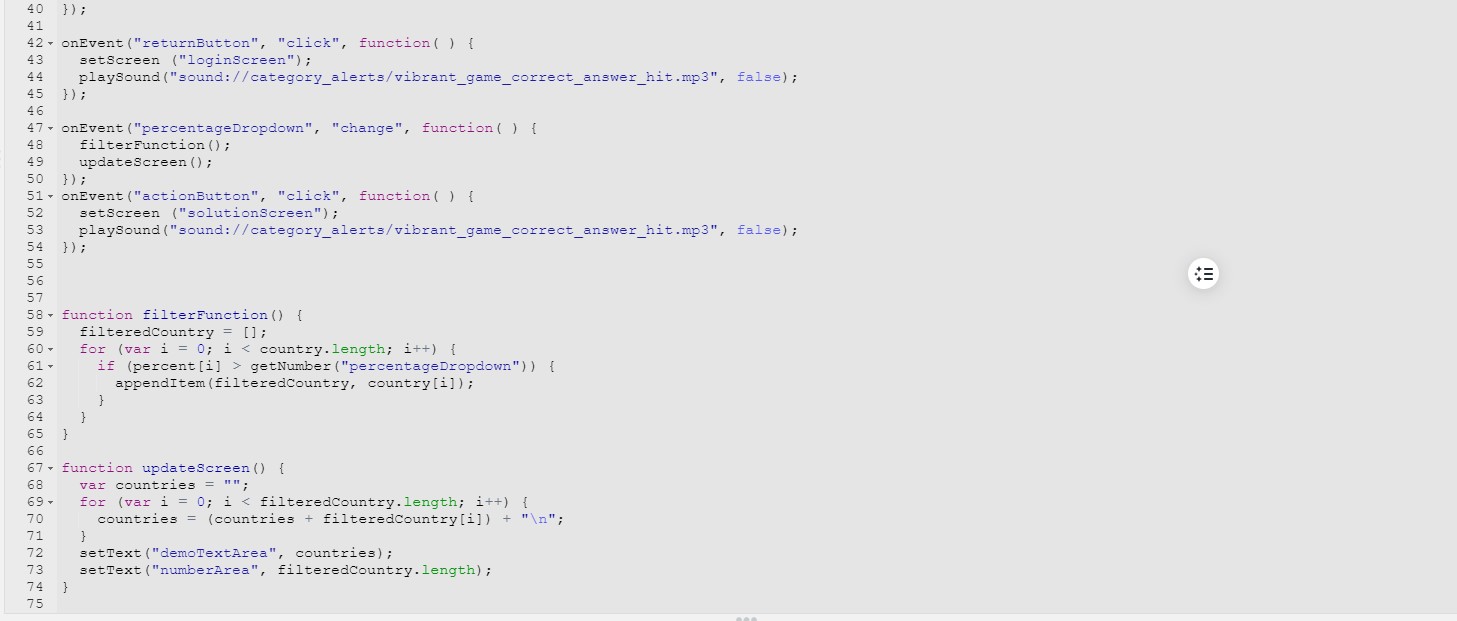
2nd Half of Code
-
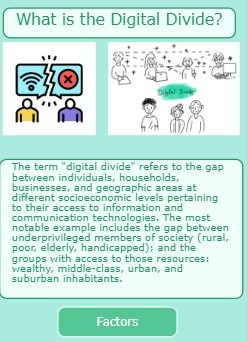
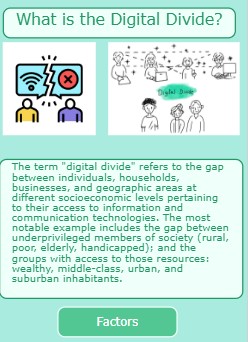
2nd Slide on What is the Digital Divide
-
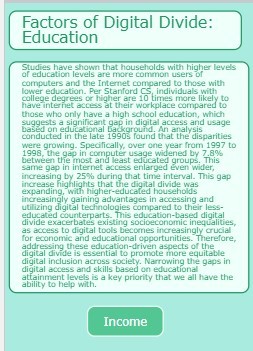
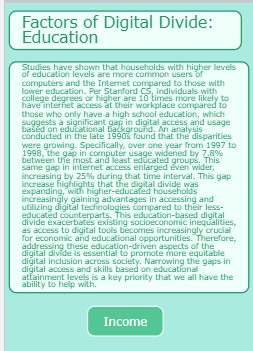
Slide on the Educational Factor
-
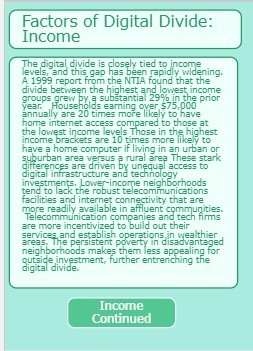
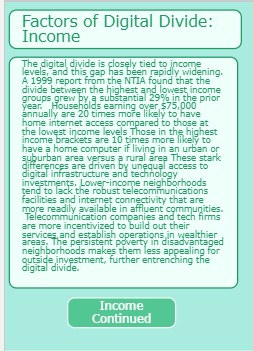
Slide on the Income Factor
-
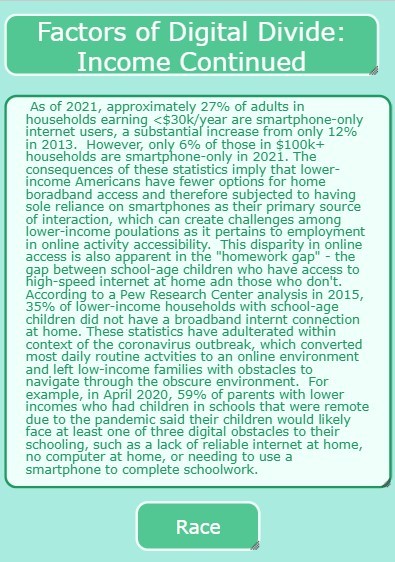
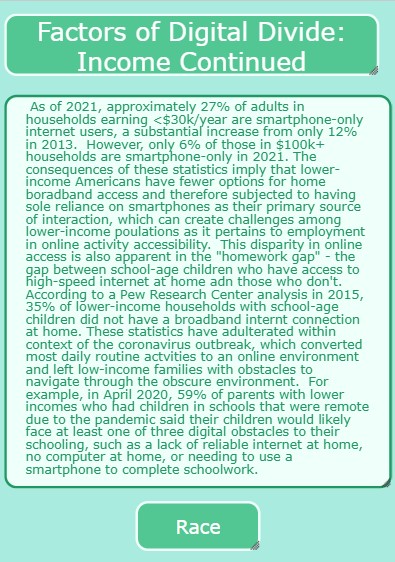
Slide on the Income Factor Continued
-
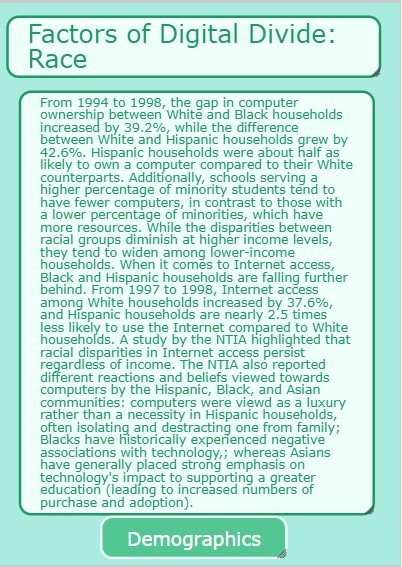
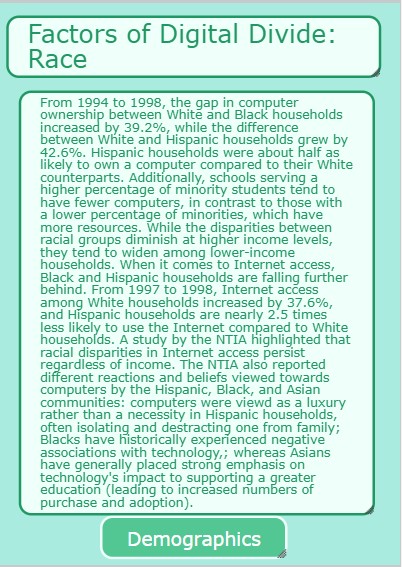
Slide on the Race Factor
-
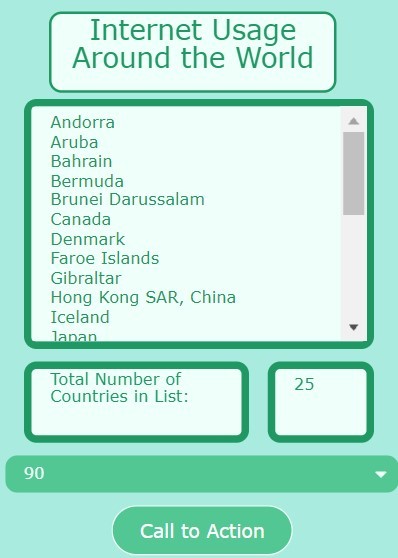
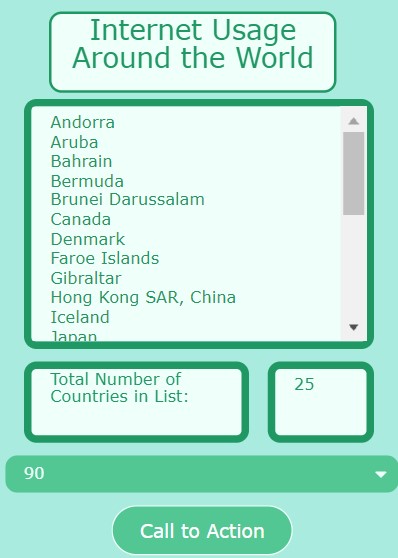
Slide on Demographics
-
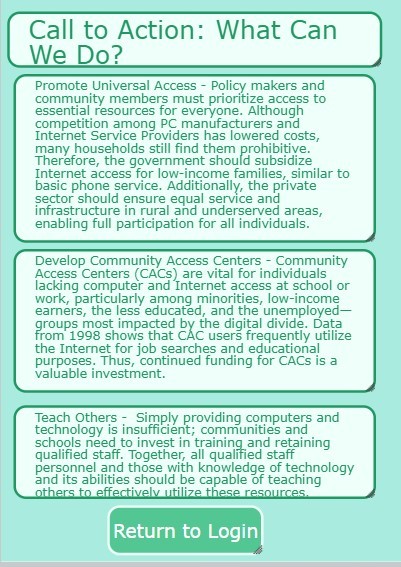
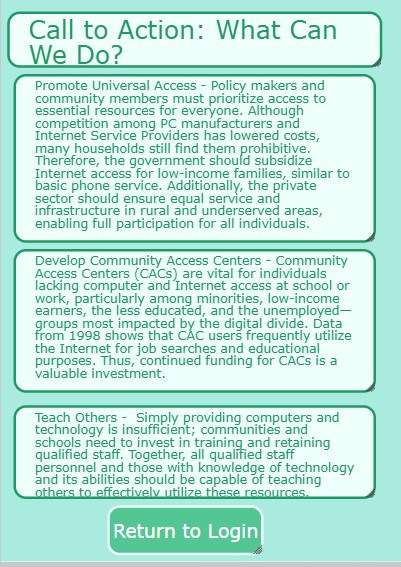
Slide on Call to Action and What One Can Do
-
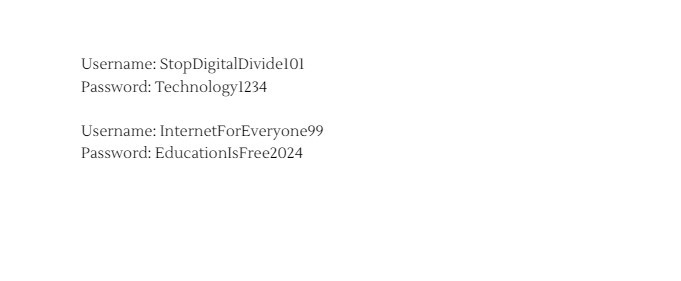
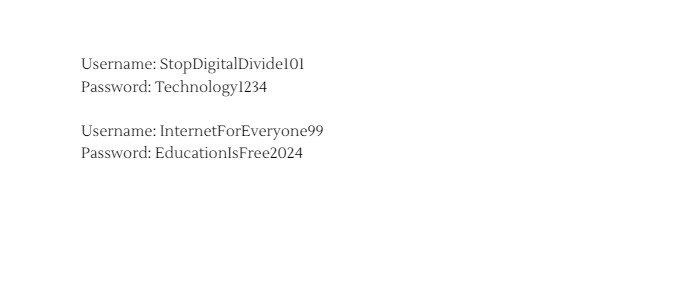
These are both username and password combinations that can be used to access the application. The pairs are ordered as followed.
Inspiration: Regarding my inspiration, the Digital Divide immediately came to mind when reading the prompt on issues that 1st gen low-income families face. More specifically, I grew up in an impoverished community in Watts, California, where the majority of inhabitants were low-income minorities (Hispanic/Latino and Black) who regularly faced financial issues. In regards to the local pedagogical system, the K-12 schools were universally seen underperforming in proficiency regarding STEM and English programs; the deficient College Readiness Index and Graduation Rates statistics were also verbatim indications of the area's lack of success and advancement. Despite moving to a significantly improved area for matriculation and educational success, my exposure to the deplorable standard of living in the community had a major influence on my quest to understand more about the root causes of the economic downstate and living conditions of my old residence; the quest brought me to the Digital Divide. Finally, I could work passionately and discover more about the reasoning behind the lack of educational resources and tools I encountered in my earliest years of elementary school and how it has impacted me as a first-generation Latino student, who embarks on his journey into University while reminding himself of the economic obstacles he faced during his childhood years. With this in mind, I strongly work towards making the issue of the Digital Divide and its impacts accessible to a larger audience and community of people from different backgrounds. Having talked with hundreds of people from low-income minorities whether in my old or new community on the negative effects the Digital Divide had on them, my example of finding success ( being within the top 10% of my class while succeeding in rigorous AP courses ) as part of a family that makes less than $50,000 annual income makes me realize that there are so many other brilliant students from low-income minorities who can make a difference in this world and find success for themselves, but that begins with a joined effort to combat the Digital Divide and help bring these students to a new light, showing them that they are never defined by how much money they have or what zip-code they are from.
What it does
The app I created models the common interface of a website or blog. Moreover, the app begins with a sign-in resembling that of a casual app in which the user chooses a pre-made username and password to access the app's content. Next, the user is taken to an introduction page on the definition of the Digital Divide issue and context. Thereafter, the user is exposed to the factors that contributed to the Digital Divide: Education, Income, and Race ( all of which had their information sourced from Stanford CS and Pew Research Center's websites). A demographics page using information from Code.org is used to provide a visual representation of the number of countries with variable internet usage in percentage, highlighting the disparity between 1st world, 2nd world, and 3rd world countries. The user is then finally taken to a Call to Action page with solutions on how they can get involved and combat the Digital Divide themselves.
How we built it
I built the application using Code.org's app creator using different screens and Javascript coding to create appropriate variables and lists to navigate through the app.
Challenges we ran into
Challenges I ran into relate to my struggle to condense as much resourceful and important information I can into the textbox spaces while still making them readable for the viewer.
Accomplishments that we're proud of
I am proud that I was able to create a beginner-friendly app that can help teach and provide information on such an overlooked issue in our human society, especially when considering the global context of the rise of technology and cellular device interactions, as well as the impacts to digital education made by the recent events of the COVID-19 pandemic. I sincerely wish the beginner-friendly aspect can help bring more people to this issue and work towards making education more accessible to low-income communities.
What we learned
I learned that bringing people together through education has become a strong passion that I've developed and it really shows with the effort I placed into programming this app. I am grateful that I created an app that truly voiced my efforts and beliefs to make a change to existing communities that are underprivileged, as well as having the ability to reach other minorities like Latino students and assure them that so much in this world can be achieved through hard work and perseverance .
What's next for Exploring the Digital Divide
Following the application, I wish to get into contact with others interested in fighting the Digital Divide, whether other students, researchers, or organizations. I've had communication with friends at my local school at the beginning of a non-profit for making technology accessible to underprivileged communities with a STEM emphasis, i.e. sending materials associated with engineering and science to communities.
Built With
- codestudio
- javascript


Log in or sign up for Devpost to join the conversation.