Inspiration
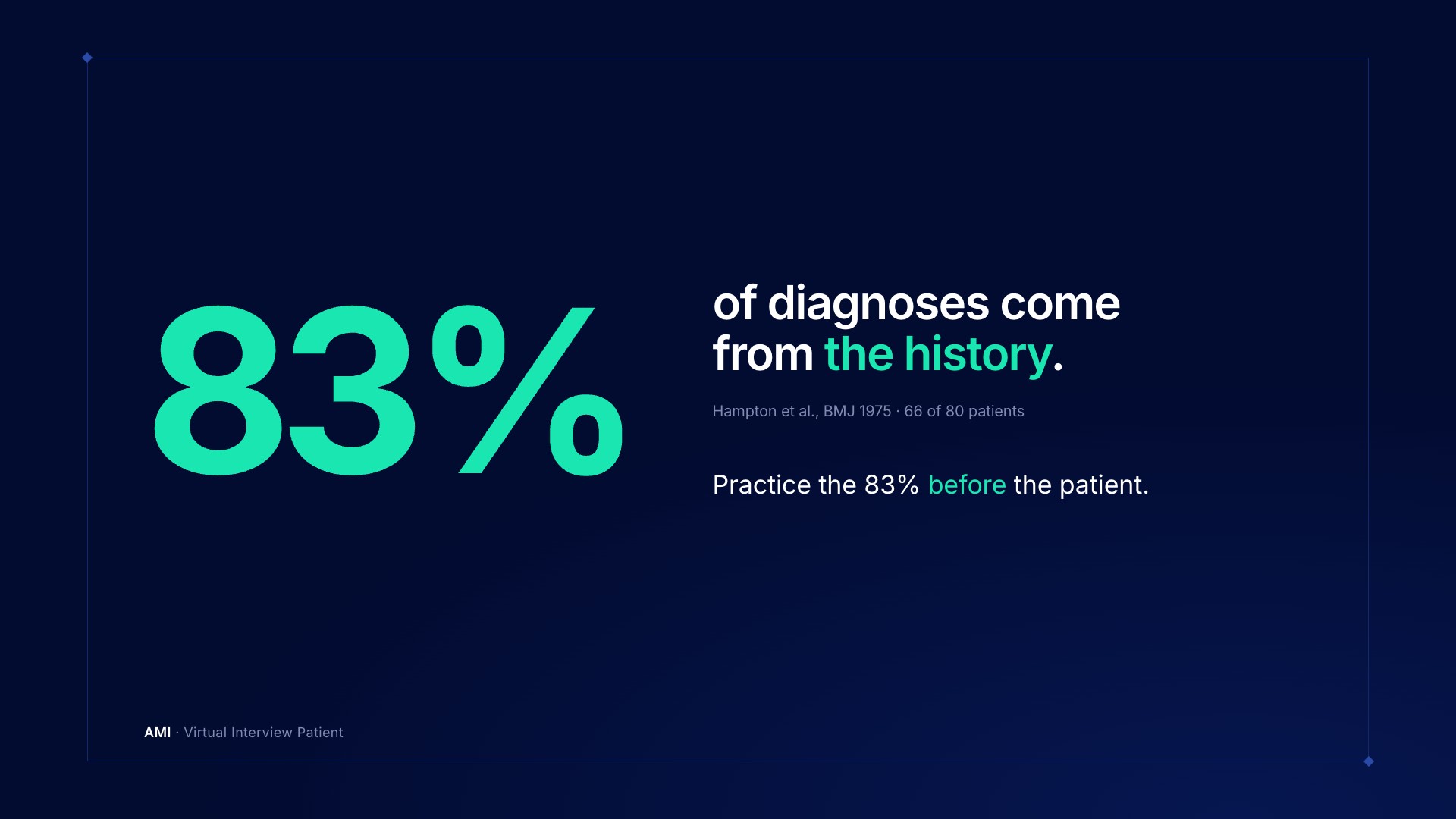
83% of diagnoses come from the patient history alone (Hampton et al., BMJ 1975: 66 of 80 patients). In neurology, the history is the diagnosis. Yet simulated-patient actors are the bottleneck: many students, one trained actor paid by the hour, a handful of slots, so every session counts and students arrive nervous. What is missing is practice on demand.
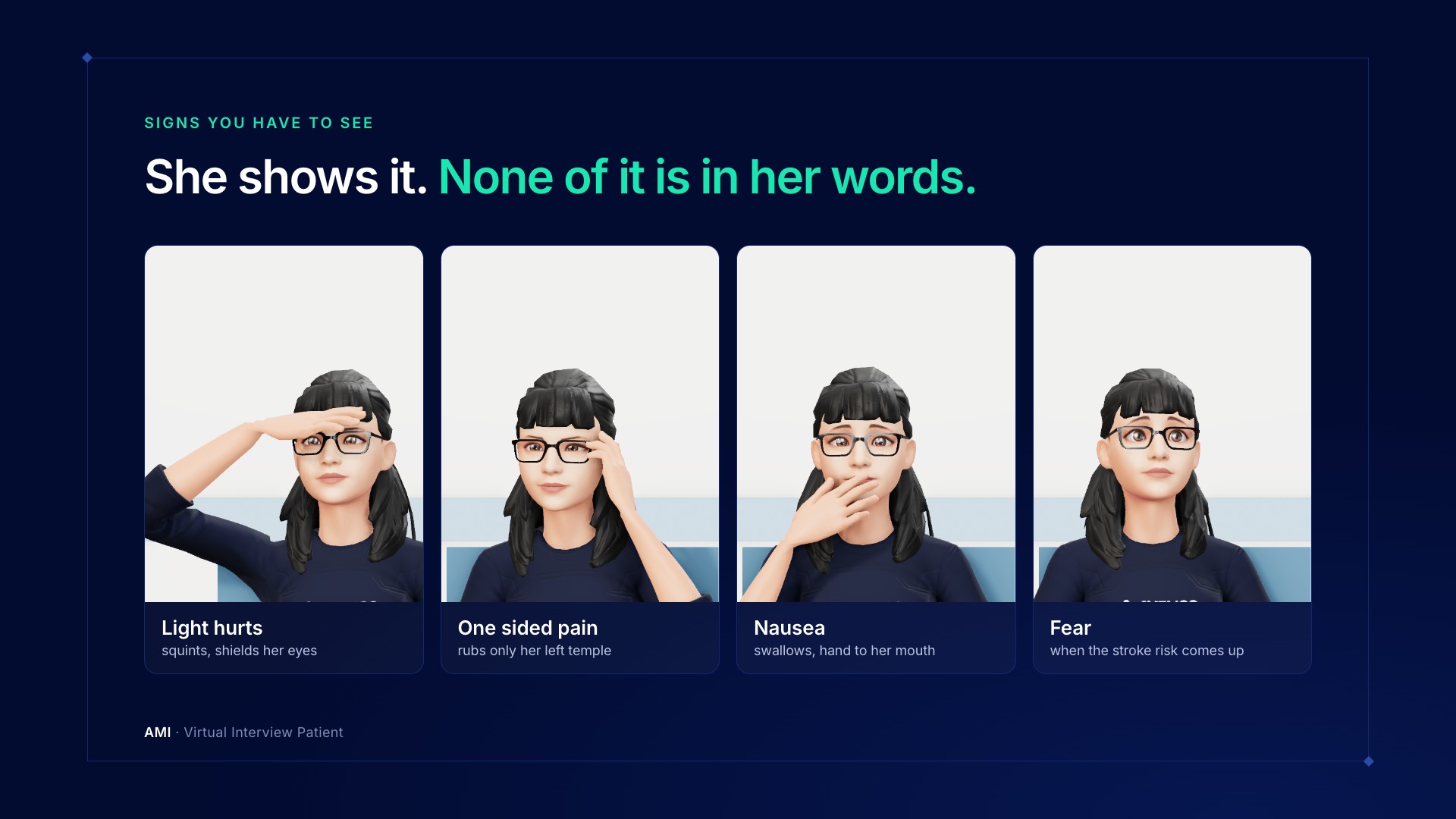
And real patients don't just answer questions. They downplay, get irritated, forget things, and they show things: they squint at the light, rub one temple, swallow because they feel sick. Existing virtual patients read out every fact at once, in textbook words, with a flat face.
We asked ourselves: what if students could practise the 83% before the patient, as often as they want, at 11 pm, with nobody watching, and then get told exactly what they missed?
What it does
AMI is a practice session in four steps: pick a case, interview the patient, take your notes by hand on the iPad, get your evaluation.
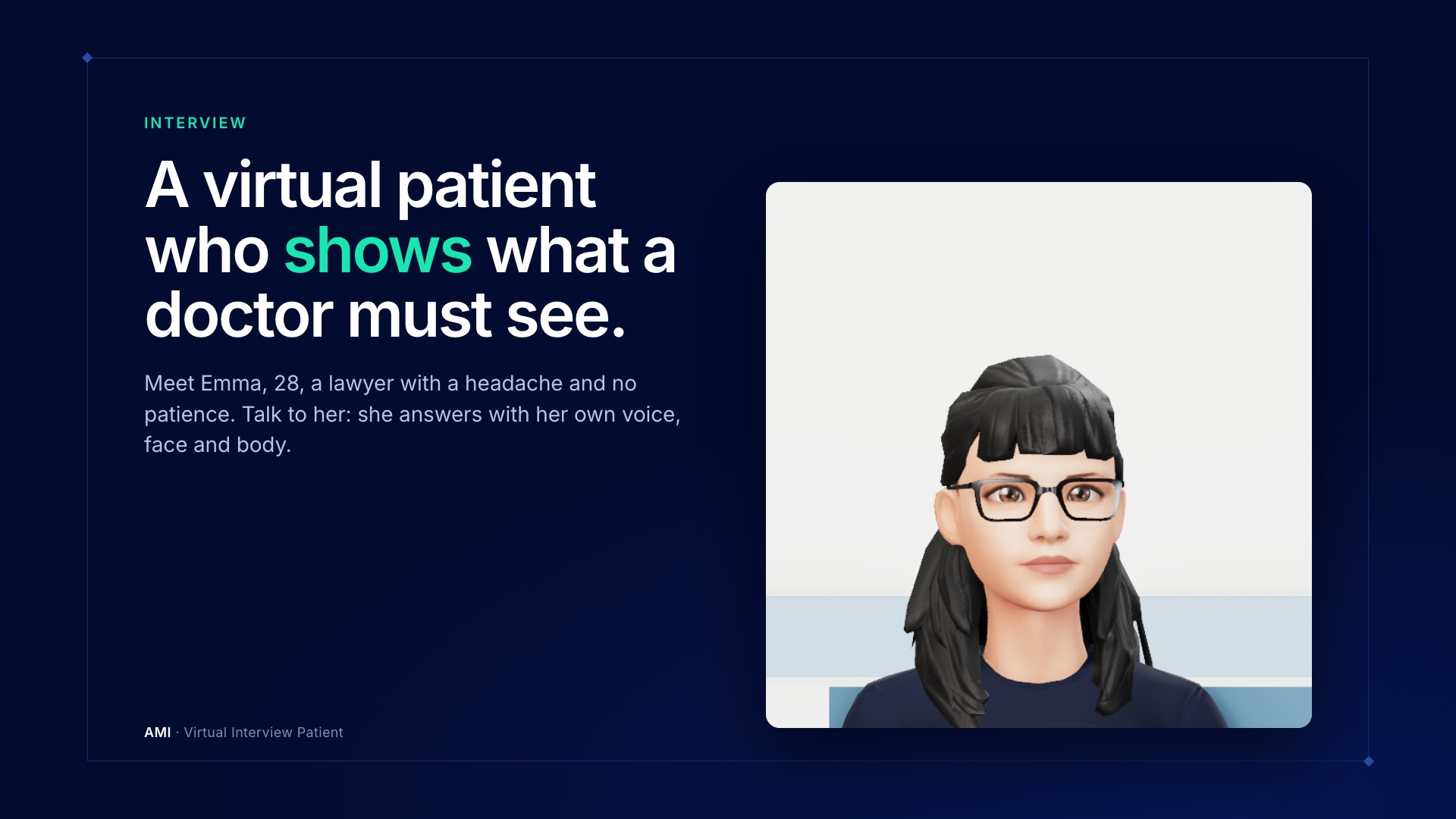
Meet Emma Clarke, 28: a junior lawyer with a headache and no patience. You speak; she answers live with her own voice, face and body. She thinks it's her sinuses and wants antibiotics. She only mentions the pill when you ask about contraception directly, admits the smoking with a sheepish "I know, I know", and when you explain her stroke risk, her armour cracks: "My gran had one... Wait. Could it have been a stroke?" Only an empathic answer calms her down.
She shows it, you have to see it: she shields her eyes until you dim the light, rubs only her left temple, swallows hard with her hand to her mouth. None of that is in her words. She keeps eye contact with you, like a real patient would.
A conversation that flows: say it your own way. Emma copes with pauses, "alright, so...", self-corrections and paraphrases. Ask something outside the script and she still answers in character, from her physician-written case file, and says "no idea" where the file is silent instead of inventing anything.
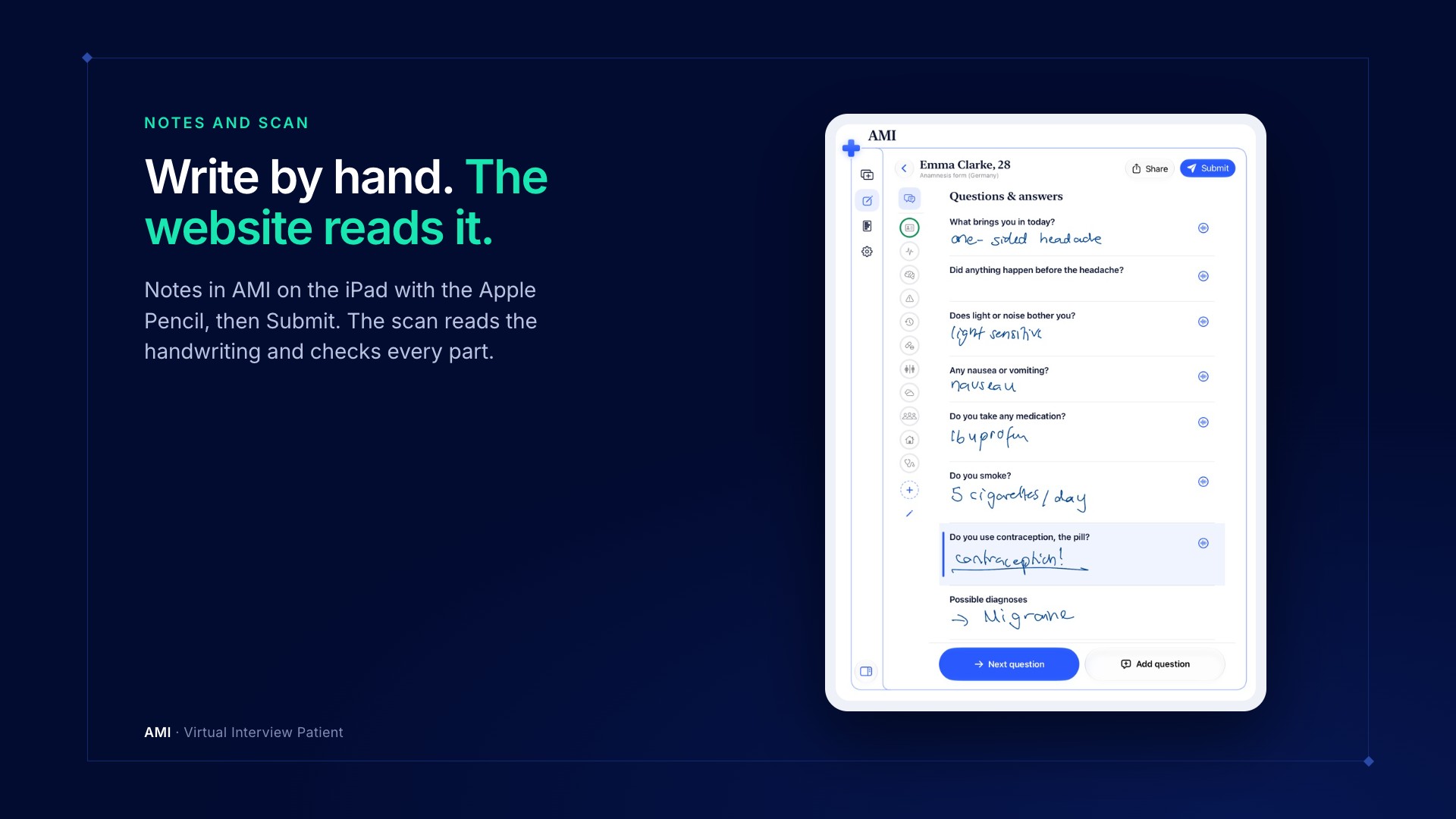
Write by hand, the website reads it: take your notes in AMI on the iPad with the Apple Pencil and tap Submit. The website scans the page, reads the handwriting and checks every part.
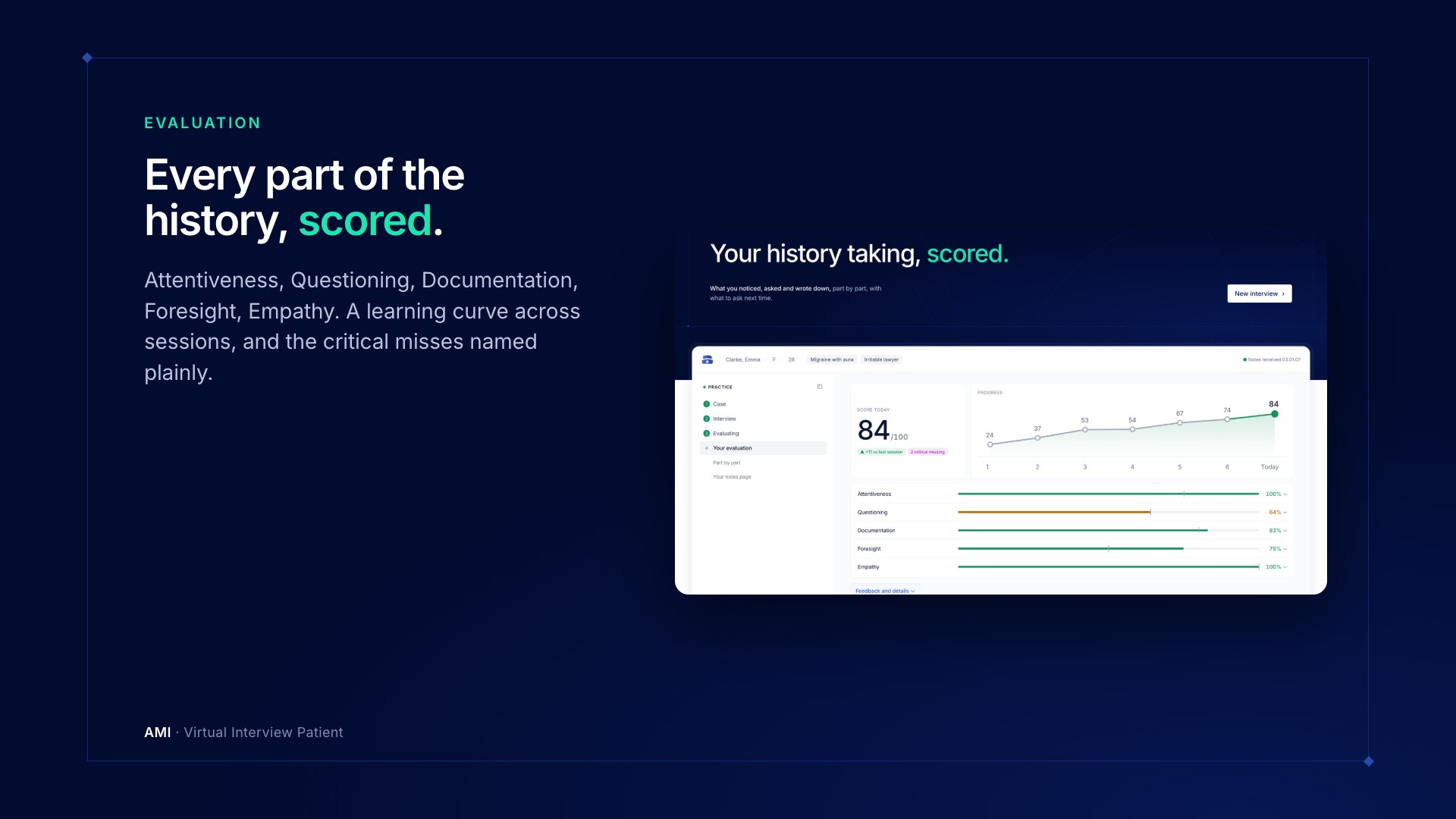
Your history taking, scored: Attentiveness (signs noticed), Questioning, Documentation, Foresight and Empathy, with the critical misses named plainly: red flags never asked, aura asked but never written down. A learning curve across sessions; at 80/100 the next, harder patient unlocks. The patient model is checked too: nothing invented, nothing contradicted, nothing told before it was asked.
How AMI answers the challenge
Judged on how real the conversation feels:
- Naturalness: Emma answers in a median of 0.62 s and stays in character, also off script ("No idea, I've been stuck in here all morning.").
- Medical consistency: every fact comes from a physician-written case file; nothing invented, nothing contradicted. Off script, 37 of 38 answers were right, judged blind with the physician's rubric.
- Personality: two patients with the same disease feel different. Every fact has its own wording per personality: the impatient lawyer says "Pounding. Like someone's hammering behind my eye. Here.", the exhausted one "Left side. Behind the eye. It throbs." Emotion is in the voice: irritated, sheepish, then frightened.
- A demo that works: live at our table, speech recognition running on the laptop (no Wi-Fi needed), a typed fallback, and a recording mode that plays the whole session as a backup.
The five hard parts:
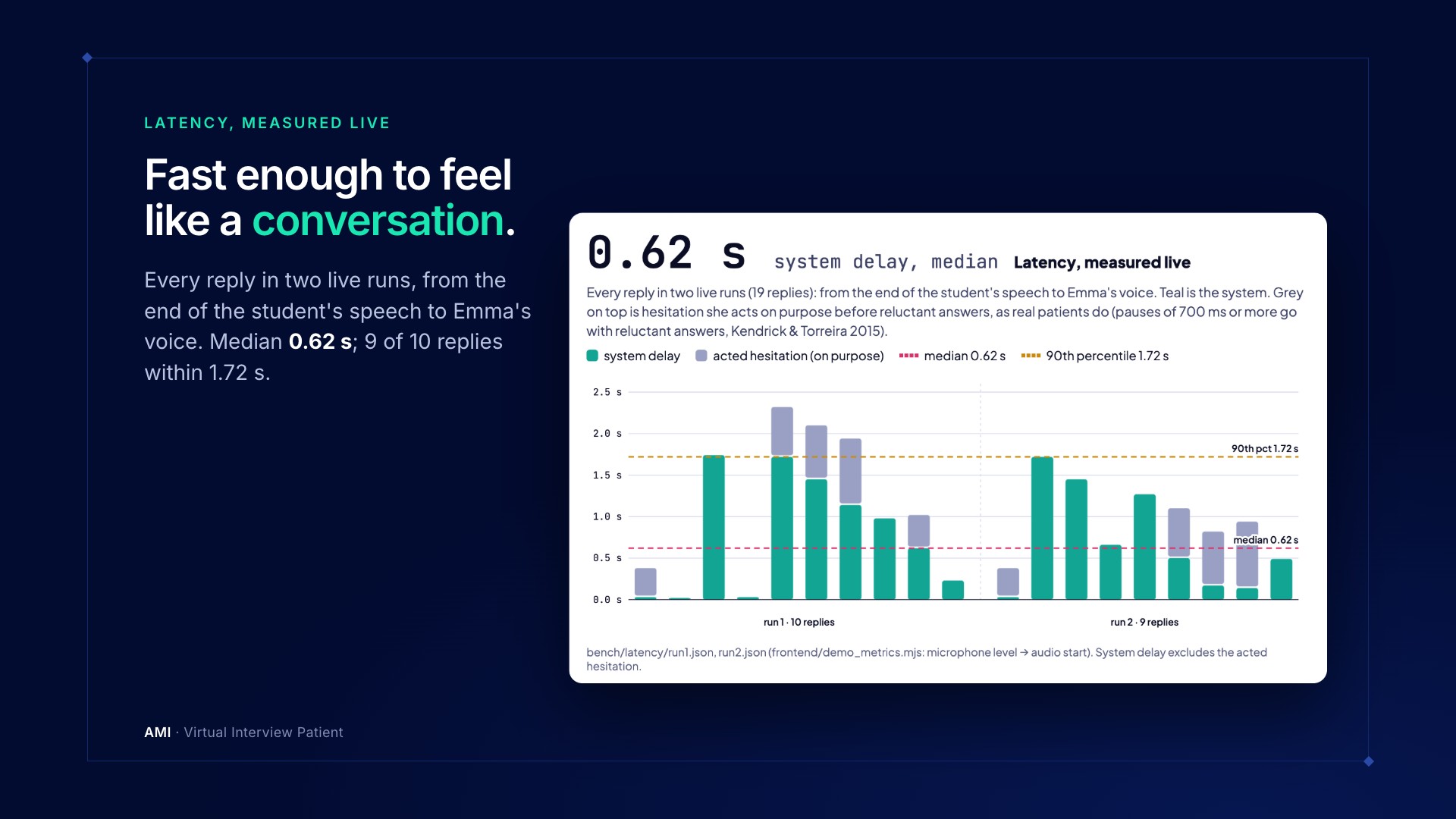
- Latency: measured end to end on every turn from the first prototype: median 0.62 s, 90% within 1.72 s.
- Selective disclosure: a disclosure rule per fact. "Any medication?" gets "Ibuprofen. Obviously."; the pill only when contraception is asked directly; the smoking ("Five a day. I know, I know.") only after a non-judging question.
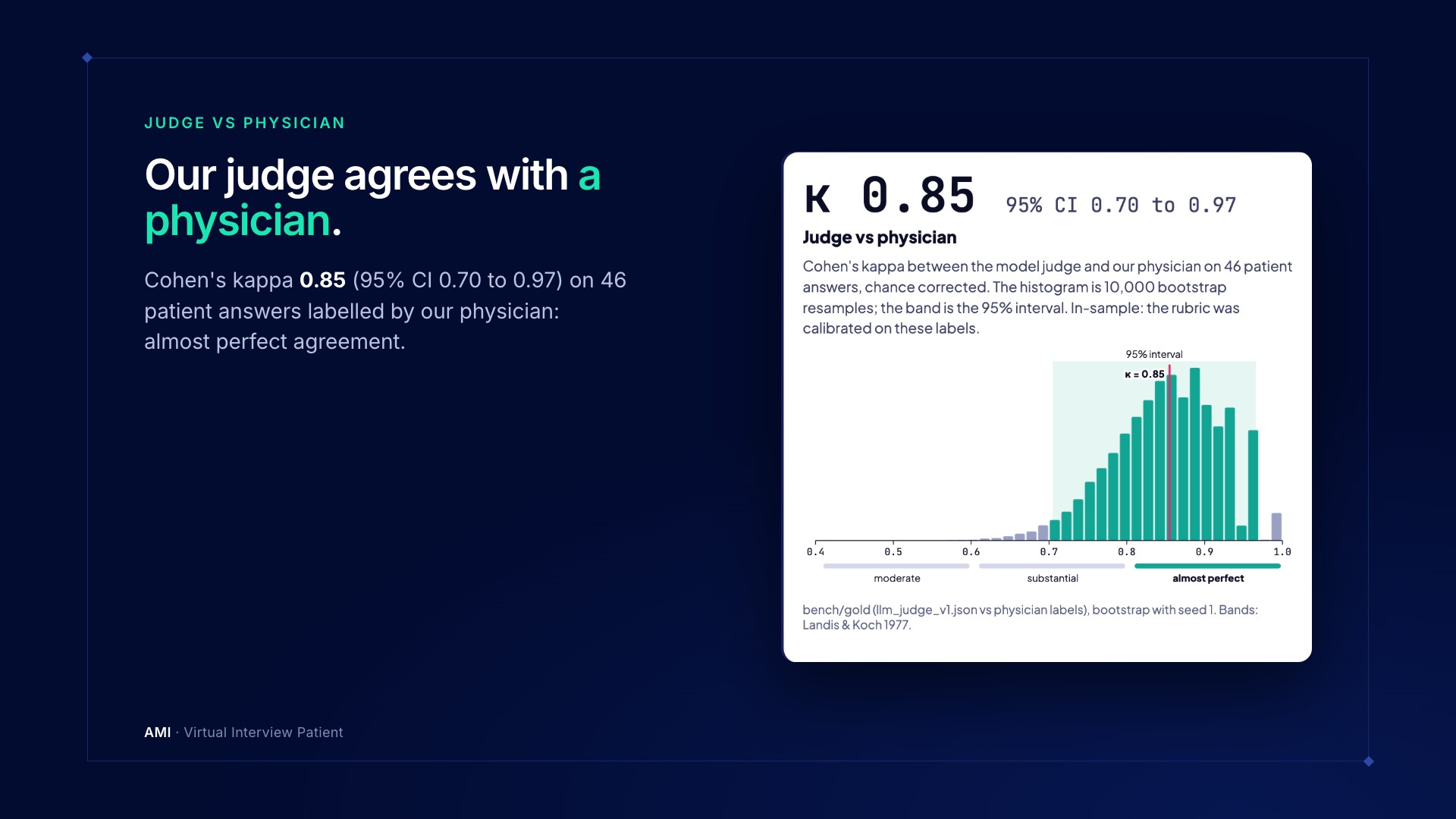
- Consistency: facts fixed up front in the case file; a judge checks every answer, agreeing with our physician on 43 of 46 (kappa 0.85).
- Turn-taking: pauses mid-sentence, "alright, so...", thinking aloud, self-corrections and topic changes: 25 of 25 scenarios handled right.
- Evaluation: a benchmark for every claim, rerunnable from the repository, against physician labels.
Nice to haves we built too: feedback for the student after the talk (five parts, critical misses), the notes taken by hand and read back from the scan, and an avatar with facial expressions, signs and eye contact.
How we built it
- Cases as data: TOML case files written and reviewed by our physician: facts, a disclosure rule per fact (volunteered, on a broad question, only when asked specifically), lay wording, signs with timing, emotions with empathic and non-empathic outcomes.
- 3D patient in the browser: TalkingHead + Three.js, procedural hand and body animations with inverse kinematics, facial reactions per line (pain, relief, embarrassment, fear), portrait lighting and soft shadows.
- Voice: ElevenLabs (eleven_v3 with emotion tags) for Emma's lines, with character timestamps for exact lip sync.
- Listening: Chrome's speech recognition running on the laptop (offline, no Wi-Fi needed), a matcher with stemming and signal words, and turn-taking logic for pauses and fillers.
- Off script: a small language model (OpenAI) with the physician-checked case prompt answers anything the script doesn't cover, voiced live by ElevenLabs. Budget-capped and logged.
- AMI, our anamnesis app: SwiftUI on the iPad with Apple Pencil handwriting; Send posts the notes to the evaluation.
- Evaluation: rule-based scoring against the case file, plus a language model judge on a physician-written rubric, shown on a two-screen stage.
Evaluation and benchmarking
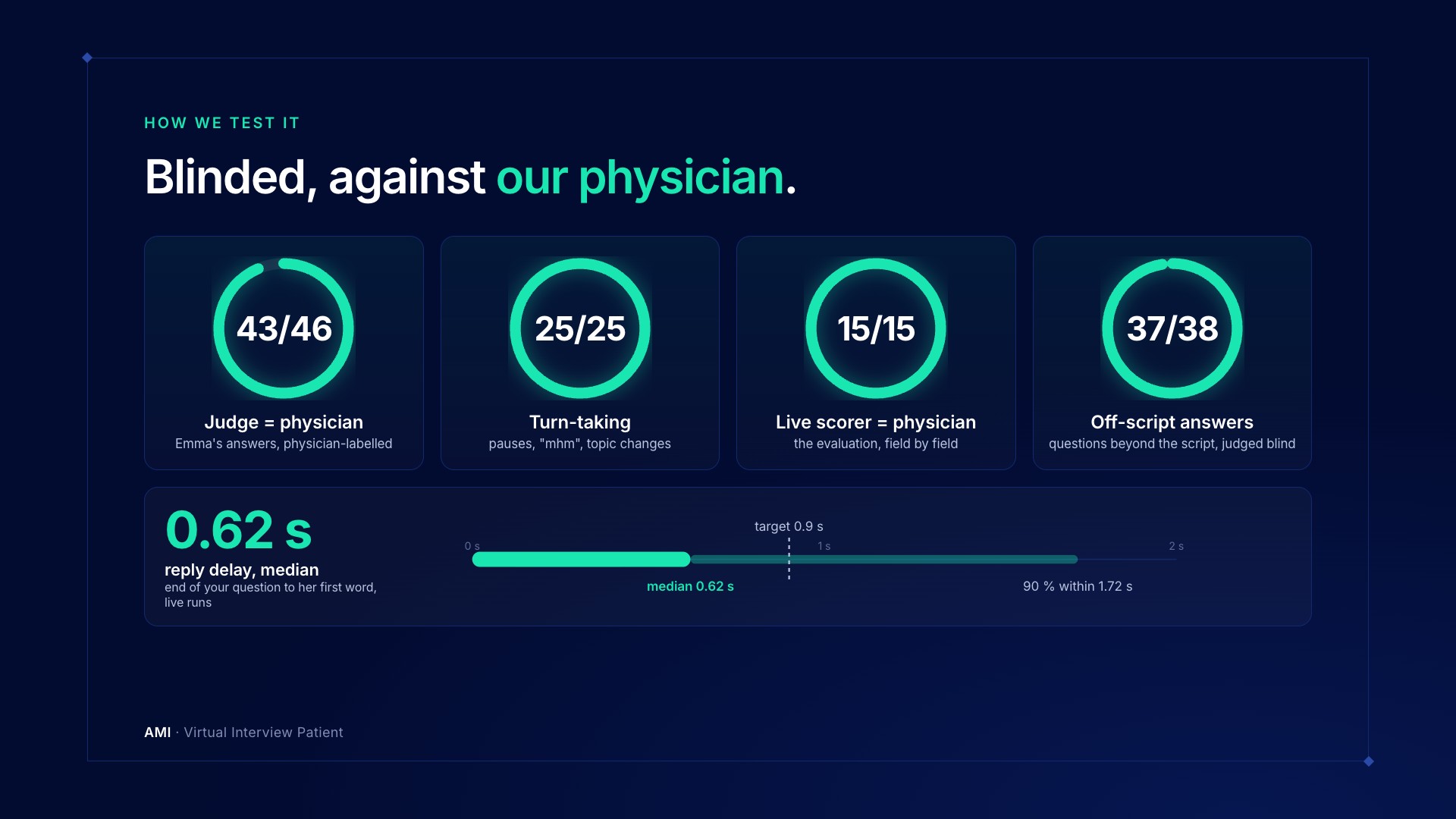
Blinded, against our physician. Every number is reproducible with a script in the repository.
- Fast enough to feel like a conversation: median 0.62 s from the end of your question to her first word, 90% within 1.72 s (live runs; target 0.9 s, met).
- The live scorer matches the physician: 15 of 15 fields of the evaluation, field by field.
- Students don't follow scripts: on 90 paraphrased or misheard lines the matcher picks the right reply 76% of the time and a wrong one only 3%; 0 of 20 off-script remarks trigger a scripted line; 25 of 25 turn-taking scenarios (thinking aloud, pauses, topic changes) handled right.
- Beyond the script: 37 of 38 off-script questions answered correctly, judged blind with the physician's rubric.
- Can we trust the judge? Our physician labelled 46 of Emma's answers; the language model judge agrees on 43 of 46, Cohen's kappa 0.85 (95% CI 0.70 to 0.97, 10,000 bootstrap resamples): almost perfect agreement.
- A second patient holds up: Mr. Miller (sceptic, chest pain) answered 49 of 51 questions correctly.
Challenges we ran into
- Making a language model not say things: hidden facts leak and symptoms get invented unless every fact is gated.
- Body language a jury sees from three metres: a squint and a one-sided temple rub must be unmistakable without becoming theatre.
- Speech recognition on hackathon Wi-Fi: Chrome's cloud recogniser stalled for seconds mid-sentence, so we moved it onto the laptop.
- Pauses: a student who breathes mid-sentence must not get an answer to half a question.
- A loud room: on-device speech recognition, signal words so one misheard word does not lose a line, and a typed fallback.
- Merging animation, voice and a pitch script at 4 am.
Accomplishments that we're proud of
- A patient who reacts to what the student does: dim the light and her face relaxes; ignore her fear and she asks again.
- The same avatar as a flat, robotic patient and as Emma: the difference is obvious in seconds.
- Scoring the handwritten notes, not only the conversation, so "asked but never written down" becomes visible.
- Medical content a physician would sign: ICHD-3 criteria, US MEC 2024 (migraine with aura rules out the combined pill), red flags, and a scored empathy moment (NURSE).
- Honest numbers: a benchmark for every claim, with physician-labelled test sets.
What we learned
- It's not only what is said: ten seconds of a surgeon's tone of voice predicted who had been sued (Ambady et al., 2002). A training patient has to show, not only tell.
- Speech recognition on the device beats the cloud when the Wi-Fi is bad.
- A physician on the team turns "looks plausible" into "is correct".
What's next for AMI
- Emma grades you back: after the score, the patient tells you in her own words how the conversation felt, the feedback no examiner can give.
- Every word has a source: an audit trail that ties each fact Emma reveals to the physician's case file and each score to the quote it is based on. Built for accountability from the start.
- Straight into the hospital system: the notes leave AMI as a FHIR QuestionnaireResponse, so what students practise is the structured documentation an AI-native system like Avelios runs on.
- Did you look? With the webcam, AMI will measure eye contact and how fast a student reacts to the signs a patient shows, the nonverbal skills medicine has never been able to train at scale.
- Harder patients: low health literacy, language barriers with an interpreter, fear and anger; the same physician-written case, a different person.
- Beyond the classroom: onboarding for new residents inside the hospital's own system, and the same scoring as a completeness check on real notes, where German hospital doctors already spend up to three hours a day.
Measured, not claimed: a physician-labelled gold set (judge agrees 43 of 46), turn-taking 25 of 25, live scorer matches the physician 15 of 15, median reply delay 0.62 s.