-
-
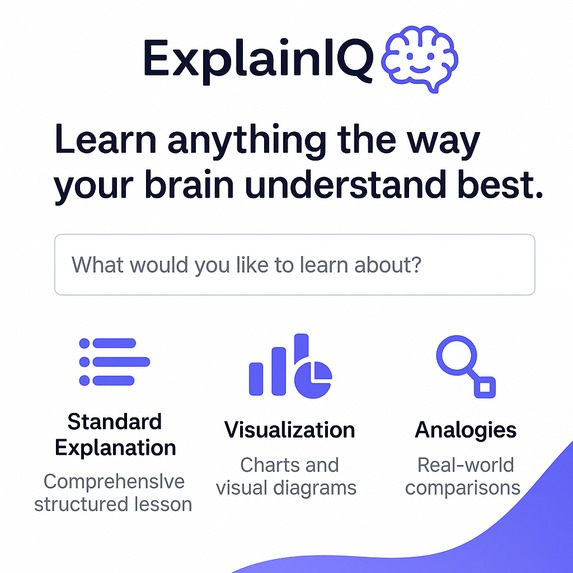
App OnePager
-
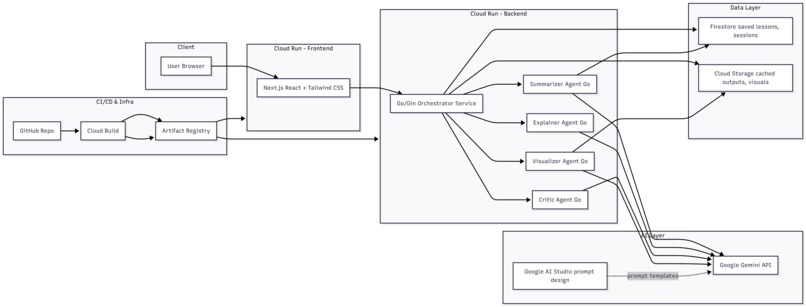
Diagram
🧠 ExplainIQ AI
🌍 Inspiration
The process of learning complex topics can often feel overwhelming — not due to a lack of curiosity, but because every mind learns differently. Some people process information visually, others through metaphors, and some through structured logic.
ExplainIQ AI was conceived to adapt to the learner, not the other way around.
The project was inspired by the idea of creating an intelligent explainer that could transform any topic into multiple learning formats — structured explanations, visual diagrams, and real-world analogies — enabling anyone to understand anything faster and more effectively.
🚀 What ExplainIQ Does
ExplainIQ is an AI-powered learning assistant that converts any topic (for example, “quantum entanglement” or “escape analysis in Go”) into a personalized, structured learning experience.
Users are presented with multiple explanation modes designed to match diverse learning preferences:
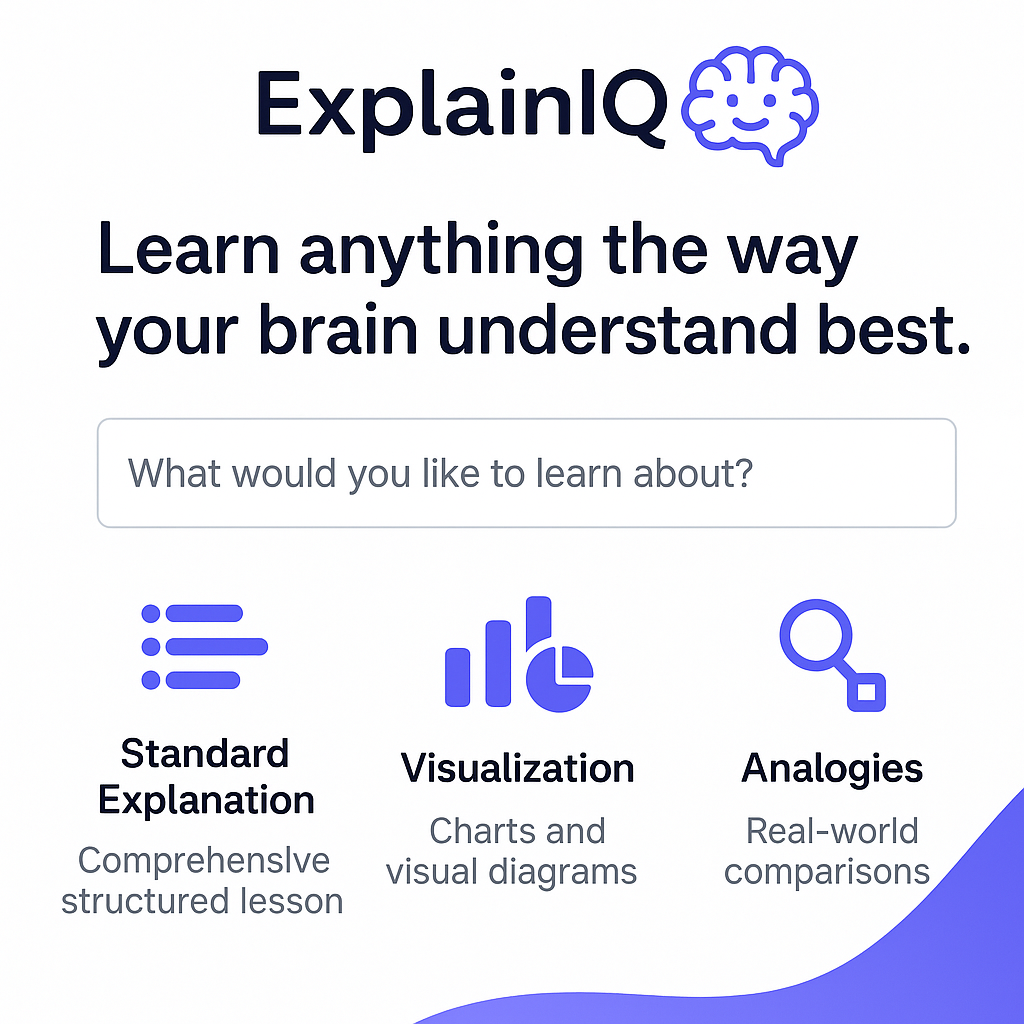
- 🧩 Standard Explanation – provides a clear, structured summary.
- 📊 Visualization – generates diagrams and flow-based conceptual maps.
- 💡 Analogy-Based Learning – connects abstract concepts to real-world metaphors for better retention.
The goal of ExplainIQ is to make learning intuitive, memorable, and beautifully simple.
🛠️ How It Was Built
ExplainIQ AI was developed using a modern, cloud-native architecture optimized for speed, modularity, and adaptability.
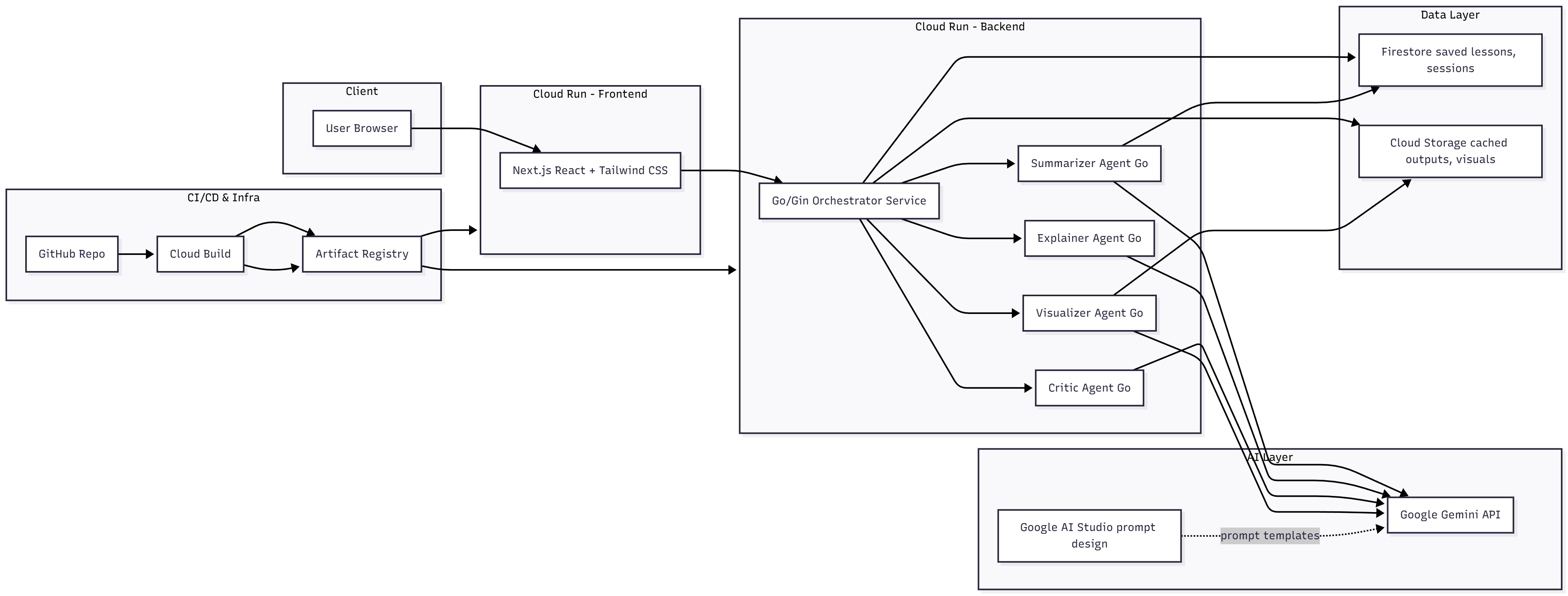
- Frontend: Built with Next.js (React) and Tailwind CSS, and deployed on Google Cloud Run for scalable, serverless performance.
- Backend: Implemented in Go using the Gin framework, orchestrating specialized AI agent services that interact with the Google Gemini API for real-time summarization and adaptive prompt chaining.
- Prompt Engineering: Prompt templates were embedded directly within the Go codebase (
internal/llm/gemini.go), allowing precise control over tone, depth, and learning style adaptation through code-based refinements — eliminating the need for external prompt tools. - Architecture: Designed as a modular agent pipeline, where user input is processed by an orchestrator that routes through dedicated agents — Summarizer → Explainer → Critic → Visualizer — each contributing a unique learning mode before producing a combined, multi-format output.
The system was optimized for low latency, modularity, and independent scalability, enabling each agent to evolve as a separate microservice within the ExplainIQ ecosystem.
⚙️ Challenges Encountered
Several challenges were faced during development:
- Balancing creativity with precision: AI models tended to over-simplify or hallucinate; additional prompt layers were introduced to re-summarize and fact-check outputs.
- Generating meaningful visualizations: Translating abstract topics into accurate, interpretable diagrams required iterative prompt engineering and structural refinement.
- Performance optimization: Achieving low latency while running concurrent LLM processes required advanced caching strategies and API concurrency tuning.
🎓 Key Learnings
The development of ExplainIQ demonstrated that personalized learning is as much a design challenge as it is a technical one.
Key takeaways include:
- The ability to design and deploy a lightweight, serverless AI system that scales efficiently.
- Insights into how prompt chaining and contextual mode switching can emulate different teaching styles.
- The realization that natural, adaptive learning experiences create stronger engagement and retention.
💭 Future Vision
ExplainIQ is being evolved into an adaptive learning brainprint system — one capable of discovering a learner’s dominant learning mode and tailoring all future explanations accordingly.
The vision is to create an AI tutor that understands how each individual thinks, providing the most effective path to comprehension.
ExplainIQ’s mission is to make understanding effortless — enabling everyone to learn anything, in the way their brain understands best.
Built With
- adk
- artifact-registry
- cloud-build
- cloud-storage
- figma
- firestore
- gin
- github
- go-(golang)
- google-ai-studio
- google-cloud-run
- google-gemini-api
- mermaid
- mermaid.js
- next.js-(react)
- tailwind-css
- typescript


Log in or sign up for Devpost to join the conversation.