-
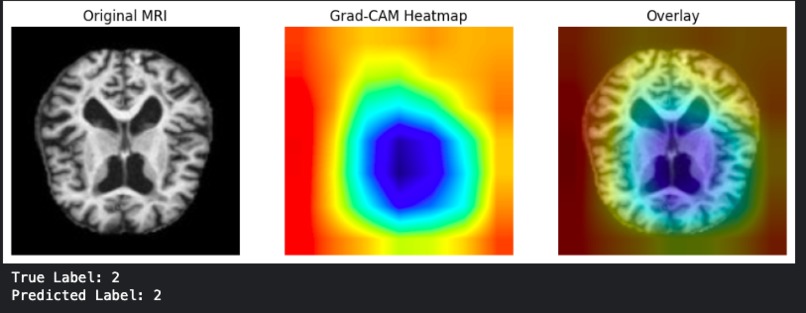
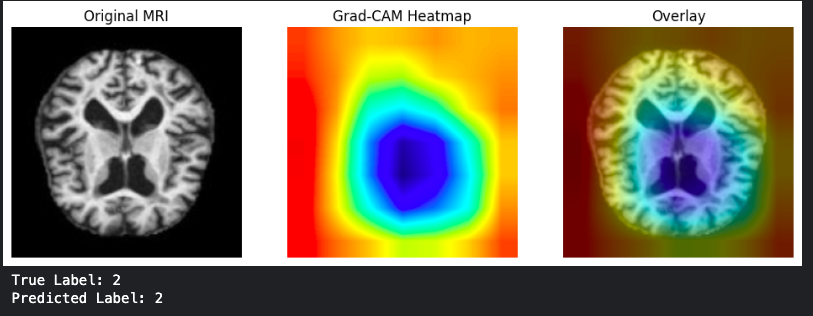
Grad-CAM highlighting brain regions that influenced the model’s correct Alzheimer’s MRI prediction, improving transparency and trust.
-
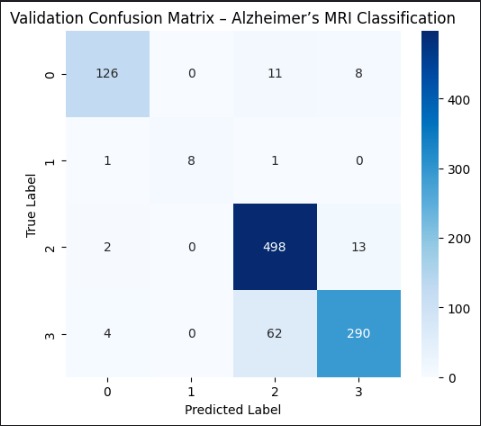
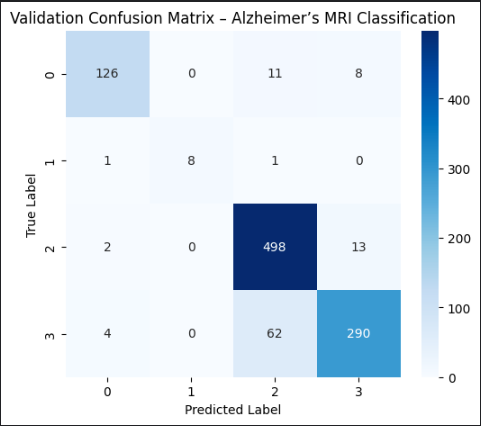
Validation confusion matrix showing balanced class-wise performance of the ResNet model for Alzheimer’s MRI classification.
-
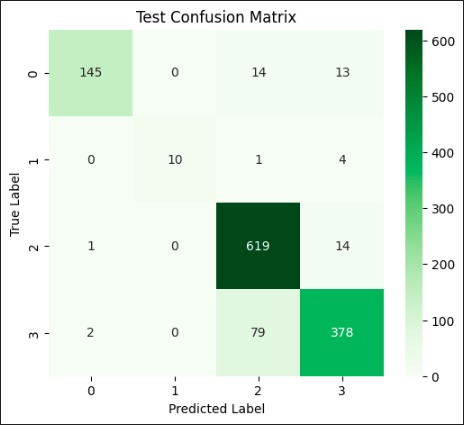
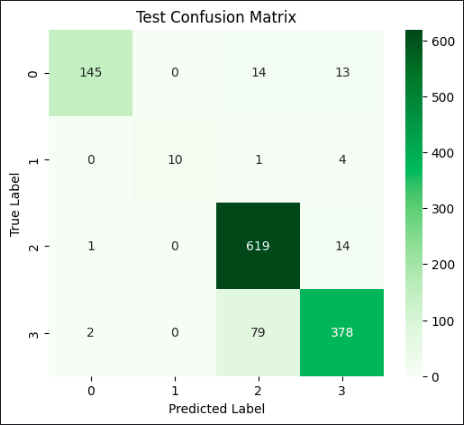
Test confusion matrix demonstrating strong generalization of the model on unseen MRI data.
Inspiration
Alzheimer’s disease is difficult to diagnose early because symptoms often appear only after irreversible brain damage has occurred. Although brain MRI scans contain valuable structural information, access to expert neurological interpretation is limited.
At the same time, many deep learning models used in medical imaging act as black boxes, producing predictions without explanations. In a high-stakes domain like healthcare, this lack of transparency reduces trust. This project was inspired by the need to build an accurate yet explainable AI system that supports clinical understanding rather than replacing it.
What it does
This project classifies brain MRI scans into Alzheimer’s-related categories using a deep learning model and explains the predictions using Grad-CAM. For a given MRI image, the system:
Predicts the Alzheimer’s disease class Generates Grad-CAM heatmaps highlighting influential brain regions Provides visual interpretability to validate model decisions The goal is to combine performance and transparency in medical AI.
How we built it
MRI data stored in Parquet format was decoded into grayscale images A pretrained ResNet-18 model was adapted for single-channel MRI input The model was trained using cross-entropy loss with label smoothing Performance was evaluated using accuracy, classification reports, and confusion matrices Grad-CAM was applied to the final convolutional layer to visualize class-specific attention Grad-CAM is computed as: Grad-CAM=ReLU(∑αk*A^k) where ( A^k ) are feature maps and ( \alpha_k ) are gradient-based importance weights.
Challenges we ran into
Ensuring Grad-CAM highlighted meaningful brain regions instead of background noise Handling limited and sensitive medical imaging data Balancing model accuracy with interpretability requirements Dealing with slight performance variation across training runs
Accomplishments that we're proud of
Built an effective MRI-based Alzheimer’s classification model Successfully integrated explainable AI using Grad-CAM Demonstrated that predictions rely on clinically relevant brain regions Achieved strong and consistent validation and test performance Delivered a clean, reproducible, and well-documented solution
What we learned
Explainability is essential for healthcare AI systems Deep learning models can capture meaningful neuroanatomical patterns Visualization techniques improve trust and model validation Responsible AI design requires more than just high accuracy
What's next for Explainable Alzheimer’s Detection from MRI Using ResNet
Extend the approach to 3D or multi-slice MRI data Compare Grad-CAM with other explainability methods Incorporate clinical metadata alongside imaging data Improve robustness across datasets from different sources Explore deployment as a clinician-assisted decision support tool

Log in or sign up for Devpost to join the conversation.