Inspiration
Medical reports are written for pathologists and oncologists, not patients. When someone receives a pathology or biopsy report, they are confronted with terrifying terms like invasive ductal carcinoma, lymphovascular invasion, margins negative, or HER2 equivocal.
In the vulnerable days before their follow-up oncology appointment, patients routinely search isolated medical terms late at night, landing on alarming or inapplicable survival statistics that amplify anxiety. Furthermore, general-purpose AI chatbots frequently invent diagnoses, offer unverified staging, or suggest clinical advice they are unqualified to give.
We built Explain My Report to bridge the gap between clinical jargon and patient comprehension. We believe a cancer report should never feel like an incomprehensible second diagnosis—it should be the starting point for an informed, calm conversation with a care team.
### What It Does

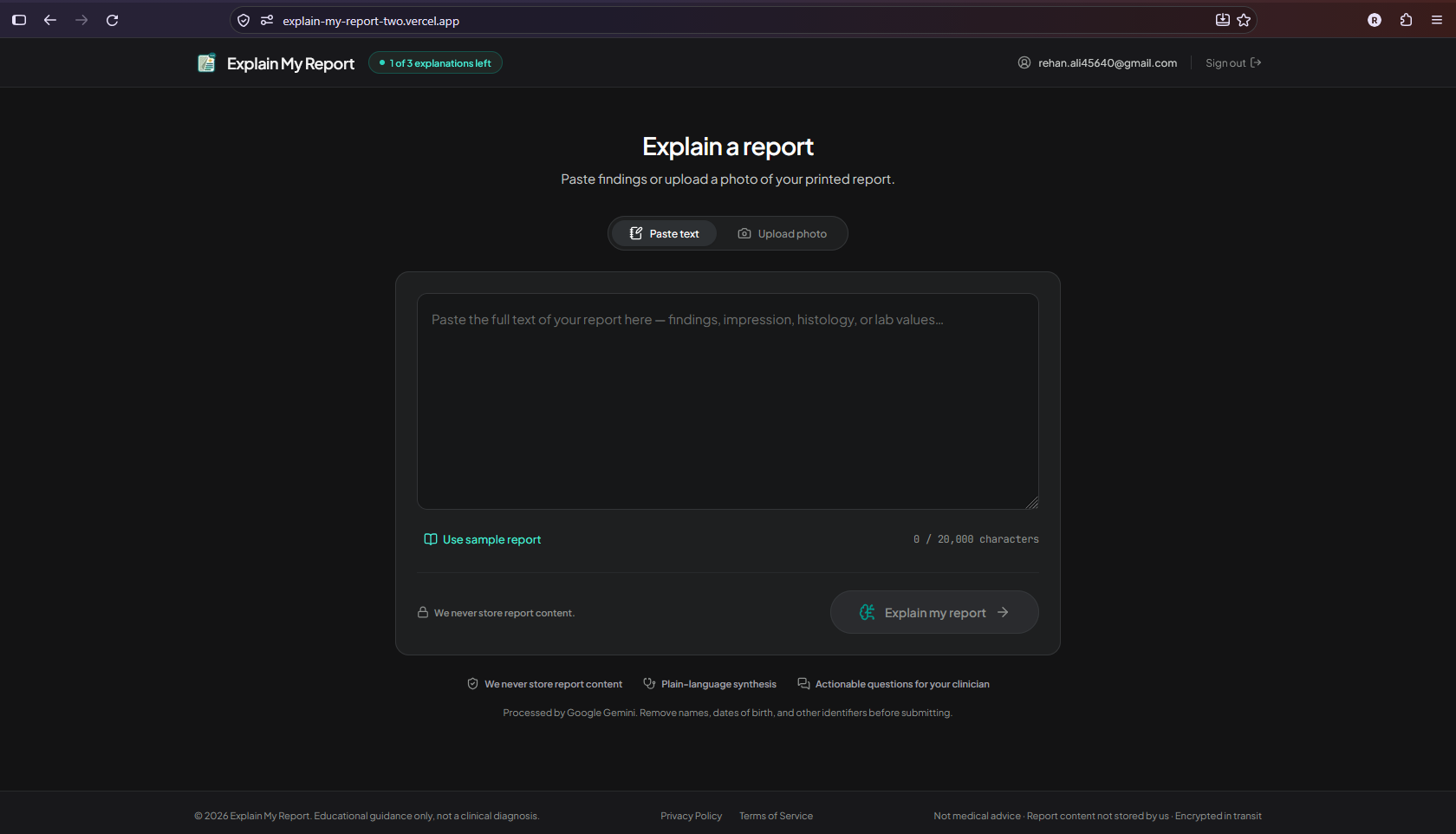
Explain My Report is a free, privacy-first web application that translates cancer-related pathology and laboratory reports into plain, compassionate language:

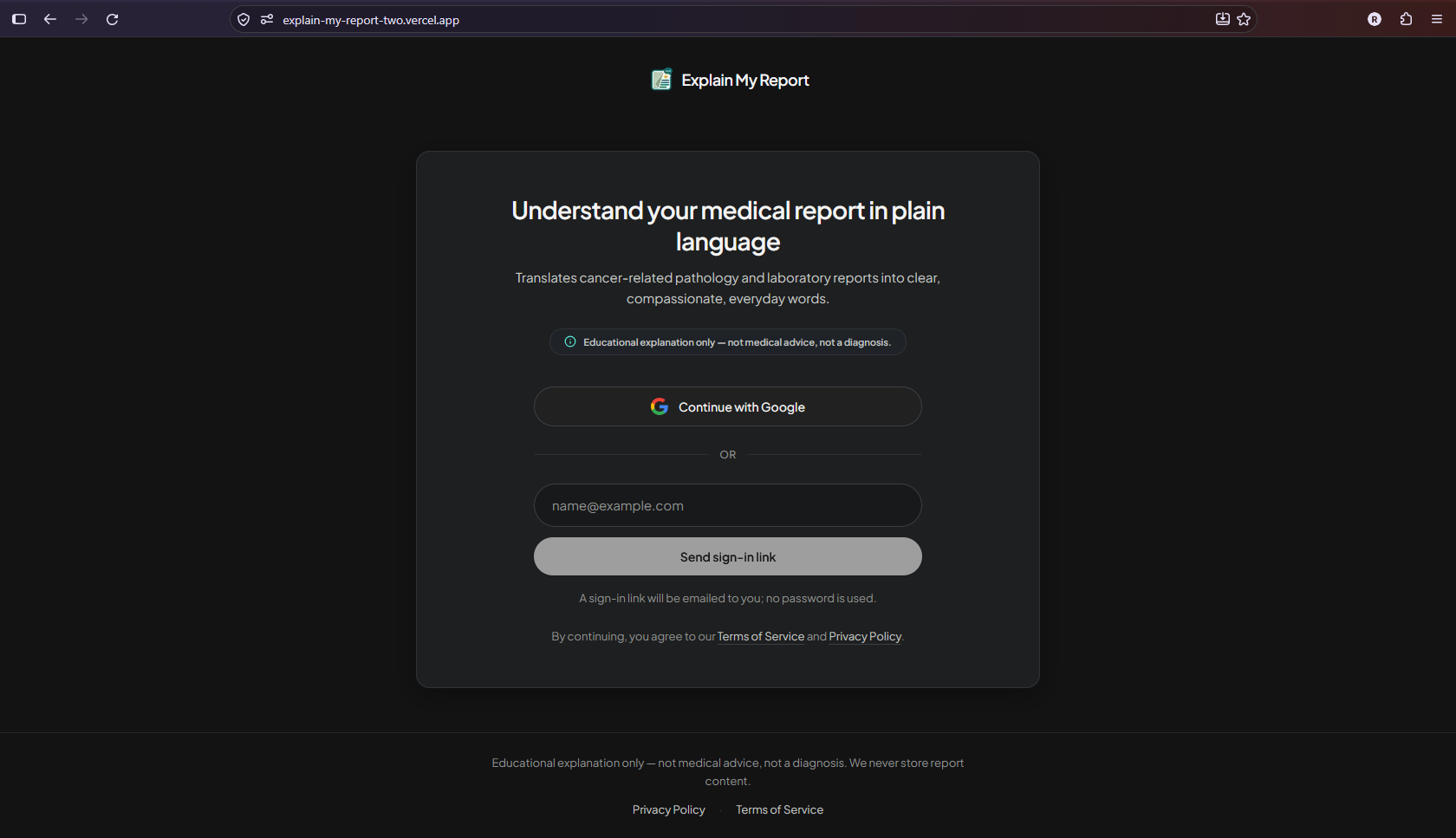
-1. **Flexible Input:** Users securely sign in (via passwordless Google OAuth or email magic link) and either paste their report text (up to 20,000 characters) or upload a photo of a printed paper report (PNG, JPEG, WebP).
-2. **Plain-Language Summary:** Delivers an immediate, empathetic overview describing what kind of report it is and what it discusses in plain English.
-3. **Structured & Grounded Findings:** Categorizes key findings with clear status badges:
   - **Routine:** Presented as expected, benign, or negative for disease.
   - **Needs Attention:** Abnormal or clinically significant points that warrant a conversation with the clinician.
   - **Unclear:** Ambiguous or illegible items that the AI intentionally refuses to guess at.
-4. **Verifiable Source Excerpts:** Every single finding links back to verbatim phrases extracted from the original report, preventing AI hallucinations and giving patients total transparency.
-5. **Care Team Questions:** Generates personalized, targeted questions equipped with a one-click copy button to bring to their next appointment.
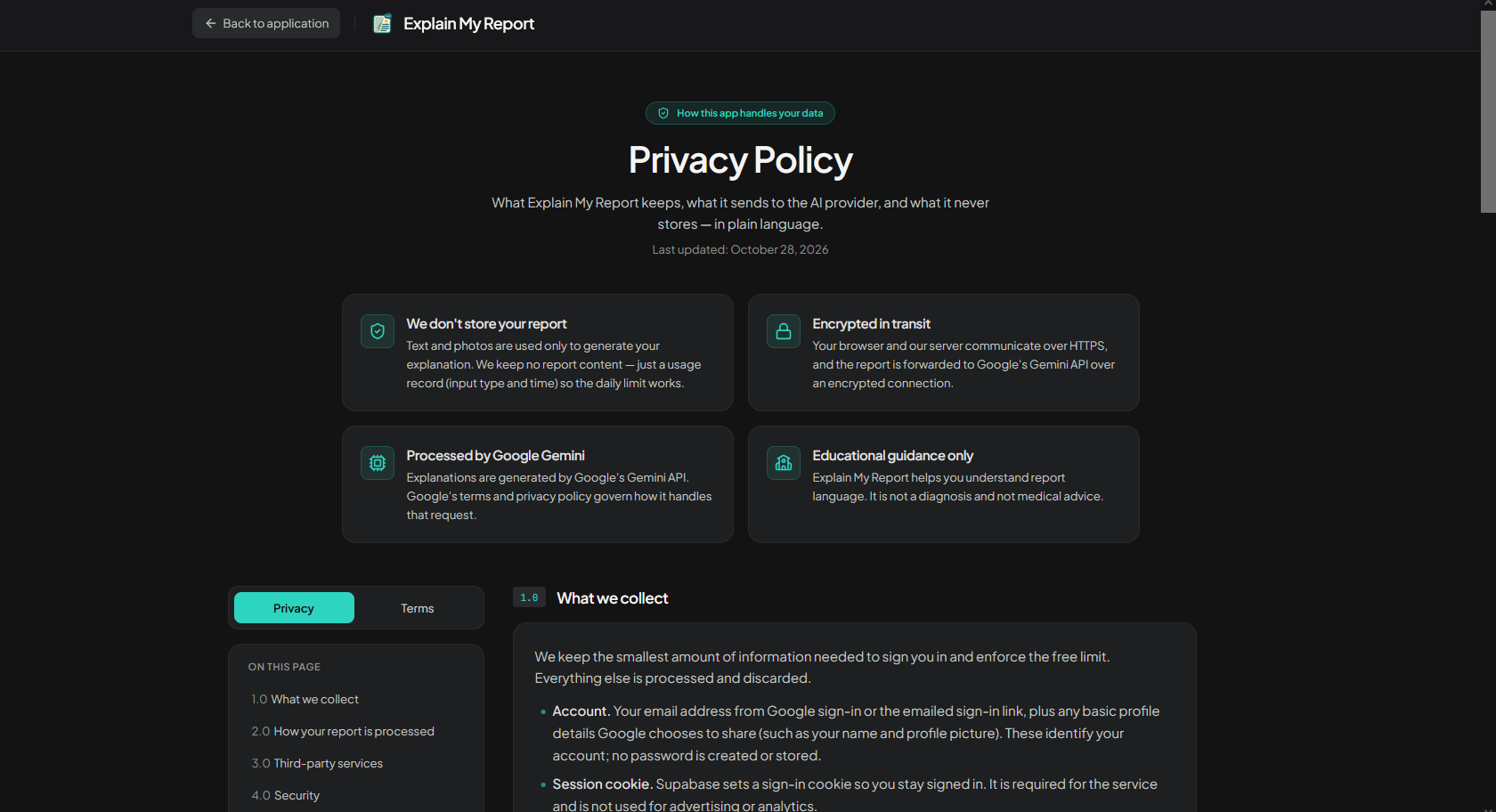
-6. **Strict Ephemeral Privacy:** Reports and explanations are never stored in any database; they exist purely on the screen and are wiped on navigation or sign-out.
How We Built It
- Frontend & Routing: Built with Next.js 16 (App Router), React 19, and Tailwind CSS v4 for a fast, accessible, and distraction-free dark interface.
- AI Engine & Multimodal Analysis: Powered by Google's Gemini 3.5 API (
gemini-3.5-flash-lite). Text reports and document photo scans are processed with strict system constraints. - Safety & Schema Validation: Gemini's structured output is validated through strict Zod schemas. For text reports, every quoted excerpt is cross-verified against the original text; any ungrounded findings are dropped before reaching the user.
- Backend & Auth: Supabase handles secure authentication (Google OAuth & magic links) and enforces an automated rate-limiting quota (3 explanations per rolling 24-hour window) without persisting any medical text or images.
- Deployment: Deployed globally on Vercel with automated CI/CD and strict security headers (Content Security Policy, no-cache directives). ```
Challenges We Ran Into
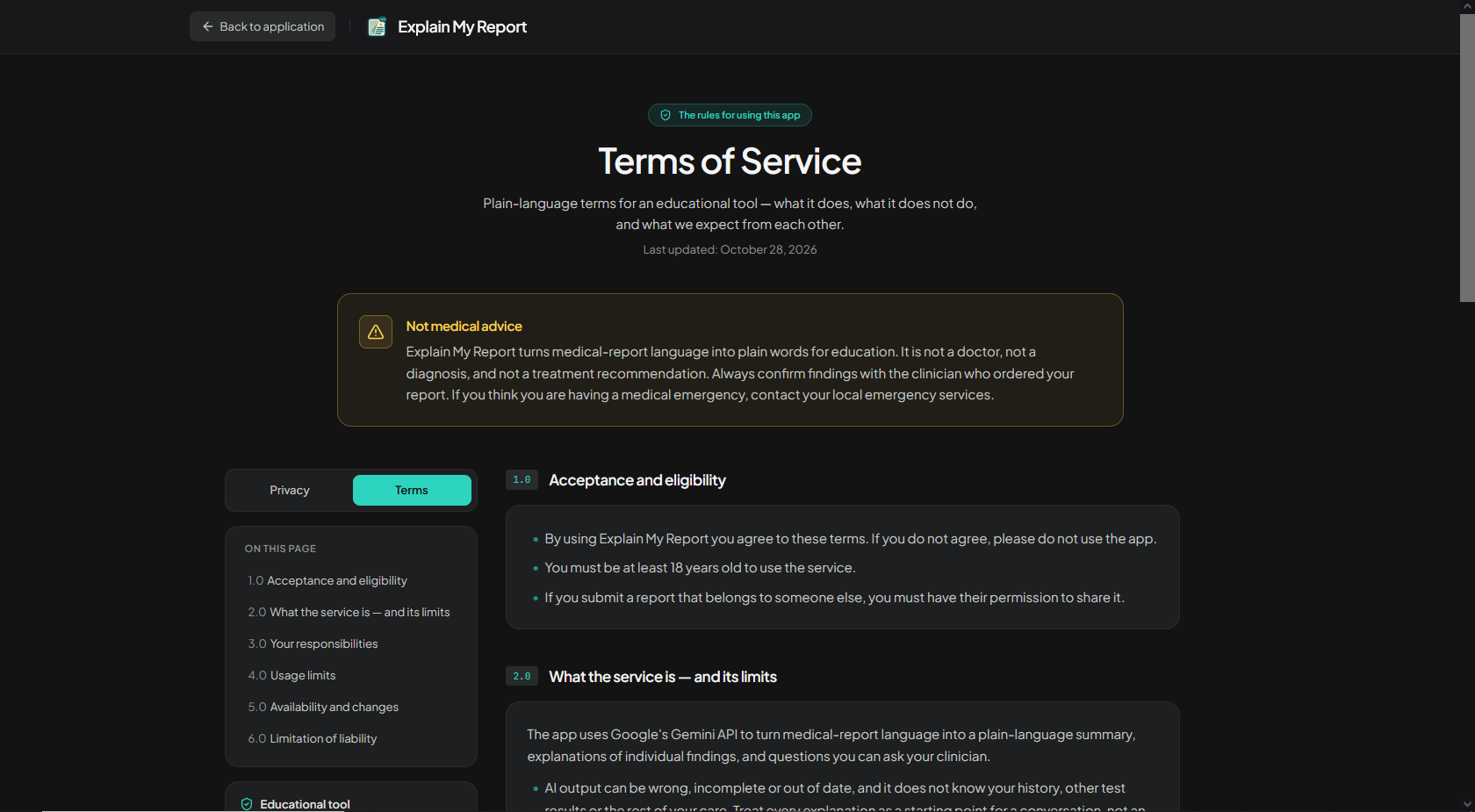
- Enforcing Non-Diagnostic Boundaries: Designing prompt guardrails and programmatic schema validations that firmly refuse to diagnose, stage, predict outcomes, or recommend treatment—even when a user explicitly asks or uploads an advanced report.
- Grounding Excerpts: Preventing LLM hallucination in high-stakes oncology contexts. We engineered a dual-validation pipeline that cross-checks AI-quoted text against the source document.
- Medical Report OCR & Layouts: Processing mobile photographs of crumpled or rotated paper lab reports with varied lighting while accurately isolating clinical findings without fabricating missed words.
- Patient Privacy Compliance: Balancing rate-limiting protection with absolute zero-retention privacy for sensitive health documents. ```
Accomplishments That We're Proud Of
- Built a fully functional, live production prototype that works smoothly across both pasted text and photo uploads.
- Maintained a zero-report-storage architecture where patient data never touches persistent storage.
- Designed a reassuring, compassionate user experience that turns anxiety into productive, actionable doctor appointment questions.
- Implemented robust error recovery and automated daily fair-use limits. ```
What We Learned
- In oncology support tools, what the AI refuses to say is just as important as what it explains. Clear boundaries build patient trust.
- Grounding AI explanations in verbatim source excerpts dramatically lowers patient anxiety by removing ambiguous interpretations.
- Passwordless authentication combined with ephemeral state provides the ideal balance between security and frictionless access for stressed users. ```
What's Next for Explain My Report
- Clinician-Reviewed Phrase Library: Partnering with oncology nurse navigators and pathologists to audit explanations against standardized patient-education dictionaries.
- Multilingual Support: Translating English medical reports into Spanish, Cantonese, Tagalog, and other languages to aid non-English speaking families.
- Direct PDF & Portal Export: Supporting direct PDF report uploads and printable "Question Sheets" formatted for oncology visits.
- Usability Study: Conducting patient and caregiver feedback sessions to measure comprehension gains and appointment preparedness.
Built With
- google-gemini-api
- next.js
- postgresql
- react
- supabase
- tailwindcss
- typescript
- vitest
- zod

Log in or sign up for Devpost to join the conversation.