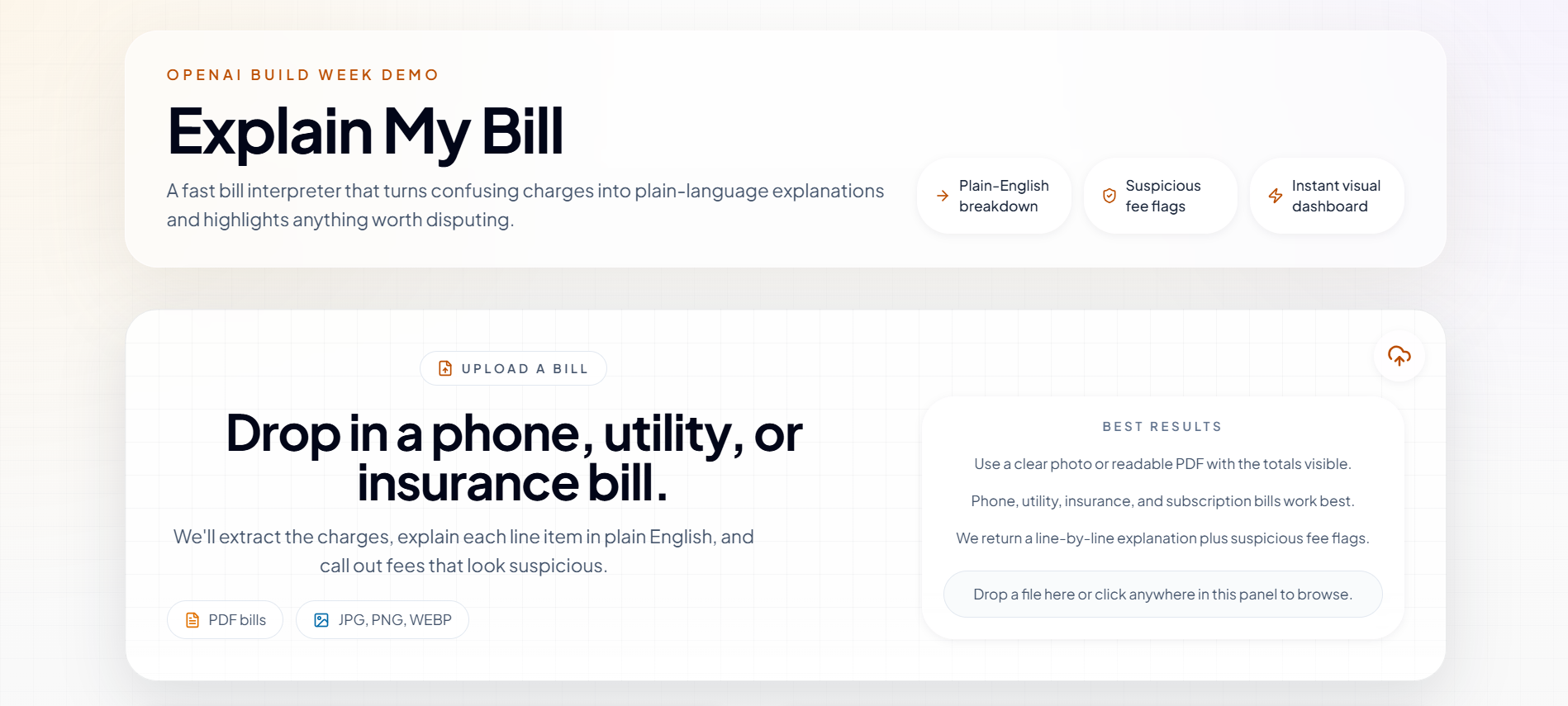
Explain My Bill
Inspiration
Bills are an unavoidable part of everyday life, yet they are often filled with technical jargon, taxes, surcharges, and hidden fees that many people struggle to understand. Whether it's a mobile phone bill, an electricity bill, or an insurance statement, users are frequently left wondering what they're actually paying for.
We built Explain My Bill to make billing transparent. By combining document processing with AI, our goal is to help users instantly understand every charge, identify unusual fees, and make more informed financial decisions.
What it does
Explain My Bill is an AI-powered web application that allows users to upload a phone, utility, or insurance bill as either a PDF or an image.
Once uploaded, the application:
- Extracts the bill contents.
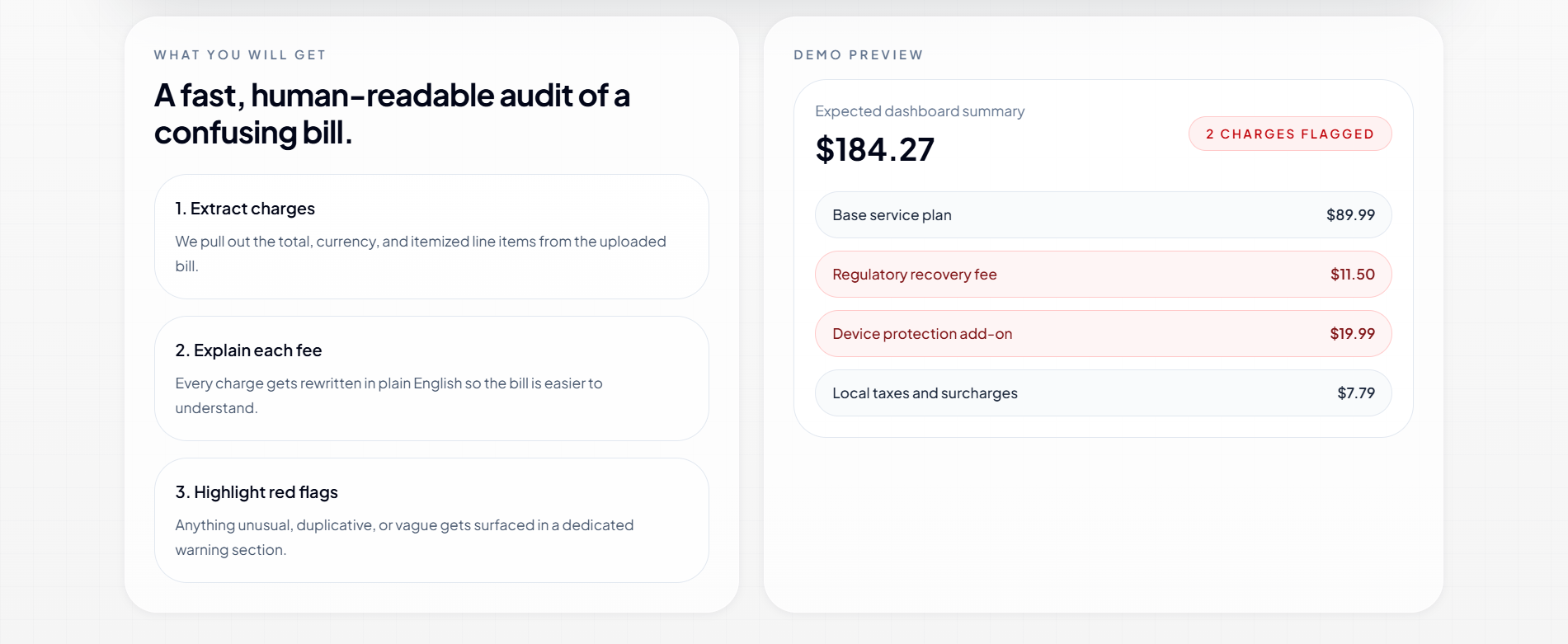
- Identifies individual line items.
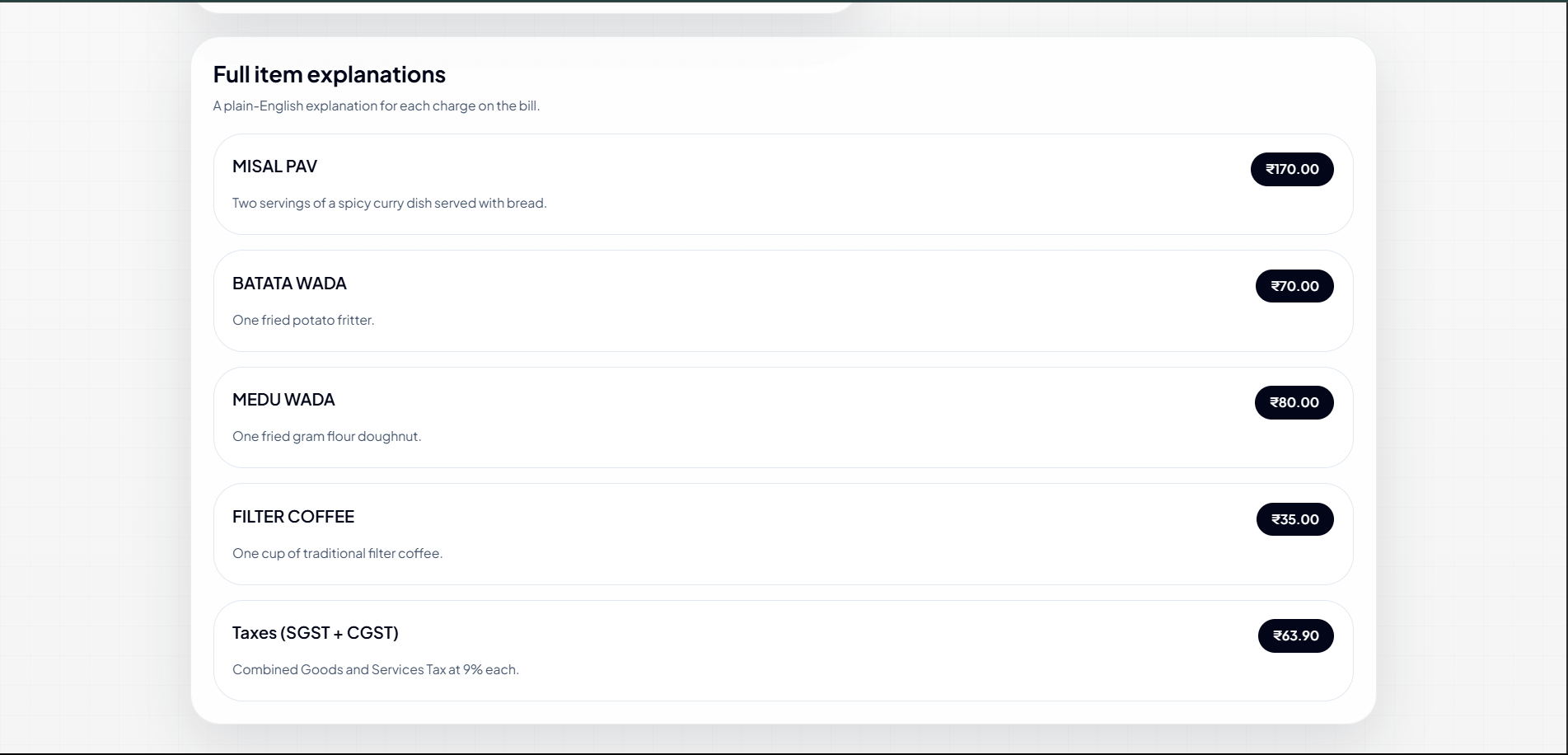
- Explains every charge in plain English.
- Flags suspicious or hidden fees.
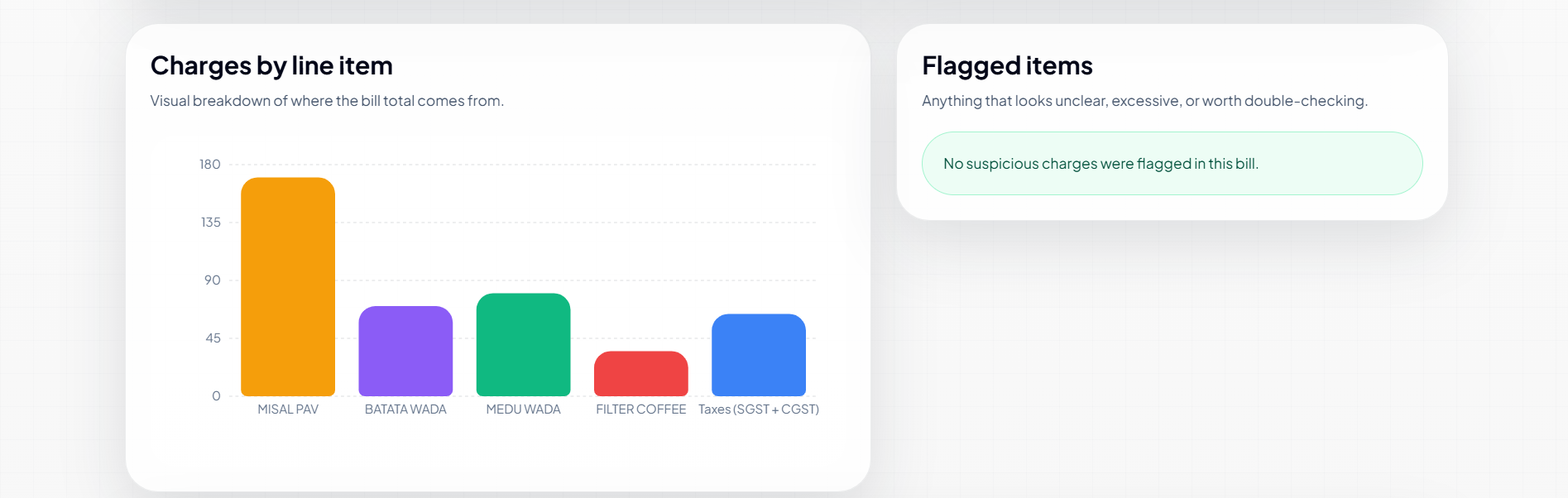
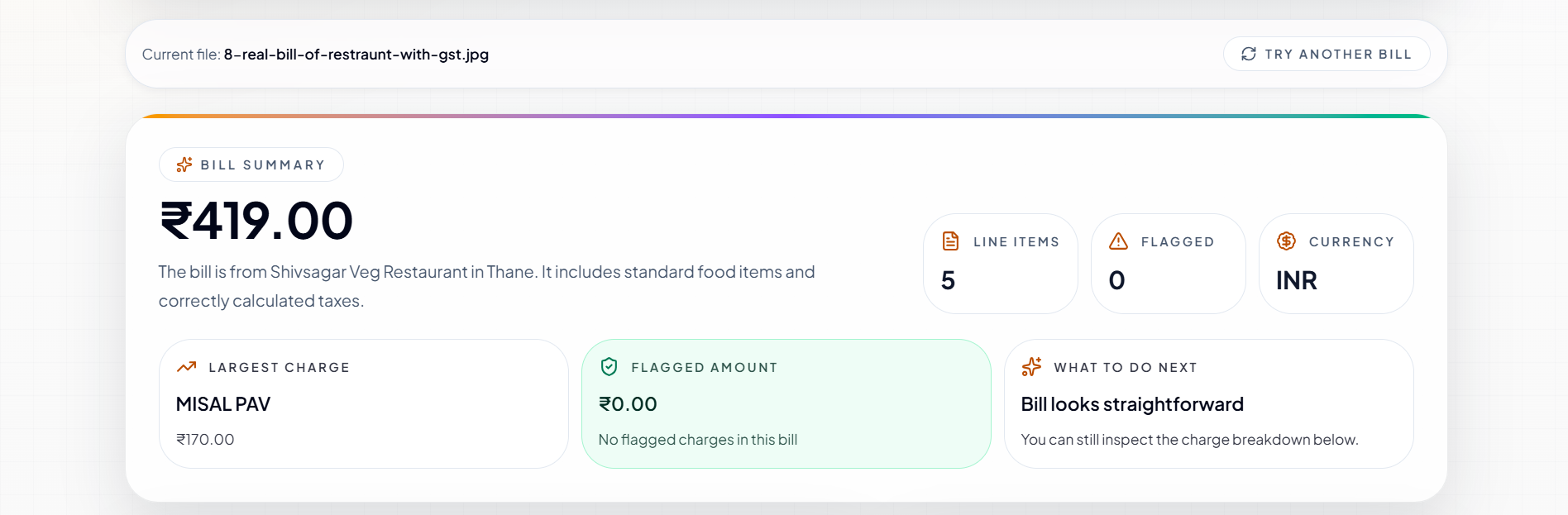
- Displays the analysis in an interactive dashboard with charts and summaries.
Instead of reading confusing billing terminology, users receive explanations they can understand in seconds.
How we built it
Frontend
- Next.js (App Router)
- TypeScript
- Tailwind CSS
- Recharts
The frontend provides a responsive drag-and-drop upload experience, loading states, error handling, summary cards, flagged fee alerts, and interactive visualizations.
Backend
- FastAPI
- Python
- pdfplumber
- Pydantic
The backend accepts uploaded files, detects whether they are PDFs or images, extracts text where applicable, validates AI responses, and returns structured JSON to the frontend.
AI
We use a Large Language Model through the Groq API to:
- Understand bill contents
- Explain charges in simple language
- Detect hidden or suspicious fees
- Produce structured JSON for reliable rendering
Challenges we ran into
One of our biggest challenges was supporting different document formats. PDFs often contain selectable text, while images require visual understanding, so we implemented separate processing pipelines for each.
Another challenge was ensuring reliable AI output. Since language models may return inconsistent formatting, we used Pydantic to validate every response before displaying it to users.
Designing a clean user experience was also important. We added loading skeletons, clear error messages, and visual dashboards to make complex billing information easy to understand.
What we learned
Building Explain My Bill taught us how to:
- Build an end-to-end AI application.
- Process both images and PDF documents.
- Design reliable APIs using FastAPI.
- Validate AI-generated structured data.
- Build modern user interfaces with Next.js and Tailwind CSS.
- Present AI insights through interactive visualizations.
Most importantly, we learned that AI can simplify everyday financial information and make it accessible to everyone.
Example Insight
If a bill contains the following charges:
- Base Plan: ₹599
- Convenience Fee: ₹49
- Regulatory Charge: ₹35
- Taxes: ₹114
The total amount is computed as
$$ \text{Total} = 599 + 49 + 35 + 114 = 797 $$
Our AI then explains why each charge exists, whether it appears reasonable, and highlights fees that deserve closer attention.
Conceptually, the application converts a complex bill into understandable insights:
$$ \text{Bill} \xrightarrow{\text{AI Analysis}} \text{Structured Data} \xrightarrow{\text{Visualization}} \text{Clear Explanation} $$
What's next
We plan to expand Explain My Bill with:
- Support for medical bills, bank statements, and credit card statements.
- OCR improvements for low-quality scans.
- Multi-language explanations.
- Spending analytics across multiple bills.
- Monthly bill comparisons to detect unexpected changes.
- Personalized recommendations for reducing recurring expenses.
Our vision is to make Explain My Bill a trusted AI assistant that helps people understand their bills, avoid unnecessary charges, and make smarter financial decisions with confidence.
Built With
- ai
- api
- css3
- gpt
- html5
- javascript
- next.j
- python
- react
- rest
- tailwindcss


Log in or sign up for Devpost to join the conversation.