
Expetenogy
Science should be something you experience, not just something you read.
Expetenogy started in 2026 as a personal project with a pretty simple idea. I wanted a place where students, independent researchers and curious people could explore science without constantly jumping between dozens of different websites.
At first, the idea was mostly focused on biology and scientific experiments. But while developing it, I realised the same problem exists in almost every scientific field. There are amazing tools available online, but they are often scattered across different platforms, and sometimes difficult for beginners to understand.
So I decided to bring them together.
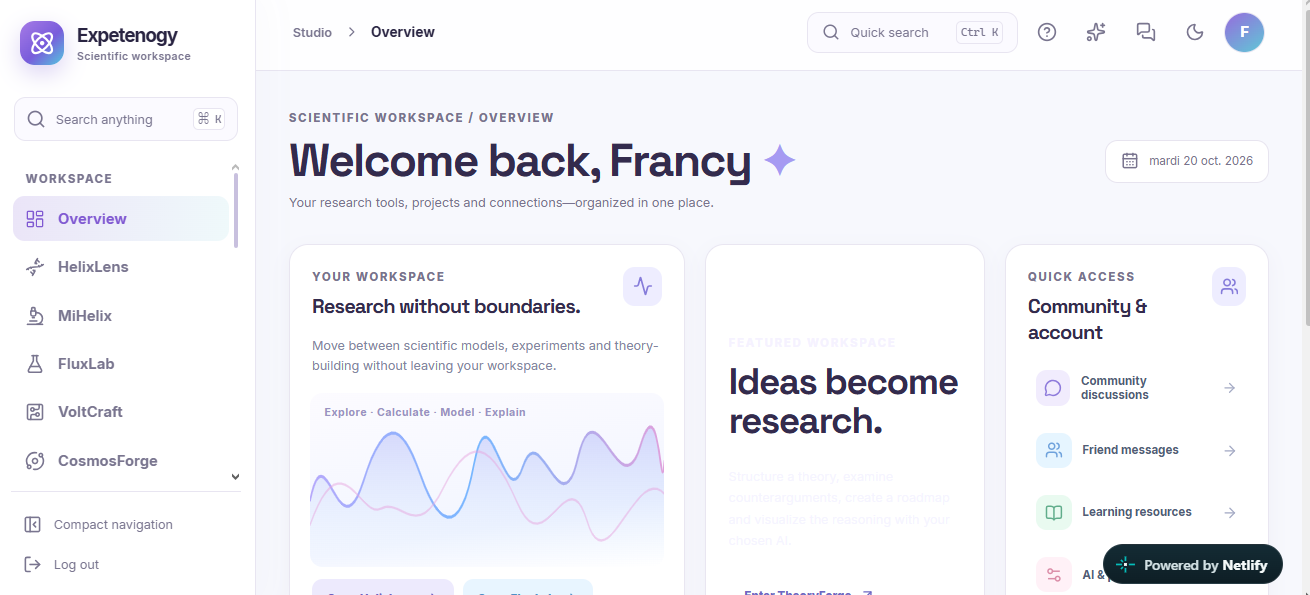
Expetenogy is a scientific workspace combining bioinformatics, physics, astrophysics, microbiology, geography, electronics and interactive education.
Instead of trying to recreate every scientific instrument from scratch, Expetenogy also integrates existing scientific technologies and databases into a more accessible research environment.
What can you actually do?
With HelixLens, users can explore bioinformatics, DNA, proteins, molecular structures and scientific data.
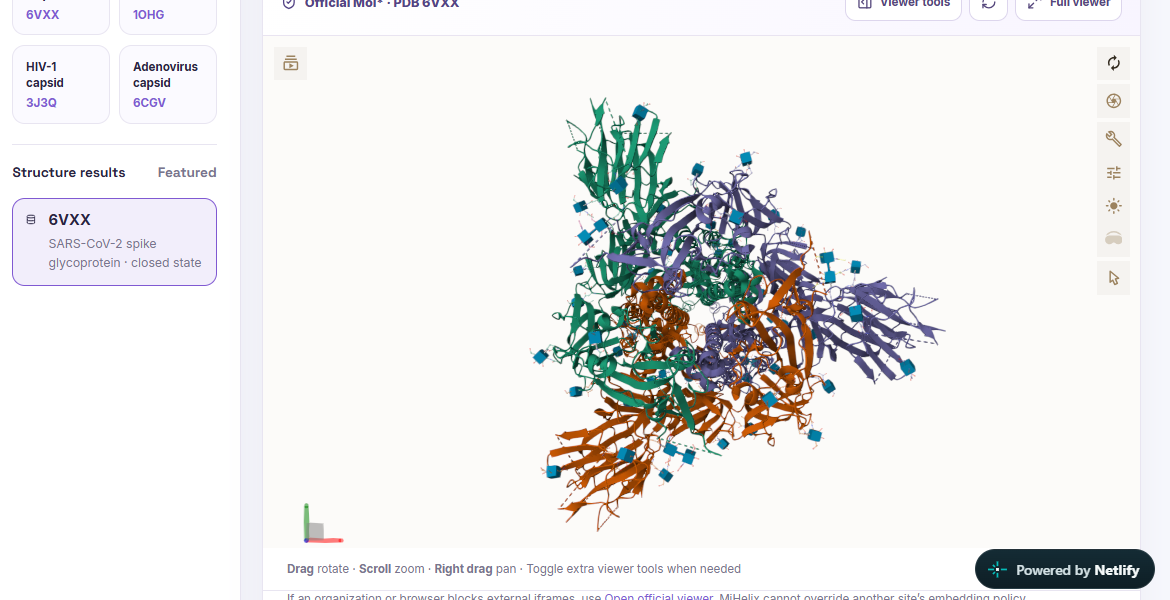
MiHelix focuses on microbiology and structural biology. It connects to real molecular records and visualization tools, allowing users to inspect published structures and learn more about them.
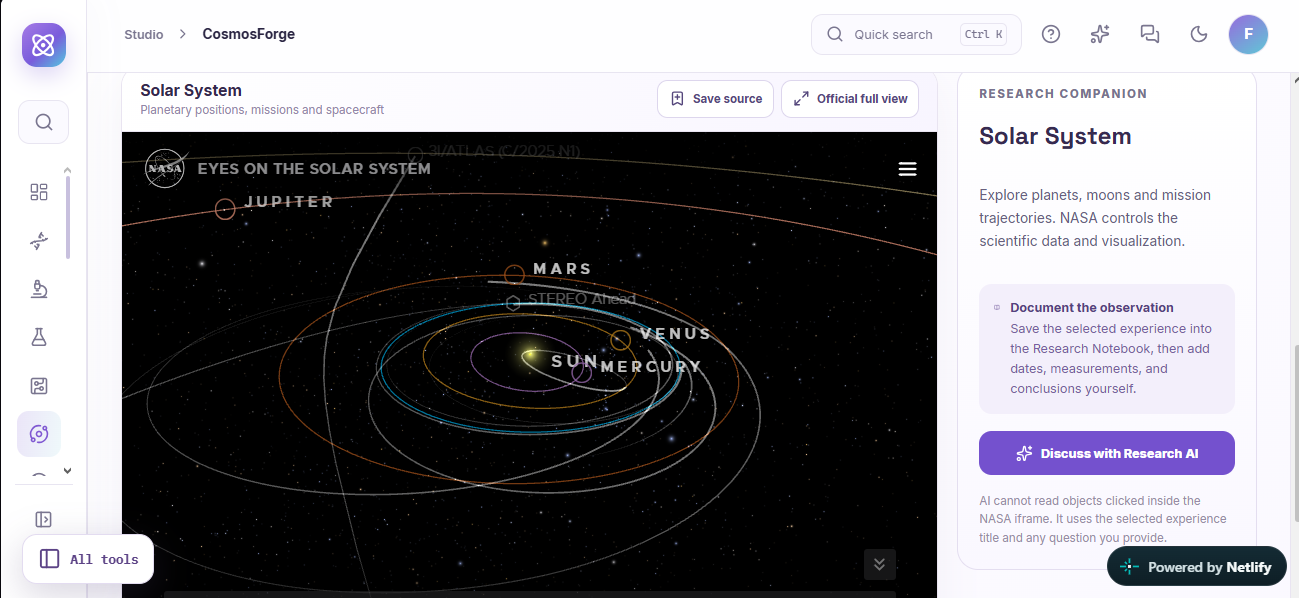
CosmosForge is dedicated to space. It brings astronomical exploration, sky surveys, NASA visualizations, celestial objects and research tools into one workspace.
FluxLab focuses on physics experiments, mathematical models, mechanics, electricity, waves and scientific measurements.
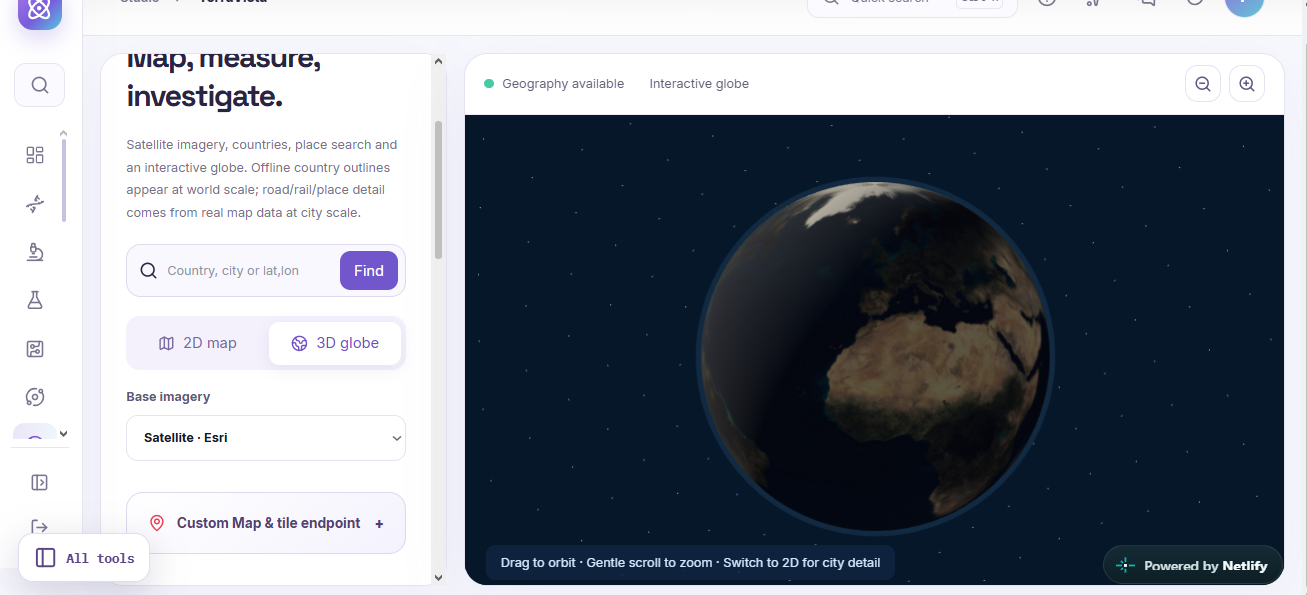
TerraVista is designed for geographic exploration, including maps, satellite views and 3D terrain where supported.
VoltCraft introduces interactive electronics and circuit simulation, while TheoryForge provides an environment for exploring scientific ideas and hypotheses.
The platform also includes educational resources, interactive lessons, research notebooks and tools for working with scientific data.
Where does AI fit into all of this?
AI is not supposed to replace scientific research.
In Expetenogy, it acts more like a research assistant.
Users can connect their own supported AI provider and use it to understand scientific concepts, discuss experiments, interpret available information and explore new ideas.
One of the newer features is an AI Animation Studio, where users can describe a scientific animation they want, and a compatible AI model can generate interactive HTML, CSS and JavaScript content.
For example, someone learning physics could request a visual explanation of an electric field or an orbital system and interact with the generated animation.
The goal is to make science easier to understand through experimentation and visualization.
Why I built it
I think science becomes much more interesting when you can interact with what you're learning.
Reading about a molecule is useful, but rotating its real structure makes it easier to understand. Learning about astronomy is fascinating, but exploring actual sky observations makes the experience completely different.
I wanted Expetenogy to connect those two sides of science.
Its not intended to replace professional scientific software or established databases. Instead, it brings useful tools and learning resources together in a way that feels more approachable.
What's next?
There is still alot I would like to improve.
I want to expand the scientific integrations, make the interface faster, improve the educational content and develop more advanced research workflows.
Expetenogy is still evolving, and some features depend on external services, API configuration or supported browser technologies.
But the main idea will stay the same.
Science should be accessible, interactive and open to anyone willing to explore it.

Log in or sign up for Devpost to join the conversation.