Inspiration
Choosing an expert witness can make or break a case, but finding one is slow and unreliable. Court record sites aren't built to search by expertise, dedicated expert-research tools are closed commercial platforms and focusing on vetting a particular expert, and Googling an expert usually leads to their own website, if existing at all, which is marketing, not court data. We wanted to see how far public court data alone could go.
What it does
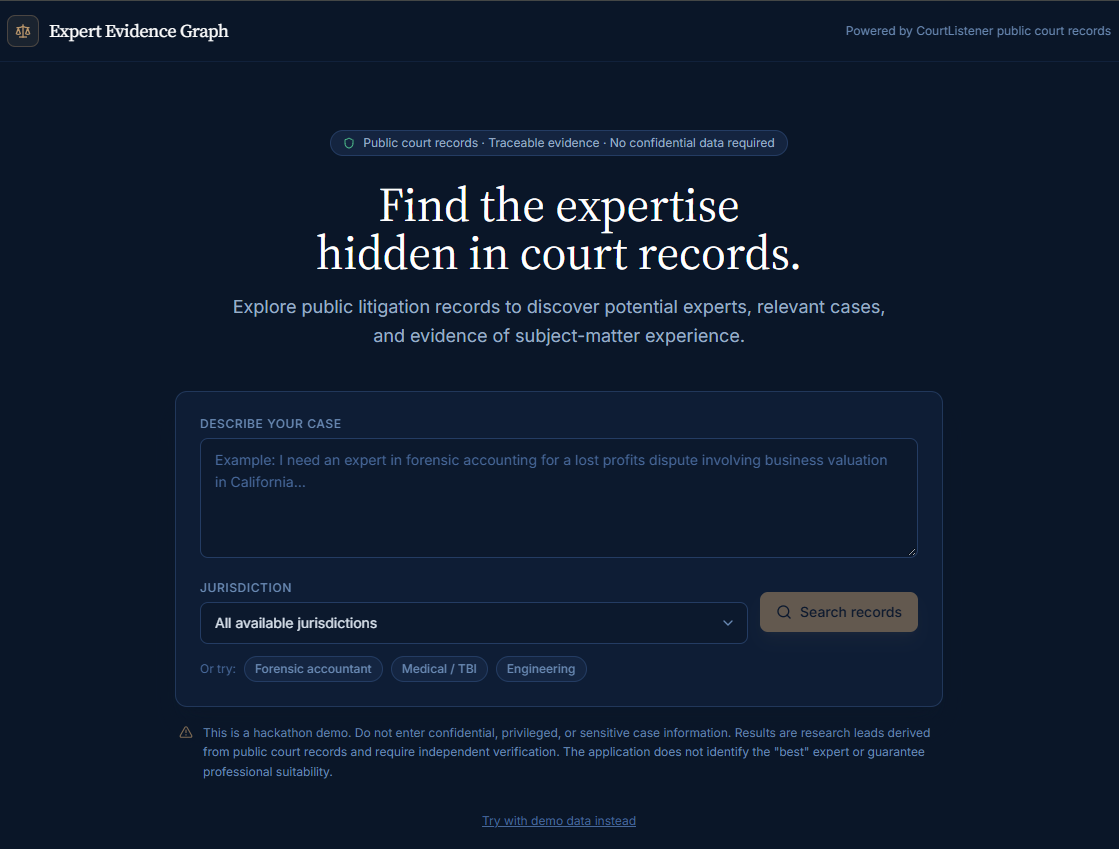
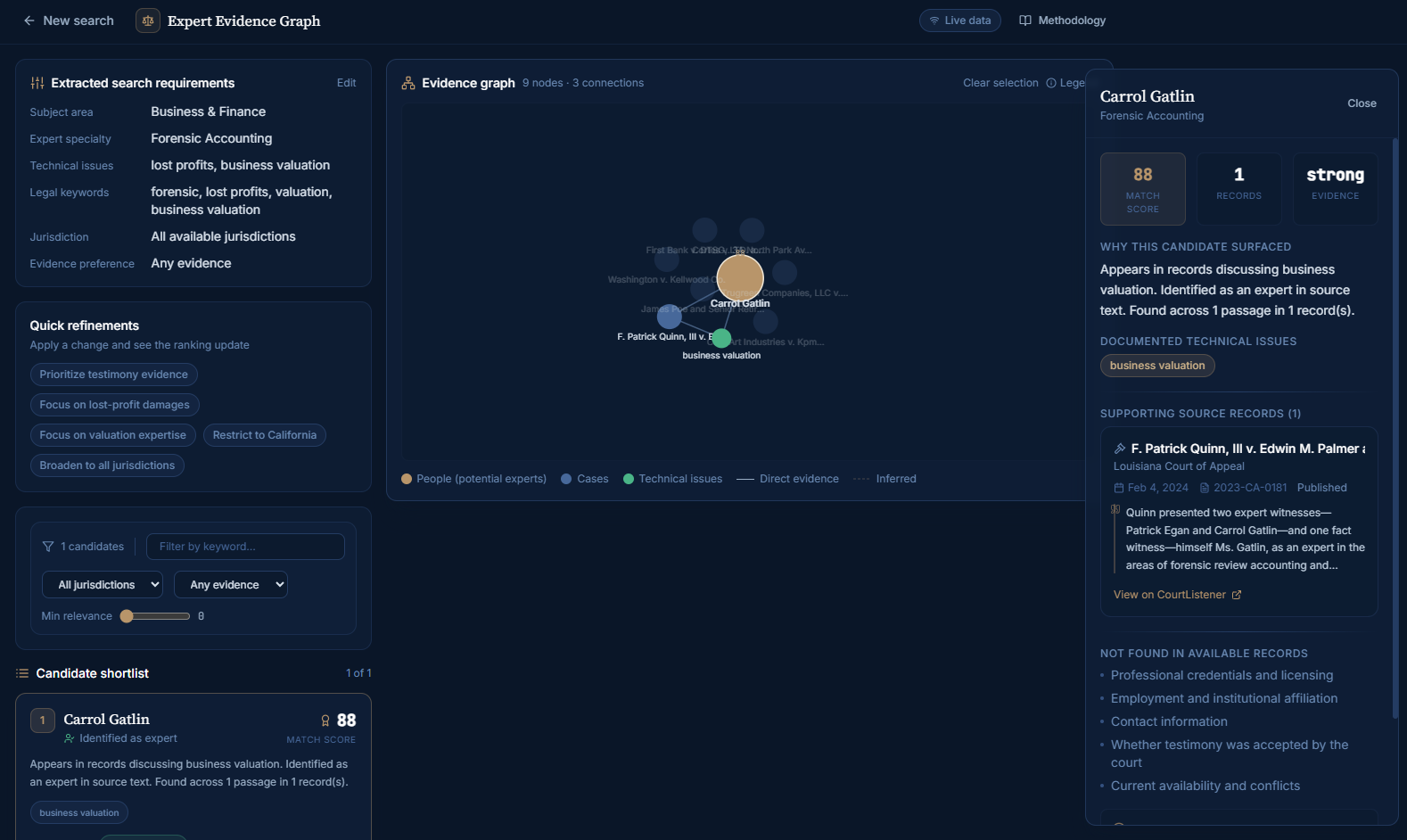
Expert Evidence Graph is built for lawyers and litigants. You describe a dispute and get a ranked shortlist of potential experts. Each candidate appears in a graph linking the expert to the case, the issue and the source passage, with a link back to the public court opinion.
In our demo, a search for forensic accounting, lost profits, business valuation surfaces Ms. Carrol Gatlin from Quinn v. Palmer (La. App. 4 Cir. 2024), where the court accepted her as an expert in forensic review accounting and business valuation. She helped her client win the trial and the Court of Appeal affirmed the trial judgement.
How we built it
React UI → Supabase edge function (keeps the CourtListener API token server-side) → CourtListener REST search API → TypeScript scoring, graph and evidence panel. Demo data keeps the workflow usable if live search is unavailable.
The score is a transparent heuristic based on five factors: expert named in the case, specialty match to the query, number of cases found, trial won, and appeal won.
Challenges we ran into
- Scoring honestly. A win doesn't prove the expert was good, so we treat outcome factors as context and label the score as a ranking aid, not a legal opinion.
- One day, no lawyer validation. We haven't tested precision with practicing lawyers.
Accomplishments that we're proud of
- A working end-to-end prototype in one day: describe a dispute and get a ranked shortlist of expert candidates (on a graph!), built on live public court data.
- Every match is traceable. Each candidate links person → case → issue → source passage → the original court opinion, so users can check the evidence instead of trusting a number.
- A real, verifiable example. Our demo surfaces Carrol Gatlin from Quinn v. Palmer (La. App. 4 Cir. 2024), a published opinion anyone can read (trial won! appeal won!)
- A transparent score. Five visible factors, labeled as a ranking aid and not a legal opinion, with outcome factors treated as context rather than proof of expert quality.
- Responsible by design. Public court opinions only, the API token kept server-side, and an honest demo-data fallback.
What we learned
A score without a source is hard to trust. Making every match traceable to the original opinion mattered more than the number.
What's next for Expert Evidence Graph
Entity resolution across cases, calibrated and auditable scoring with evidence-level citations, validation with practicing lawyers, and more specialties and jurisdictions.
Built With
- courtlistener-api
- react
- supabase
- supabase-edge-functions
- tailwindcss
- typescript
- vite

Log in or sign up for Devpost to join the conversation.