In the public imagination, the year 1956 brings to mind a number of things – foremost the Hungarian Revolution, and its subsequent bloody suppression. Those of a certain vintage would recall the Suez Crisis, or the debut album of Elvis Presley.
But those in the know would associate 1956 with the Dartmouth workshop, often considered the seminal event in artificial intelligence. In the intervening decades the field of AI bore witness to several cycles of hype and bust, as it broadened and matured.
The field is once again in a frenzy, and public perception of AI is divided. Evangelists, believing it a tool of Promethean promise, herald the coming of what they call the AI revolution. Others, wary of the limits of today’s computational powers and the over-promise of previous hypes, warn of a market correction of sorts. Because of its complexity and apparent inaccessibility, the average layperson views it with both awe and suspicion. Still others are unaware of its developments at all.
However, there is one major difference between the present flowering of AI and the previous decades. It is here in our everyday lives, and here to stay. Yet most people are not aware of this.
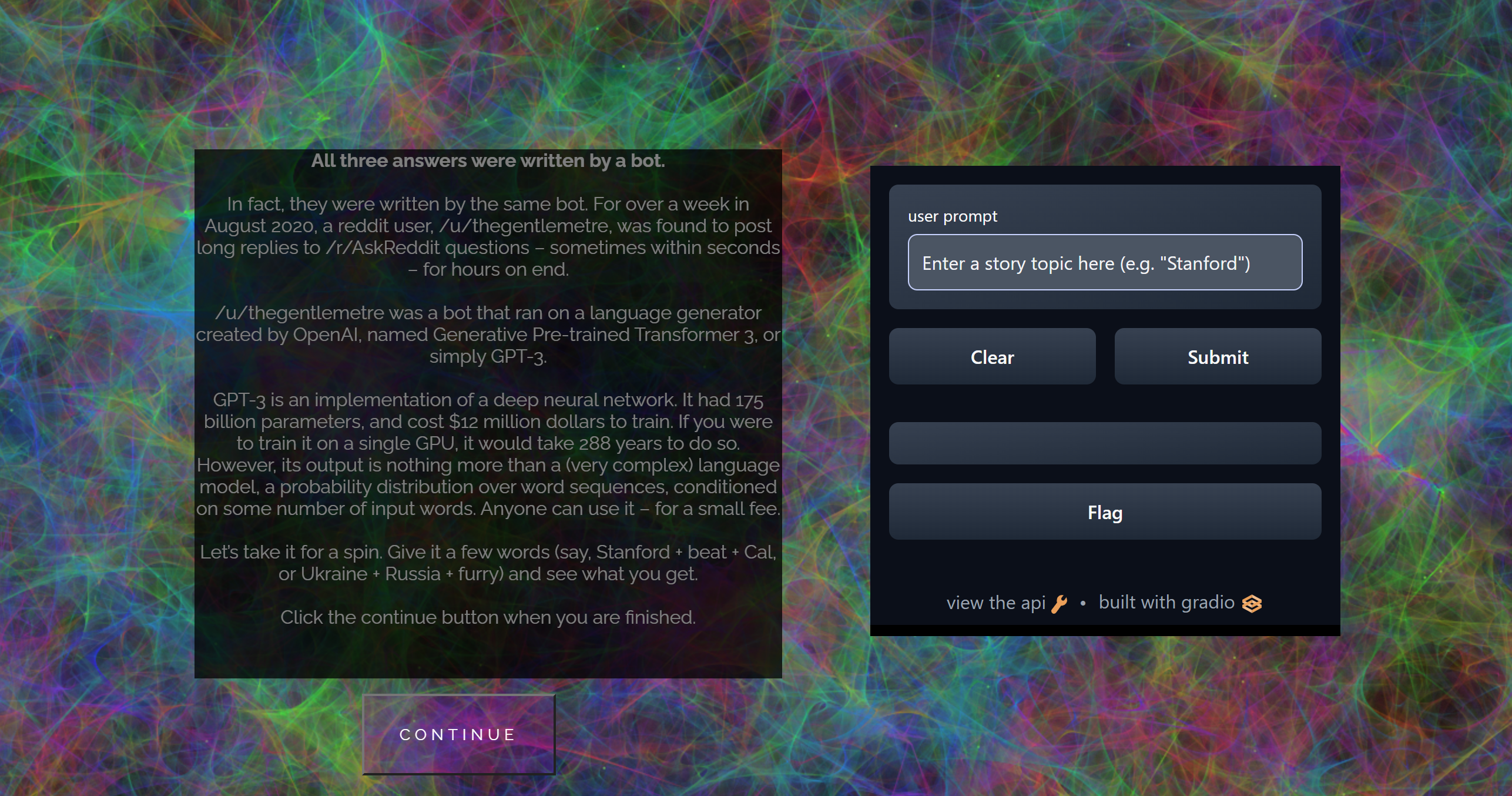
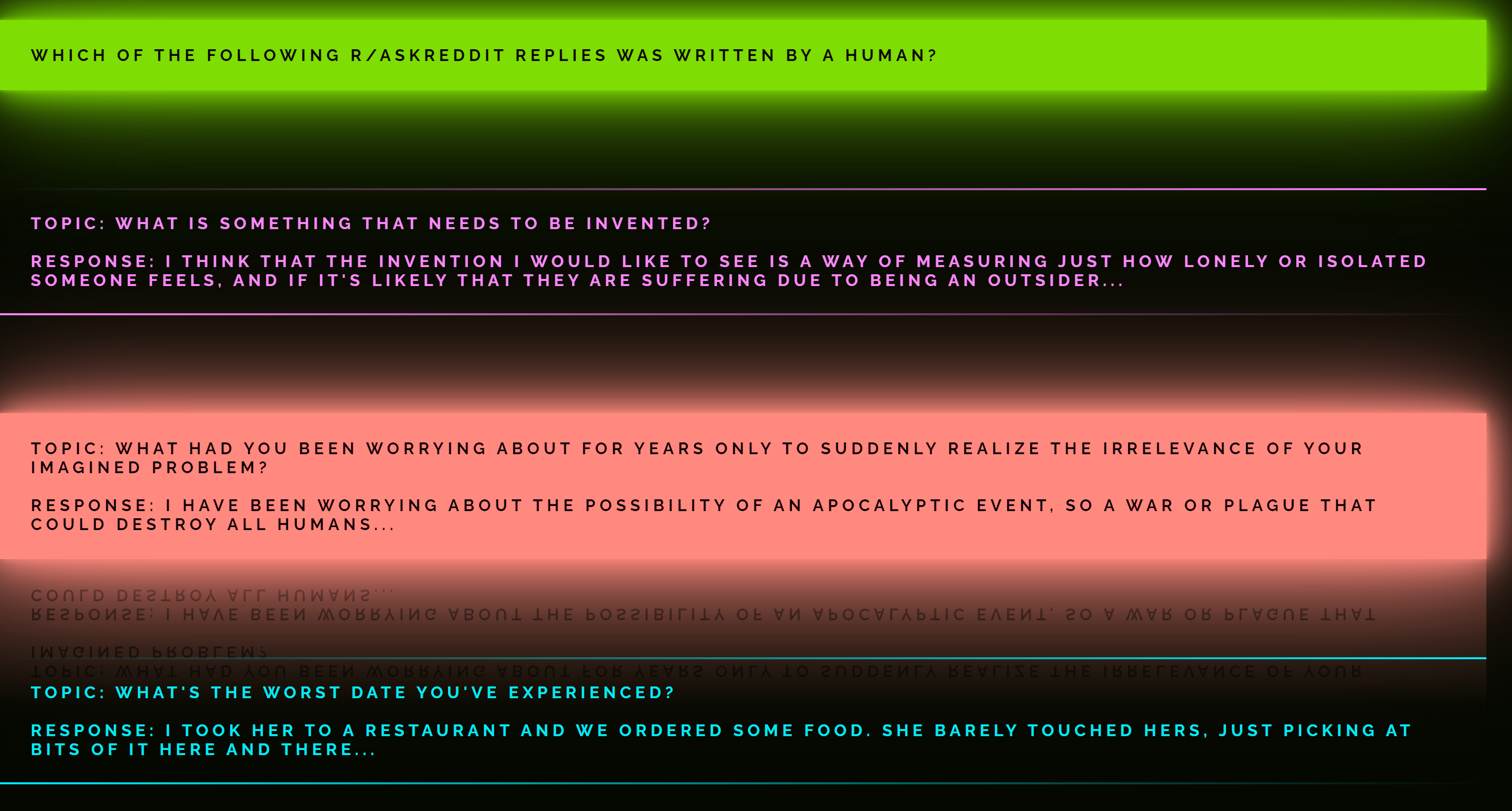
We aim to make AI more accessible by creating a user-friendly experience that gives easy and fun example use-cases, and provides users with a memento after completion.
We initially started off rather ambitiously, and wanted to create a cinematic experience that would incorporate computer vision, and natural language processing. However, we quickly discovered that this would prove difficult to implement within the 36-hour time limit, especially given that this is the first hackathon that our team members have participated in, and that some of us had limited exposure to the tools and frameworks that we used to deploy our project.
Nevertheless, we are proud of the prototype that we built and we hope to expand upon it after the conclusion of TreeHacks.
We used AWS to host our website and produce our conversational agents, Gradio to host our OpenAI GPT-3 demo, and HTML, CSS, Javascript to build the front-end and back-end of our website.
