-
-
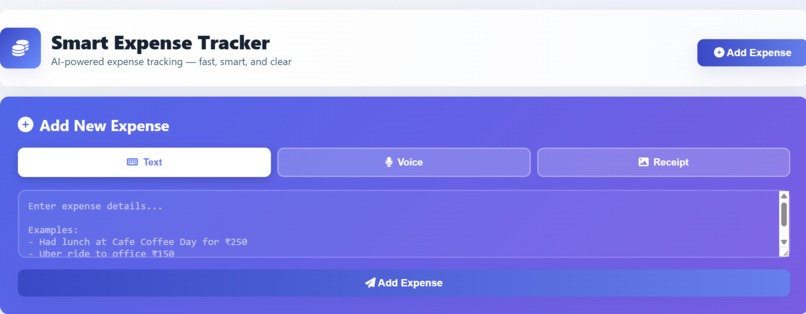
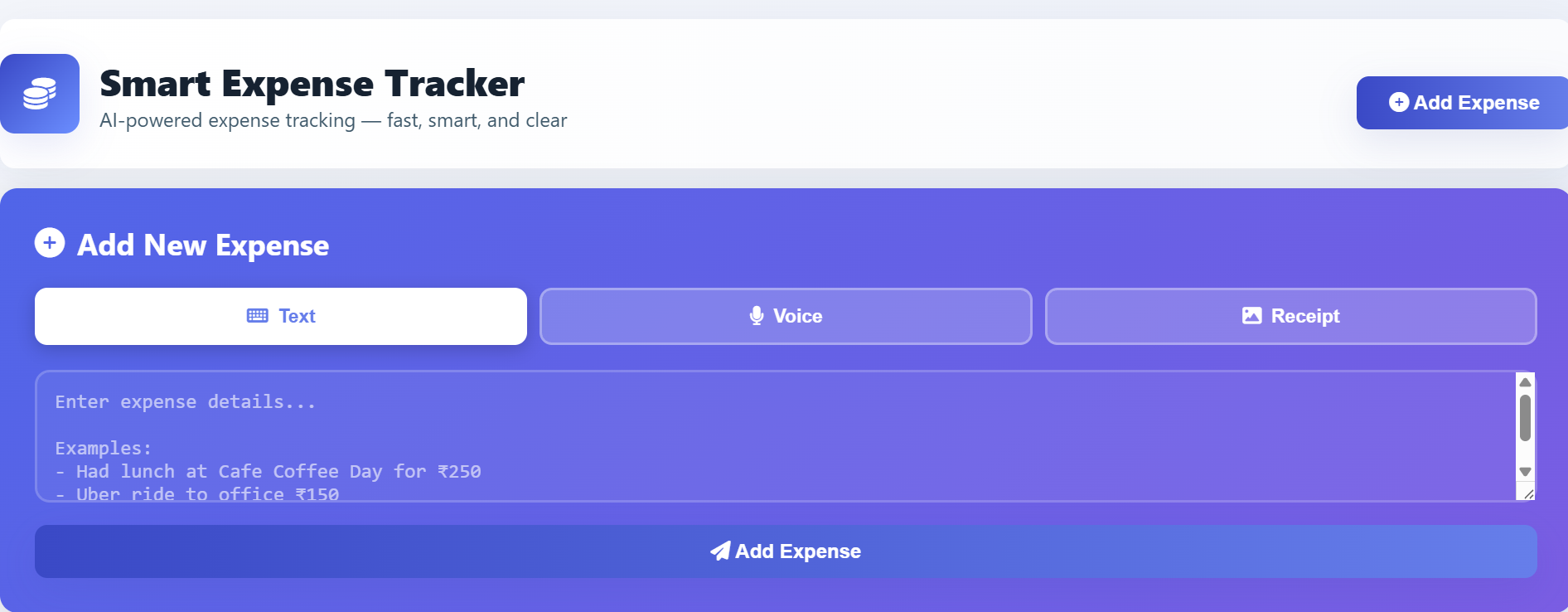
its ui pic
Inspiration
As a student, managing money often feels simple at first — until it suddenly doesn’t.
I used to think:
“It’s just small amounts, it won’t matter.”
But by the end of every month, the numbers told a different story.
If I spent a little on food, a little on travel, and a little on shopping every day, the total quietly grew:
$$ \text{Total Spending} = \sum_{i=1}^{n} \text{Daily Expense}_i $$
Without tracking, those expenses became invisible. I didn’t know where my money was going, only that it was disappearing. This personal struggle as a student became the inspiration behind building the Smart Expense Tracking System — a tool that makes spending visible, understandable, and controllable.
What it does
The Smart Expense Tracking System turns everyday spending into structured and meaningful data.
Users can record expenses using:
- Text input (natural language)
- Voice input
- Receipt images (OCR)
The system automatically extracts:
- Amount
- Category
- Date
- Description
Expenses are categorized into Food, Travel, Shopping, Maintenance, and Others, and displayed in a clear history and summary dashboard.
Spending is no longer a guess — it becomes a calculation:
$$ \text{Category Total} = \sum \text{Expenses}_{\text{category}} $$
How we built it
- Frontend: HTML, CSS, JavaScript
- Backend: Node.js, Express.js
- AI Integration: Gemini API for expense extraction and insights
- Voice Processing: Speech-to-text with fallback logic
- Image Processing: OCR using Tesseract.js
- Storage: Persistent JSON-based backend
- Real-time Updates: Server-Sent Events (SSE)
The frontend communicates with the backend using REST APIs to store, retrieve, and analyze expense data in real time.
Challenges we ran into
One major challenge was handling unstructured human input.
People don’t speak in strict formats — they speak naturally:
“Had lunch with friends, cost around 250”
Another challenge was reliability. When AI services were unavailable, the system still needed to work. This required building fallback extraction logic to ensure expenses could always be recorded.
Accomplishments that we're proud of
- Built a fully functional AI-powered expense tracker
- Integrated text, voice, and image inputs into one system
- Implemented real-time updates without page reloads
- Designed a solution based on a real student problem
- Created a scalable foundation for future growth
What we learned
This project showed that small expenses matter. When ignored:
$$ \text{Untracked Spending} \rightarrow \text{Financial Stress} $$
But when tracked and analyzed:
$$ \text{Awareness} \rightarrow \text{Better Financial Decisions} $$
Technically, we learned how to integrate AI APIs, handle asynchronous processes, and design reliable full-stack systems with a user-first approach.
What's next for Expense Tracking System
Planned future improvements include:
- User authentication and multi-user support
- Database integration (MongoDB / PostgreSQL)
- Advanced analytics and monthly reports
- Mobile app or Progressive Web App (PWA)
- Multi-currency and regional language support
The goal is simple: help students turn chaotic spending into clear financial understanding — one expense at a time.
Built With
- css-backend:-node.js
- express.js-ai-&-apis:-gemini-api
- html
- json-storage-tools:-vs-code
- languages:-javascript
- server-sent-events-(sse)
- web-speech-api-image-processing:-tesseract.js-(ocr)-data-handling:-rest-apis

Log in or sign up for Devpost to join the conversation.