-
-
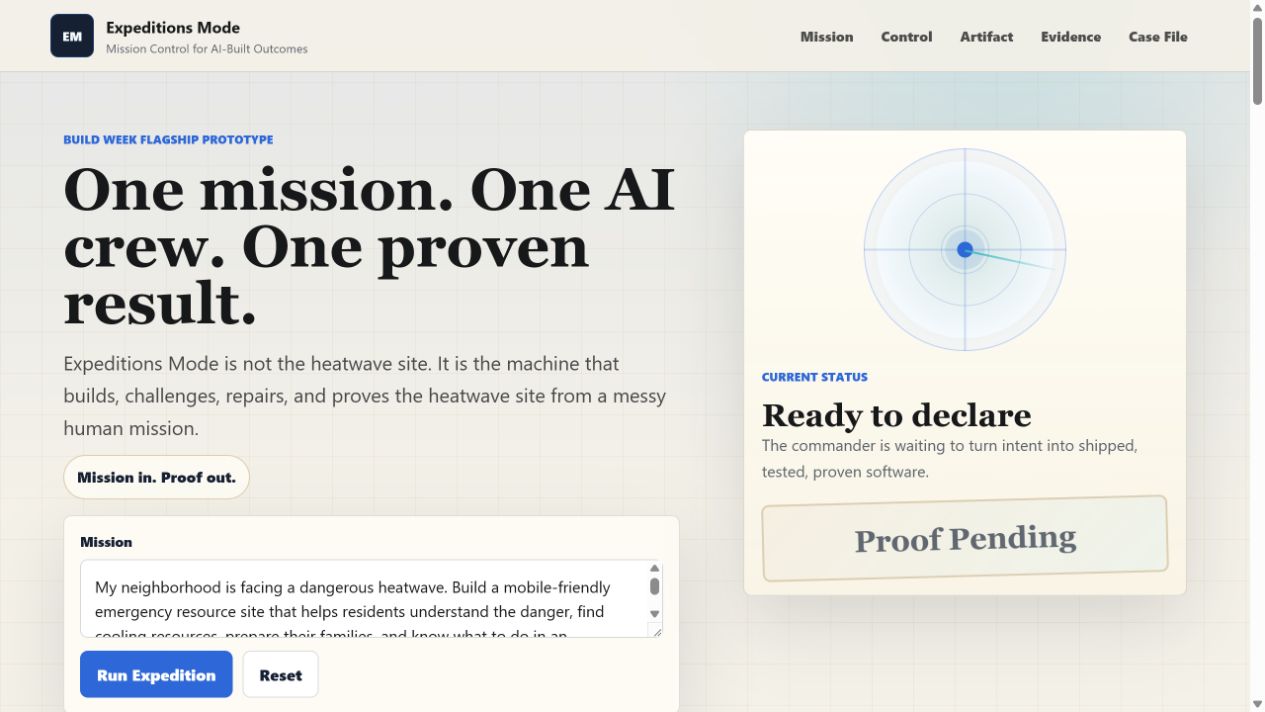
01-proof-pending-first-screen.png
-
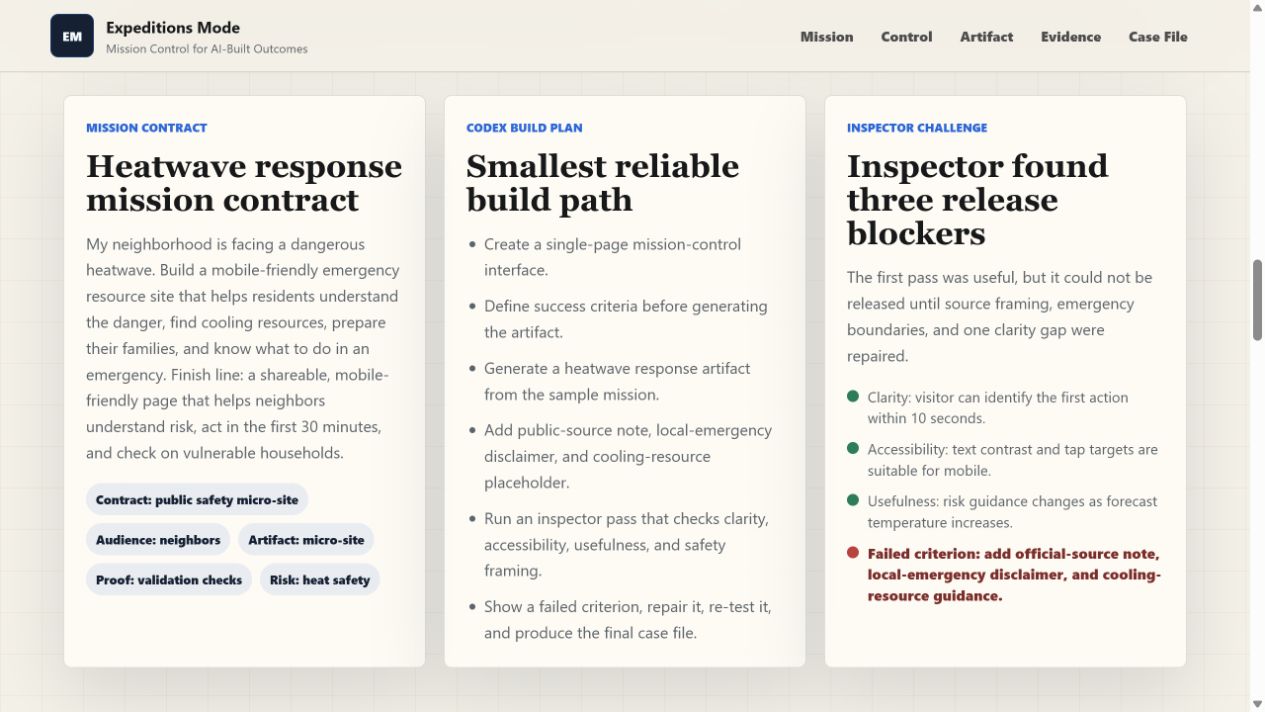
02-inspector-blocked.png
-
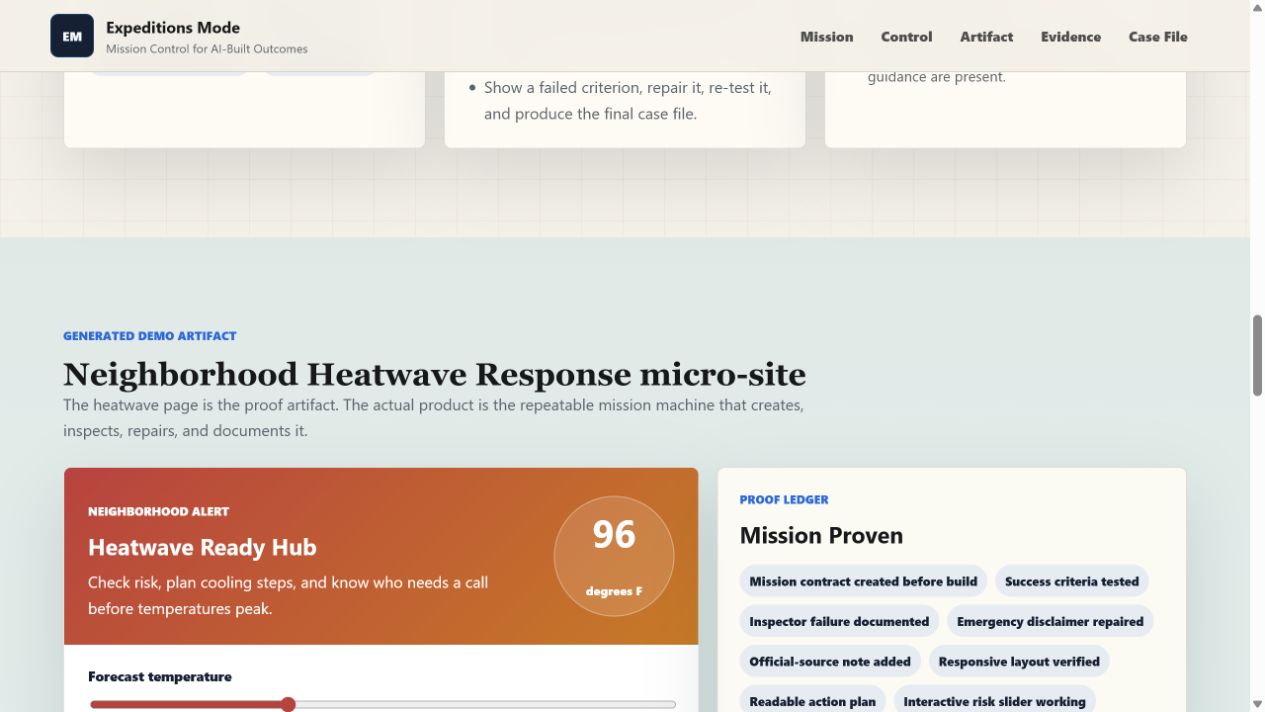
03-repair-retest-artifact
-
04-case-file-receipt.png
-
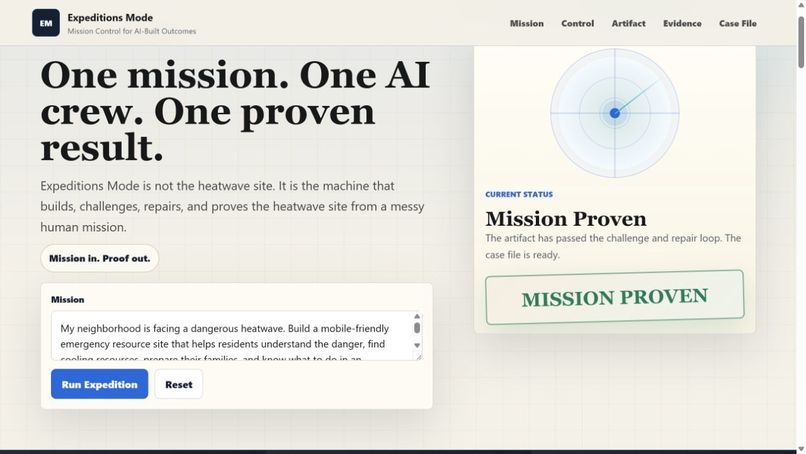
05-mission-proven-seal.png
Inspiration
Most AI tools stop when something is generated. I wanted to explore a different question: what if the system did not stop at creation, but continued until the result had been challenged, repaired, re-tested, and proven?
That idea became Expeditions Mode.
The goal is to turn human intent into a clear mission with defined success criteria, build an artifact, inspect it against those criteria, repair failures, re-test the same requirements, and preserve evidence of what happened.
Mission in. Proof out.
What it does
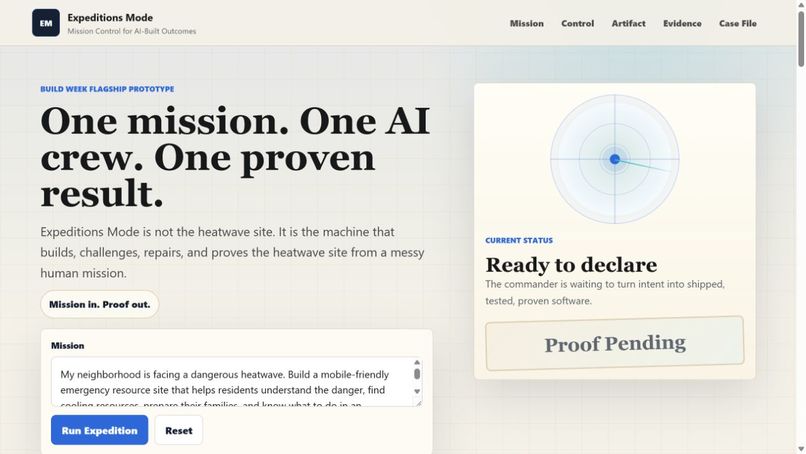
Expeditions Mode is Mission Control for AI-Built Outcomes: a workflow for moving from human intent toward a shipped, tested, proven outcome.
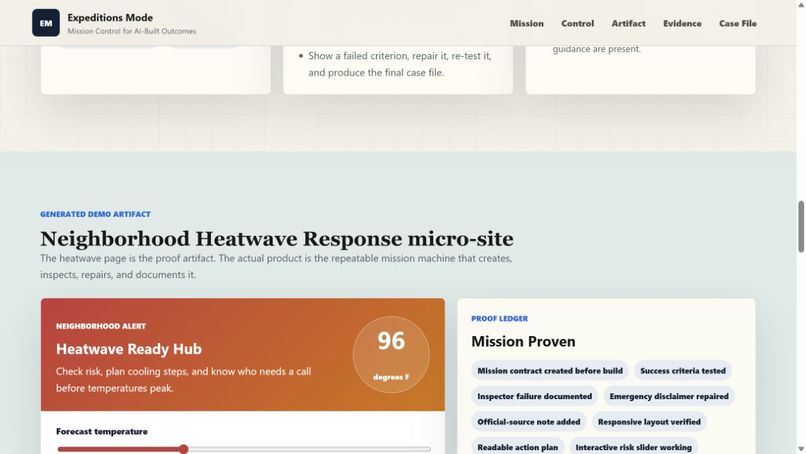
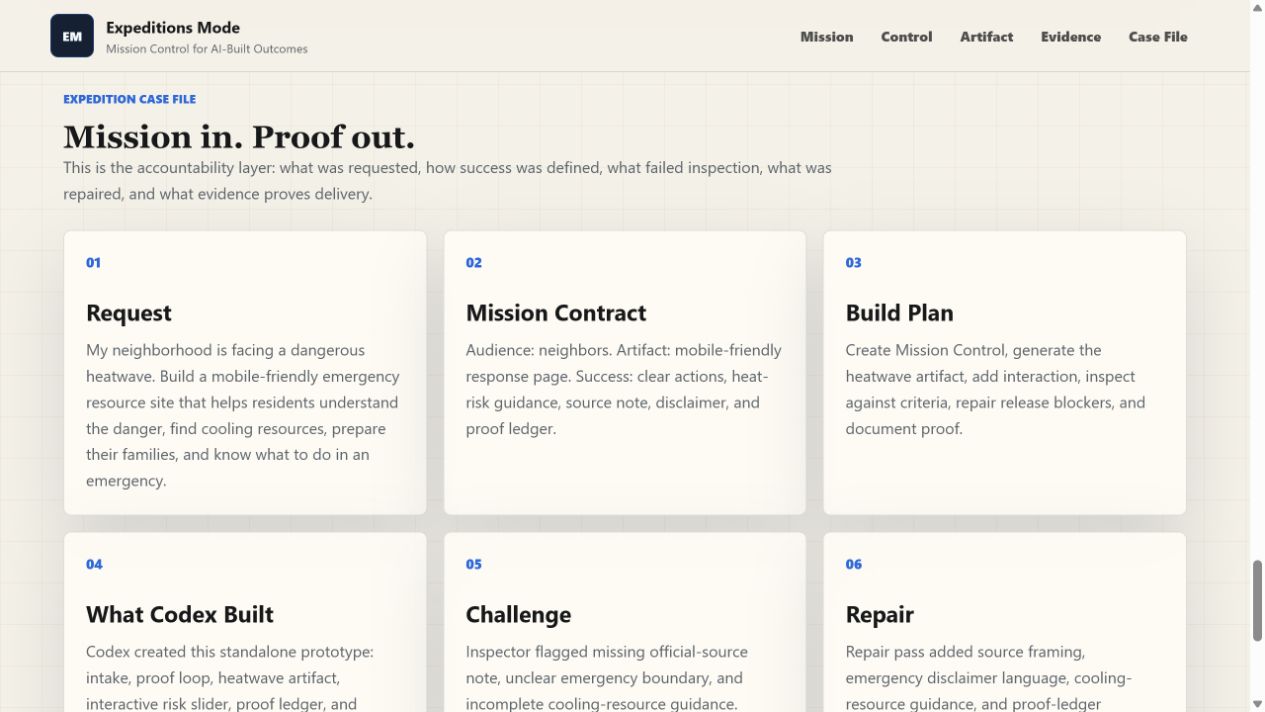
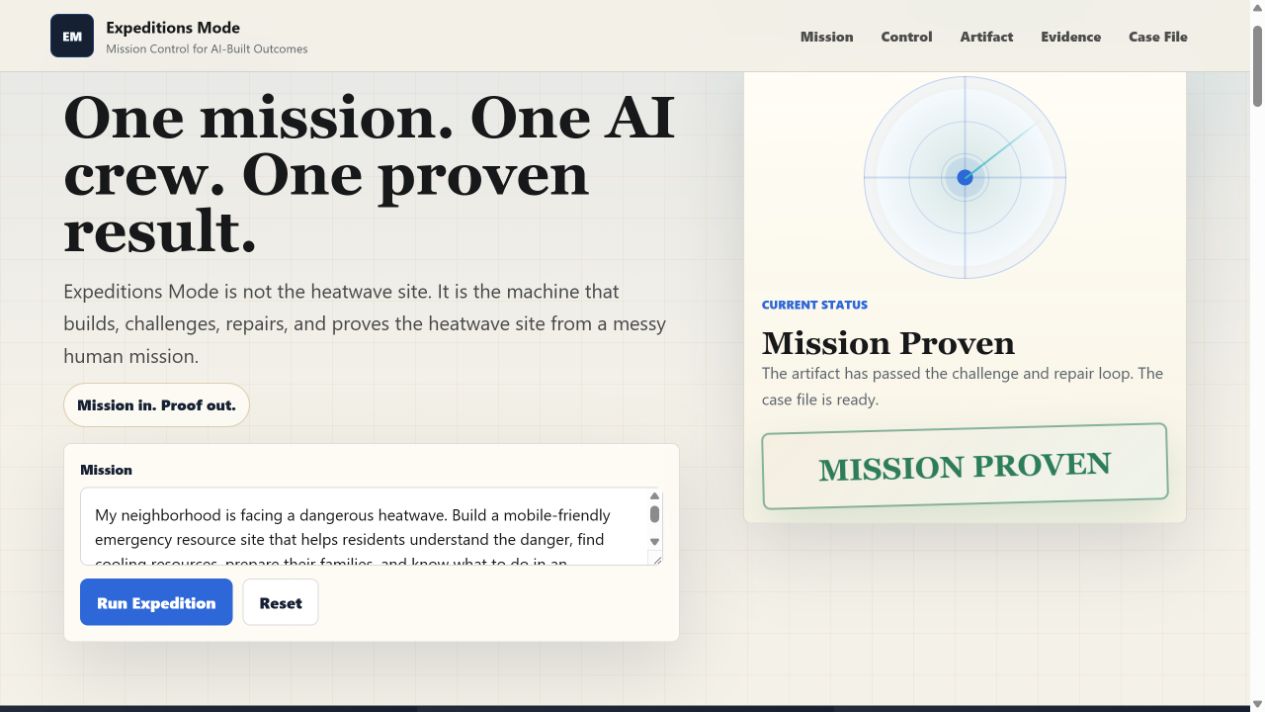
The prototype demonstrates this through a mission to build a mobile-friendly neighborhood heatwave emergency resource site.
The heatwave site is the artifact. Expeditions Mode is the machine around it.
The workflow moves through:
Mission -> Contract -> Build -> Challenge -> Repair -> Re-test -> Mission Proven -> Case File
Or shorter:
Fail -> Fix -> Re-test -> Prove
A mission begins as Proof Pending. Expeditions Mode defines who is being served, what must be built, what requirements matter, and how success will be proven.
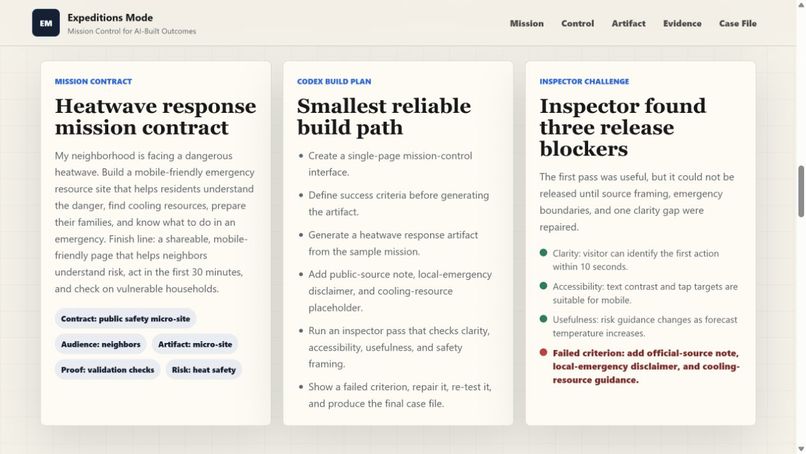
The artifact is then challenged against its requirements. In the demo, the Inspector blocks completion because required resource guidance is missing. The issue is repaired, the same criterion is tested again, and only after it passes does the evidence support completion.
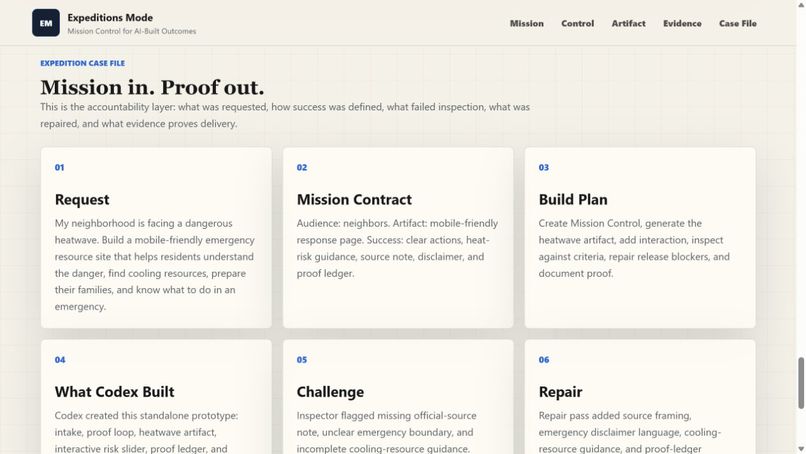
The final Expedition Case File preserves what was requested, built, challenged, repaired, re-tested, proven, and delivered.
The v1.0 crew roles shown in the interface are demo-mode representations of the intended workflow, not live autonomous agents.
Reality over theater.
How I built it
This Build Week prototype was developed as a standalone web application using HTML, CSS, and JavaScript.
GPT-5.6 helped me define and refine the mission, product concept, Mission Contract framing, workflow, success criteria, product language, proof-loop structure, and key product decisions.
Codex materially helped me build and polish the prototype, including the interface, proof-state behavior, repair and re-test flow, heatwave artifact, visual refinement, documentation, release checks, screenshots, demo preparation, and submission packaging.
I intentionally designed the prototype around an explicit proof loop:
Fail -> Fix -> Re-test -> Prove
Rather than presenting generated output as automatically successful, the interface makes the proof state visible and demonstrates how a failed criterion can block mission completion until it is repaired and tested again.
The product architecture and decisions remained human-directed while GPT-5.6 and Codex served distinct AI-assisted roles in helping define, build, refine, and prepare the prototype.
Challenges I ran into
One of the biggest challenges was making the distinction between building something and proving that it satisfies the mission clear in both the product and the demo.
It was not enough to show cards that said "build," "inspect," and "repair." The demo needed an observable failure, a visible repair, and a re-test of the same criterion. That became the heart of the prototype.
Another challenge was communicating an ambitious future workflow without overstating what v1.0 currently does. Prompt-to-app tools and agent orchestration already exist, so I did not want to claim novelty simply for generating software or representing agent roles.
The stronger idea became accountable completion: defining success before building, challenging the result, repairing what fails, re-testing the requirement, and preserving evidence.
I also had to keep the demo public-safe, under three minutes, and transparent about the boundary between the real AI-assisted development process and the demo-mode crew roles represented in the interface.
Accomplishments that I'm proud of
I am proud that Expeditions Mode does not treat generation as the finish line.
The prototype demonstrates a complete journey from messy human request to Mission Contract, artifact, Inspector block, repair pass, re-test, Mission Proven seal, and final Expedition Case File.
I am especially proud of the Expedition Case File concept: a final record designed to show what was requested, what was built, what failed inspection, what was repaired, what was re-tested, what passed, and what was ultimately delivered.
The result is a simple but important principle:
A mission is not proven because something was generated. It is proven when the requirements have evidence.
What I learned
I learned that generation is not the same as completion.
A result can look finished and still miss the mission. The proof loop forced me to think differently: define success first, challenge the artifact, allow a failure to become visible, repair it, re-test the same requirement, and then preserve the evidence of what changed.
I also learned that human intention and AI capability can be strongest when they work together toward an accountable finish line.
The Build Week process reinforced the value of combining human product judgment with AI-assisted development while maintaining clear ownership of decisions and transparent documentation of how the prototype was built.
What's next for Expeditions Mode
The next step is to evolve Expeditions Mode from this v1.0 demonstration into a more functional mission orchestration and verification system.
Future development could include executable Mission Contracts, richer evidence capture, persistent Expedition Case Files, configurable acceptance criteria, automated test integrations, human approval gates, version history, and deeper Codex-powered build and repair workflows.
The long-term vision is a system where a user can bring a mission and receive more than generated output. They receive an artifact accompanied by a transparent record:
Here is what you asked for.
Here is how success was defined.
Here is what was built.
Here is what failed.
Here is what changed.
Here is what passed.
Here is what proves delivery.
GPT-5.6 helps define the mission. Codex helps build the prototype. Expeditions Mode proves the outcome.
Mission in. Proof out.
Mission Proven.
Built With
- ai
- codex
- css
- gpt-5.6
- html
- javascript
- product-design
- prototype
- ux
- web

Log in or sign up for Devpost to join the conversation.