-
-
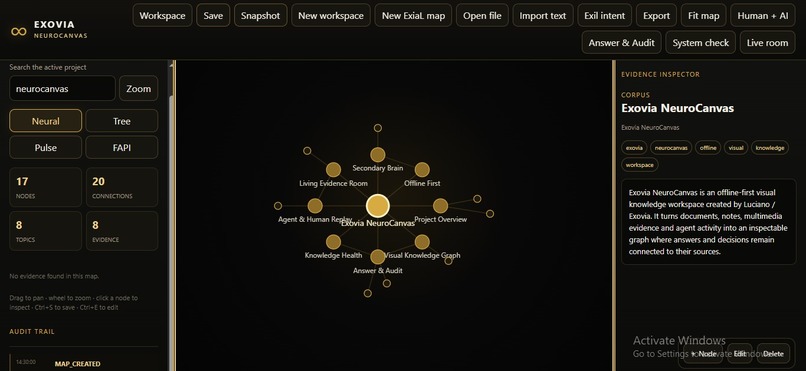
Prueba en Windows.
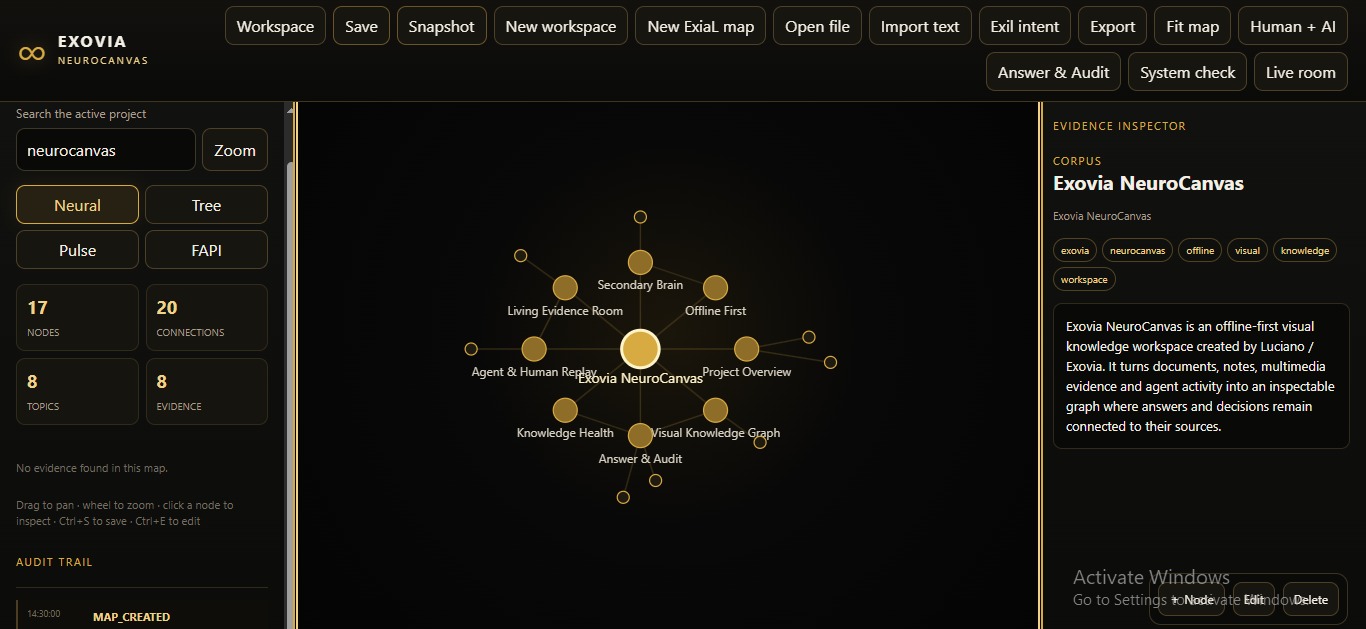
Inspiration
We navigate the physical world with maps, yet we still navigate knowledge through flat documents, endless chat histories, disconnected dashboards, and isolated agent logs.
Exovia NeuroCanvas began with a simple question:
What if knowledge, evidence, agent activity, intent, and execution could all be explored as one living visual territory?
The project was inspired by years of experimentation inside Exovia: visual workspaces, local-first AI systems, agent communication, compact machine languages, routing layers, and tools designed to preserve long-term context.
During OpenAI Build Week, those ideas were consolidated into a new product: an infinite, inspectable knowledge canvas where users can zoom from a global overview down to the exact source evidence behind every node.
What it does
Exovia NeuroCanvas transforms documents, conversations, code, notes, and structured agent events into an interactive visual memory.
Users can:
- import or paste long-form text;
- automatically divide content into traceable source fragments;
- explore a hierarchical knowledge tree;
- reveal cross-topic relationships through a neural graph;
- pan and zoom through an infinite canvas;
- search semantically using Zoom to Answer;
- move directly from a question to the strongest matching evidence;
- inspect the exact original source text behind every node;
- import and export complete knowledge maps as JSON;
- run the core experience locally without API credits;
- visualize compact ExiaL agent pulses;
- inspect FAPI capabilities such as routing, health, streaming, generation, warmup, and budget control;
- preview safe Exil intentions before any graph mutation or executable action.
The visualization is not treated as the memory itself.
It is the doorway into structured, verifiable memory.
How we built it
The current Build Week implementation is an offline-first web application built with HTML5 Canvas, JavaScript, CSS, and local semantic heuristics.
The local processing pipeline performs:
- text normalization;
- structural and paragraph-aware chunking;
- keyword extraction;
- weighted similarity scoring;
- topic grouping;
- hierarchical tree generation;
- semantic edge generation;
- canvas layout;
- source-preserving inspection;
- search-driven camera navigation.
The project also integrates concepts recovered and rebuilt from previous Exovia research:
ExiaL
ExiaL is a compact pulse format for describing agent communication and system events.
NeuroCanvas can represent these pulses as graph activity, showing who produced an event, what action occurred, where it was routed, and how it affected the system.
EXIR
EXIR provides a canonical intermediate representation for validating and normalizing events before they modify the visual graph.
This creates a clear separation between raw messages, validated operations, and rendered state.
Exil
Exil is used as a compact intent layer. In the Build Week version, a constrained and safe subset can describe operations such as finding concepts, focusing evidence, linking related nodes, and requesting explanations.
Exil intentions are previewed and validated before application. They do not execute hidden or destructive actions.
FAPI
FAPI represents the capability and routing plane.
Instead of showing only text, NeuroCanvas can also visualize services, tools, supported actions, health information, streaming capabilities, model routes, and budget policies.
This turns the canvas into both a visual memory system and an inspectable interface for agent capabilities.
How we used GPT-5.6 and Codex
GPT-5.6 was used as a product reasoning and architecture partner throughout Build Week.
It helped us:
- recover and reconcile years of fragmented Exovia research;
- distinguish verified implementation evidence from unvalidated historical claims;
- define the product architecture;
- design the interaction model;
- formalize the integration of NeuroCanvas, ExiaL, EXIR, Exil, and FAPI;
- improve the safety model;
- shape the judging strategy and project narrative;
- generate and review implementation plans;
- identify technical risks and missing validation.
Codex-oriented workflows were used to structure implementation tasks, repository changes, validation scripts, smoke tests, documentation, and release preparation.
The public Git history documents the Build Week development process and makes the evolution of the project inspectable.
Challenges
Preserving exact evidence
A visual map can become misleading if it replaces the original source.
We solved this by keeping the original text as the source of truth and connecting every visual node back to exact evidence.
Building without API credits
The project needed to remain useful even without paid model calls.
We created a complete offline processing path using local chunking, keyword extraction, similarity scoring, clustering, and search.
OpenAI embeddings and grounded model answers are designed as optional server-side enhancements rather than requirements for the core experience.
Combining memory and agent activity
Knowledge graphs usually display stored relationships, while agent dashboards display temporary execution logs.
NeuroCanvas combines both. It can show what the system knows, how that knowledge was produced, which intent triggered a change, and which route or capability was involved.
Recovering prior research responsibly
Some Exovia components had historical benchmarks, tests, and operational records, while others were still research directions.
We carefully separated:
- functionality implemented in the current public repository;
- historically tested Exovia components;
- integrations that still require revalidation against the original local Windows services;
- future architecture.
This distinction makes the project ambitious without making unsupported claims.
Accomplishments that we are proud of
- Built a working offline-first infinite knowledge canvas.
- Preserved exact evidence behind every visual abstraction.
- Created synchronized neural and hierarchical views.
- Implemented Zoom to Answer as a spatial evidence-retrieval interaction.
- Added support for compact ExiaL events and pulse visualization.
- Reconstructed FAPI, EXIR, and Exil concepts into one coherent architecture.
- Designed a safety boundary between visual navigation, intent preview, and execution.
- Published the source code and Build Week development history publicly.
- Turned years of fragmented experimentation into a focused product with a clear future.
What we learned
We learned that visual knowledge systems become significantly more valuable when they do more than display relationships.
A useful AI interface should answer five questions:
- What does the system know?
- Where did that knowledge come from?
- Which agent or process produced it?
- What intention or action changed it?
- Can a human inspect and verify the complete path?
We also learned that offline-first design is not merely a fallback. It improves privacy, accessibility, resilience, and trust.
What's next for Exovia NeuroCanvas
The next stages include:
- OpenAI embeddings for deeper semantic relationships;
- grounded answers through the Responses API;
- a secure server-side OpenAI provider;
- live FAPI capability discovery;
- real-time ExiaL pulse streaming;
- complete EXIR replay and event histories;
- a formally specified Exil compiler;
- multimodal evidence nodes;
- collaborative knowledge spaces;
- codebase and company-memory maps;
- agent execution trails with health and budget visibility;
- a ChatGPT App and MCP server integration.
Our long-term vision is to build a universal visual interface where people and AI agents can navigate shared knowledge, understand how decisions were produced, and verify the evidence behind every result.
Impact
Exovia NeuroCanvas can support:
- software development teams;
- AI agent builders;
- researchers;
- educators;
- consultants;
- small businesses;
- organizations with fragmented institutional memory;
- people managing years of conversations, documents, and projects.
For Exovia, this project is also a foundation for creating practical AI tools that can help small businesses and community projects access capabilities normally available only to large organizations.
Core idea
Knowledge should be navigated. Agent activity should be visible. Execution should be explainable.
Desarrollo y evidencia pública
Sitio oficial: https://exovia.wixsite.com/exovia-neurocanvas-1
Repositorio: https://github.com/ruminui/exovia-neurocanvas
Proceso público de creación con ChatGPT: https://chatgpt.com/share/6a5cddb2-6080-83e9-82b7-b4b5940dc1a8
Recorrido completo del desarrollo: https://github.com/ruminui/exovia-neurocanvas/blob/main/docs/BUILD_JOURNEY_AND_PROVENANCE.md
Exovia NeuroCanvas fue desarrollado mediante una colaboración humano–IA. La visión, las prioridades, las pruebas, el video y las decisiones finales fueron dirigidas por el creador. ChatGPT colaboró en la estructuración del producto, implementación, documentación, experiencia móvil, preparación de Android, auditoría y presentación.
El repositorio y su historial de commits constituyen la evidencia técnica principal. La conversación pública documenta el proceso creativo y las decisiones seguidas durante el desarrollo.

Log in or sign up for Devpost to join the conversation.