Inspiration
We are a team of four software engineering students with a shared interest in astronomy. When we discovered that NASA publishes real observations used to search for exoplanets, the idea immediately stood out to us. We chose the Computational Research track, which focuses on software for scientific computing, mathematical modeling, and scientific data analysis. And our goal was to test whether AI agents could do more than chat: could they take part in a real scientific investigation?
What ExoSwarm Does
Traditional analysis usually follows a fixed set of scripts in a fixed order. ExoSwarm takes a different approach:
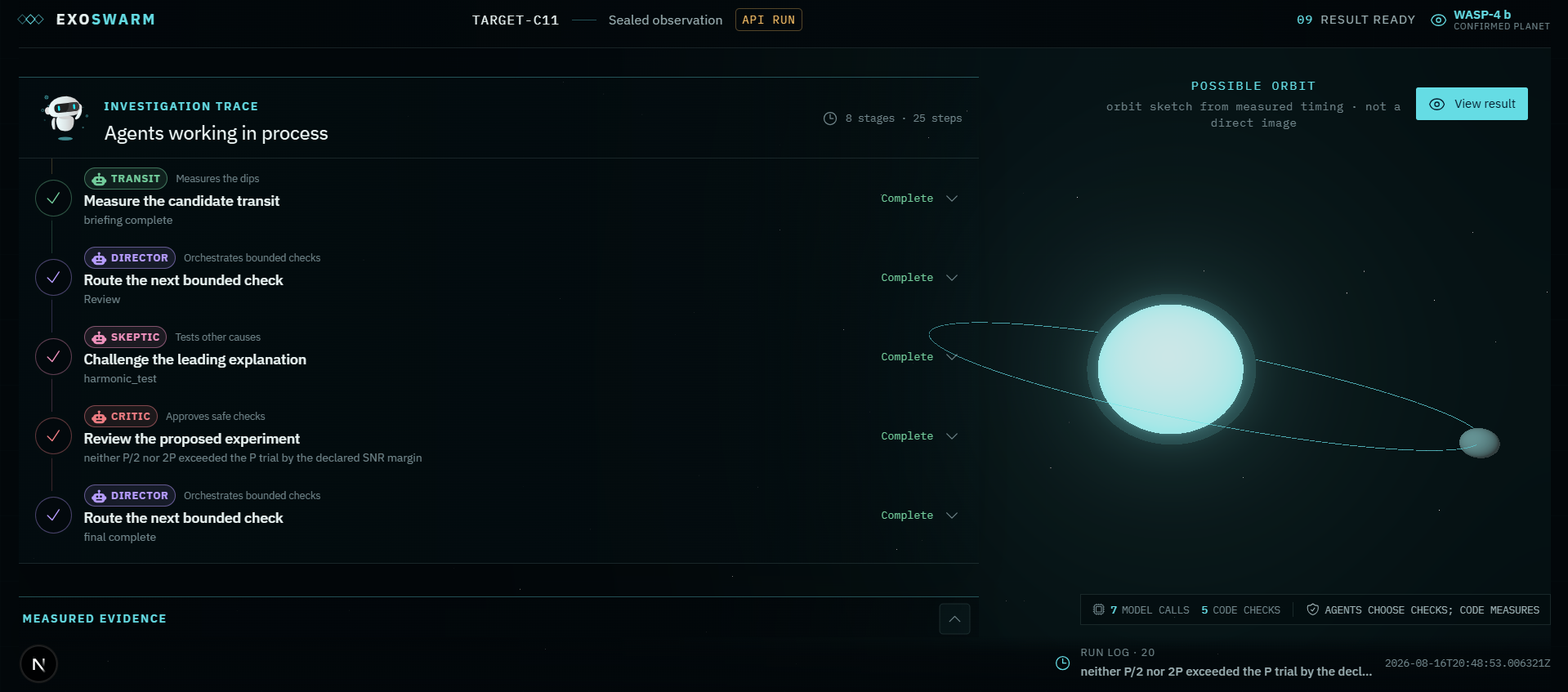
- AI agents examine the available evidence.
- They choose which scientific test to run next.
- They challenge each other's conclusions.
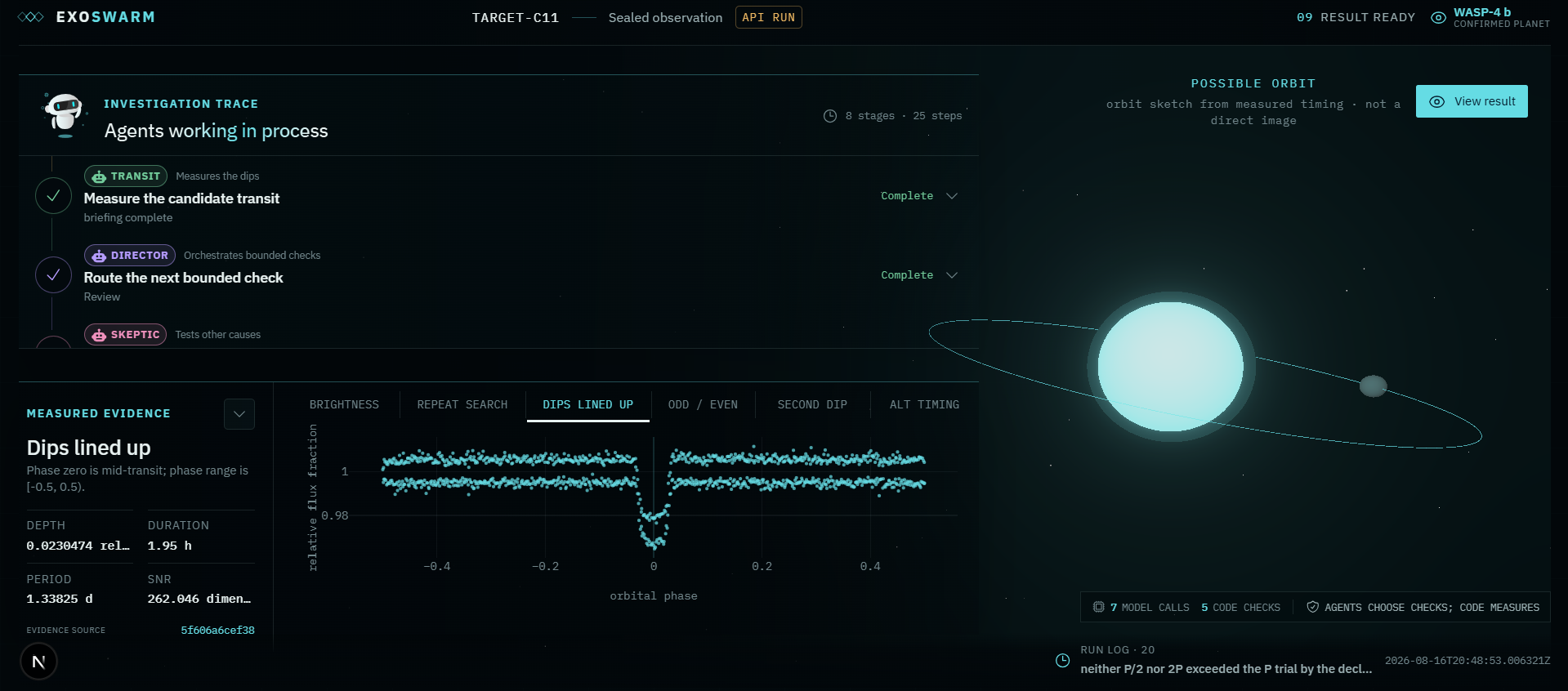
- Deterministic Python tools perform every measurement.
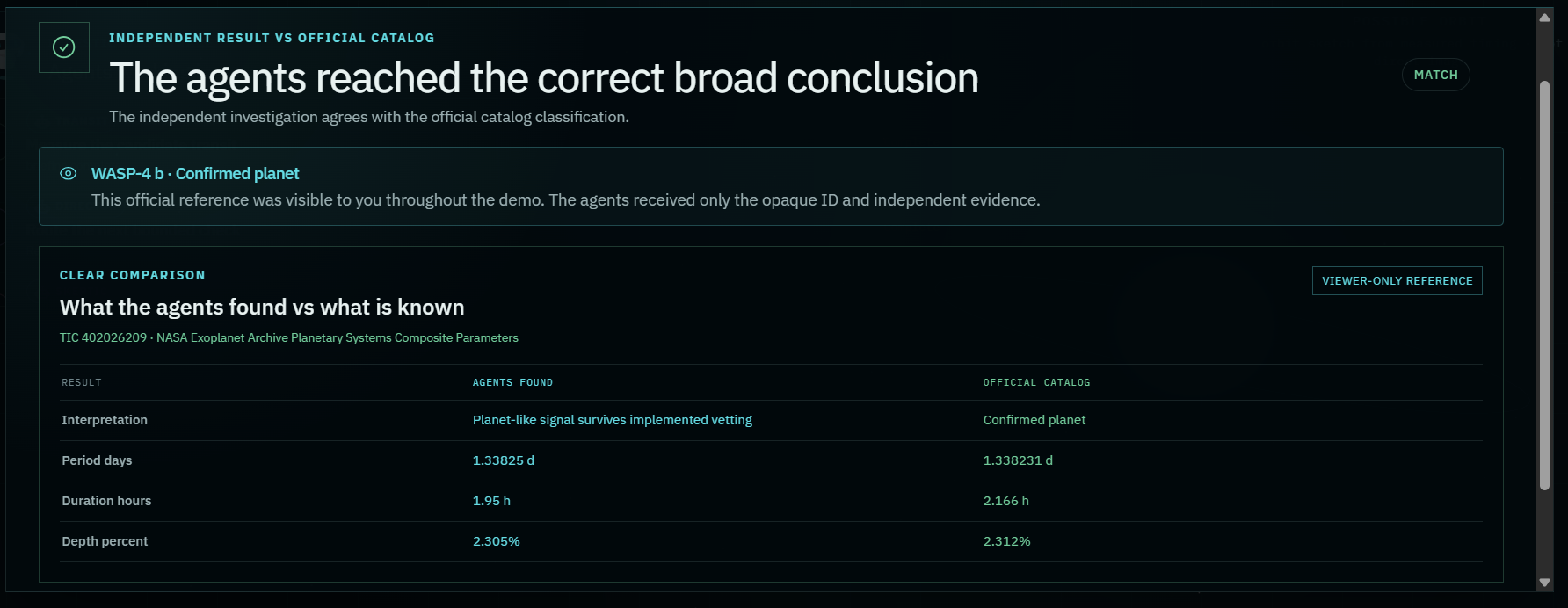
- The planet's identity stays hidden until the investigation is complete.
This means the agents cannot invent measurements or simply peek at the correct answer.
How We Built It
We built ExoSwarm as a multi-agent research harness connected to real NASA TESS observations.
The agents handle decisions and review, while Python tools handle calculations such as detecting repeating dips in a star's brightness. Every measurement and decision is saved, creating a complete record of how the final conclusion was reached.
Challenges We Faced
The hardest part was not building the interface or calling an AI model—it was understanding and implementing the science correctly.
We had to learn about:
- Light curves
- Transit signals
- Orbital periods
- Signal strength
- False-positive checks
We quickly realized that giving an agent a graph and asking for an answer would only create a more complicated chatbot. To make ExoSwarm useful, we had to give the agents real scientific tools, reliable evidence, and strict limits.
What We Learned
ExoSwarm taught us that useful AI agents need much more than a prompt. They need trustworthy tools, clear responsibilities, and a system that records and checks their work.
For us, this project became an experiment in how agent-based systems could support computational research—not by replacing scientists, but by making complex investigations easier to run, inspect, and reproduce.
Built With
- fastapi
- langraph
- next.js
- python
- typescript


