-
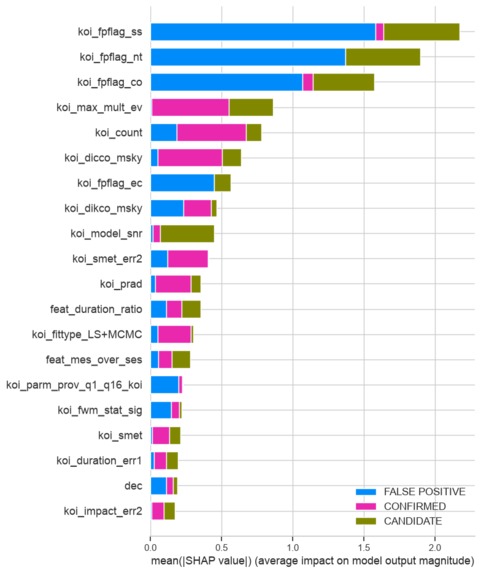
output image
What it does
Classifies all 9,564 Kepler Objects of Interest from the NASA Exoplanet Archive into three classes: confirmed planet, candidate, or false positive (eclipsing binaries, instrument noise). SHAP explains every prediction in terms an astronomer would recognize: transit geometry, signal repeatability, centroid offset — all learned from transit-physics and stellar-parameter features alone.
| Metric | Score |
|---|---|
| Accuracy | 85.9% |
| Macro F1 | 0.830 |
| F1 — False positive | 0.907 |
| F1 — Confirmed | 0.903 |
| F1 — Candidate | 0.682 |
Inspiration
Kepler flagged thousands of periodic dimming events between 2009 and 2018, but a computer catching a dip in starlight isn't the same as confirming a planet. Vetting each signal by hand takes real astronomer time, and the archive still carries plenty of KOIs stuck in CANDIDATE limbo. So this project mirrors what vetting teams do: check the transit shape, check whether the signal repeats, check whether the dimming is happening on the target star at all.
How I built it
Two notebooks backed by four modules in src/.
01_eda.ipynb — audit the raw 9,564 × 140 table first.
- 19 entirely empty columns (eccentricity errors, stellar age, model fit stats) dropped.
- Leakage hunted down:
koi_scorealready absent (it is the vetting pipeline's own confidence score),koi_pdispositionnear-copies the target, andkepler_nameis only assigned to confirmed planets, so even its missingness leaks the label. The fourkoi_fpflag_*columns (not transit-like, stellar eclipse, centroid offset, ephemeris match) are outputs of NASA's automated false-positive vetting pipeline — they encode the target classification and are excluded as data leakage. All excluded, along with vetting comments, vetting status metadata, and data-validation report links. - KOI uncertainties come in symmetric ± pairs;
_err2columns are perfectly anti-correlated with their_err1twin, so the mirrored halves were pruned.
02_modeling.ipynb — preprocessing, features, training.
Remaining missingness (≤16% per column) is median-imputed, medians fit on the training split only; the physical quantities are heavily right-skewed, so a mean would be dominated by the tails.
Eight domain-derived features, each tied to a piece of vetting physics:
| Feature | Formula | Why |
|---|---|---|
| Depth per hour | depth / duration | Stellar eclipses deep and sharp; planetary transits shallow and gradual |
| Radius ratio | \(R_p / (109.2\,R_\star)\) | Ratio near 1 means the "planet" is a star \((1\,R_\odot \approx 109.2\,R_\oplus)\) |
| Event statistic ratio | MES / SES\(_{\max}\) | Real transits accumulate evidence across orbits; one-off glitches don't |
| Duration check | observed vs. \(P^{1/3}\) | Kepler's third law; large deviations flag grazing eclipses or blends |
| Log transforms | \(\log_{10}\) of period, depth, insolation | These span several orders of magnitude |
| SNR per transit | SNR / \(N_{\mathrm{transits}}\) | Strong-because-deep vs. strong-because-seen-many-times |
Three models compared, stratified 5-fold CV on an 80/20 stratified split, seed 42:
| Model | Accuracy | Macro F1 |
|---|---|---|
| Logistic regression (baseline) | 0.869 | 0.776 |
| Random forest | 0.884 | 0.821 |
| XGBoost | 0.859 | 0.830 |
A 20-configuration randomized hyperparameter search moved CV macro F1 only slightly and did not improve the held-out test score, so the near-default configuration is what gets reported rather than a cherry-picked run.
Challenges I ran into
Class imbalance. 51% false positive, 29% confirmed, 21% candidate. Optimizing for accuracy alone would have flattered a model that mostly calls things "false positive." Macro F1 became the primary metric, paired with balanced class weighting instead of synthetic oversampling: SMOTE-style interpolation on heavy-tailed physical quantities like orbital period can fabricate physically impossible objects, while weighting keeps every real observation.
How much credit to give the model. The four koi_fpflag_* columns come from Kepler's automated vetting pipeline. They are not legitimate features — they encode the very false-positive classification we are trying to predict. Using them as features would be textbook data leakage, and indeed training with them artificially inflated macro F1 to 0.922. We exclude them entirely: the honest model, trained on transit-physics and stellar-parameter features alone, achieves 0.830 macro F1 with most error concentrated on the CONFIRMED/CANDIDATE boundary where it physically belongs.
Accomplishments I'm proud of
Almost all remaining errors sit on the boundary between CONFIRMED and CANDIDATE, which is the correct place for a model to be uncertain: a candidate is, by NASA's own definition, a signal that hasn't cleared the confirmation bar yet, so overlap there reflects real physics rather than a modeling flaw.
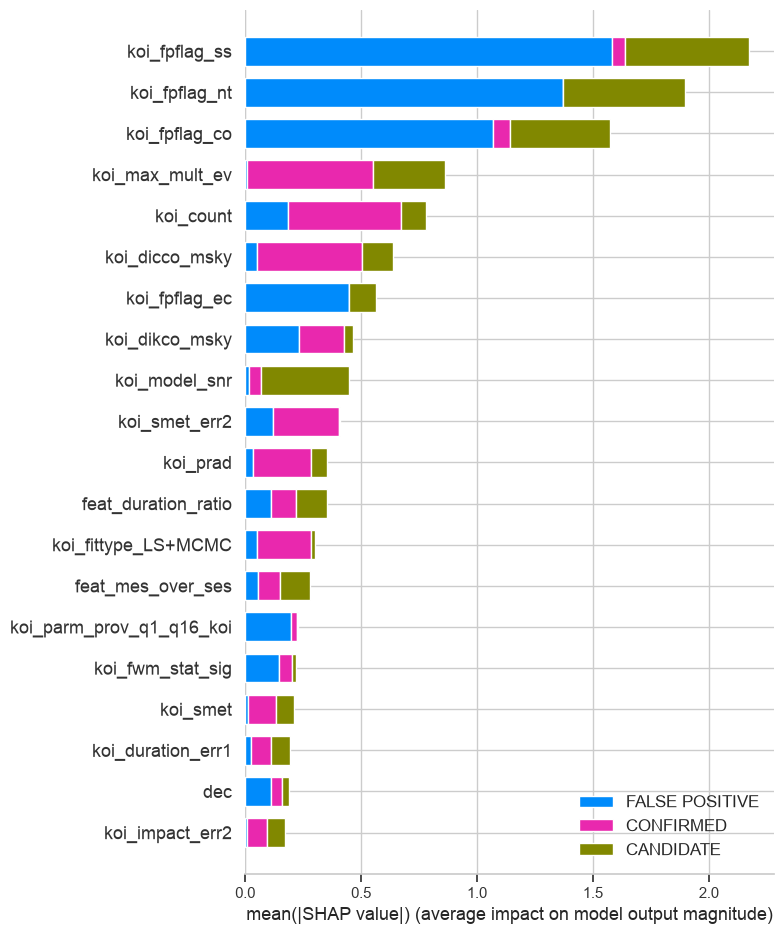
SHAP backs this up. The top features are:
- the multiple-event statistic (does the signal repeat?)
- the centroid offset
koi_dicco_msky(is the dimming on the target star, or a neighbor blended into the same pixel?) - transit signal-to-noise
- planet radius — objects larger than about \(2\,R_{\mathrm{Jup}}\) are almost always small stars
That ranking tracks how astronomers vet these signals by hand: check the geometry, check the repeatability, check the signal quality.
What I learned
The dataset guide's decision to strip koi_score mattered more than expected: it forced actual feature engineering instead of letting one precomputed column do the whole job. More importantly, rigorous leakage control — excluding the koi_fpflag_* vetting pipeline outputs — kept the benchmark honest. The gap between the original inflated 0.922 and the honest 0.830 is a vivid lesson in how easily a "good" model can be a bad model wearing a training-contaminated score. Class-imbalance decisions mattered more than model choice; logistic regression to XGBoost moved macro F1 from 0.776 to 0.830.
What's next
- Test on TESS candidates to check generalization past Kepler's instrument characteristics.
- Lightweight web demo: predictions plus SHAP explanations for individual KOIs.
- Per-feature ablation to isolate what each of the 8 engineered features contributes.
Built With
- jupyter
- matplotlib
- numpy
- pandas
- python
- scikit-learn
- seaborn
- shap
- xgboost


Log in or sign up for Devpost to join the conversation.