-
-
ExoJury
Inspiration
When we plotted our first model's 99%+ accuracy, we got suspicious instead
of excited. Digging in, we found the dataset quietly contains the answer
key: columns like koi_pdisposition and the Robovetter fpflags are
outputs of NASA's vetting, and two lines of code using them score 99.96%
with zero machine learning. Most models trained on this table are partly
grading themselves with the teacher's answer sheet. We decided our project
would be about honesty: what can you really tell about a distant signal
from the physics alone — and how sure are you allowed to be?
What it does
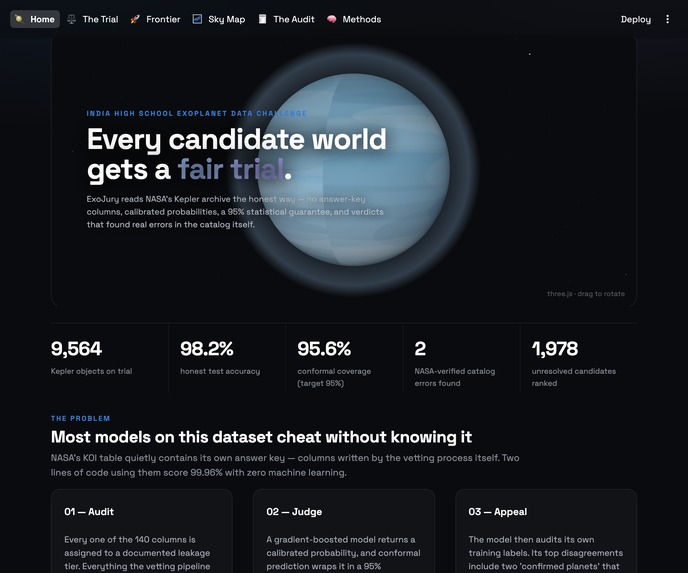
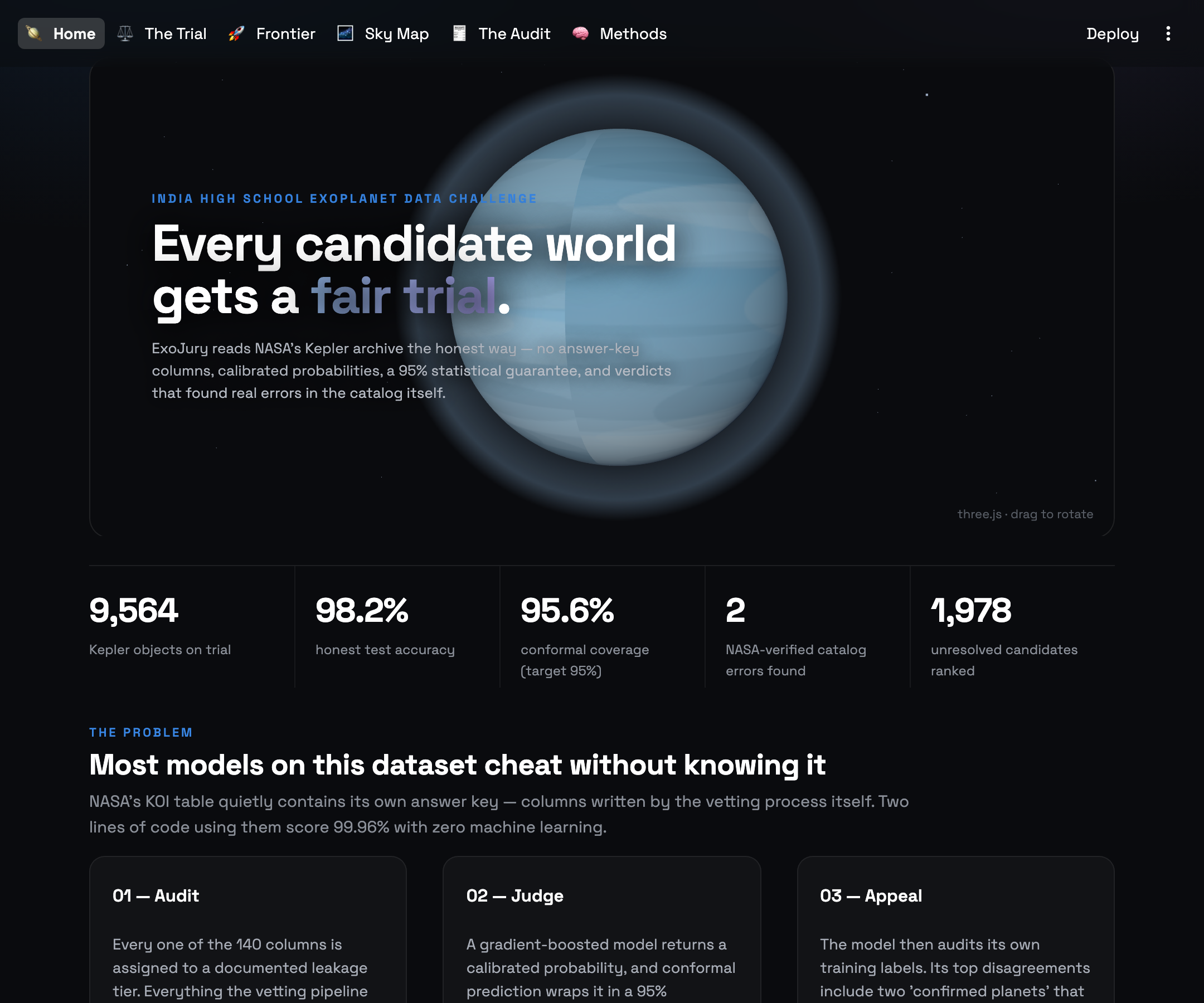
ExoJury puts all 9,564 Kepler Objects of Interest on trial:
- Honest classifier — gradient boosting on transit and stellar observables only, under a documented per-column leakage policy. 98.2% held-out accuracy, ROC-AUC 0.997 — and we quantify exactly how many points the leaky columns would have inflated (+1.3).
- Calibrated probabilities — isotonic calibration (ECE 0.009), so "90%" means 90%.
- Conformal prediction — every object gets a prediction set with a finite-sample 95% coverage guarantee (empirical 95.6%). When the evidence is ambiguous, ExoJury says NEEDS REVIEW instead of guessing — on the unresolved candidates it abstains 3× more often than on labeled data, correctly sensing they're harder.
- Label audit — confident learning flags catalog labels the model most disagrees with. Its #1 flag, "confirmed planet" Kepler-854 b (p_planet = 0.00003), was actually demoted to false positive by NASA (Niraula et al. 2022) — our snapshot predates the fix. Same for Kepler-840 b. It also flagged Kepler-452 b, whose validation is formally disputed in the literature. The pipeline rediscovered real catalog errors from this CSV alone.
- Follow-up ranking — the 1,978 unresolved CANDIDATEs scored and sorted: 335 planet-like with a 95% guarantee, 1,125 false-positive-like, 518 flagged for human eyes. A telescope-time priority list.
- AI vetting dossiers — DeepSeek-V3 via Featherless.ai writes an astronomer-style SIGNAL / ASSESSMENT / FOLLOW-UP report for any object, grounded strictly in numbers the pipeline computed. The model decides; the LLM narrates.
- Mission control — a Streamlit app to try any KOI live.
How we built it
Python + scikit-learn (HistGradientBoosting — handles missing values natively), a hand-rolled split conformal implementation (~30 lines, no library magic), cleanlab for the label audit, matplotlib for figures, Streamlit for the app, and the sponsor's Featherless API (OpenAI-compatible) for dossiers. Physics-motivated feature engineering: transit duty cycle, depth-vs-radius-ratio consistency, centroid offset significance (background eclipsing binary signature), SNR per transit.
Challenges we ran into
- Leakage is sneaky.
kepler_namelooks like an innocent string column; it's a perfect label. We ended up assigning all 140 columns to explicit tiers and testing the "answer key" accuracy directly. - Calibration on imbalanced, near-separable data — mid-probability bins hold very few objects, so we had to read reliability diagrams carefully (marker size = bin population) instead of trusting wiggly lines.
- The CANDIDATE class. Treating it as a third class caps you at ~86% accuracy because it's not a kind of object, it's a state of knowledge. We report the 3-class metrics the challenge asks for, then argue the better framing: binary training + scoring candidates as unlabeled objects.
Accomplishments we're proud of
The audit table. A student-scale pipeline, given one CSV, independently flagged planets that NASA later demoted — before we ever searched the literature. Also: a conformal guarantee that actually holds (95.6% vs 95% target) on real astronomical data.
What we learned
Accuracy is the least interesting number in a scientific ML project. The interesting ones are: how much of your accuracy is leakage, whether your probabilities mean anything, and whether your model knows when it doesn't know.
What's next
Cross-matching our 335 guaranteed planet-like candidates against TESS and Gaia DR3 to see which have since been confirmed — turning the priority list into testable predictions.
Built With
- clean-lab
- conformal-prediction
- deepseek-v3
- featherless-ai
- matplotlib
- nasa-exoplanet-archive
- python
- scikit-learn
- streamlit


Log in or sign up for Devpost to join the conversation.