Inspiration
ExoHunterAI is based on exoplanet problem statements and the scientific challenge of detecting distant planets from subtle variations in stellar brightness. Space missions such as Kepler, K2, and TESS observe stars over time and record light curves, where periodic dips may indicate a transiting exoplanet. The core idea was to explore whether an AI model could learn the same statistical and physical relationships astronomers rely on, and then expose that intelligence through an interactive web interface so humans can reason with the model rather than simply receive predictions. So this project is a unique one in both methodology and working nature.
What it does
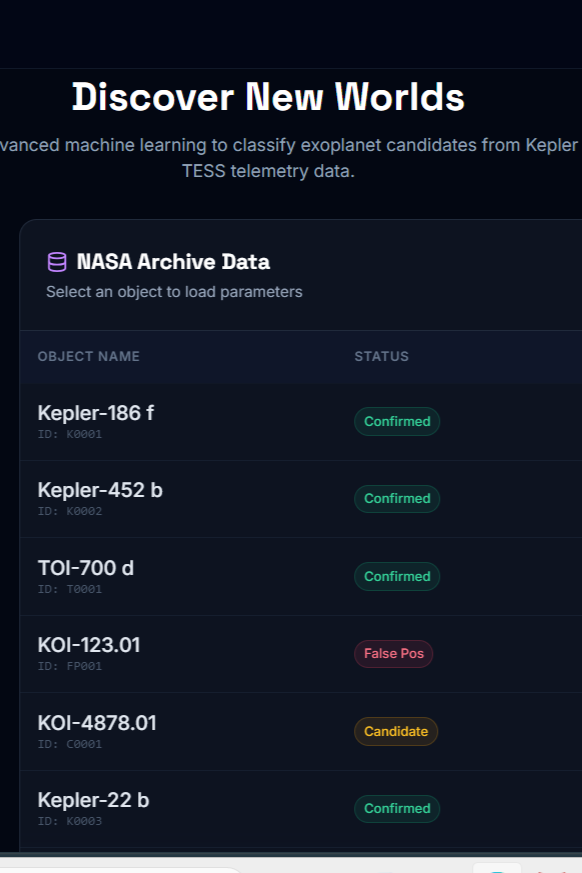
ExoHunterAI is an AI-powered web platform that classifies stellar observations into three categories:
y ∈ Y Y = { Confirmed Exoplanet, Planetary Candidate, False Positive }
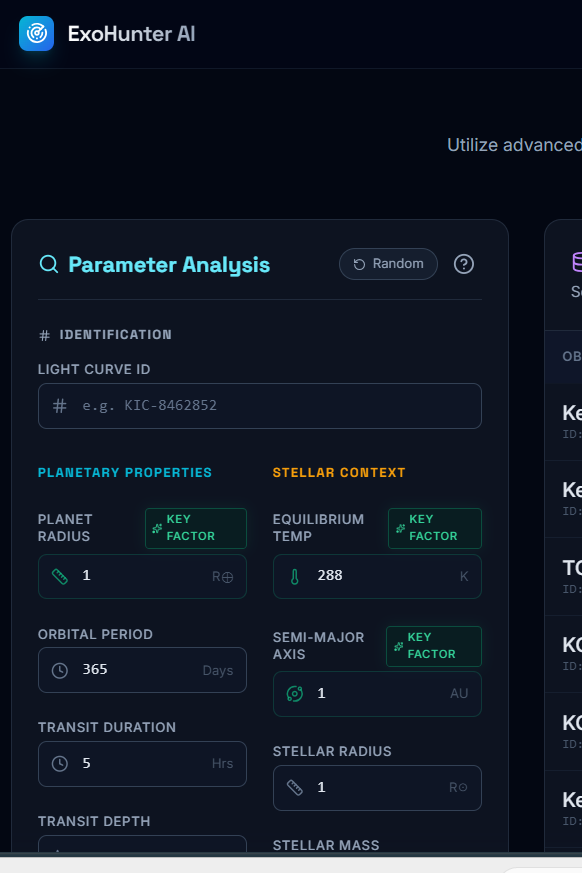
Using astrophysical features such as orbital period (P), transit duration (D), transit depth (\delta), and planetary radius (R_p), the model learns a decision function:
f(x) = class c such that P(y = c | x) is maximum
x = [ P, D, δ, Rp, … ]
where P = orbital period D = transit duration δ = transit depth Rp = planetary radius
The web interface allows users to explore predictions, input new observations, and view AI-assisted explanations describing why a data point was classified a certain way.
How we built it
Data Processing
I used open-source exoplanet datasets from various sources. Raw observations were cleaned, normalized, and transformed into feature vectors. For example, transit depth was derived as:
δ = ΔF / F
where F = baseline stellar flux ΔF = observed decrease in stellar flux during a planetary transit
Model Training
Trained a supervised classification model to minimize categorical cross-entropy loss:
Loss = − (1 / N) * sum over i from 1 to N of sum over c from 1 to 3 of y(i, c) * log( ŷ(i, c) )
where N = total number of training samples y(i, c) = true label (one-hot encoded) for sample i and class c ŷ(i, c) = predicted probability for sample i and class c
Web Interface and Gemini Integration
The trained model was deployed behind a web interface that supports interactive exploration. Google AI Studio and Gemini models were used to:
- Assist with data analysis and experimentation
- Generate natural language explanations of predictions
- Enable rapid iteration and refinement of the system
Challenges we ran into
One major challenge was class imbalance, as false positives greatly outnumber confirmed exoplanets. This required careful sampling strategies and evaluation beyond raw accuracy. Another challenge was deciding which features to emphasize, since poorly scaled or noisy variables degraded performance. Also faced the challenge of ensuring scientific interpretability. A model that performs well numerically but contradicts known astrophysical relationships is not useful in practice.
Accomplishments that we're proud of
We built a complete end-to-end system that combines:
- Realtime data from previous exoplanet datasets
- A mathematically grounded ML model
- An interactive, user-focused web interface
ExoHunterAI does more than classify data. It provides insight into why a prediction was made, aligning AI outputs with scientific reasoning.
What we learned
This project reinforced how critical domain knowledge is in scientific machine learning. Understanding the physics behind features like orbital period and transit depth significantly improved model performance. I also learned that explainability and usability are just as important as accuracy when designing AI for researchers.
What's next for ExoHunterAI
Future work includes incorporating ensemble methods:
ŷ = (1 / K) × sum over k from 1 to K of fₖ(x)
where K = total number of models in the ensemble fₖ(x) = prediction produced by the k-th model for input x
to improve robustness, adding support for user-uploaded datasets, and exploring semi-supervised learning to leverage unlabeled observations. Ultimately, ExoHunterAI aims to evolve into a collaborative platform that accelerates exoplanet discovery while keeping humans firmly in the loop.


Log in or sign up for Devpost to join the conversation.