-
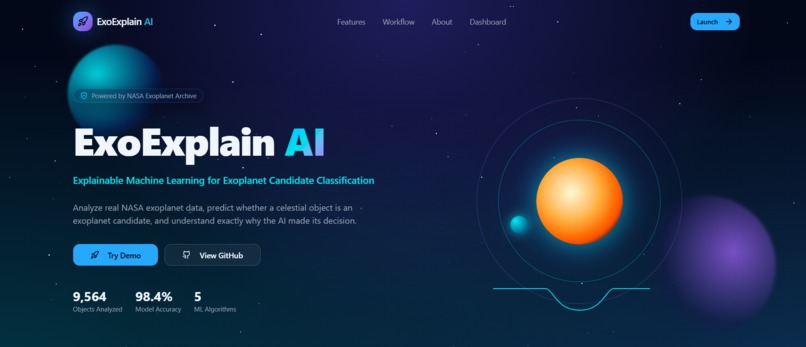
Home Page
-
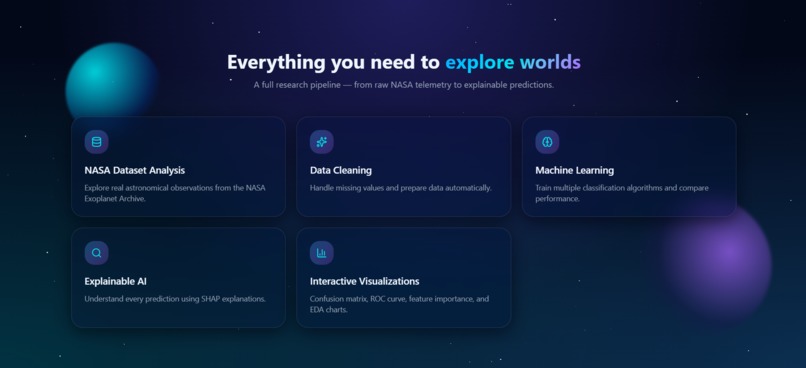
Everything you need to explore worlds
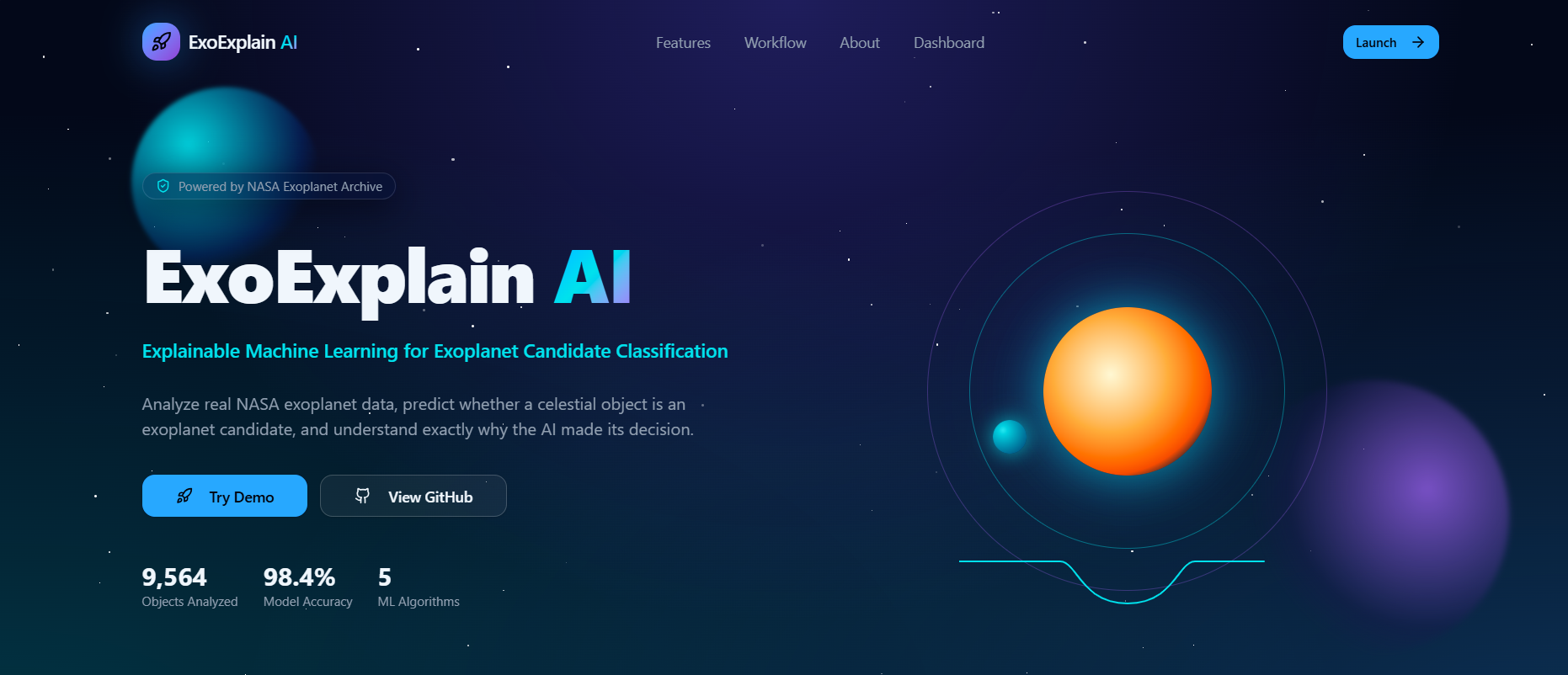
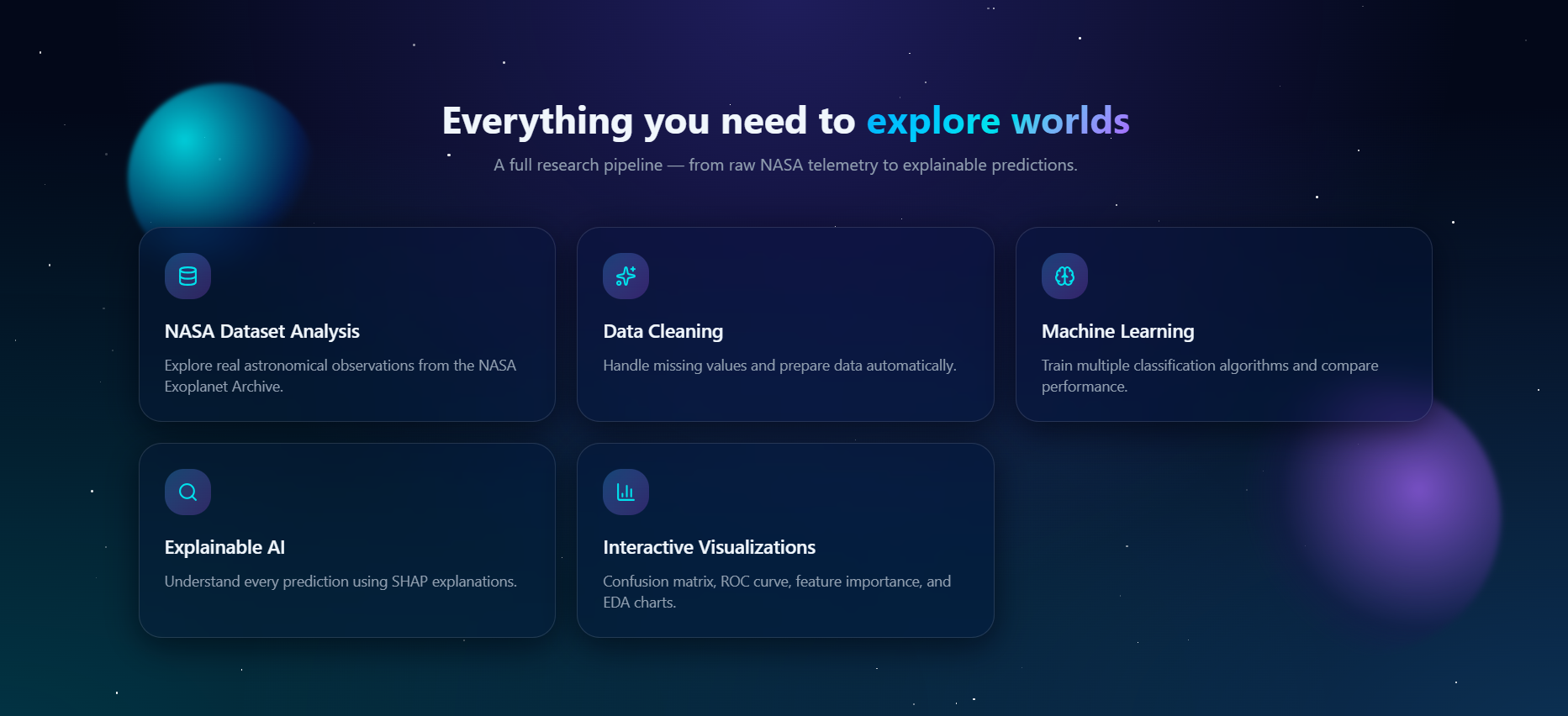
ExoExplain AI – Explainable Machine Learning for Exoplanet Candidate Classification
Inspiration
Every year, NASA discovers thousands of potential exoplanets using space telescopes that monitor tiny changes in the brightness of distant stars. However, identifying which signals truly represent planets is a difficult and time-consuming process because many observations are affected by noise, instrument errors, or stellar activity.
We were inspired by the idea of combining Artificial Intelligence with astronomy to help analyse these observations more efficiently. Rather than building a model that only predicts whether a candidate is an exoplanet, we wanted to create a system that also explains why it made that prediction. Our goal was to make machine learning more transparent, trustworthy, and educational while working with real scientific data from the NASA Exoplanet Archive.
What it does
ExoExplain AI is an explainable machine learning framework that classifies exoplanet candidates using real NASA observational data.
The project performs an end-to-end machine learning pipeline that includes:
- Data loading and preprocessing
- Exploratory Data Analysis (EDA)
- Data cleaning and feature preparation
- Training multiple classification models
- Model evaluation using Accuracy, Precision, Recall, and F1-Score
- Visualising confusion matrices, ROC curves, and feature importance
- Explaining every prediction using SHAP (SHapley Additive Explanations)
Instead of acting like a "black box," ExoExplain AI provides understandable explanations that show which features influenced each prediction the most. This makes the results more transparent and easier to interpret for students, educators, and researchers.
How we built it
We developed ExoExplain AI using Python and the scientific machine learning ecosystem.
Our workflow consisted of:
- Importing and analysing the NASA exoplanet dataset.
- Performing Exploratory Data Analysis to understand feature distributions, missing values, outliers, and correlations.
- Cleaning the dataset by handling missing values, removing duplicate records, and preparing features for training.
- Splitting the data into training and testing datasets.
- Training multiple machine learning models including Logistic Regression, Random Forest, XGBoost, and CatBoost.
- Comparing model performance using Accuracy, Precision, Recall, F1-Score, Confusion Matrix, and ROC-AUC.
- Selecting the best-performing model based on overall performance.
- Applying SHAP Explainability to identify the most influential features behind each prediction.
- Documenting the complete workflow in a reproducible Jupyter Notebook and preparing a research-style report.
Technologies used:
- Python
- Pandas
- NumPy
- Scikit-learn
- XGBoost
- CatBoost
- SHAP
- Matplotlib
- Seaborn
- Jupyter Notebook
Challenges we ran into
Working with real-world scientific data introduced several challenges.
The dataset contained missing values, feature correlations, and varying data distributions that required careful preprocessing before model training. Selecting the most suitable algorithm also required extensive experimentation because different models performed differently depending on the feature set.
Another challenge was making the model explainable rather than simply accurate. Integrating SHAP required additional effort to correctly interpret feature contributions and present them in a way that non-technical users could understand.
Finally, ensuring that the notebook remained fully reproducible while keeping the code clean and well-documented required careful organisation throughout the project.
Accomplishments that we're proud of
- Built a complete end-to-end machine learning pipeline using real NASA data.
- Successfully compared multiple classification algorithms.
- Developed an explainable AI system instead of relying on a black-box model.
- Generated meaningful visualisations that simplify complex scientific data.
- Produced a fully reproducible notebook with clear documentation suitable for educational and research purposes.
- Demonstrated how explainable AI can improve confidence in machine learning predictions.
What we learned
This project strengthened our understanding of the complete machine learning lifecycle, from data preprocessing to model evaluation and interpretation.
We learned that high accuracy alone is not sufficient for scientific applications. Explainability is equally important because researchers need to understand why a model reaches a particular decision.
We also gained practical experience in feature engineering, model comparison, evaluation metrics, and Explainable AI techniques such as SHAP. Most importantly, we discovered how machine learning can contribute to real scientific research and help accelerate discoveries beyond traditional manual analysis.
What's next for ExoExplain AI
Our future plans include expanding ExoExplain AI into a more advanced research assistant for astronomical data analysis.
Future improvements include:
- Integrating deep learning models for improved classification accuracy.
- Supporting additional datasets from NASA missions such as Kepler and TESS.
- Developing an interactive web dashboard where users can upload new observations and receive predictions instantly.
- Adding uncertainty estimation and confidence intervals for every prediction.
- Building an educational mode that explains astronomical concepts alongside AI predictions.
- Exploring anomaly detection techniques to identify previously unseen planetary signals.
Our long-term vision is to create an open-source AI platform that helps students, researchers, and astronomy enthusiasts understand and explore exoplanet discovery through transparent and trustworthy artificial intelligence.
Built With
- ai
- artificial
- classification
- data
- explainable
- intelligence
- jupyter
- learning
- machine
- matplotlib
- notebook
- numpy
- pandas
- python
- science
- scikit-learn


Log in or sign up for Devpost to join the conversation.