Inspiration
Most AI agents still interact with websites the way humans do: reading pages, interpreting interfaces, and clicking through forms.
Exit Desk already existed as a real buyer-lens exit-readiness product for business owners. Its free assessment asks eight questions and evaluates a company across revenue quality, founder dependence, financial health, competitive position, and timing alignment.
The WebMCP Challenge gave us a simple question:
What if ChatGPT did not have to operate Exit Desk by guessing how its interface works? What if Exit Desk could expose its actual capability directly to the agent?
That became Exit Desk × WebMCP.
What it does
A business owner can describe their company to ChatGPT in ordinary language:
“We do about $5M in revenue. Customers repeat but aren't contracted. I still own key client relationships. Our largest customer is about 15% of revenue. The team handles daily operations, margins are stable, our moat is reputation, and I'm exploring a sale.”
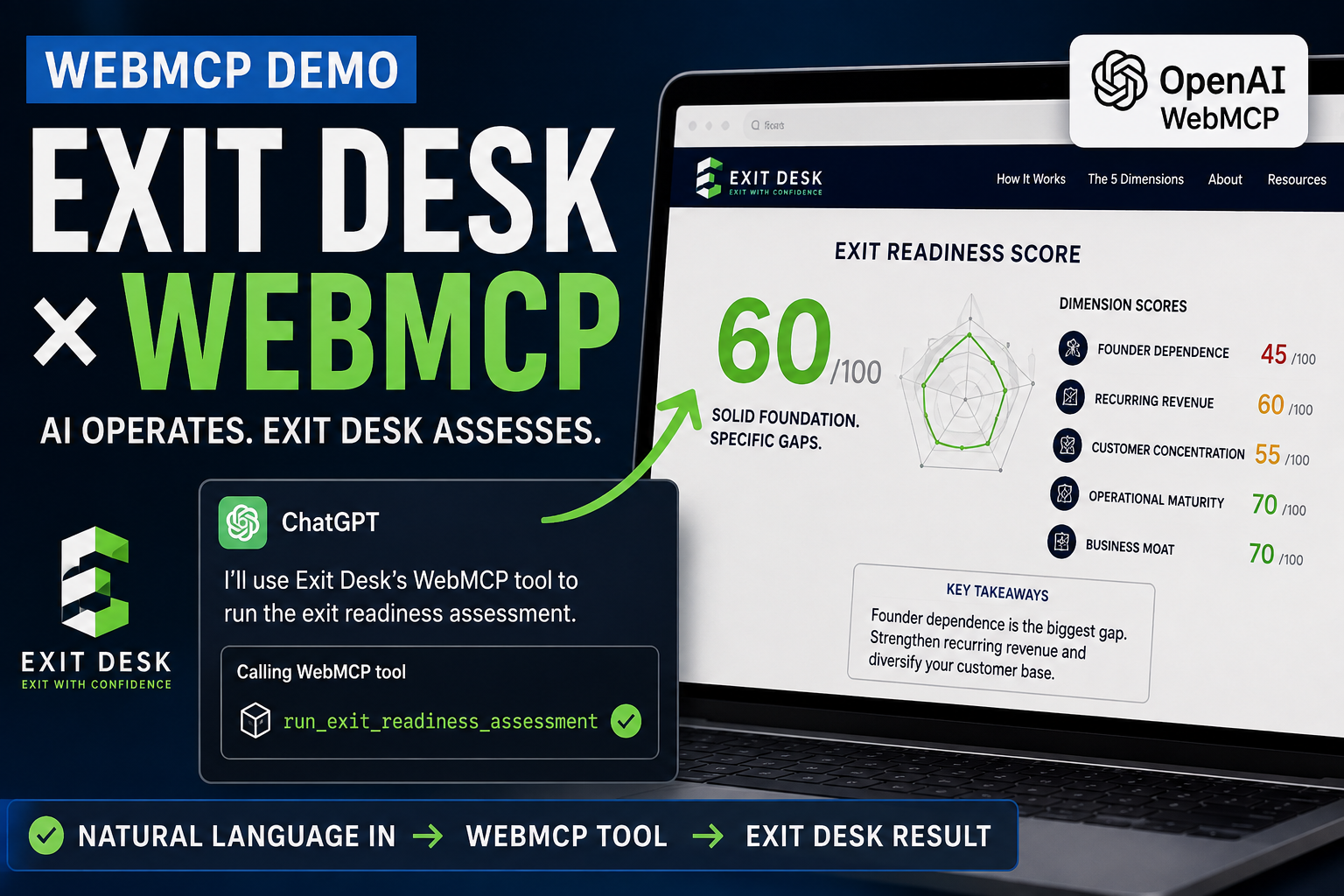
Instead of clicking through Exit Desk's eight-question interface, ChatGPT discovers a WebMCP tool exposed by the site:
run_exit_readiness_assessment
ChatGPT translates the owner's natural-language description into the structured inputs required by Exit Desk and invokes the tool.
Exit Desk then runs its existing deterministic assessment engine and returns the same score, dimension scores, weakest dimension, findings, and next-step information that the human-facing application produces.
The human and the agent therefore work from the same authoritative result.
Why WebMCP matters
The important architectural distinction is that ChatGPT does not recreate Exit Desk's M&A logic.
ChatGPT handles conversation, intent, and translation.
Exit Desk remains the authoritative application performing the assessment.
Without WebMCP, an agent has to infer the interface and manipulate eight separate questions. With WebMCP, the website declares what it can do and the structured inputs it requires.
The interaction becomes:
Natural language → ChatGPT → WebMCP tool → Exit Desk assessment → structured result
This turns Exit Desk from a website an AI can read or click through into a capability an AI can reliably operate.
How we built it
The production Exit Desk assessment runs at mikeye.com/exit/score.
For the challenge, we added a WebMCP integration using the imperative document.modelContext.registerTool() API.
The tool defines a structured input schema for the eight assessment dimensions and maps those inputs into Exit Desk's existing assessment application. It invokes the same scoring and results logic used by the human interface, then returns structured output to the agent.
The WebMCP source lives in the public GitHub repository and is deployed through Vercel. The production Webflow page loads that repository-backed implementation.
We tested the integration using ChatGPT's in-app browser. ChatGPT successfully discovered run_exit_readiness_assessment, invoked it, and received Exit Desk's resulting score and dimension analysis.
What we built during the challenge
Exit Desk itself predates the WebMCP Challenge.
The WebMCP capability does not.
During the challenge period we:
- Designed the agent-facing assessment interface.
- Implemented
run_exit_readiness_assessment. - Defined the structured input schema and mappings.
- Connected WebMCP to Exit Desk's existing scoring engine and human-facing results.
- Deployed the integration to the production Exit Desk website.
- Tested the complete flow using ChatGPT's in-app browser.
- Added public implementation documentation and challenge-period source history.
The GitHub commit history documents these additions separately from the pre-existing application.
What we learned
The most interesting lesson was that WebMCP is not primarily about making agents better at clicking websites.
It can remove the need to click them.
A website can retain ownership of its domain logic while allowing an AI agent to provide a much more natural interface to that capability.
For Exit Desk, that means the AI does not become the M&A assessment engine. It becomes the conversational layer through which a founder can access that engine.
What's next
The same architecture can extend beyond the initial assessment.
Future Exit Desk tools could help owners prepare diligence materials, identify buyer-readiness gaps, evaluate founder dependence, compare buyer types, and prepare for acquisition conversations.
The broader idea is simple:
The web is moving from machine-readable to machine-operable.
Built With
- chatgpt
- javascript
- next.js
- openai
- typescript
- vercel
- webflow
- webmcp


Log in or sign up for Devpost to join the conversation.