-
-
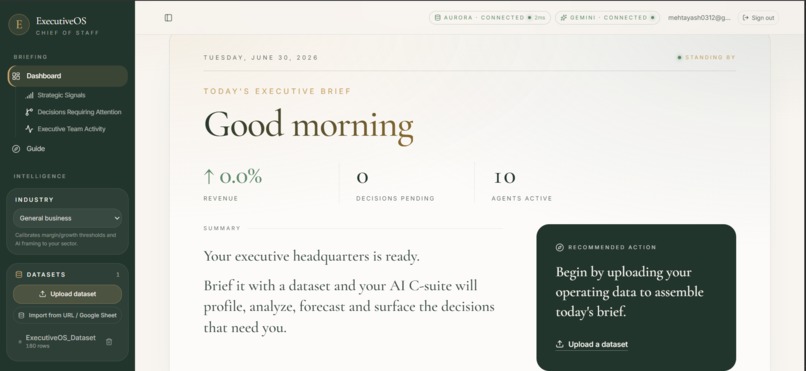
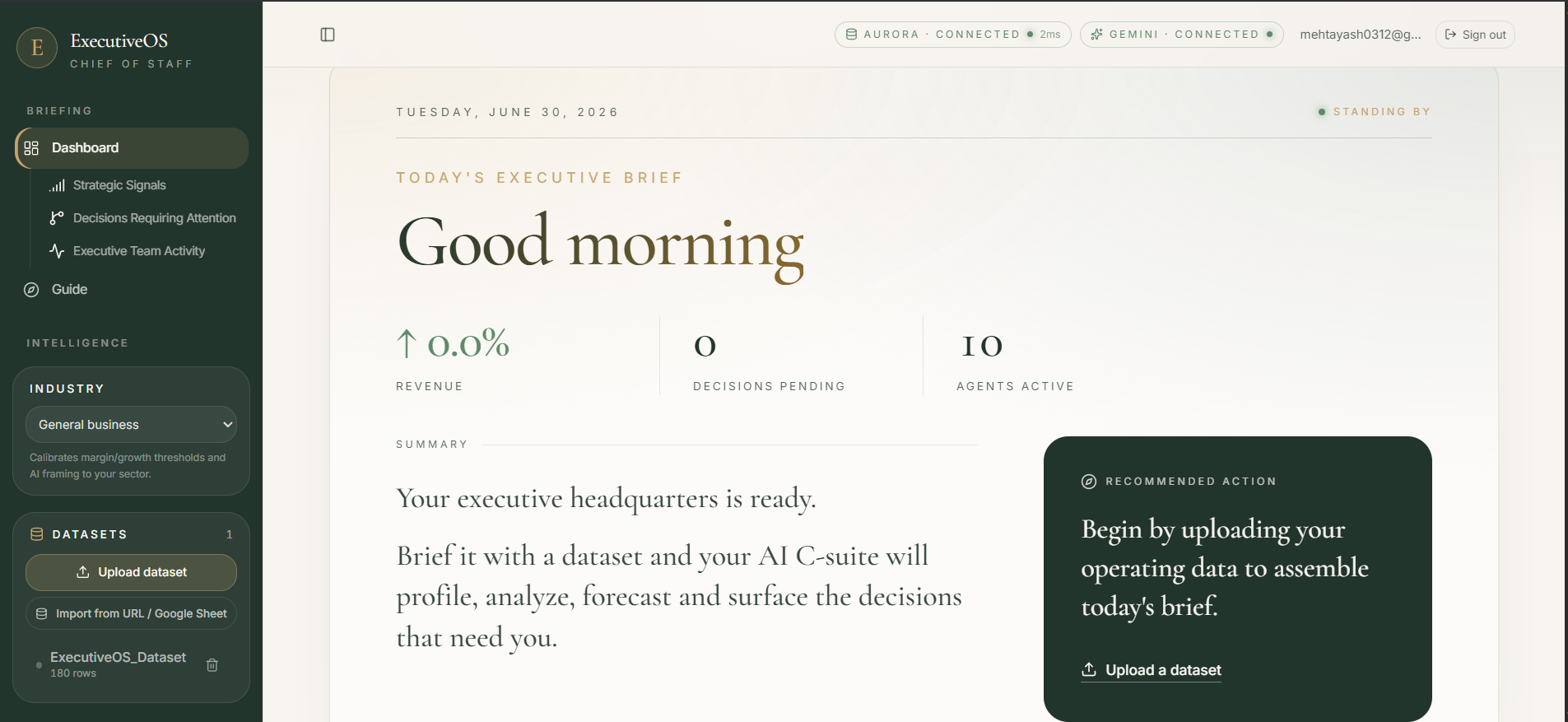
Dashboard of ExecutiveOS
-
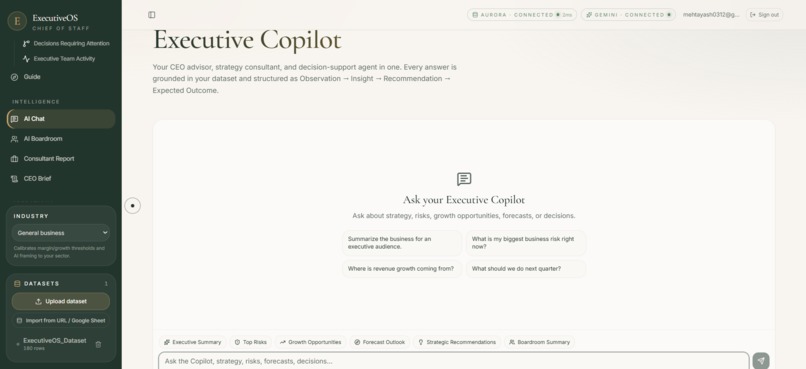
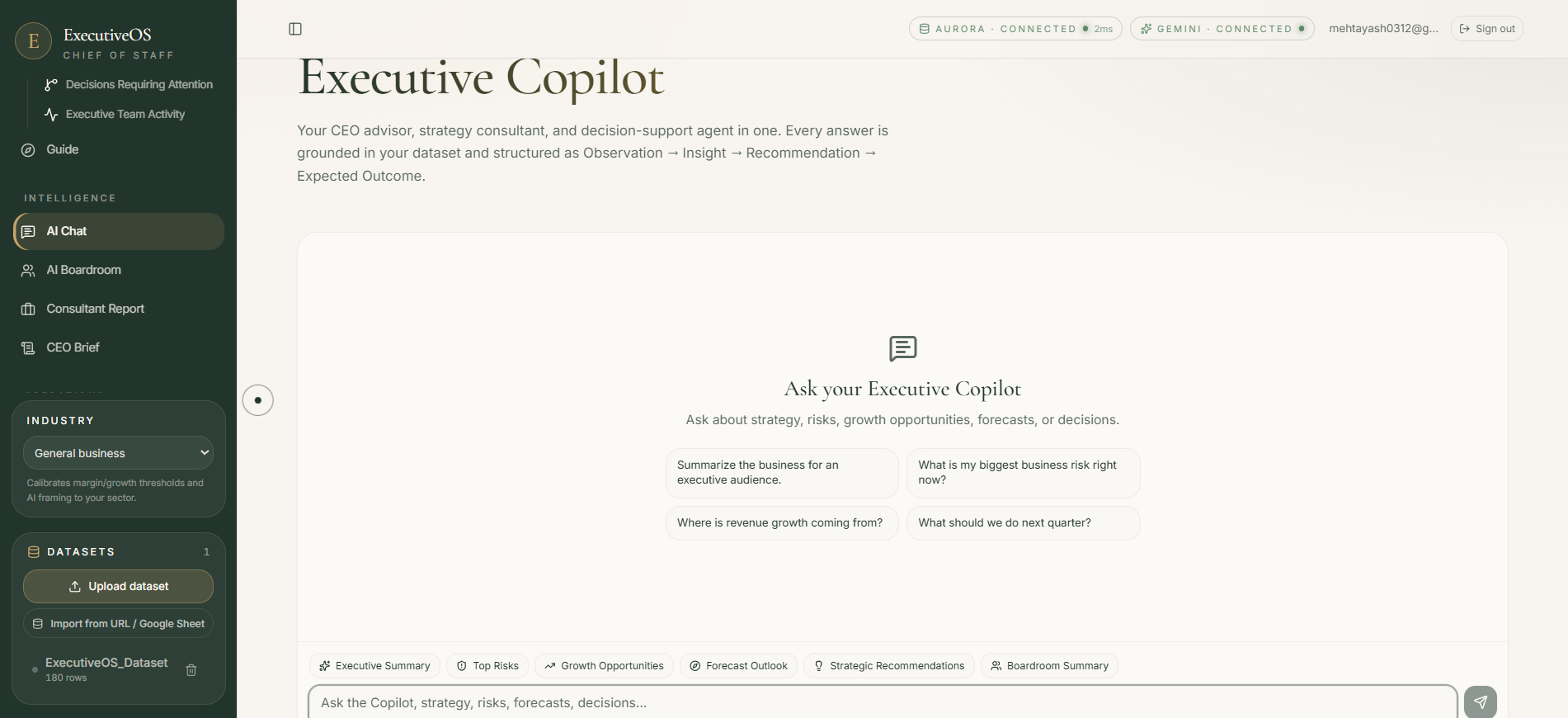
Executive OS Copilot (AI Chat)
-
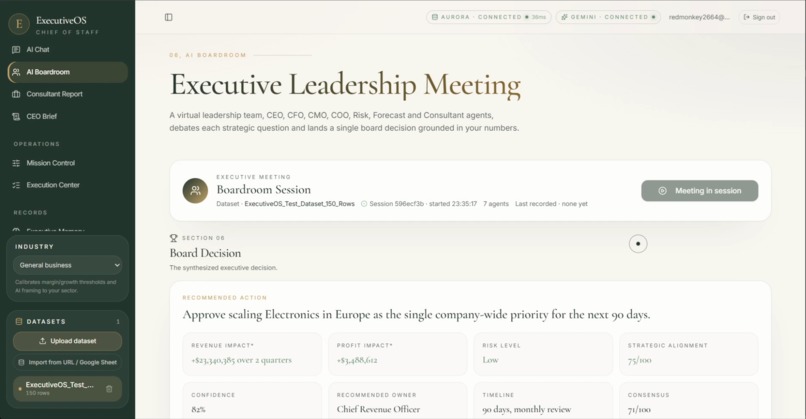
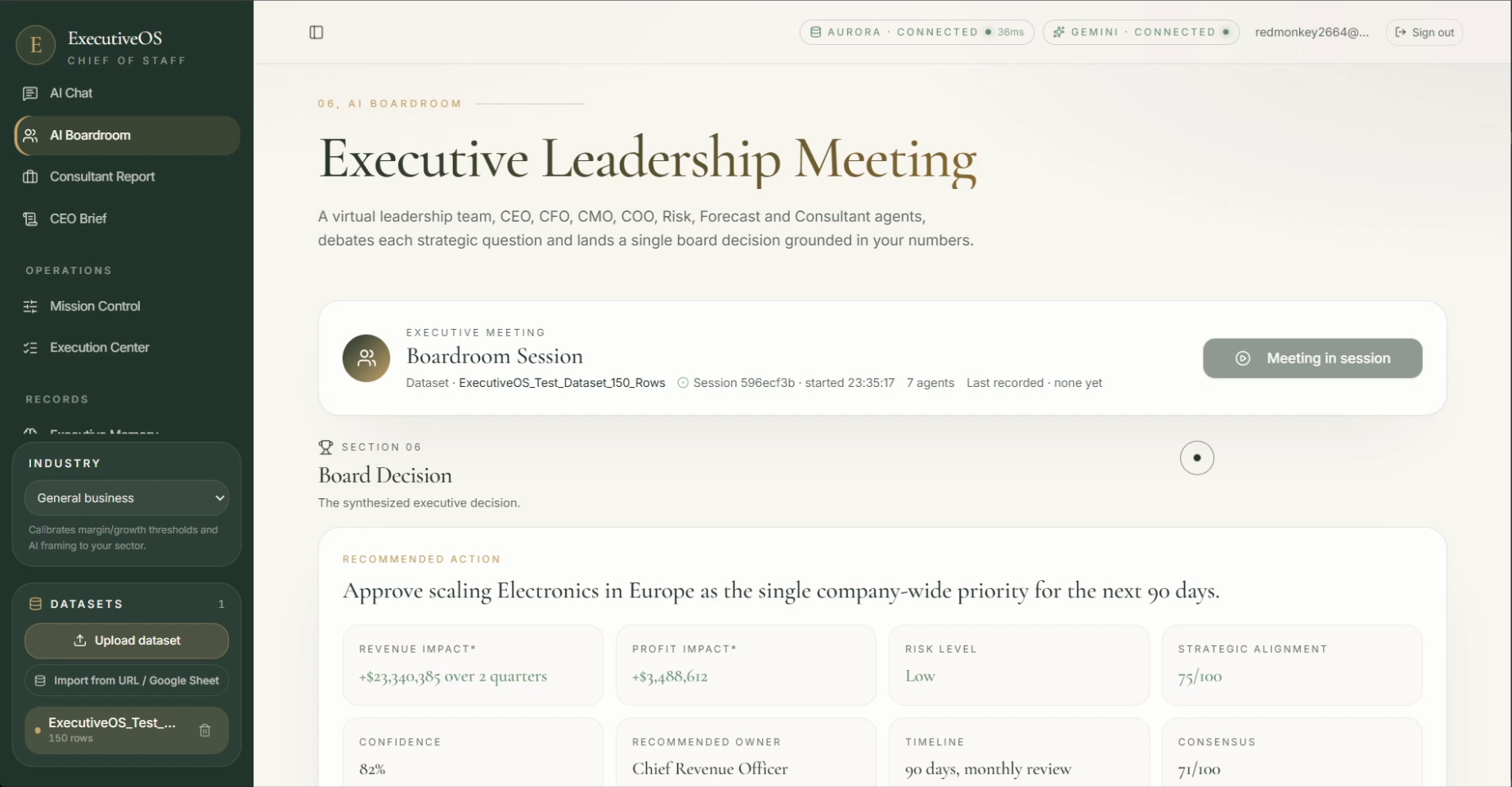
AI Boardroom for all Agents
Inspiration
Most business intelligence tools hand you data and leave you to write the analysis yourself. We wanted to flip that. What if you could walk into a virtual boardroom, ask your hardest strategic question, and have a CFO, CMO, and COO argue it out in real time - surfacing trade-offs you might have missed?
That idea became Executive OS: an AI-powered decision layer for executives, built on Amazon Aurora PostgreSQL with a multi-agent AI engine that reasons over your company's real numbers.
What it does
Executive OS lets you upload a company dataset and submit any strategic question - "Should we expand internationally?" or "Where should we cut costs?" - then watch a boardroom of AI agents respond from their C-suite roles. Each agent argues from its perspective, the debate surfaces competing priorities, and the platform outputs a Boardroom Confidence Score from 0 to 100 that signals how decision-ready your team is.
Every answer is grounded in your real data stored in Aurora - not generic advice.
Key features:
- Executive Question Center - natural-language strategic questions with quick-action chips
- Live AI Boardroom - seven role-aware agents (CEO, CFO, CMO, COO, Risk, Forecast, Consultant) debate opposing positions and land on a single board decision
- CEO Brief - a live, one-page executive summary (risks, opportunities, business-health score) generated from your numbers
- Consultant Report & AI Chat - deeper strategic analysis and an ask-anything executive copilot
- Boardroom Confidence Score - a single signal on decision readiness
- Aurora PostgreSQL backend - 16 tables, sub-50 ms latency in production
How we built it
Architecture Layer Technology / Service Used Frontend & User Interface TanStack Start + React, deployed on Vercel AI Processing Engine Google Gemini (gemini-2.5-flash-lite → 2.5-flash), multi-agent Database Layer Amazon Aurora PostgreSQL 17.7 (AWS, us-east-1) Cloud Infrastructure Amazon Web Services (AWS) Version Control GitHub CI/CD & Deployment GitHub → Vercel automatic deployment pipeline Security & Access Management Server-side secrets only - Gemini API key + Aurora DATABASE_URL; TLS to DB, HTTPS to client
The app uses Vercel serverless functions as the API layer with no separate backend server. Aurora connects via a DATABASE_URL environment variable; all Gemini calls are made server-side so the API key never touches the client. The schema spans 16 tables covering users, sessions, datasets, KPI summaries, forecasts, CEO briefs, consultant reports, boardroom conversations, action plans, and executive decisions.
The AI brain is built for resilience: agent outputs are schema-validated with Zod, a model fallback chain keeps the app live if one model is throttled, and the entire seven-agent boardroom debate runs in a single Gemini call that returns every agent's response at once.
Challenges we ran into
AWS Marketplace billing → AI pivot. We originally built the AI layer on AWS Bedrock, but Indian UPI payment methods caused Bedrock subscriptions to terminate instantly - 13 failed attempts before we identified the root cause. Under deadline, we pivoted the entire AI engine to Google Gemini's free tier, keeping Amazon Aurora as our data backbone.
Supabase → Aurora migration. We removed an entire Supabase integration mid-project and rebuilt the data layer from scratch against Amazon Aurora PostgreSQL 17.7 - all 16 table schemas rewritten and migrated cleanly, with 67/67 tests passing after the switch.
VPC and security-group configuration. Aurora sits inside a VPC with port 5432 closed by default. We had to open the correct inbound rule and configure the connection string before Vercel serverless functions could reach the database.
Engineering for a free AI tier. A naïve boardroom fired one model call per agent (~7 per debate) and instantly hit per-minute rate limits. We collapsed it to one call for the whole board (7× fewer requests), added exponential backoff that distinguishes per-minute throttles from spent daily quota, and layered in response caching and a daily call budget - so the live demo stays fast without exhausting the free tier.
Accomplishments that we're proud of
- Migrated from a managed BaaS to raw Aurora PostgreSQL with zero test regressions
- Aurora showing CONNECTED at sub-50 ms latency in production
- A full C-suite debate architecture with genuinely role-differentiated agent responses
- AI answers grounded in real uploaded company data, not hallucinated
- Resilient free-tier AI - single-call boardroom, model fallback chain, smart 429 backoff
- Clean serverless architecture - no backend server, just Vercel functions talking directly to Aurora and Gemini
- Live at https://executive-os-v2.vercel.app/
What we learned
Building directly on AWS primitives instead of abstraction layers forced us to understand how VPC security groups, connection pooling, and TLS actually interact with serverless functions. We also learned that payment infrastructure differs significantly by region — something with real consequences when you're racing a deadline for AI model access, and the reason we pivoted providers without missing a beat.
On the engineering side, designing for a free-tier quota turned out to be a discipline of its own: batching calls, caching, and classifying rate-limit types matter as much as the prompts. And on the product side - framing AI output as a structured debate between roles is dramatically more useful than a single summarized answer. The disagreement between agents is where the insight lives.
What's next for Executive OS
- Multi-user workspaces with role-based access control
- Export debates as board-ready PDF reports
- Deeper live data connectors — P&L, headcount, and CRM pipeline feeds for continuous grounding
- Upgrade to a larger Gemini model (2.5 Pro) for deeper reasoning on complex, multi-factor decisions
- Expand the memory layer so agents recall more past debates and decisions when answering follow-ups
Built With
- amazon-aurora-postgresql-17.7
- amazon-rds-relational-database-service
- amazon-vpc
- aws-iam
- gemini
- github
- html
- javascript
- node.js
- react.js
- tailwind-css
- typescript
- vercel
- vercel-serverless-functions


Log in or sign up for Devpost to join the conversation.