-
-
ExceptionOS
Inspiration
Operational teams spend hours resolving supplier delays and other business exceptions by moving between dashboards, spreadsheets, policies, and approval systems. AI agents can help, but traditional websites only expose interfaces designed for humans. Agents must interpret visual elements, guess which buttons to press, and operate without clear authority boundaries.
We built ExceptionOS to explore a different model: operational software that exposes structured capabilities directly to agents while keeping humans in control of material decisions.
What it does
ExceptionOS is an agent-operable operations command center centered on a realistic supplier disruption.
Pacific Components has reported that a battery-module purchase order will arrive nine days late. The disruption threatens a production order, a customer delivery, and $84,000 in revenue.
Through WebMCP, an agent can:
Retrieve the structured exception. Trace affected production and customer orders. Read its spending and approval policy. Search for qualified alternative suppliers. Compare recovery strategies. Simulate a resolution without changing business records. Request human approval when the plan exceeds its authority. Execute the approved supplier change. Verify that the customer commitment is protected. Produce an auditable evidence ledger.
The recommended recovery plan changes the supplier to Northstar Cells for an additional $3,400, protecting the delivery date and $84,000 in revenue.
Because the agent’s autonomous spending limit is $2,000, ExceptionOS blocks execution until a human explicitly approves the plan. Why this is a strong fit for WebMCP
ExceptionOS is not a conventional dashboard with an AI chatbot added to it. WebMCP is the application’s structured agent interface.
Without WebMCP, an agent would need to interpret cards, tables, buttons, and changing application state visually. With WebMCP, it receives purpose-built tools with typed inputs, structured results, safety annotations, and clearly defined authority boundaries.
The experience demonstrates a complete operational workflow:
Observe → Investigate → Compare → Simulate → Ask → Act → Verify
WebMCP makes the workflow faster and more reliable while letting the application control what the agent can read, simulate, and change.
How it improves the user experience
Humans no longer have to manually collect information from multiple screens, calculate the consequences of each option, or reconstruct what an agent did.
The agent handles structured investigation and comparison. The human concentrates on the decision that requires judgment and authority.
ExceptionOS also keeps the user informed through a live agent-activity panel. Every tool invocation visibly updates the interface, making the agent’s work understandable rather than invisible.
After execution, the evidence ledger records the complete human-agent decision trail for accountability and review.
What humans and agents can do together
Before WebMCP, operational applications were largely human-operated, while agents had to approximate human interaction through screenshots and browser automation.
ExceptionOS enables a safer partnership:
The agent investigates structured operational data. The agent compares and simulates recovery plans. The application enforces organizational policy. The human approves consequential actions. The agent executes only within that approval. The system independently verifies the outcome. Both parties receive an auditable evidence trail.
This combines machine speed with human authority.
How we implemented WebMCP
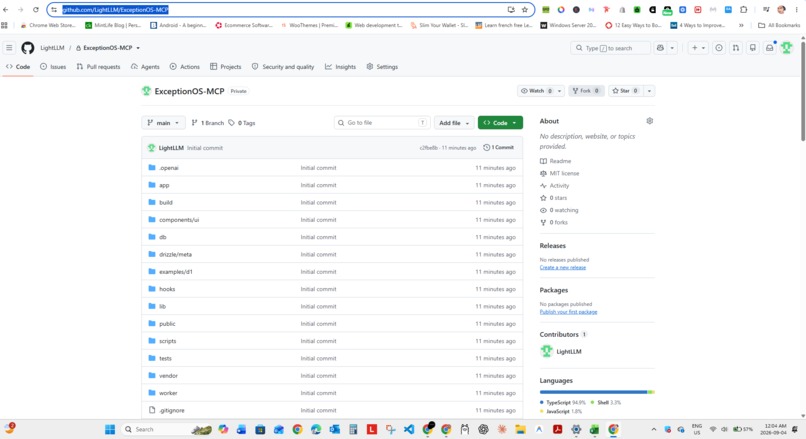
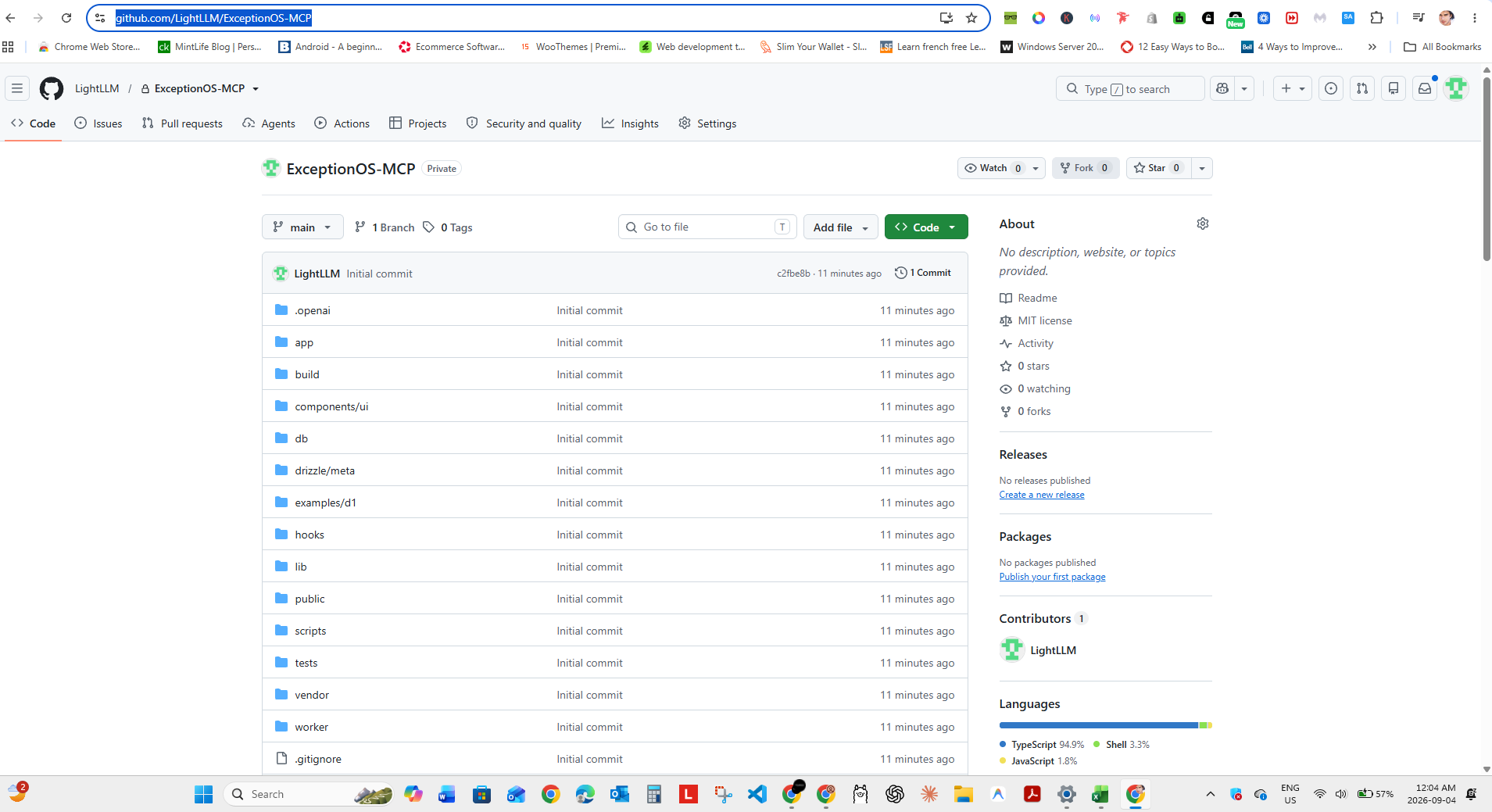
The browser application registers ten tools through document.modelContext.registerTool():
get_exception get_impacted_orders get_policy search_alternative_suppliers compare_recovery_options simulate_resolution request_approval execute_resolution verify_resolution get_evidence_ledger
These tools invoke the same stateful application logic used by the visible interface. Agent activity therefore changes the application in real time.
ExceptionOS also exposes the same capabilities through a Streamable HTTP MCP endpoint at /mcp. It supports initialization, tool discovery, tool calls, structured results, and safety annotations.
Read and simulation operations are marked read-only. execute_resolution is marked destructive and requires explicit human confirmation plus an approver name. Calls without approval are rejected.
How we built it
Suggested “Built With” tags:
WebMCP Model Context Protocol TypeScript React Next.js JSON-RPC Streamable HTTP ChatGPT GitHub
Challenges we ran into
The central challenge was designing tools that represented operational capabilities rather than simply exposing UI controls.
We separated the workflow into read, plan, act, and verify capabilities. We also needed to ensure the agent could investigate and simulate freely without gaining unrestricted execution authority.
The approval boundary became a core part of the architecture: requesting approval does not grant approval, and execution is rejected unless explicit human authorization is supplied.
Another challenge was making agent activity visible enough for users to understand. We addressed this with synchronized interface state, a live tool-call feed, execution status, and an evidence ledger.
Accomplishments that we're proud of
Implemented ten meaningful WebMCP tools. Created a complete, stateful agent workflow rather than isolated tool demonstrations. Added a genuine human approval boundary. Blocked unapproved destructive operations. Made every agent action visible in the user interface. Added post-execution verification and an auditable evidence ledger. Exposed the capabilities through both browser WebMCP and remote MCP. Produced a polished, deterministic scenario that judges can understand quickly.
What we learned
Agent-native websites require more than tool discovery. They require carefully designed authority, observability, verification, and evidence.
We also learned that the best division of responsibility is not to make agents omnipotent. Agents are strongest at structured investigation and comparison, while humans should retain control over consequential decisions.
WebMCP provides the bridge between those roles.
What's next for ExceptionOSMCP
ExceptionOS could expand to additional operational exceptions, including inventory shortages, logistics disruptions, quality incidents, invoice discrepancies, and customer-delivery risks.
Future versions could connect to real ERP, procurement, logistics, and policy systems. The same authority model could support role-based approval limits, multi-stage approvals, organization-specific policies, and cryptographically signed evidence records.
The broader vision is an agent-operable layer for enterprise software in which every action is structured, policy-aware, observable, and verifiable.
Testing Instructions
ExceptionOS could expand to additional operational exceptions, including inventory shortages, logistics disruptions, quality incidents, invoice discrepancies, and customer-delivery risks.
Future versions could connect to real ERP, procurement, logistics, and policy systems. The same authority model could support role-based approval limits, multi-stage approvals, organization-specific policies, and cryptographically signed evidence records.
The broader vision is an agent-operable layer for enterprise software in which every action is structured, policy-aware, observable, and verifiable.
Testing instructions Open the live application. Click Run agent resolution to see the complete deterministic workflow. Review the recovery options and simulated outcome. At the authority boundary, click Approve plan. Allow the system to execute and verify the recovery. Review the live agent activity and final evidence. Click Replay resolution to replay the human-agent decision trail.
For native browser-agent testing, open the application in ChatGPT’s in-app browser or enable WebMCP testing in Chrome.

Log in or sign up for Devpost to join the conversation.